Heritage · University
University of British Columbia: History and Overview
Founded in 1908, the University of British Columbia held its first classes in 1915 in temporary huts before students marched across Vancouver in the Great Trek of 1922 to demand their unfinished campus be built. Today UBC occupies the Point Grey peninsula above the Salish Sea and keeps one of the great Northwest Coast collections at its Museum of Anthropology.Written to last.
By Confinity Heritage Editorial · 2026-08-24 · 8-minute readQuiet tools, kept out of the way.
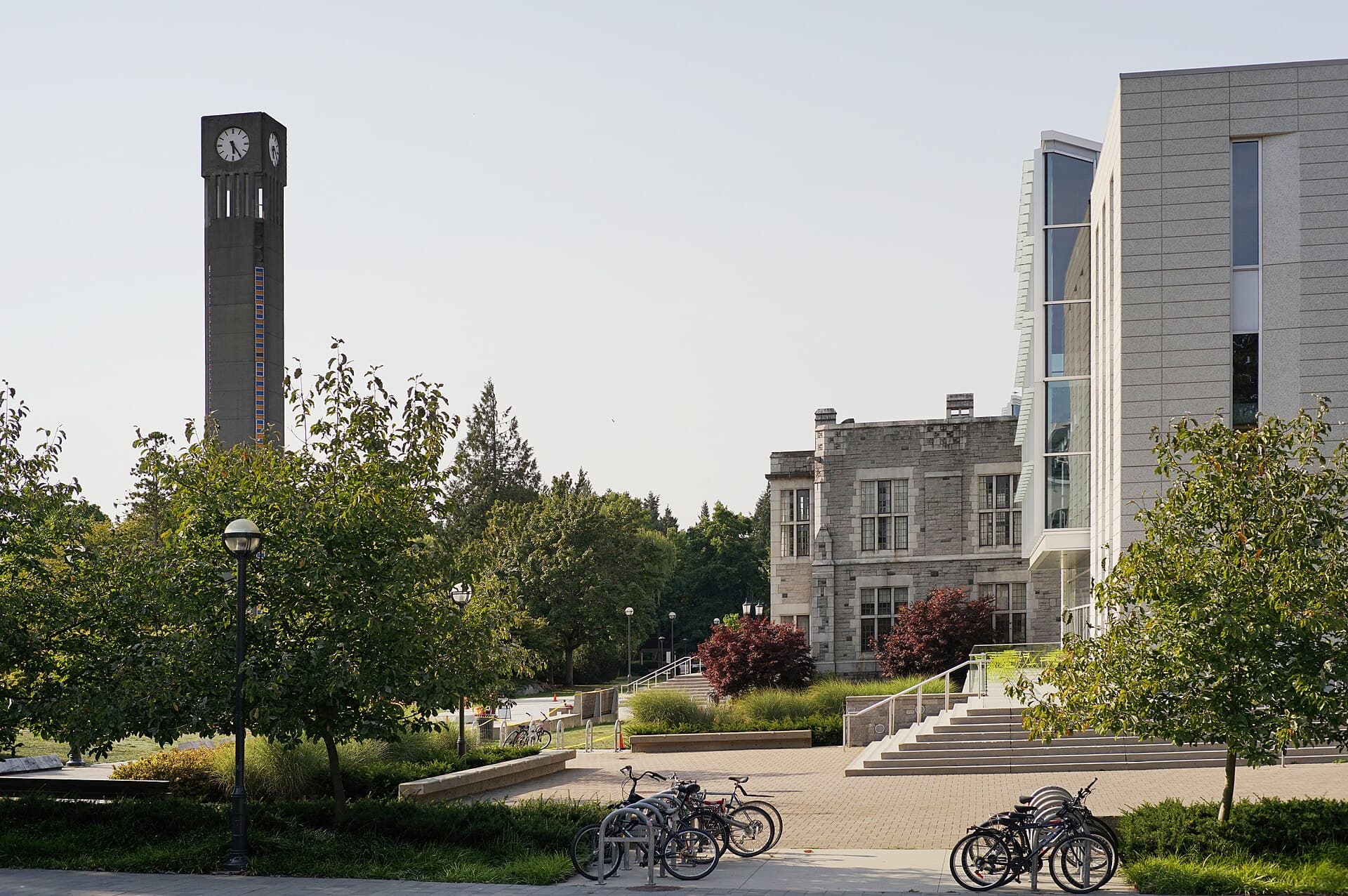
The University of British Columbia stands at the tip of the Point Grey peninsula in Vancouver, on the western edge of Canada, where the campus ends in cliffs above the Salish Sea and the North Shore mountains rise across the water. It is the youngest of Canada's three leading research universities, founded by provincial statute in 1908, and the only one of them whose existence was demanded in the street. In 1922 more than a thousand of its students marched across Vancouver to the abandoned construction site of their promised campus and refused to accept that the province had stopped building it. The campaign worked, and the stones they piled into a cairn that autumn still stand at the centre of the campus they won.
That founding story gives UBC an unusual relationship with memory. Most universities inherit their traditions; this one begins with an act of collective insistence retold for a century. And the most visited building on its campus today is a museum that spends its energy on a harder question, that of whose memory an institution keeps, on whose land, and what it owes the communities those memories belong to.
Higher education in British Columbia began under borrowed authority. From 1906, McGill University College of British Columbia taught the first years of a degree in Vancouver under licence from McGill University in Montreal, with students travelling east to finish. The province's University Act of 1908 created an independent institution, and when UBC finally opened its doors on 30 September 1915, it absorbed the McGill college, its staff and its students in a single stroke. War had emptied the treasury, so the new university began in wooden buildings on the grounds of Vancouver General Hospital in the Fairview neighbourhood, remembered ever since as the Fairview shacks.
A permanent site at Point Grey had been chosen years earlier, and before the war a start was made: the steel and concrete skeleton of a science building rose on the peninsula, then stood unfinished as funding stopped. By 1922 enrolment had passed 1,200 in quarters built for far fewer, with classes taught in tents, attics and a church basement. That autumn the students organized the Build the University campaign, gathering a petition of 56,000 signatures from a province of barely half a million people. On 28 October 1922 they marched through downtown Vancouver with floats and banners and kept going to Point Grey, where they climbed into the bare frame of the science building and filled it, a living demonstration that the university existed and needed only walls. Each marcher added a stone to a cairn on the site. The legislature voted the money the following year, and lectures began at Point Grey on 22 September 1925. The march entered institutional memory as the Great Trek, and it remains the founding legend of the place: a university that its own students walked into existence.
Point Grey rewards the effort it took to reach. The campus occupies the end of a forested peninsula west of the city, bounded by the Strait of Georgia, English Bay and the mouth of the Fraser River, with the peaks of the North Shore filling the horizon. Main Mall, the central axis, runs toward a viewpoint where the land drops away; the Rose Garden sits on a terrace there, its beds laid out against a backdrop of open water and mountains. Below the cliffs, long wooden stairways descend through the forest to Wreck Beach. The Nitobe Memorial Garden, a Japanese stroll garden ranked among the finest outside Japan, occupies a quiet corner nearby.
The oldest buildings date from the 1925 opening, granite and collegiate Gothic, and the finest of them was the library. Rather than demolish the 1925 building, the university built the Irving K. Barber Learning Centre around and through it, completed in 2008, so that the original stone facade and core now stand preserved inside a much larger modern structure, with the freestanding Ladner Clock Tower of 1968 beside it. The old library was not replaced; it was enclosed and carried forward.
Academically, UBC is comprehensive on a large scale: faculties spanning arts, science, applied science, medicine, law, forestry, education and business, spread across the Vancouver campus and a second campus opened in the Okanagan Valley in 2005. The university also hosts TRIUMF, Canada's national particle accelerator centre, whose cyclotron is the largest of its kind in the world.
Two monuments frame what memory means at UBC. The first is the Great Trek cairn on Main Mall, the pile of stones begun by the marchers of 1922, later formalized with a plaque. Students still gather at it, and the Trek is still invoked whenever they want to remind the institution who built it. It is a memorial made by the remembered themselves, at the moment of the event.
The second is the Museum of Anthropology, and it carries a more complicated inheritance. The campus stands on the unceded territory of the Musqueam people, who have lived at the mouth of the Fraser for thousands of years; the university and the Musqueam Indian Band formalized their relationship in a Memorandum of Affiliation in 2006, and Musqueam house posts and place names now mark the campus. In 2017 the Reconciliation Pole was raised near the museum, carved by the Haida hereditary chief and master carver James Hart. It tells the story of the time before, during and after Canada's residential schools, and driven into it are thousands of copper nails, hammered in by survivors and others, one for each child who died in the schools.
The museum itself, opened in 1976 in a building by Arthur Erickson that translates Northwest Coast post-and-beam architecture into concrete and glass, holds one of the world's great collections of Northwest Coast art, from monumental totem poles in the glass-walled Great Hall to Bill Reid's yellow cedar sculpture The Raven and the First Men, a carving of the Haida creation story that once appeared on the Canadian twenty dollar note. What distinguishes the museum now is less what it holds than how it holds it: it works with Musqueam and other originating communities on repatriation and the shared stewardship of belongings taken in the colonial era. A campus founded by marching students has become a place that weighs, carefully and in public, how memory should be kept and when it should be given back. The museum reopened in 2024 after its Great Hall was rebuilt to modern seismic standards.
UBC's scientific record includes work that reshaped molecular biology. Har Gobind Khorana worked on the campus from 1952 to 1960 at the British Columbia Research Council, where he began the nucleotide chemistry that led, after his move to Wisconsin, to a share of the 1968 Nobel Prize for deciphering the genetic code. Michael Smith, a UBC professor for three decades, invented site-directed mutagenesis, the technique for rewriting a gene one letter at a time, and won the Nobel Prize in Chemistry in 1993. The geneticist David Suzuki taught at UBC for four decades while becoming, through The Nature of Things, the country's best known voice for science and the environment. Insulin belongs to the University of Toronto; UBC's signature contributions came a generation later, in the chemistry of the gene.
Its alumni include two Canadian prime ministers: Kim Campbell, who took degrees in political science and law at UBC before becoming the country's first woman prime minister in 1993, and Justin Trudeau, who earned his Bachelor of Education there in 1998. Rick Hansen, whose Man in Motion world tour in a wheelchair raised millions for spinal cord research, graduated in physical education, the first student with a physical disability to do so at UBC.
UBC is consistently ranked among the top three universities in Canada and around the top forty in the world, with more than 72,000 students across its Vancouver and Okanagan campuses and one of the largest international enrolments of any Canadian university. The institution counts eight Nobel laureates among its affiliated researchers and more than 435,000 alumni across 145 countries, with research strengths ranging from oceans and fisheries science to forestry, medicine and quantum matter.
The Point Grey campus is open to walk at any time and is about thirty minutes by bus from downtown Vancouver. The Museum of Anthropology is the anchor of a visit; it is ticketed, closed Mondays in winter, and worth unhurried time in the Great Hall. From the museum a short walk reaches the Reconciliation Pole, and Main Mall leads past the Barber Learning Centre and the Great Trek cairn to the Rose Garden viewpoint. The Nitobe Memorial Garden and the UBC Botanical Garden, with its canopy walkway, are both ticketed; Wreck Beach, at the foot of the Trail 6 stairways, is free and clothing optional. Teaching buildings fill up in term, but the Rose Garden, the Museum of Anthropology and the walk down to Wreck Beach ask nothing of anyone.
History
Campus and academics
The cairn and the museum
Scholarship
The university today
Visiting
References and resources
- University of British Columbia: About (official)
- UBC Archives: Campus History (official)
- Museum of Anthropology at UBC (official)
- TRIUMF: Canada's particle accelerator centre (official)
- Nobel Prize: Michael Smith, facts
- Britannica: University of British Columbia
- Wikipedia: University of British Columbia