Heritage · University
University of Manchester: History and Overview
The University of Manchester traces its lineage to the Mechanics' Institute of 1824 and Owens College of 1851, and took its present form in a 2004 merger with UMIST. On 21 June 1948 its Manchester Baby ran the world's first stored program, held in the Williams-Kilburn tube, the first working electronic computer memory.Written to last.
By Confinity Heritage Editorial · 2026-08-24 · 8-minute readQuiet tools, kept out of the way.
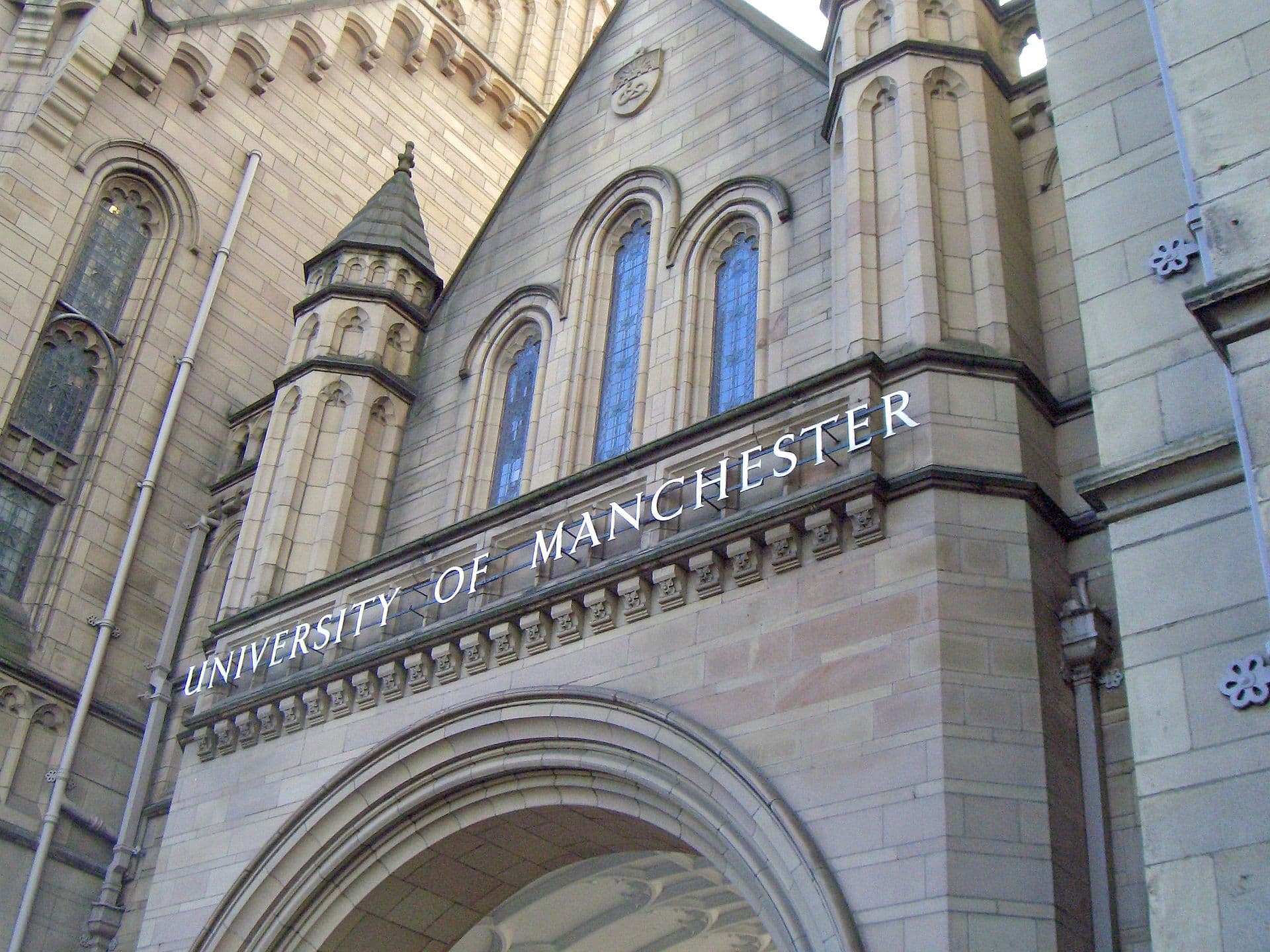
The University of Manchester grew out of the city that built the industrial age, and its history reads like a ledger of what Manchester decided to keep. It descends from two Victorian institutions, a Mechanics' Institute founded in 1824 to teach working men the science behind their trades, and Owens College, endowed in 1851 by a merchant who wanted a college that asked no questions about a student's religion. Those two lines ran side by side for a century and a half before joining, in 2004, to form the university that now stretches along Oxford Road in the United Kingdom's second-largest urban area.
For an archive concerned with memory, few universities offer a more literal claim. In a Manchester laboratory in June 1948, a room-sized machine called the Baby became the first computer to run a program held in its own electronic memory, a cathode-ray tube storing digits as spots of charge. Every device that keeps a photograph, a message or a document today descends from that moment. The same university keeps the John Rylands Library on Deansgate, whose collection includes a papyrus fragment of the Gospel of John that is widely held to be the oldest surviving piece of the New Testament.
The older of the university's two roots is the Manchester Mechanics' Institute, founded in 1824 by manufacturers and engineers who believed the city's artisans should understand the principles underlying their work. It grew into a technical school, then a municipal college of technology, and eventually the University of Manchester Institute of Science and Technology, known everywhere as UMIST.
The second root was planted by a bequest. John Owens, a Manchester merchant, died in 1846 leaving nearly £97,000 to found a college open to students without religious tests, at a time when the ancient English universities still restricted their degrees by faith. Owens College opened in 1851 in a house on Quay Street and moved in 1873 to new buildings on Oxford Road. In 1880 it became the first constituent college of the Victoria University, a federal institution chartered to bring university education to the industrial north; colleges at Liverpool and Leeds joined in the years that followed. When the federation dissolved in the early 1900s, the Manchester college continued as the Victoria University of Manchester, the name it carried for a century.
For much of the twentieth century UMIST served as the Victoria University's faculty of technology before becoming a fully autonomous university in its own right. On 1 October 2004 the two institutions dissolved themselves and combined under a new royal charter as the University of Manchester, at the time the largest merger in British higher education.
The university's historic face is the Gothic quarter that Owens College built along Oxford Road. Alfred Waterhouse, the architect of London's Natural History Museum, designed the quadrangle begun in the 1870s, including the John Owens Building and the Manchester Museum, and his son Paul completed the ensemble with the Whitworth Building and Whitworth Hall, finished in 1902 and funded from the legacy of the engineer Joseph Whitworth. The Whitworth Building's entrance arch opens from Oxford Road into the old quadrangle, and Whitworth Hall is still where the university confers its degrees. A mile north, the Sackville Street Building, a vast Edwardian block of brick and terracotta, anchors the former UMIST campus.
The university's most remarkable building, though, stands away from campus on Deansgate. The John Rylands Library was commissioned by Enriqueta Rylands in memory of her husband, a cotton merchant who had been Manchester's richest man, and opened to readers on 1 January 1900. Basil Champneys designed it as a cathedral of books, all pink sandstone vaulting and stained glass, and since 1972 it has been part of the university's library. Among its holdings is Rylands Papyrus P52, a scrap of the Gospel of John usually dated to the first half of the second century and widely regarded as the earliest known New Testament manuscript fragment. A library built as an act of remembrance keeps the oldest surviving trace of the most copied text in history.
Today the university teaches and researches across three faculties covering biology, medicine and health; science and engineering; and humanities. Its cultural estate, unusually broad for a British university, takes in the Manchester Museum, the Whitworth art gallery and Jodrell Bank Observatory in Cheshire, home of the Lovell Telescope.
The problem that stalled early computing was memory. Machines of the 1940s could calculate electronically, but they had no fast way to store a program and its working data. At Manchester, the engineer Freddie Williams and his colleague Tom Kilburn solved it with a cathode-ray tube, storing each binary digit as a charged spot on the face of the tube and reading the pattern back electronically. The Williams-Kilburn tube was the first practical random-access electronic memory.
To prove the tube worked, Williams, Kilburn and Geoff Tootill built a minimal computer around it, the Small-Scale Experimental Machine, known as the Manchester Baby. On the morning of 21 June 1948 it ran a 17-instruction program written by Kilburn to find the highest proper factor of a number, running for 52 minutes before producing the right answer. It was the first time a machine executed a program stored in its own electronic memory: the machine remembered its own instructions. The Baby grew into the Manchester Mark 1, and the local firm Ferranti engineered that design into the Ferranti Mark 1, delivered to the university in February 1951 as the world's first commercially available general-purpose electronic computer. A working replica of the Baby, built for the fiftieth anniversary in 1998, runs at the Science and Industry Museum in the city.
Manchester's scientific record began compounding long before the Baby. Ernest Rutherford held the chair of physics from 1907 to 1919, and in those rooms Hans Geiger and Ernest Marsden fired alpha particles at gold foil and watched a few bounce back, the experiments from which Rutherford drew his nuclear model of the atom in 1911. Niels Bohr worked under him at Manchester before publishing his quantum model of the atom. In experiments carried out between 1917 and 1919, Rutherford bombarded nitrogen with alpha particles and produced the first artificially induced nuclear reaction, work remembered as the first splitting of the atom. He left in 1919 to lead the Cavendish Laboratory at the University of Cambridge, succeeding his old teacher J. J. Thomson, who had begun his own studies at Owens College.
Alan Turing came to Manchester in 1948 to join the computing laboratory, wrote the programming manual for the Ferranti Mark 1, and published his 1950 paper proposing what became known as the Turing test while working there. In 1952 he published his theory of morphogenesis, a mathematical account of how patterns form in living things, opening a field that biology is still exploring. That same year he was convicted for his relationship with another man, then a crime in Britain, and in June 1954 he died at his home near Manchester of cyanide poisoning; the inquest ruled it suicide, and in 2013 he received a posthumous royal pardon.
The record has continued into the present century. In 2004 Andre Geim and Konstantin Novoselov, working in the university's physics department, isolated graphene, a sheet of carbon one atom thick, by repeatedly peeling flakes of graphite with adhesive tape; the material's strength and conductivity earned them the 2010 Nobel Prize in Physics. More than two dozen Nobel laureates have studied or worked at Manchester and its predecessor institutions, among them the economist Arthur Lewis, who at Manchester became Britain's first Black professor. The philosopher Ludwig Wittgenstein studied engineering there before turning to logic.
Modern Manchester operates at a scale to match its history. With more than 40,000 students it is the largest single-site university in the United Kingdom by enrolment. It is a founding member of the Russell Group of research universities, and its recent investments follow its inheritances: the National Graphene Institute carries the 2004 discovery toward application, and a rebuilt engineering campus consolidates the UMIST tradition on Oxford Road. The university's own count of Nobel laureates, past and present, stands at twenty-five.
The university sits along Oxford Road, about a mile south of Manchester city centre, and the corridor rewards a walking visit. The Whitworth Building and the Victorian quadrangle can be seen from the street, the Manchester Museum on Oxford Road is free to enter, and the Whitworth gallery stands a short walk further south in Whitworth Park. The John Rylands Library on Deansgate, in the city centre, is open to visitors free of charge. The working replica of the Manchester Baby is displayed at the Science and Industry Museum off Deansgate, and Jodrell Bank, a World Heritage Site since 2019, is an easy trip into Cheshire. Term-time visitors do best along Oxford Road itself, where the Whitworth Building, the art gallery and the museum are all public and all within a mile.
History
Campus and academics
The Baby and the Williams tube
Scholarship
The university today
Visiting
References and resources
- University of Manchester: History and heritage (official)
- University of Manchester: About (official)
- John Rylands Research Institute and Library (official)
- Britannica: Victoria University of Manchester
- Wikipedia: University of Manchester
- Wikipedia: Manchester Baby
- Wikipedia: Williams tube
- Wikipedia: Rylands Library Papyrus P52