Heritage · University
McGill University: History and Overview
Founded in 1821 from the bequest of the fur trader James McGill, McGill University rose at the foot of Mount Royal in Montreal. Ernest Rutherford worked out radioactive decay in its physics building, and at its Montreal Neurological Institute Wilder Penfield and Brenda Milner mapped where remembering lives in the human brain.Written to last.
By Confinity Heritage Editorial · 2026-08-24 · 8-minute readQuiet tools, kept out of the way.
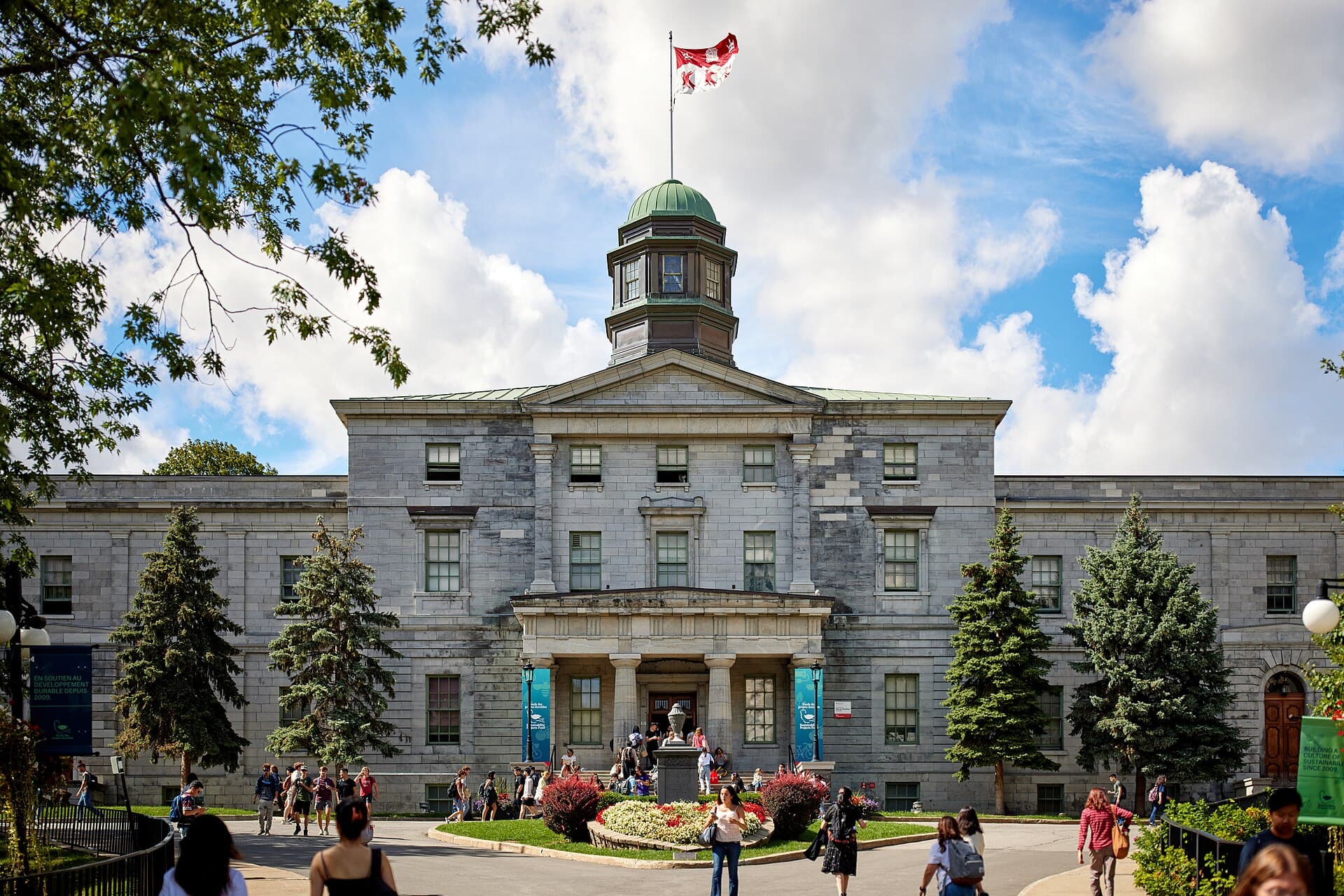
McGill University stands at the foot of Mount Royal in the centre of Montreal, the largest city of French-speaking Quebec in Canada. It began with a will. James McGill, a Glasgow-born merchant who made his fortune in the Montreal fur trade, died in 1813 and left his forty-six acre Burnside estate at the mountain's foot, together with ten thousand pounds, to endow a college bearing his name. A royal charter followed in 1821, and the university that grew on his farmland became one of the most consequential in the Americas.
For an archive concerned with memory, McGill holds two remarkable claims. The first is literal: the founder himself lies on the campus, his remains moved there in 1875 to rest beside the Arts Building, so that the university is, among other things, its founder's memorial. The second runs deeper. At the Montreal Neurological Institute, Wilder Penfield stimulated the exposed cortex of awake patients and drew the first working maps of the human brain, and Brenda Milner's studies of the amnesic patient H.M. established where and how new memories are made. McGill is, as nearly as any institution can be, the university that mapped where remembering lives.
James McGill arrived in Montreal from Scotland in the 1760s and prospered in the fur trade that then drove the city's economy, later serving in the legislature of Lower Canada. His bequest directed the Royal Institution for the Advancement of Learning to establish a college within ten years of his death, a condition that forced the matter through years of legal dispute with his heirs. The charter of 1821 created the University of McGill College, but teaching began in earnest only in 1829, when the Montreal Medical Institution joined the college as its first faculty, making it the earliest medical faculty in Canada. The institution took its present name, McGill University, in 1885.
The nineteenth century shaped both the campus and its character. The Arts Building, designed by John Ostell and opened in 1843, was the first building raised on the old Burnside land, and in 1875 the founder's remains were transferred from a downtown burial ground to a tomb beneath his monument beside it, where they remain. Women entered the university in 1884, supported by an endowment from Donald Smith, and the first women graduates were long known as Donaldas in his honour. Through all of this McGill grew as an English-language institution in a largely French-speaking city, a position it still occupies, teaching in English while drawing much of its student body from Quebec and the wider francophone world.
Sport left its own mark on the record. On 3 March 1875 the first organized indoor hockey game was played at Montreal's Victoria Skating Rink, arranged by James Creighton with McGill students among the players, and the McGill club formed soon afterward stands among the game's founding teams. The men's varsity teams carried the name Redmen for much of the twentieth century; the university retired that name in 2019 following a campaign led by Indigenous students, and the teams now compete as the Redbirds.
The downtown campus rises from the Roddick Gates on Sherbrooke Street up the lower slope of Mount Royal, a walled green quadrangle of grey limestone in the middle of the city. The Arts Building closes the main axis at the top of the avenue, with the founder's tomb at its east side, and around it stand the Redpath Museum of natural history, one of Canada's oldest purpose-built museums, and the ranges of Victorian and modern building that house most of the faculties. A second campus, the Macdonald campus at Sainte-Anne-de-Bellevue on the western tip of the island of Montreal, carries agricultural and environmental sciences.
McGill teaches across the full range of a research university, with faculties including arts, science, medicine and health sciences, engineering, law, education, and its business school, together numbering around 39,000 students. Its medical faculty, the oldest in the country, anchors a network of teaching hospitals across Montreal. Among its historic buildings, the Macdonald Physics Building deserves particular notice, for the work done inside it a century and a quarter ago changed the understanding of matter itself.
In 1934 the neurosurgeon Wilder Penfield founded the Montreal Neurological Institute at McGill with Rockefeller Foundation support, joining a hospital and a research institute under one roof. There he refined what became known as the Montreal procedure for severe epilepsy. Operating under local anaesthetic, Penfield kept his patients awake and stimulated the exposed surface of the brain with a mild electrical current, asking them to report what they felt, so that he could find and spare the tissue that carried speech and movement before removing the tissue that caused their seizures.
The method treated epilepsy, and it also produced knowledge no one had held before. From hundreds of these operations Penfield and his colleagues charted which strip of cortex moved each part of the body and which received its sensations, summarised in the drawing known as the cortical homunculus, a distorted human figure whose huge hands and lips show how much of the brain serves them. Stranger still, stimulation of the temporal lobes in some patients called up what seemed to be vivid fragments of past experience, a voice, a piece of music, a remembered scene, which led Penfield to argue that the brain keeps a far fuller record of a life than the rememberer can summon at will.
Brenda Milner, a psychologist at the institute, carried the question further. From her base at McGill she travelled to Hartford, Connecticut, to study Henry Molaison, the patient known for decades only as H.M., who had lost the ability to form new long-term memories after surgery there in 1953 removed structures deep in both temporal lobes. Milner showed that H.M. could still learn new motor skills he had no recollection of practising, proof that memory is not one faculty but several, and that the hippocampus is essential for laying down new conscious memories. The 1957 paper she wrote with his surgeon became one of the most cited in neuroscience, and her work is widely regarded as the founding of memory science as a discipline. Milner remained a professor at McGill past her hundredth birthday, still affiliated with the institute into the mid-2020s.
The university's other great scientific chapter opened in 1898, when a young New Zealander named Ernest Rutherford arrived to take the chair of physics. In the Macdonald Physics Building, between 1898 and 1907, Rutherford and the chemist Frederick Soddy worked out that radioactivity is the spontaneous disintegration of atoms, one element transmuting into another as it decays, work that overturned the ancient assumption that atoms are immutable. The Nobel Prize in Chemistry awarded to Rutherford in 1908 cited these investigations, carried out substantially at McGill before he returned to England. The university has kept the physical evidence: the Rutherford Museum in the physics department preserves the actual instruments he used in Montreal, the electroscopes and ionisation chambers with which the age of the atom was opened.
Medicine gave McGill an earlier legend. William Osler took his medical degree there in 1872 and taught in its faculty before moving on to Philadelphia and then to Johns Hopkins University, where he became one of the founding professors of its medical school and reshaped how physicians are trained at the bedside. McGill's graduates since have included prime ministers of Canada, the singer and poet Leonard Cohen, and a long line of scientists and jurists; a dozen Nobel laureates have studied or taught there, and its students have won more Rhodes Scholarships than those of any other Canadian university.
McGill consistently ranks among the leading universities in Canada, alongside the University of Toronto, and within the top tier of international league tables. It is a member of the U15 group of Canadian research universities and of the Association of American Universities. Research strengths run from neuroscience, where the Montreal Neurological Institute remains one of the world's principal centres for the brain, to quantum materials, public health and artificial intelligence through the city's Mila institute. The Neuro has also committed itself to open science, sharing its data and materials without patent restrictions.
The downtown campus is open to walk through, entered most naturally by the Roddick Gates on Sherbrooke Street, from which the avenue climbs directly to the Arts Building and James McGill's tomb beside it. The Redpath Museum welcomes the public to its collections of fossils, minerals and cultural artefacts, and the McCord Stewart Museum of Canadian history stands just across Sherbrooke Street. The Rutherford Museum's historical apparatus can be seen through the physics department, and Mount Royal park rises directly behind the campus. The lower campus, the Roddick Gates and the climb to the Redpath Museum are the parts made for strangers; lecture halls and libraries belong to the students in them.