Heritage · University
University of Toronto: History and Overview
Founded in 1827 as King's College and secularized at mid-century, the University of Toronto grew into Canada's largest university through an unusual federation of colleges. It is the place where insulin was discovered in 1921 and 1922, and the notebooks that record the discovery are still kept on its campus.Written to last.
By Confinity Heritage Editorial · 2026-08-24 · 8-minute readQuiet tools, kept out of the way.
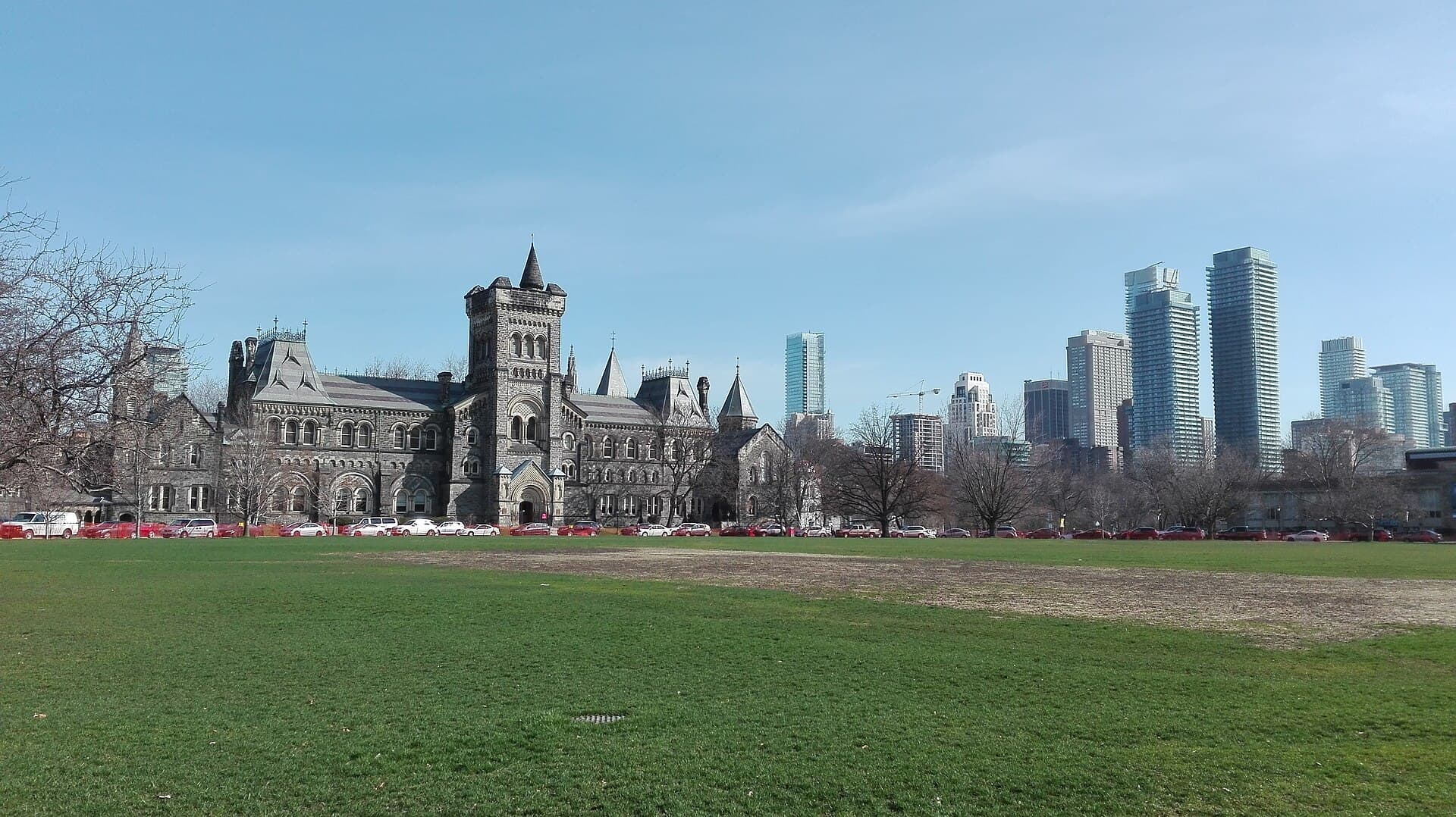
The University of Toronto is the largest university in Canada and one of the most consequential research institutions in the world. It began in 1827 as an Anglican college on the edge of a colonial town and grew, through a century of argument about religion and a century of scientific work, into a federation of colleges spread across three campuses, its central grounds anchored by the Romanesque bulk of University College beside Queen's Park.
Two threads run through its history. The first is institutional: Toronto settled the nineteenth century's church-and-state quarrel over education not by absorbing its rivals but by federating with them, an arrangement rare in North America. The second is a matter of record. In a campus laboratory in 1921 and 1922, insulin was isolated and given to the world for a dollar, and the notebooks in which that work was written down are still held a few hundred metres from where it happened.
A royal charter of 1827 established King's College as the first university in the colony of Upper Canada. Its driving figure was John Strachan, the Anglican bishop of Toronto, and the college he designed was Anglican in character, with religious tests attached to its governance. In a colony of Methodists, Presbyterians and Catholics, that settlement could not hold. Teaching did not begin until 1843, and an act passed in 1849 secularized the institution: on the first day of 1850, King's College became the University of Toronto, a nondenominational body with no religious tests. Strachan denounced the change and founded Trinity College in 1851 as an Anglican alternative; University College was created in 1853 as the university's own nondenominational teaching college.
What followed was the arrangement that still defines the place. Rather than compete indefinitely, the denominational colleges of Ontario began to federate with the provincial university. Victoria University, a Methodist foundation from Cobourg, federated in 1890 and moved to Toronto soon after. Trinity, the college founded in protest, joined in 1904, and St. Michael's College, run by the Basilian Fathers, entered full federation in 1910. Each kept its name, its property, its religious identity and much of its student life, while degrees came to be granted by the university as a whole. The colleges, later joined by newer secular foundations, still give the university its collegiate texture: a very large institution experienced by most undergraduates as a series of smaller ones.
The physical heart of the campus nearly did not survive the century. On the evening of 14 February 1890, as workers prepared University College for its annual conversazione, a dropped tray of lamps set the building alight. The fire gutted the east wing and destroyed the college library, and with it roughly 33,000 books. The building was restored within a few years, and the loss pushed the university toward a proper central library, the ancestor of one of the largest academic library systems in North America.
University College remains the emblem of the St. George campus. Designed by Frederic Cumberland with William Storm and built between 1856 and 1859, it is a long Romanesque Revival pile of carved stone, famous for its ornamented main doorway, and now a National Historic Site of Canada. Around it stand the landmarks of the university's growth: Convocation Hall with its domed rotunda, Hart House, the Gothic student commons given by the Massey family, and the Soldiers' Tower, a memorial to members of the university killed in the world wars.
The library system's two most distinctive buildings sit side by side. Robarts Library, opened in 1973, is a vast concrete research library on a triangular plan, a landmark of brutalist architecture that students long ago nicknamed Fort Book. Attached to it is the Thomas Fisher Rare Book Library, whose holdings run from a Shakespeare First Folio and early scientific classics to the papers of Canadian writers, and whose most visited treasures are the laboratory records of the insulin discovery.
The university teaches across three campuses. The historic St. George campus occupies the centre of Toronto; the Mississauga and Scarborough campuses, both founded in the 1960s, serve the western and eastern reaches of the metropolitan region. Across the three, the institution spans the full range of academic work, from humanities and law to engineering, medicine and computer science, with teaching hospitals throughout the city as its clinical partners.
In the summer of 1921, the surgeon Frederick Banting and a student assistant, Charles Best, began experiments in the physiology laboratory of J. J. R. Macleod, trying to isolate the internal secretion of the pancreas. By late that year they had an extract that lowered blood sugar in dogs, and the biochemist James Collip joined the team to purify it for human use. In January 1922, a fourteen-year-old boy named Leonard Thompson, dying of diabetes at Toronto General Hospital, received the extract; after Collip's purified preparation was used, his blood sugar fell and his condition turned. Diabetes in children, until that month a death sentence, became a treatable disease. The Nobel Prize in Physiology or Medicine followed in 1923, awarded to Banting and Macleod, who divided their shares with Best and Collip.
What the team did next is the part of the story medicine still tells. Banting, Best and Collip took out a patent on insulin, not to profit from it but to control it, and assigned it to the Board of Governors of the University of Toronto for one dollar each. The university licensed manufacturers on terms meant to keep quality up and the price down. Banting's often quoted position was that insulin belonged to the world, not to him, and the dollar patent has been cited for a century as the standard against which the pricing of essential medicine is measured.
The record of that work never left the campus. The Fisher Library holds the papers of Banting and Best, including the laboratory notebooks in which the 1921 experiments were written up and the charts from Leonard Thompson's treatment; in 2013 the archive was inscribed on UNESCO's Memory of the World Register. It is a rare alignment of event and evidence: the discovery is documented in the hand of the discoverers, in the place where it happened, and anyone can consult it.
Insulin opened a century of firsts. In 1938, working under the physicist E. F. Burton, the graduate students James Hillier and Albert Prebus built the first practical electron microscope in North America. In 1950, the engineer John Hopps, collaborating with the surgeons Wilfred Bigelow and John Callaghan in Toronto, built the external cardiac pacemaker that founded a field. In 1961, James Till and Ernest McCulloch published the evidence that established the existence of stem cells.
The humanities produced a figure just as influential. Marshall McLuhan taught at St. Michael's College for most of his career, and from 1963 ran the Centre for Culture and Technology from a coach house behind the college, producing the analyses of media that made "the medium is the message" and "the global village" part of the language. The chemist John Polanyi won the Nobel Prize in Chemistry in 1986 for his work on the dynamics of chemical reactions, joining a roll of laureates that includes Banting, Macleod and the alumnus Lester B. Pearson, who won the Peace Prize in 1957 and later served as Canada's prime minister.
The most recent chapter belongs to computer science. Geoffrey Hinton spent decades at Toronto pursuing neural networks through years when the approach was unfashionable. In 2012 his students Alex Krizhevsky and Ilya Sutskever, working with Hinton, entered a deep convolutional network later known as AlexNet in the ImageNet recognition challenge and won by a wide margin, a result that set off the modern era of deep learning. Hinton received the Nobel Prize in Physics in 2024 for foundational work on machine learning with artificial neural networks, and Toronto remains one of the world's centres of AI research.
The University of Toronto is Canada's largest university, with more than ninety thousand students across its three campuses and consistently the country's highest position in the major international rankings. Its library system ranks among the largest on the continent. The colleges continue to admit and house undergraduates under their own names, so that a student may belong at once to Trinity or Victoria or St. Michael's and to the university that binds them together, an arrangement now approaching its third century.
The St. George campus is open to walk through, and it rewards a slow circuit: University College's carved doorway, the quadrangle of Hart House, Convocation Hall and the concrete geometry of Robarts Library are all within a few minutes of one another, with Queen's Park adjoining the campus to the east. The Fisher Library's exhibition space is open to the public free of charge, and the insulin papers have been digitized for consultation online. The campus is a short walk from the Queen's Park and St. George subway stations, and its buildings are working classrooms and libraries in term time.