Heritage · University
University of Buenos Aires: History and Overview
Founded in 1821, the University of Buenos Aires is Argentina's great public university, tuition-free and open to all who complete its common entry cycle. Its faculties are scattered through the city rather than gathered on a campus, and its roll of graduates includes Nobel laureates, presidents and Che Guevara.Written to last.
By Confinity Heritage Editorial · 2026-08-24 · 8-minute readQuiet tools, kept out of the way.
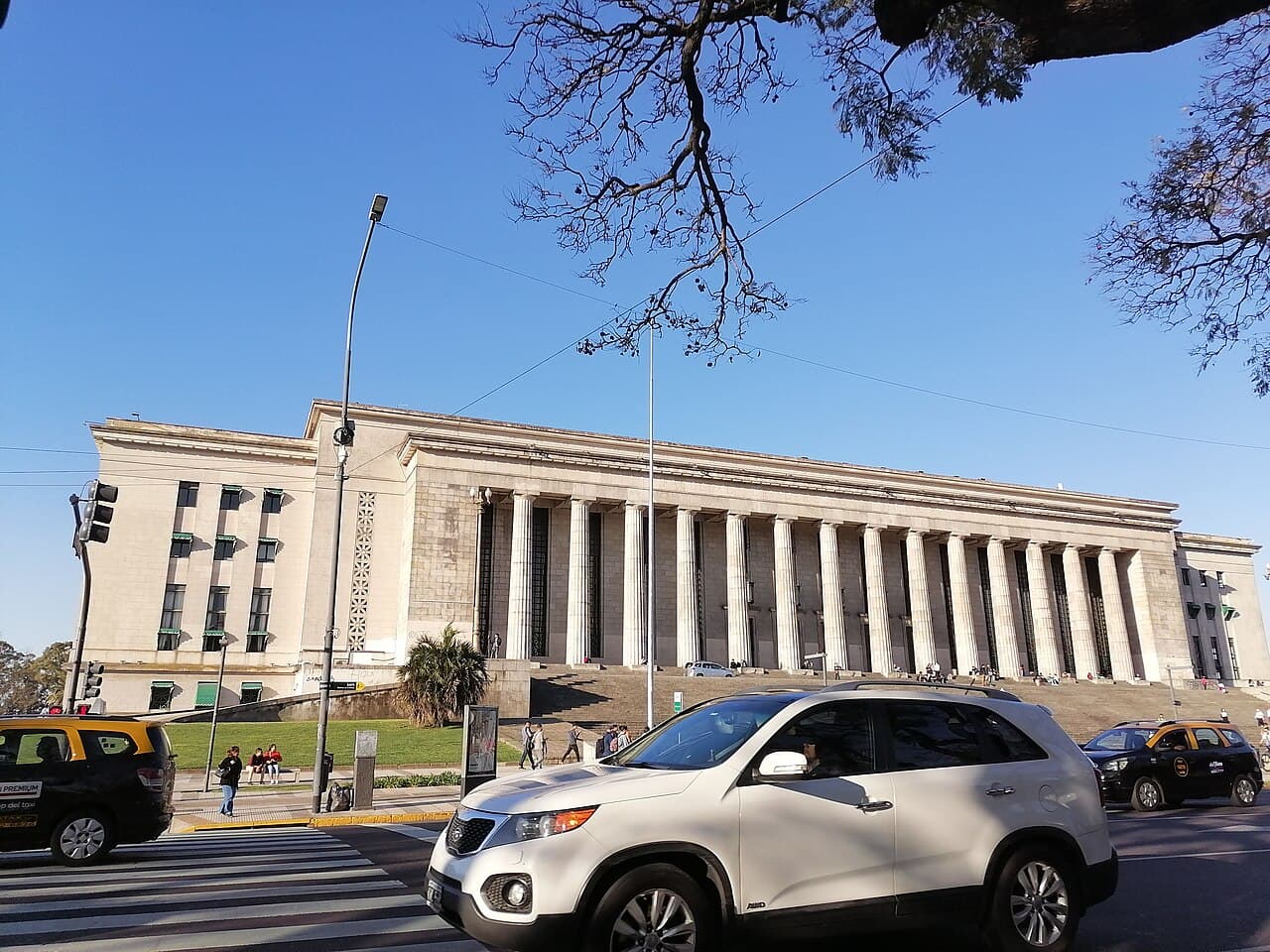
The University of Buenos Aires is the great public university of Argentina, and one of the largest in the Americas. It has no walled campus and no single address. Its thirteen faculties are scattered through the city that shares its name: the columned law faculty facing the parks of Recoleta, the vast medical faculty a few blocks away, the science towers of Ciudad Universitaria on the edge of the Río de la Plata. To study at the UBA is to study in Buenos Aires itself, riding the same buses and subways as everyone else, because the university was never set apart from the city. It was built to belong to it.
Two commitments define the institution. Undergraduate study is free of tuition, and entry is open: there is no admissions examination, only a first-year common cycle that any holder of a secondary diploma may begin. Those principles have carried more than 300,000 students at a time through its lecture halls, along with four Nobel laureates, a long line of Argentine presidents, and one restless medical student named Ernesto Guevara. That history includes the night in 1966 when the state turned on its own university and the country counted the cost for a generation.
The university was founded on 12 August 1821 by the government of Buenos Aires province under Governor Martín Rodríguez, with his minister Bernardino Rivadavia as the driving figure. The new institution gathered the city's existing colleges and chairs into a single university on the European model, with departments spanning law, medicine and the exact sciences. Through the nineteenth century it trained the lawyers, doctors and engineers of the young republic, and its law faculty in particular became the seedbed of Argentine political life.
The event that reshaped it came from another city. In 1918, students at the University of Córdoba rose against a closed, clerical academic order and issued the Liminar Manifesto, demanding modern curricula, open competition for professorships, and a say in how their university was run. The University Reform of 1918 spread within months to Buenos Aires and then across the continent, and its principles became the charter of the Latin American public university: institutional autonomy from the government of the day, co-governance shared among professors, students and graduates, freedom of teaching, and extension of the university's work to society at large. The UBA became the largest institution built on that model, a status it shares in spirit with the National Autonomous University of Mexico, the other great public university of Latin America.
Tuition fees for undergraduate study were abolished in 1949, and free instruction has been a settled principle of Argentine public higher education ever since, reaffirmed by national law in 2015. Open admission took its present form in 1984-1985, when the restored democracy replaced entrance examinations with the Ciclo Básico Común, a common first-year cycle of courses that any secondary-school graduate may enter. The gates, once opened, stayed open.
The university's buildings map a century and a half of civic ambition. The Faculty of Law, inaugurated in 1949 beside the parks of Recoleta, presents a stripped neoclassical front of giant columns that has become the university's best-known image. The Faculty of Medicine rises over the district still called Barrio de los Médicos, and the Faculty of Economic Sciences occupies a former merchants' academy in the city centre. On reclaimed land along the river stand the pavilions of Ciudad Universitaria, a modernist complex begun in the 1960s that houses the exact and natural sciences and the school of architecture. The old Manzana de las Luces, the colonial block of the Jesuits, held the sciences before that, and the Colegio Nacional de Buenos Aires, the university's storied preparatory school, still teaches there beside it.
Academically the UBA spans thirteen faculties covering law, medicine, exact and natural sciences, engineering, economics, philosophy and letters, social sciences, psychology, architecture, agronomy, veterinary science, pharmacy and biochemistry, and dentistry. It runs six hospitals and health institutes, a network of museums, and the Ciclo Básico Común through which every entering student passes. Enrolment above three hundred thousand makes it one of the largest universities in the Americas, and its scale is inseparable from its idea of itself: a university sized to a nation's demand for it, not to a selection committee's.
On 29 June 1966 a coup installed General Juan Carlos Onganía in the presidency, and one month later his government dissolved the co-governance won in 1918 and placed the universities under state control. The faculties declared their opposition. On the night of 29 July 1966, federal police entered five UBA faculties to clear them, and in the Faculty of Exact and Natural Sciences, then housed in the Manzana de las Luces, they drove professors, students and staff down the stairways between two ranks of officers swinging long batons. Deans and internationally known scientists were beaten alongside their students. Among the injured was Warren Ambrose, a visiting mathematician from MIT, whose letter describing the beatings was published in the New York Times and carried the news abroad.
What followed did the deeper damage. In the weeks after the raid, roughly 1,400 professors and researchers resigned from the UBA rather than serve under intervention, and hundreds of scientists left the country for posts in Europe, the United States and the rest of Latin America. Whole research groups in mathematics, physics and computing, including the team around Manuel Sadosky and Clementina, the country's pioneering computer, were dispersed. A university can rebuild a syllabus in a season; a scientific community takes decades. The exodus of 1966, deepened by the harsher dictatorship of 1976-1983, is remembered in Argentina as the night the country emptied its own lecture halls, and the return of democracy in 1983 was felt at the UBA as a restoration in the plainest sense: concursos reopened, exiles came back to their chairs, autonomy and co-governance were re-established, and the CBC opened the doors wider than they had ever been.
Four Nobel laureates studied or taught at the UBA, a tally often cited as unmatched among universities of the Spanish-speaking world. Carlos Saavedra Lamas, professor and later president of the university, received the Peace Prize in 1936 for brokering the end of the Chaco War. Bernardo Houssay, awarded the 1947 Prize in Medicine for his work on pituitary hormones, was the first Latin American Nobel laureate in the sciences, and his student Luis Leloir took the 1970 Prize in Chemistry for uncovering the sugar nucleotides. César Milstein, who studied chemistry at the UBA before moving to Cambridge, shared the 1984 Prize in Medicine for the monoclonal antibody technique that transformed modern medicine.
The wider roll reads like a history of Argentina. Ernesto "Che" Guevara studied medicine at the UBA before the journeys that carried him into revolution. Jorge Luis Borges never took a degree anywhere, but from 1956 he held the chair of English and American literature at the university, and generations of students heard the blind master lecture from memory. More than a dozen Argentine presidents trained in its classrooms, most of them in the law faculty, along with much of the country's judiciary, its diplomats and editors, and the physicians who built its public hospitals.
The UBA regularly places first among the universities of Ibero-America in international rankings, and the QS World University Rankings have repeatedly listed it within the world's top hundred, a rare standing for a tuition-free open-admission institution. Its research system, tied closely to the national research council CONICET, remains the largest in Argentina. The founding commitments are still contested ground: proposals to charge fees or restrict entry return with each fiscal crisis, and in 2018 and again in 2024 students and professors filled the streets of Buenos Aires in mass marches to defend free public education. The university's answer has not changed since 1918: the UBA belongs to the public that pays for it and walks through its doors.
Most UBA buildings are working faculties rather than tourist sites, but several reward a visit. The Faculty of Law on Avenida Figueroa Alcorta is a short walk from the Recoleta cemetery and the Floralis Genérica sculpture, and its columned front can be seen at any hour. The Manzana de las Luces, the colonial block where the university's sciences began and where the batons fell in 1966, is run as a historic site with guided tours of its Jesuit buildings and tunnels. Ciudad Universitaria, reached along the riverside parks, offers the modernist pavilions and an open shoreline popular with birdwatchers. Visitors should remember that classes run day and evening; the crowds moving between buses and lecture halls are the university itself.