Heritage · University
Technical University of Munich: History and Overview
Founded in 1868 by King Ludwig II of Bavaria as a polytechnic school, the Technical University of Munich grew into Germany's leading technical university. Its lecture halls trained Carl von Linde and Rudolf Diesel, and its Garching campus keeps the Atomic Egg, West Germany's first nuclear research reactor, as a monument to a scientific restart.Written to last.
By Confinity Heritage Editorial · 2026-08-24 · 8-minute readQuiet tools, kept out of the way.
King Ludwig II of Bavaria is remembered as the dreamer who poured his treasury into Neuschwanstein Castle, a fairy-tale fortress in the Alpine foothills. Two years into his reign, the same king signed a plainer and more consequential document: the founding decree of a polytechnic school in Munich, opened in 1868 to train the engineers a rapidly industrialising Bavaria could not import fast enough. The romantic king's practical school became the Technical University of Munich, usually shortened to TUM, and today it is the most consistently top-ranked university in Germany.
Few institutions can trace so much of the machinery of modern life to their own lecture halls. Refrigeration as an industry began in a laboratory here. The diesel engine carries the name of a student who sat in those refrigeration lectures. And on the university's research campus north of the city stands an egg-shaped dome of aluminium, the first nuclear reactor of the Federal Republic, kept now as a protected monument to the moment a country barred from advanced research was allowed to begin again.
The Polytechnische Schule München opened its doors in the autumn of 1868 with a few hundred students and a mandate to teach the mathematical and technical sciences at the highest level. It answered a different need from the older German universities: where the Humboldt University of Berlin had defined the nineteenth-century ideal of scholarship pursued for its own sake, the Munich polytechnic existed to build things, and made no apology for it. In 1877 it was raised to the rank of a Technische Hochschule, and in 1901 it won the right to award doctorates, the surest sign that engineering had become a science in its own right.
The decades that followed bound the school to the growth of German industry. In 1930 it absorbed the agricultural and brewing academy at Weihenstephan, near Freising, adding the life sciences to its portfolio on a site where beer had been brewed since the Middle Ages. The Second World War left its central Munich buildings heavily damaged, and the post-war years were spent in reconstruction, both physical and moral, as German science worked its way back into the international community from which it had been expelled. In 1970 the institution took its present name, Technische Universität München, marking formally what had long been true in practice: it was a full university, with technology at its core rather than at its margin.
The university's historic home is a dense block on Arcisstraße in central Munich, across the street from the city's great art museums. But its centre of gravity has shifted steadily northward to Garching, a research campus begun in the 1950s on open fields beyond the city edge. Garching has since grown into one of the tightest concentrations of scientific institutions in Europe. Alongside the university's physics, chemistry, mathematics and informatics departments stand Max Planck Institutes for plasma physics, astrophysics, extraterrestrial physics and quantum optics, the Leibniz Supercomputing Centre, and the headquarters of the European Southern Observatory, from which some of the world's largest telescopes in the Chilean desert are run.
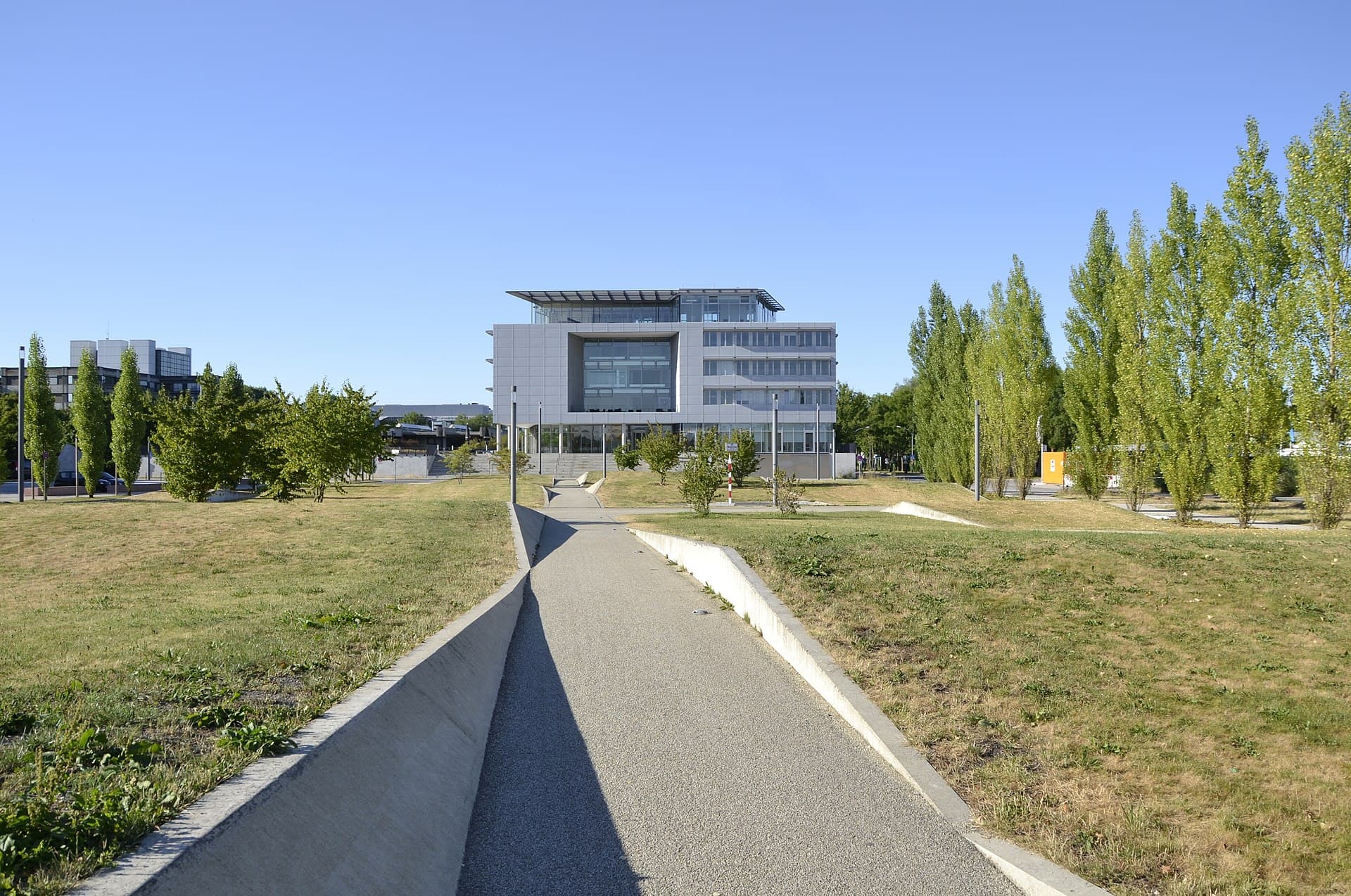
The campus carries its seriousness lightly in places. The mathematics and informatics building, opened in 2002, contains two enormous parabolic slides that descend from the third floor to the ground in a single sweeping curve, their shape tracing the very function taught in the lecture halls around them. Students really do use them between classes, and the slides have become the campus's most photographed interior. The hero image of this page shows another Garching landmark, the Institute for Advanced Study, a slatted rectangular hall built with the funds of the German Excellence Initiative as a home for the university's most open-ended research.
Beyond Munich and Garching, the Weihenstephan campus at Freising carries the life sciences, from brewing and food technology to forestry and nutrition, and newer sites in Heilbronn and Straubing extend management and biotechnology. The university even crossed continents: TUM Asia, founded in Singapore in 2002, was the first campus of a German university abroad. Across all locations, TUM teaches more than fifty thousand students in engineering, the natural sciences, life sciences, medicine, management and social sciences.
On the eastern edge of the Garching campus stands the building that started it all: the Forschungsreaktor München, universally known as the Atomei or Atomic Egg for its ovoid aluminium dome. When it reached criticality on 31 October 1957, it became the first nuclear reactor in the Federal Republic of Germany, which had only two years earlier regained the sovereignty to pursue nuclear research at all. The reactor was driven into being by Heinz Maier-Leibnitz, the physics professor whose name the campus's central avenue now bears, and its arrival on empty farmland is the reason Garching became a science city; the town later placed an atomic symbol in its municipal coat of arms.
The Egg was never a power plant. It was a neutron source, a tool for probing the structure of matter, and around it Maier-Leibnitz built one of the strongest schools of experimental physics in post-war Europe. His doctoral student Rudolf Mößbauer discovered recoil-free gamma-ray emission, the effect that bears his name, and received the Nobel Prize in Physics in 1961 at the age of thirty-two. The original reactor was shut down in 2000, its scientific work passing to the far more powerful FRM II neutron source that rose beside it, but the Egg itself was not demolished. It stands under monument protection, a piece of industrial architecture preserved the way a chapel or a city gate might be: as the visible record of a beginning.
The university's deepest imprint on the world is mechanical. Carl von Linde, appointed professor at the young polytechnic in 1868, made refrigeration a science, developed practical machines for liquefying air, and spun his laboratory work into the company that still bears his name, today one of the largest industrial gas firms in the world. Among the students in his lectures was Rudolf Diesel, who graduated with the best examination results the school had yet recorded and went on to build the high-efficiency engine named after him. That an engine running in ships and trucks on every continent is named for a Munich student remains one of the university's plainest claims on modern life. The school also trained a line of aviation pioneers, among them Claude Dornier, whose flying boats defined an era of long-distance flight, and Willy Messerschmitt, whose aircraft designs became central to German aviation in the 1930s and the war that followed.
The Nobel roll is long. Ernst Otto Fischer, a Munich native who spent his career at the university, shared the 1973 Nobel Prize in Chemistry for his work on sandwich compounds, molecules with a metal atom held between rings of carbon. Mößbauer returned from the United States to a Munich chair. Klaus von Klitzing, who completed his habilitation at the university, won the 1985 physics prize for the quantum Hall effect, and Joachim Frank, who took his doctorate at TUM in 1970, shared the 2017 chemistry prize for cryo-electron microscopy.
TUM has been named a University of Excellence in every round of Germany's national excellence competition since the scheme began in 2006, and it regularly places first among German universities in the major international rankings. It shares its city with Ludwig Maximilian University, itself among Europe's strongest, an unusual twin-university ecology that makes Munich one of the continent's densest academic centres.
The university's most distinctive modern trait is entrepreneurial. Through UnternehmerTUM, one of the largest centres for innovation and business creation in Europe, it pushes students and researchers toward founding companies, and the results are measurable: Munich's startup scene leans heavily on TUM graduates, and Celonis, the process-mining firm founded by three of its students in 2011, grew into one of Germany's most valuable software companies. The official account of the university describes it as an entrepreneurial university, and for once the label describes practice rather than aspiration.
The historic main building on Arcisstraße sits in Munich's museum quarter, a short walk from the Alte Pinakothek, and its courtyards can be walked through freely. The Garching campus is reached directly by underground line U6 from the city centre, and visitors can see the Atomic Egg's dome, the Institute for Advanced Study and the mathematics building with its parabolic slides from the public paths; the slides themselves are inside a working university building, so discretion during teaching hours is asked. The FRM II reactor site is fenced and open only by arranged tour with advance registration. At Weihenstephan, the campus adjoins the world's oldest working brewery, which makes the life-sciences site the rare university campus where the visit traditionally ends with a beer garden.