Heritage · University
Humboldt University of Berlin: History and Overview
Founded in 1810 to Wilhelm von Humboldt's design, the University of Berlin became the template of the modern research university, uniting teaching and research under academic freedom. Its roll of names runs from Hegel and the brothers Grimm to Einstein and Planck, and its hardest memory is kept on Bebelplatz, where an empty sunken library marks the book burning of 1933.Written to last.
By Confinity Heritage Editorial · 2026-08-24 · 8-minute readQuiet tools, kept out of the way.
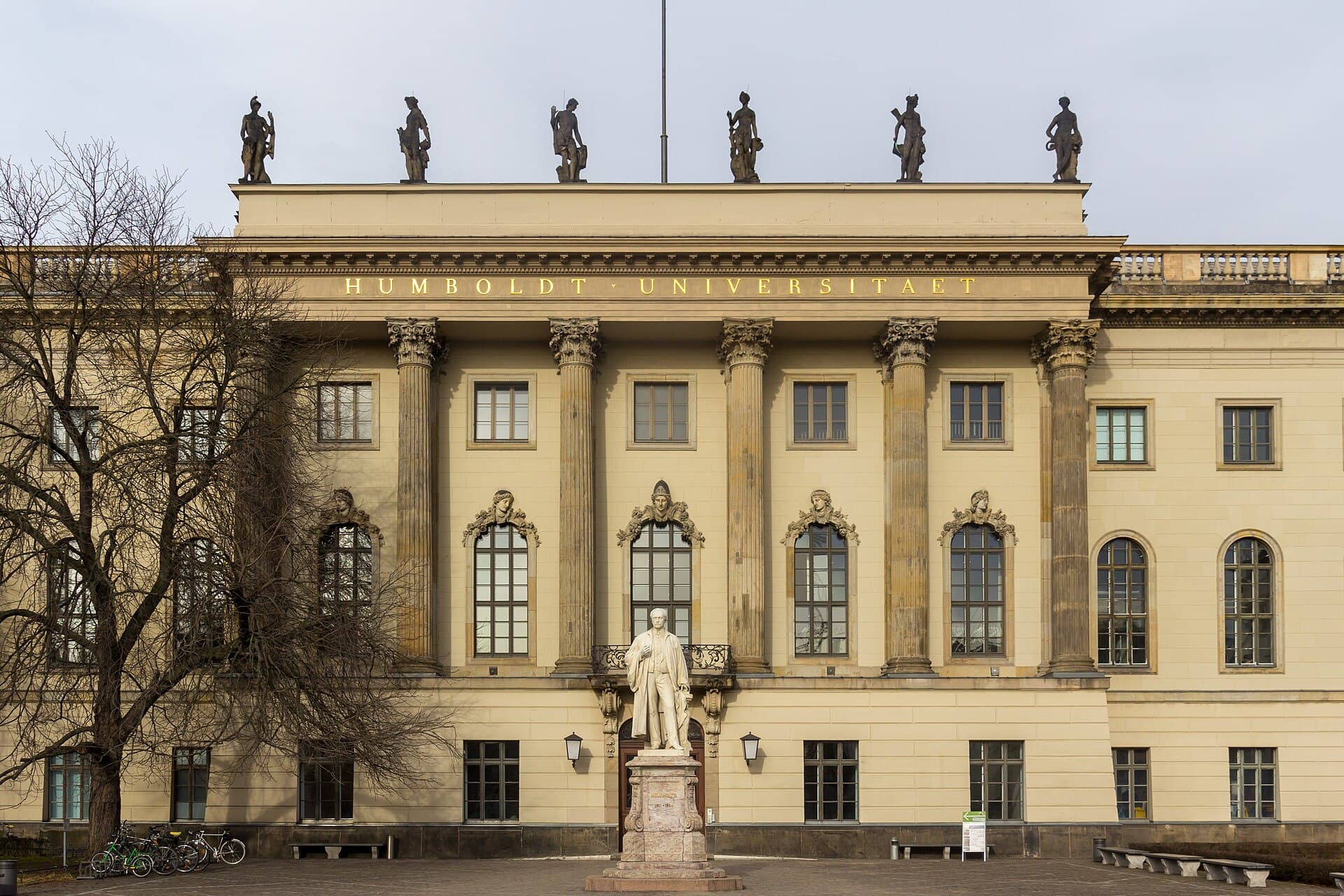
Humboldt University of Berlin stands on Unter den Linden in the middle of Germany's capital, its main building an eighteenth-century palace facing the boulevard between the Brandenburg Gate and Museum Island. It opened in 1810 as the University of Berlin, and it may be the most influential university of the modern era. The idea it was built to test, that a university should produce new knowledge and not only transmit old knowledge, became the pattern for research universities on every continent.
The same address holds one of the darkest scenes in the history of learning. On the square opposite the main building, students and professors of this university helped burn some twenty thousand books in May 1933, and the memorial there is a room of empty shelves sunk beneath the paving.
The university was born out of defeat. Prussia had been broken by Napoleon at Jena in 1806, had lost its university at Halle in the settlement that followed, and turned to internal reform as the road back. Wilhelm von Humboldt, a linguist and philosopher then heading the Prussian education administration, drafted the plan for a new kind of university in Berlin. King Frederick William III approved it in 1809, gave it the Prinz-Heinrich-Palais on Unter den Linden as a home, and teaching began in the autumn of 1810.
Humboldt's design, now called the Humboldtian model, rested on three linked convictions. The first was the unity of teaching and research: professors should be active investigators, and students should learn by joining the work of discovery rather than by memorising settled results. The second was academic freedom, both the freedom to teach and the freedom to choose what to study, shielded from church and state direction. The third was Bildung, the formation of the whole person through scholarship pursued for its own sake. Germany's older universities, Heidelberg University among them, gradually reorganised themselves along the same lines, and the model travelled far beyond Germany. Johns Hopkins University, founded in 1876 as the first American research university, was consciously built on the Berlin pattern, and the imperial universities of Japan, beginning with Tokyo, drew on it in the same generation. The seminar, the doctoral dissertation and the research professorship as most of the world now knows them descend from this one institution.
The nineteenth century made Berlin the capital of German scholarship. Johann Gottlieb Fichte held the first chair of philosophy; Hegel succeeded to it in 1818 and taught until his death in 1831, drawing the largest audiences in the university. Arthur Schopenhauer, then an unsalaried lecturer, deliberately scheduled his own course at the same hour as Hegel's in 1820, found the benches almost empty, and soon gave up lecturing altogether. The brothers Grimm came in the 1840s to lecture and to labour on their great German dictionary. In the sciences, Rudolf Virchow founded cellular pathology and Robert Koch held the chair of hygiene after identifying the bacterial causes of tuberculosis and cholera. Among the students were Karl Marx, who read law and philosophy there from 1836, Friedrich Engels, who audited lectures during his military service in Berlin, Otto von Bismarck, who completed his law studies there, and Heinrich Heine, whose words would later be set into the square outside. W. E. B. Du Bois spent two formative years there in the 1890s studying economics and history.
In 1828 the university took the name Friedrich-Wilhelms-Universität, which it kept until after the Second World War. By the early twentieth century its physics faculty alone justified the model: Max Planck, a professor there for nearly four decades, introduced the quantum in 1900; Albert Einstein held a research professorship in Berlin from 1914 to 1932; Erwin Schrödinger succeeded to Planck's chair in 1927; Werner Heisenberg held a professorship in the 1940s. Around 55 Nobel laureates are associated with the university, the great majority from before 1945. That date is not incidental.
The main building remains the Prinz-Heinrich-Palais, built in the mid-eighteenth century for a brother of Frederick the Great and handed to the university at its founding. Statues of the two Humboldt brothers flank the forecourt gates: Wilhelm, the founder, and Alexander, the naturalist and explorer whose name the university also bears. Second-hand book stalls trade in the forecourt.
The university teaches across nine faculties in the arts, humanities, social sciences, law, theology, economics and the sciences. Its medical faculty is the Charité, one of Europe's largest university hospitals, run jointly with Freie Universität Berlin. Mathematics and the natural sciences have largely moved to a purpose-built campus at Adlershof in the city's southeast, while the life sciences occupy Campus Nord near the Charité. The Museum für Naturkunde, Berlin's natural history museum, grew up as part of the university from 1810 and became an independent research museum in 2009; its collections include the Berlin specimen of Archaeopteryx and the tallest mounted dinosaur skeleton in the world.
Directly across Unter den Linden from the main building lies Bebelplatz, then called Opernplatz. On the night of 10 May 1933, a few months after Hitler took power, the square filled with a torchlit crowd for the Berlin instalment of a nationwide "action against the un-German spirit". Students of the university, with the participation of some professors, fed roughly 20,000 books into the fire: works by Heinrich Heine, Karl Marx, Sigmund Freud, Erich Kästner, Kurt Tucholsky and hundreds of others judged un-German. Joseph Goebbels addressed the crowd near midnight. This was not a mob descending on a university from outside. It was organised, in large part, from within.
Under the racial civil service law of 1933 and the measures after it, the university dismissed around a third of its academic staff, above all its Jewish scholars. Einstein, abroad when Hitler came to power, never returned; Schrödinger left in protest the same year. The expulsions gutted German science, and the stream of exiled scholars enriched universities in Britain, the United States and elsewhere for a generation.
The memorial on Bebelplatz, created by the Israeli artist Micha Ullman and unveiled in 1995, refuses monumentality. Set flush into the cobbles is a square glass plate; below it, lit day and night, is a white underground room lined with empty bookshelves, room for about twenty thousand volumes, and no way in. A nearby plaque carries a line Heine wrote in 1820: "where they burn books, they will in the end burn people". The university that once counted Heine among its students keeps his warning at its front door.
The university's intellectual legacy is carried less by any single discovery than by the working habits of modern academia itself, but the individual record is still without parallel. Hegel's Berlin lectures shaped European philosophy for a century. Virchow's cellular pathology and Koch's bacteriology stand at the foundations of modern medicine. Planck's quantum and Einstein's Berlin years, in which general relativity was completed and first presented, opened twentieth-century physics. Marx's thought, formed partly in Berlin's lecture halls, reshaped world history, and Du Bois carried the seminar methods of his Berlin teachers into American social science. The roll of names is not an ornament of the Humboldtian model but its evidence.
The end of the war in 1945 left the university in the Soviet sector of Berlin, and the new authorities steadily brought admissions and teaching under party control; students who resisted were arrested. In 1948 students and scholars, backed by the American occupation authorities, founded the Free University in the western district of Dahlem as a rival built on the freedoms the old university had lost. In 1949 the eastern institution took its present name, Humboldt-Universität zu Berlin, honouring both Wilhelm and Alexander von Humboldt, and it served four decades as East Germany's leading university. After reunification in 1990 it was refounded in all but name: faculties restructured, staff reviewed, chairs opened to international competition.
Today around 36,000 students study at Humboldt. The university is recognised under Germany's Excellence Strategy as part of the Berlin University Alliance, and the two Berlin universities born of the Cold War division now work as partners rather than rivals.
The main building at Unter den Linden 6 is a working university, and visitors can enter the forecourt, browse the book stalls and view the Humboldt statues at any time. Bebelplatz lies directly across the boulevard; the Ullman memorial can be seen through its glass plate at all hours, at its most striking after dark when the empty shelves are lit from below. The Museum für Naturkunde on Invalidenstraße pairs naturally with a visit, and the State Opera, St. Hedwig's Cathedral and the old royal library stand within a few minutes on foot.