Heritage · University
University of Havana: History and Overview
Founded in 1728 in a Dominican convent in Old Havana and moved in 1902 to a hill in Vedado, the University of Havana is Cuba's oldest university. Its broad stone escalinata, crowned by Mario Korbel's Alma Mater, became the gathering point for a century of Cuban student politics.Written to last.
By Confinity Heritage Editorial · 2026-08-25 · 8-minute readQuiet tools, kept out of the way.
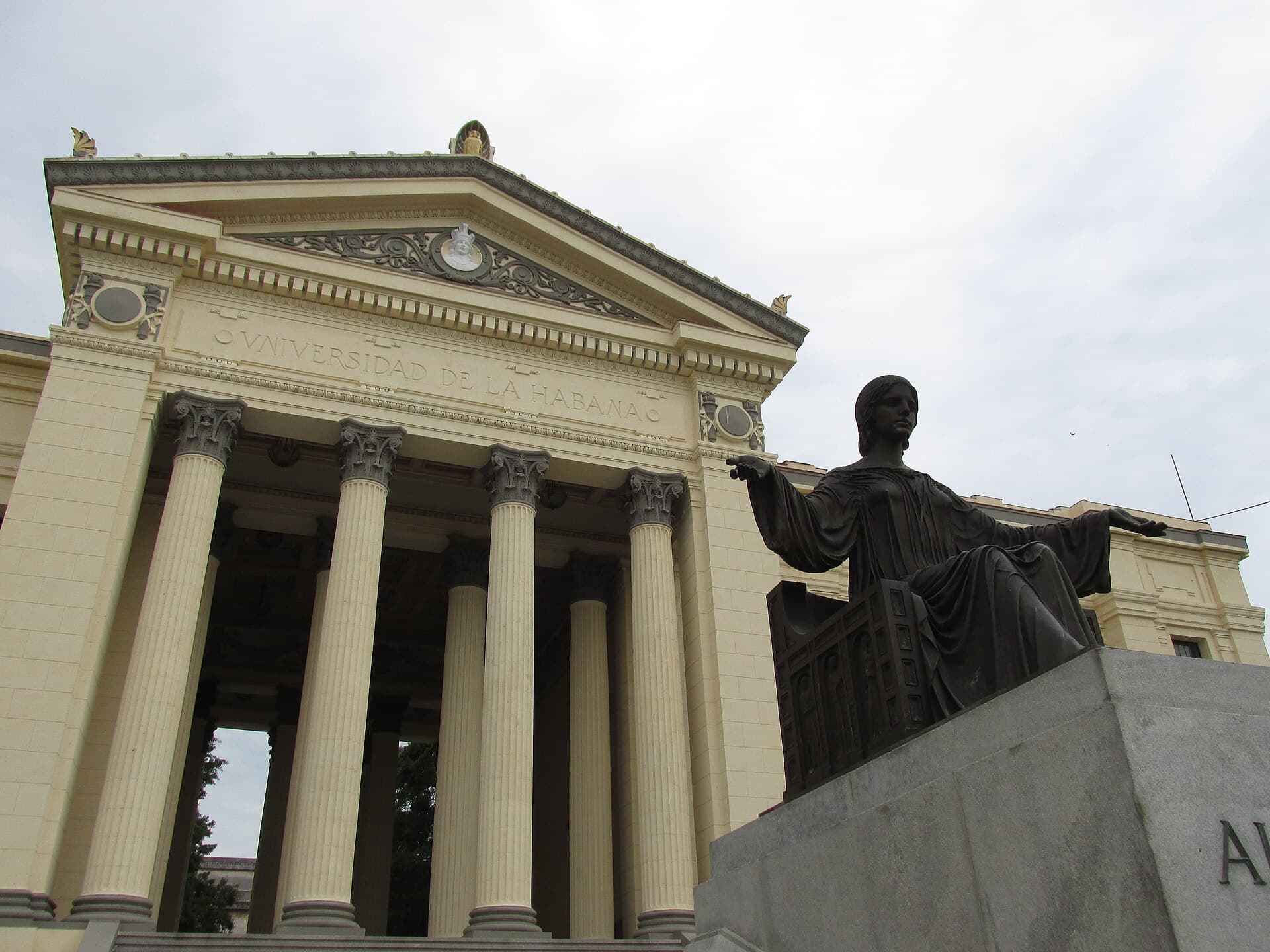
The University of Havana is the oldest university in Cuba and the one that sits highest in the international tables. Friars of the Order of Preachers founded it on 5 January 1728 in the Dominican convent of San Juan de Letrán in Old Havana, as the Real y Pontificia Universidad de San Gerónimo de La Habana, and it stayed there for the better part of two centuries. Since 1902 it has occupied a low rise in Vedado, the Loma de Aróstegui, where a broad flight of stone steps climbs from the street to a line of neoclassical porticoes.
Havana calls those steps la escalinata, and at the top of them sits the Alma Mater, a seated bronze woman with her arms held open toward the traffic below, a gesture the university has used on its seals for a century. The steps acquired a second use: from the 1920s onward they were where Cuban students gathered and were dispersed.
The founding followed a long quarrel between the Dominicans and the Jesuits over the right to confer degrees in Havana. Papal authorisation came from Innocent XIII in 1721, but the institution did not open for several more years, and the bishop of Cuba, Gerónimo Valdés, who favoured the Jesuits, stayed away from the 1728 ceremony. It began with six faculties: arts, philosophy, theology, canon law, civil law and medicine.
In 1842 it left the clerical framework of the old regime for the secular state system Spanish liberalism was then building, and became the Real y Literaria Universidad de La Habana. The Dominicans gave up the convent that October. In 1871 a decree stripped it of the power to confer doctorates, restored in September 1878.
Independence brought the move. Under the Plan Varona, drawn up by the philosopher Enrique José Varona during the second United States occupation, teaching was recast on secular and scientific lines, and between 1 and 7 May 1902 the university was carried from San Juan de Letrán to the grounds of a former military pyrotechnics works on the Loma de Aróstegui. The campus took shape around it over four decades.
The hill gave the architects an axis. The composition runs from the escalinata past the Alma Mater to the Rectorado, then on to the central square and the Aula Magna, begun in 1906 and inaugurated in 1911 to a neoclassical design by Emilio Heredia, with seven allegorical panels by Armando Menocal. The square is named for Ignacio Agramonte, the lawyer who qualified in 1865 and drove the Guáimaro constitution of 1869; around it stand the Rubén Martínez Villena library and the Montané anthropological museum. The central campus has been a National Monument since 1978.
The university is organised into sixteen faculties and three institutes covering economics, the natural sciences and mathematics, and the social sciences and humanities. Enrolment figures differ by source: around 15,900 students for 2025 in Spanish-language references, roughly 24,000 in English-language ones counting distance programmes.
For its first quarter-century in Vedado the university had no grand approach: photographs from the period show the porticoes standing on a bare, rutted slope with a service ramp cut into it. The staircase was built in 1927 as the principal entrance, unusually wide, rising in flights from the foot of Calle L to the terrace above. Most accounts count 88 steps; some date its completion to January 1928 rather than late 1927.
 The hill before the steps. Photograph from Diario de la Marina, public domain, via Wikimedia Commons.
The Alma Mater arrived by a longer route. The Czech-born sculptor Mario Korbel modelled the figure in 1919 after the seated Alma Mater that Daniel Chester French had made for Columbia University, taking the face from Feliciana Villalón, then sixteen, the daughter of a professor. Cast at Roman Bronze Works in New York, the bronze reached Havana at the end of 1920 and stood in more than one spot on the campus before it was set at the head of the new steps in 1927.
What the design produced, without setting out to, was a theatre. A wide stair gives a crowd somewhere to stand and a speaker somewhere to stand above them, with a street at the bottom to carry the crowd away or bring the police up. Cuban student politics took the room. The Federación Estudiantil Universitaria, the FEU, was founded on 20 December 1922, the nineteen-year-old law student Julio Antonio Mella among its founders; in January 1923 he led a campaign for university reform drawn from the movement that had begun at Córdoba in Argentina in 1918 and reached universities across the region, among them the National Autonomous University of Mexico.
The Directorio Estudiantil Universitario formed in 1927 against President Gerardo Machado's constitutional changes. On 30 September 1930 police broke up a student demonstration and the student Rafael Trejo died of his injuries, which made him a national figure. The university closed. Accounts of the reopening differ: some place it in 1933, after Machado fell, others put the resumption of ordinary teaching as late as 1937. After the sergeants' revolt of September 1933 the Directorio helped assemble a government headed by Ramón Grau San Martín, a physician who had taken his degree there in 1908 and taught physiology. The university gained its autonomy the same year.
The 1950s brought the steps their sharpest use. Fidel Castro enrolled in law in 1945, ran without success for the FEU presidency and took his doctorate in September 1950, in years when student gang violence was a fixture of the campus. José Antonio Echeverría entered the school of architecture in August 1950 and became FEU president in September 1954. A founder of the Directorio Revolucionario, he signed the Carta de México with Castro in Mexico City on 29 August 1956, committing the FEU and the 26th of July Movement to act together against the government of Fulgencio Batista. On 13 March 1957 he took part in attacks on the Presidential Palace and the Radio Reloj station, broadcast a statement of roughly three minutes, and was killed in an exchange of fire with a police patrol near the university, aged twenty-four. Batista had closed the university in November 1956; it reopened in 1959, and the steps have carried state and university ceremonies since.
Fernando Ortiz (1881-1969) began his law studies in Havana in 1895, finished the licenciatura at Barcelona in 1898 and a doctorate at Madrid in 1901, then returned for Havana doctorates in civil and public law in 1902; from 1909 he held a chair there. He spent the rest of his life documenting Afro-Cuban music, religion and language, and founded the Sociedad de Estudios Afrocubanos and its journal in 1937. His most durable contribution is a single word. In Contrapunteo cubano del tabaco y el azúcar (1940) he proposed transculturación in place of acculturation: when two inherited cultures meet, neither absorbs the other, something is lost on both sides, and a third thing is made that belongs to neither parent. Bronisław Malinowski wrote the introduction and adopted the term, standard in anthropology since.
Carlos Juan Finlay (1833-1915) had an awkward relationship with the institution: it would not recognise his European academic credits, so he took his medical degree at Jefferson Medical College in Philadelphia in 1855 and revalidated it in Havana in 1857. At the Fifth International Sanitary Conference in Washington in February 1881 he argued that yellow fever was carried by a mosquito, later naming Aedes aegypti as the vector. The claim was met with derision and sat unproven until the Reed Commission confirmed it in 1900. Finlay was chief health officer of Cuba from 1902 to 1909 and was nominated seven times for the Nobel Prize.
The same rooms produced the novelist José Lezama Lima, whose Paradiso appeared in 1966, along with Agramonte, Mella, Grau and Castro.
The university remains Cuba's oldest and its highest-placed, ranked first or second in the Caribbean by QS and in the low thirties across Latin America by Times Higher Education. Material conditions have been hard for years: economic difficulties, the emigration of graduates and the age of the buildings all press on it. Its 298th anniversary was marked with a formal ceremony on the hill in January 2026.
The escalinata rises from San Lázaro at the foot of Calle L, the approach worth taking on foot. Climbing it brings the Alma Mater to eye level at the top of the flights, with the Rectorado behind her; the stone is polished and steep, so the streets winding up the far side of the hill are the gentler route. The Montané anthropological museum and the Felipe Poey natural history collection, both inside the main quadrangle, keep short weekday hours that shift with the academic calendar, so confirm them on the day. Guided visits are arranged through the university's own offices rather than at the gate, and the steps are quietest in the early morning, when the light on the portico is best.
The hill before the steps. Photograph from Diario de la Marina, public domain, via Wikimedia Commons.
The Alma Mater arrived by a longer route. The Czech-born sculptor Mario Korbel modelled the figure in 1919 after the seated Alma Mater that Daniel Chester French had made for Columbia University, taking the face from Feliciana Villalón, then sixteen, the daughter of a professor. Cast at Roman Bronze Works in New York, the bronze reached Havana at the end of 1920 and stood in more than one spot on the campus before it was set at the head of the new steps in 1927.
What the design produced, without setting out to, was a theatre. A wide stair gives a crowd somewhere to stand and a speaker somewhere to stand above them, with a street at the bottom to carry the crowd away or bring the police up. Cuban student politics took the room. The Federación Estudiantil Universitaria, the FEU, was founded on 20 December 1922, the nineteen-year-old law student Julio Antonio Mella among its founders; in January 1923 he led a campaign for university reform drawn from the movement that had begun at Córdoba in Argentina in 1918 and reached universities across the region, among them the National Autonomous University of Mexico.
The Directorio Estudiantil Universitario formed in 1927 against President Gerardo Machado's constitutional changes. On 30 September 1930 police broke up a student demonstration and the student Rafael Trejo died of his injuries, which made him a national figure. The university closed. Accounts of the reopening differ: some place it in 1933, after Machado fell, others put the resumption of ordinary teaching as late as 1937. After the sergeants' revolt of September 1933 the Directorio helped assemble a government headed by Ramón Grau San Martín, a physician who had taken his degree there in 1908 and taught physiology. The university gained its autonomy the same year.
The 1950s brought the steps their sharpest use. Fidel Castro enrolled in law in 1945, ran without success for the FEU presidency and took his doctorate in September 1950, in years when student gang violence was a fixture of the campus. José Antonio Echeverría entered the school of architecture in August 1950 and became FEU president in September 1954. A founder of the Directorio Revolucionario, he signed the Carta de México with Castro in Mexico City on 29 August 1956, committing the FEU and the 26th of July Movement to act together against the government of Fulgencio Batista. On 13 March 1957 he took part in attacks on the Presidential Palace and the Radio Reloj station, broadcast a statement of roughly three minutes, and was killed in an exchange of fire with a police patrol near the university, aged twenty-four. Batista had closed the university in November 1956; it reopened in 1959, and the steps have carried state and university ceremonies since.
Fernando Ortiz (1881-1969) began his law studies in Havana in 1895, finished the licenciatura at Barcelona in 1898 and a doctorate at Madrid in 1901, then returned for Havana doctorates in civil and public law in 1902; from 1909 he held a chair there. He spent the rest of his life documenting Afro-Cuban music, religion and language, and founded the Sociedad de Estudios Afrocubanos and its journal in 1937. His most durable contribution is a single word. In Contrapunteo cubano del tabaco y el azúcar (1940) he proposed transculturación in place of acculturation: when two inherited cultures meet, neither absorbs the other, something is lost on both sides, and a third thing is made that belongs to neither parent. Bronisław Malinowski wrote the introduction and adopted the term, standard in anthropology since.
Carlos Juan Finlay (1833-1915) had an awkward relationship with the institution: it would not recognise his European academic credits, so he took his medical degree at Jefferson Medical College in Philadelphia in 1855 and revalidated it in Havana in 1857. At the Fifth International Sanitary Conference in Washington in February 1881 he argued that yellow fever was carried by a mosquito, later naming Aedes aegypti as the vector. The claim was met with derision and sat unproven until the Reed Commission confirmed it in 1900. Finlay was chief health officer of Cuba from 1902 to 1909 and was nominated seven times for the Nobel Prize.
The same rooms produced the novelist José Lezama Lima, whose Paradiso appeared in 1966, along with Agramonte, Mella, Grau and Castro.
The university remains Cuba's oldest and its highest-placed, ranked first or second in the Caribbean by QS and in the low thirties across Latin America by Times Higher Education. Material conditions have been hard for years: economic difficulties, the emigration of graduates and the age of the buildings all press on it. Its 298th anniversary was marked with a formal ceremony on the hill in January 2026.
The escalinata rises from San Lázaro at the foot of Calle L, the approach worth taking on foot. Climbing it brings the Alma Mater to eye level at the top of the flights, with the Rectorado behind her; the stone is polished and steep, so the streets winding up the far side of the hill are the gentler route. The Montané anthropological museum and the Felipe Poey natural history collection, both inside the main quadrangle, keep short weekday hours that shift with the academic calendar, so confirm them on the day. Guided visits are arranged through the university's own offices rather than at the gate, and the steps are quietest in the early morning, when the light on the portico is best.
History
Campus and academics
The escalinata