Heritage · University
Delft University of Technology: History and Overview
Founded in 1842 by King William II as a royal academy for civil engineers, Delft University of Technology grew into the Netherlands' oldest and largest technical university. Its engineers designed the Delta Works that guard the country against the sea, and in its laboratories Martinus Beijerinck named the virus in 1898.Written to last.
By Confinity Heritage Editorial · 2026-08-24 · 8-minute readQuiet tools, kept out of the way.
Delft University of Technology, known everywhere as TU Delft, is the oldest and largest technical university in the Netherlands. It sits on the southern edge of Delft, a canal town between Rotterdam and The Hague, where a campus of laboratories, wind tunnels and student workshops runs alongside the old city that raised Vermeer and van Leeuwenhoek. Around 27,000 students study there across eight faculties, from aerospace and applied physics to architecture and industrial design.
An institution can hold a nation's memory in manuscripts, or it can hold it in working knowledge. Delft holds the second kind. Much of the country it serves lies below sea level, and for nearly two centuries the university has trained the engineers who keep it dry, then kept their methods, models and hard lessons for the generation that follows. The dikes, barriers and pumping schemes of the Dutch coast are, in a real sense, the university's collected works.
King William II signed the founding decree on 8 January 1842, establishing a Royal Academy in Delft to educate civil engineers for a country whose survival depended on them, along with technologists for industry and trade. The academy carried a second assignment from the start: it trained civil servants for the Dutch East Indies, the colonial administration in what is now Indonesia, and that duty shaped its early curriculum as much as the engineering did. The choice of Delft was practical. The town lay close to the seat of government, and it had room for an academy to grow.
The Royal Academy was dissolved in 1864 and replaced by the Polytechnic School, a leaner institution focused on engineering itself. In 1905 an act of parliament raised the school to a Technische Hoogeschool, an institute of technology with full university rank and the right to confer doctoral degrees. Student numbers climbed through the twentieth century, and after the Second World War the institution outgrew its buildings in the old town and moved south into a purpose-built campus district, where it remains. In 1986 it took its present name, Technische Universiteit Delft, acknowledging in law what had long been true in practice.
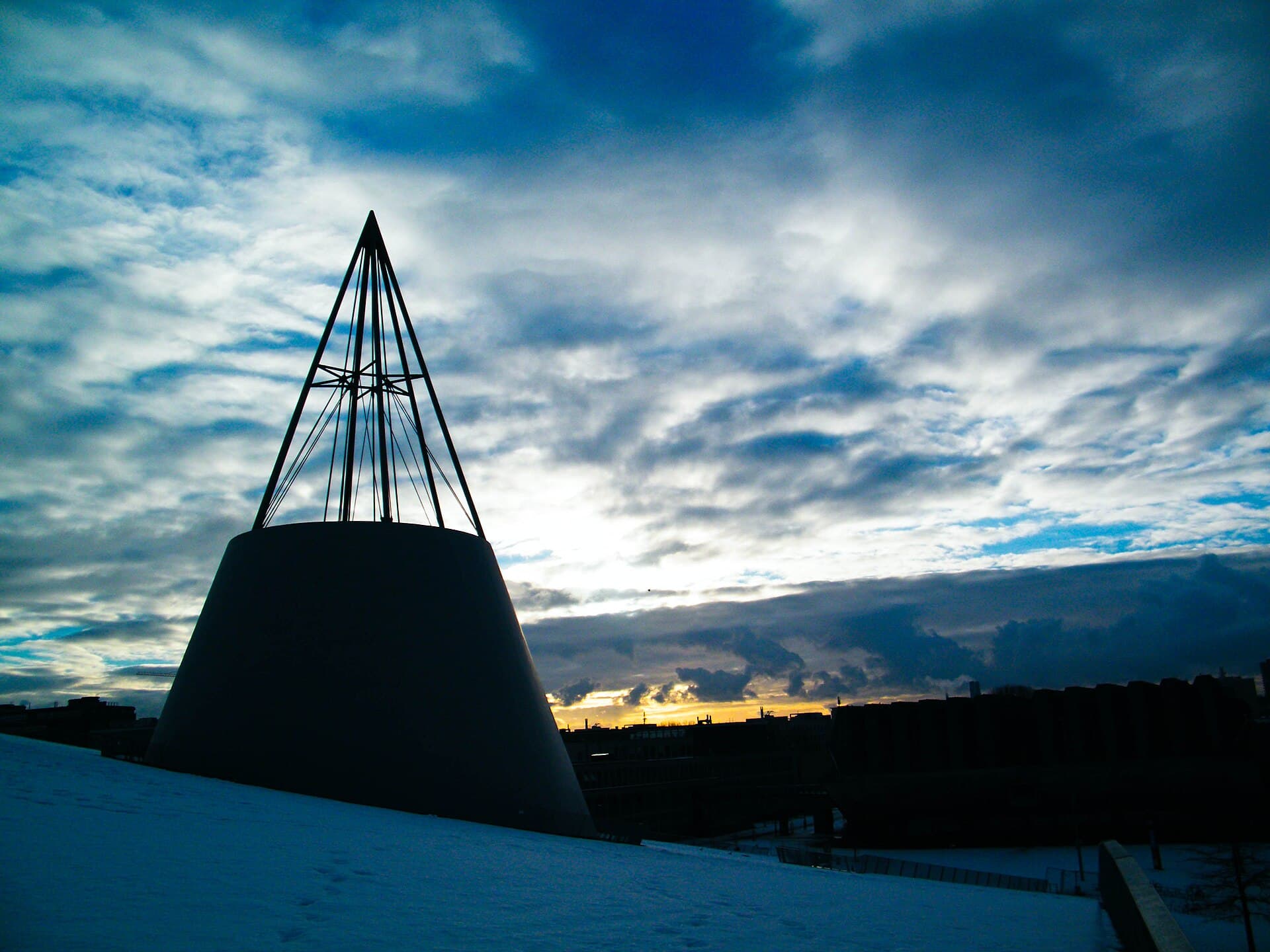
The campus announces its character with its library. Opened in 1997 to a design by the Delft firm Mecanoo, the TU Delft Library is a building you can walk on: its roof is a tilted plane of grass that rises from the lawn, and students climb it in fine weather to read or to sit. A steel cone punches through the turf and drops light into the reading rooms below, giving the campus its most photographed silhouette. Next to it stands the Aula, the university's congress centre, finished in 1966 by the architects Van den Broek and Bakema. It is a massive, cantilevered work of raw concrete, blunt where the library is soft, and every Delft engineer crosses its stage at graduation.
Around these two buildings the campus stretches for kilometres along the Mekelweg and its cycle paths, housing the eight faculties, the aerospace halls with their flight simulators, a high-voltage laboratory, towing tanks for ship hydrodynamics and the workshops where the student engineering teams build. Teaching runs from bachelor programmes taught largely in Dutch to master and doctoral programmes taught in English that draw students from across the world, and the university consistently places among the leading schools of engineering and technology in Europe.
Two stories carry the essence of the place. The first is small enough to be invisible. In 1898 Martinus Beijerinck, professor of microbiology at the Polytechnic School, was studying a disease that mottled tobacco leaves. He passed the sap of infected plants through filters fine enough to trap any bacterium, and the filtered liquid still spread the disease. Beijerinck concluded that the agent was something new to science, a contagious living fluid as he called it, and he gave it the name virus. The word, in its modern biological sense, was coined in Delft. From his laboratory grew the Delft School of Microbiology, continued by Albert Kluyver, whose comparative approach to the chemistry of microbes shaped the field for decades.
The second story is as large as the coastline. On the night of 31 January 1953 a storm surge broke the dikes of the southwestern delta and drowned more than 1,800 people. The national answer was the Delta Works, a decades-long programme of dams and storm surge barriers that closed the sea arms of Zeeland and South Holland, culminating in the Oosterscheldekering, a barrier with movable gates that lets the tide through until a storm comes, and the Maeslantkering, whose two floating arms can seal the entrance to the port of Rotterdam. Delft-trained engineers designed, modelled and built this system, working with Rijkswaterstaat, the national water authority, and with the hydraulic laboratories that became the Delft-based institute Deltares. The same lineage made Dutch dredging and land reclamation an export: when a country anywhere in the world needs a harbour deepened, a coast defended or land raised from the sea, the firms it hires are staffed from Delft. The university is the keeper of that knowledge, the archive of how a low country endures.
Delft's scientific record begins early. Jacobus van 't Hoff finished the technology programme at the Polytechnic School in 1871, completing three years of study in two, before going on to found physical chemistry and receive the first Nobel Prize in Chemistry in 1901. Jan Burgers was appointed professor of aerodynamics and hydrodynamics in 1918 at the age of 23 and built Delft into a centre of fluid mechanics; the Burgers equation in turbulence theory and the Burgers vector in crystal dislocations both carry his name.
The modern university holds that standard in new fields. QuTech, founded in 2014 with the research organisation TNO, is one of the world's principal centres for quantum computing and the quantum internet, and Microsoft chose the Delft campus for a quantum laboratory of its own. In 2022 QuTech researchers demonstrated teleportation of quantum information across a three-node network, a step toward linking quantum processors as the early internet linked computers. The student teams are a scholarship of their own kind: the Delft solar car Nuna won the World Solar Challenge across Australia seven times between 2001 and 2017, the Delft Hyperloop team won the first SpaceX Hyperloop competition in 2017, and the human powered vehicle team built with Amsterdam students has set world speed records on a bicycle.
TU Delft anchors the 4TU federation of Dutch technical universities and works closely with its neighbours: with Leiden University and Erasmus University Rotterdam it forms a standing alliance that shares teaching and research across the three cities, Leiden's science faculties a short train ride up the line. Its graduates run engineering firms, water boards and space programmes, and its researchers advise on delta management from the Mississippi to the Mekong, because the questions the Netherlands answered first are now everyone's questions.
Student life keeps its own traditions. Each August the OWee, the introduction week, fills the town with thousands of new students rowing the canals and crossing the campus by bicycle, the vehicle that defines Delft as thoroughly as the laboratories do. The rowing clubs Laga and Proteus-Eretes train on the Schie, and the student associations occupy some of the finest old buildings in the city centre, so that university life spills continuously between the historic town and the modern campus.
The campus is open ground, and the library's grass roof is the natural first stop; visitors can walk the slope and see the cone-lit reading hall inside. The Aula stands beside it, and the Science Centre Delft on the campus edge shows current research, including the student teams' cars and rockets, to the public. The old town is fifteen minutes away on foot or a few minutes by bicycle, with the Markt, the Oude and Nieuwe Kerk and the Vermeer sites close together, so a visit to the university folds naturally into a day in Delft. Trains from Rotterdam and The Hague reach Delft in around ten minutes, and the campus lies south of the station along a signed cycle route.