Heritage · University
Johns Hopkins University: History and Overview
Founded in 1876 from the largest philanthropic bequest America had then seen, Johns Hopkins University brought the German research university to the United States and reshaped its higher education. Its medical school, hospital and public health school set the pattern for modern medicine, and its Applied Physics Laboratory has flown spacecraft to Pluto and beyond.Written to last.
By Confinity Heritage Editorial · 2026-08-24 · 8-minute readQuiet tools, kept out of the way.
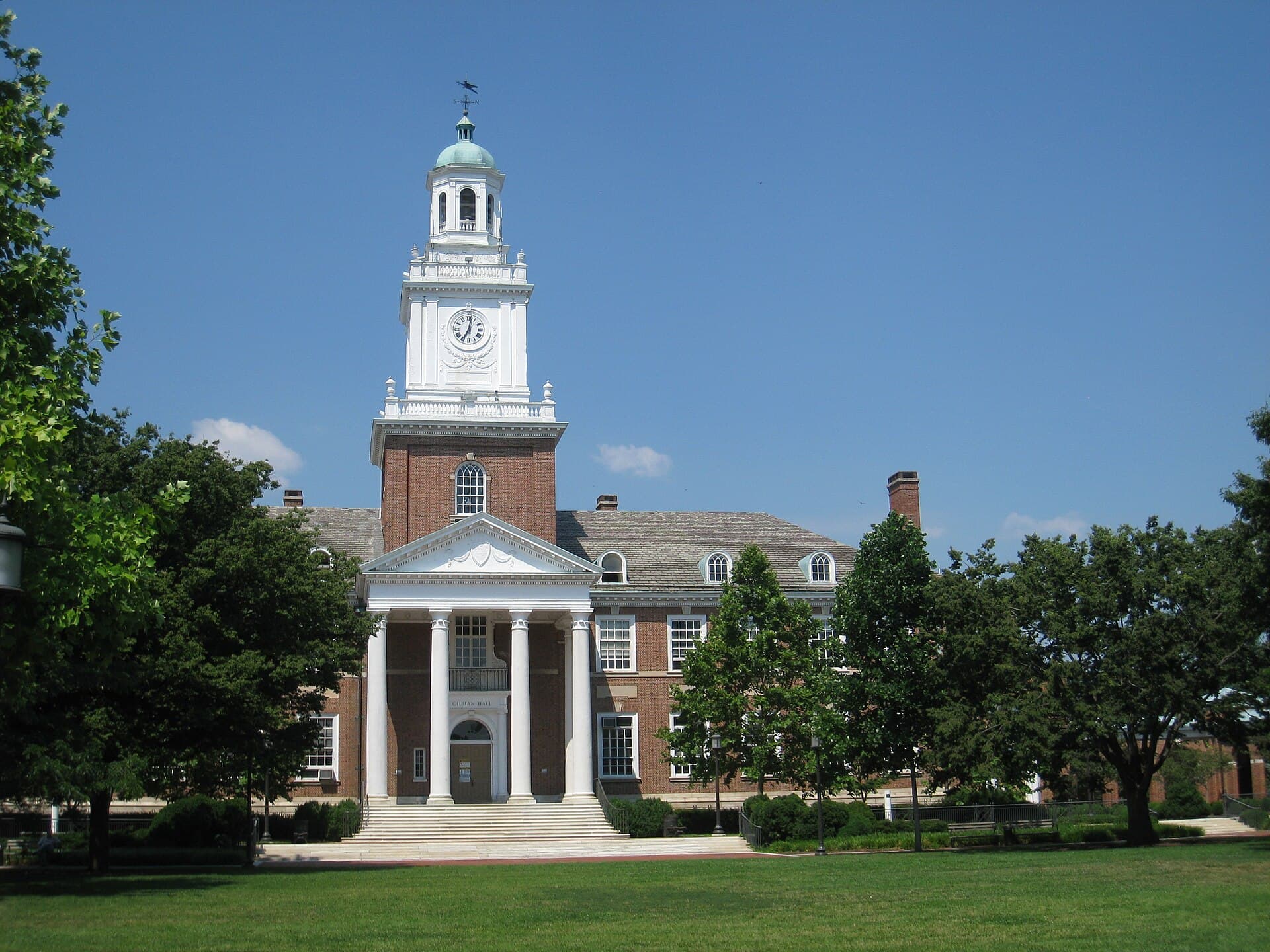
Johns Hopkins University in Baltimore, Maryland, is where the United States acquired the research university. When it opened in 1876 there were older American colleges by the score, but none built around the idea that a university exists to create knowledge as well as to pass it on. Hopkins was founded on that idea, imported from Germany, and within a generation the older institutions had remade themselves in its image. The claim usually attached to the place, America's first research university, is carried plainly because it is true.
The university's memory-keeping has been unusually public. Its press, founded in 1878, is the country's oldest university press in continuous operation. Its hospital wards produced the model by which physicians are still trained. And in 2020 its coronavirus dashboard became the ledger the whole world refreshed, the pandemic's running count kept by a university.
Johns Hopkins was a Baltimore merchant and banker who made his fortune in wholesale trade and in the Baltimore and Ohio Railroad. A Quaker bachelor with no direct heirs, he died on Christmas Eve 1873 leaving $7 million to found a university and a hospital bearing his name, at that time the largest philanthropic bequest in American history. He was long remembered as the son of abolitionist Quakers, though university researchers reported in 2020 that census records list enslaved people in his household, and Hopkins has since studied its founder's record openly.
The trustees' decisive act was choosing Daniel Coit Gilman as first president. Gilman had led the University of California and studied the universities of Europe closely, and he persuaded the board to attempt something with no American precedent: an institution on the model of the German research university, the pattern set at the Humboldt University of Berlin, where professors pursued original investigation, students learned in seminars and laboratories rather than by recitation, and the doctorate was the degree that mattered. At his inauguration on 22 February 1876 Gilman described a university for "the encouragement of research". He recruited a faculty of working investigators rather than famous names, opened with more graduate students than undergraduates, and founded scholarly journals to carry the new work outward. Within decades Harvard, Columbia, Chicago and the great state universities had adopted the graduate school, the seminar and the research doctorate, and American higher education had changed shape.
The hospital opened in 1889, delayed while the endowment recovered from a slump in railroad stock. The medical school meant to accompany it remained unfunded until a group of women organised one of the great bargains in the history of education. The Women's Medical School Fund, led by the Baltimore heiress Mary Elizabeth Garrett, raised the missing money, Garrett supplying most of the final sum herself, on two conditions the trustees could not refuse: that women be admitted on the same terms as men, and that entrance require a bachelor's degree with training in science and languages, a standard no American medical school then demanded. The school opened in 1893 with women in its first class and admission requirements so high that faculty joked they were lucky to get in as professors. Both conditions became the American norm.
The university spent its first decades in plain buildings in downtown Baltimore before moving, in the 1910s, to Homewood, a wooded estate in the north of the city that had belonged to the family of Charles Carroll, a signer of the Declaration of Independence. The campus was laid out in red brick Georgian around the Federal-period Homewood House, and its centrepiece is Gilman Hall, completed in 1915 and named for the first president, its clock tower still the university's emblem. The medical campus grew separately in East Baltimore around the domed hospital, and the Peabody Institute in Mount Vernon, a conservatory founded in 1857 that joined the university in 1977, forms a third pole of campus life.
Hopkins medicine was defined by four physicians recruited for the hospital's opening, remembered as the Big Four: William Osler in medicine, William Halsted in surgery, William Welch in pathology and Howard Kelly in gynecology. Osler brought students out of the lecture hall and onto the wards; Halsted introduced rubber gloves to surgery. Between them they created the residency system, the apprenticeship of graded hospital responsibility by which physicians have been trained ever since. Welch went on to found the School of Hygiene and Public Health in 1916, the first independent degree-granting school of public health in the world, renamed the Bloomberg School in 2001 for the alumnus Michael Bloomberg.
Today the university teaches more than thirty thousand students across nine divisions, from arts and sciences and engineering to nursing, education, business and international studies, and it has led all American universities in research spending for decades. With its health system it is the largest private employer in Maryland, an anchor institution whose fortunes are bound up with Baltimore's own.
Two Hopkins institutions make the university a keeper of public record. The first is the Johns Hopkins University Press, founded by Gilman in 1878 on the principle that a university's duty is to diffuse knowledge "far and wide". It has published continuously ever since, the oldest American university press still running, its early journals carrying the new research model to readers who would never see Baltimore.
The second is recent. In January 2020 the engineering professor Lauren Gardner and her graduate student built a map to track a novel coronavirus then confined mostly to Wuhan. It grew into the Coronavirus Resource Center, a dashboard of global cases, deaths and later vaccinations, updated around the clock when no comparable public count existed. Governments, newspapers and ordinary households refreshed it daily; its pages were viewed billions of times before the university closed the count in March 2023. For three years the pandemic's ledger was kept not by a state but by a school, a modern instance of a university acting as a memory institution.
The record-keeping has also meant reckoning. In 1951 Henrietta Lacks, a Black woman from Baltimore County, was treated for cervical cancer at Johns Hopkins Hospital, and cells taken from her tumour without her knowledge or consent became HeLa, the first immortal human cell line and one of the most important tools in modern biology, used in the polio vaccine, cancer research and virology. Consent for such use was not sought from any patient in that era, and Hopkins states it never sold or profited from the cells, but her family lived for decades with the knowledge that science had taken something of hers without asking. In 2013 the National Institutes of Health agreed to give the family a voice in access to the HeLa genome, and the university has since honoured her by name, including a research building on the East Baltimore campus.
Twenty-nine Nobel laureates have been affiliated with the university, beginning with Woodrow Wilson, who took his doctorate at Hopkins in 1886 and remains the only American president to hold a PhD. The philosopher John Dewey earned his doctorate there in 1884; the writer Gertrude Stein studied medicine at the school Garrett's committee opened to her; Rachel Carson took her master's degree in zoology in 1932. The medical laureates include Peter Agre, who found the water channels of the cell, and Carol Greider, recognised for the discovery of telomerase.
The university's reach extends off the planet. Its Applied Physics Laboratory, founded in 1942 and now the nation's largest university-affiliated research centre, built and operated New Horizons, the spacecraft that flew past Pluto in 2015 and returned the first close images of that world. APL flew DART, which in 2022 struck the asteroid moonlet Dimorphos and changed its orbit, the first deliberate test of deflecting a body in space, and it built and operates the Parker Solar Probe, the fastest spacecraft ever flown and the first to pass through the sun's outer atmosphere.
Hopkins remains what Gilman made it, a university weighted toward research and graduate training, though its undergraduate college at Homewood is now among the most selective in the country. The university places in the top ranks of international league tables, and its hospital was for decades the perennial leader of American hospital rankings. Bloomberg's 2018 gift of $1.8 billion, then the largest ever made to an American university, keeps undergraduate admissions permanently need-blind, so that no student is turned away for inability to pay.
The Homewood campus sits in north Baltimore beside Charles Village, and its lawns, quadrangles and Gilman Hall clock tower are open to walk without charge. Homewood Museum, the Carroll family house at the campus heart, and Evergreen Museum and Library, a Gilded Age mansion nearby, welcome ticketed visitors. In Mount Vernon the George Peabody Library, a cast-iron atrium of six tiers of books often counted among the most beautiful library interiors anywhere, is free to enter, and the Peabody Institute posts a calendar of student concerts. The medical campus in East Baltimore is a working hospital district; its domed Billings building can be seen from the street.
History
Campus and academics
Keeping public ledgers
Scholarship
The university today
Visiting
References and resources
- Johns Hopkins University: History (official)
- Johns Hopkins Medicine: About and history (official)
- Johns Hopkins Medicine: Henrietta Lacks (official)
- Johns Hopkins University Press: About (official)
- Johns Hopkins Coronavirus Resource Center
- Johns Hopkins Applied Physics Laboratory
- Britannica: Johns Hopkins University
- Wikipedia: Johns Hopkins University