Heritage · University
Moscow State University: History and Overview
Founded by a decree of Empress Elizabeth in 1755, on a proposal from Mikhail Lomonosov and Ivan Shuvalov, Moscow State University is Russia's oldest. Its Main Building on the Sparrow Hills, opened in 1953, was the tallest building in Europe for 37 years, and the day the founding decree was signed is now Russia's national students' day.Written to last.
By Confinity Heritage Editorial · 2026-08-25 · 8-minute readQuiet tools, kept out of the way.
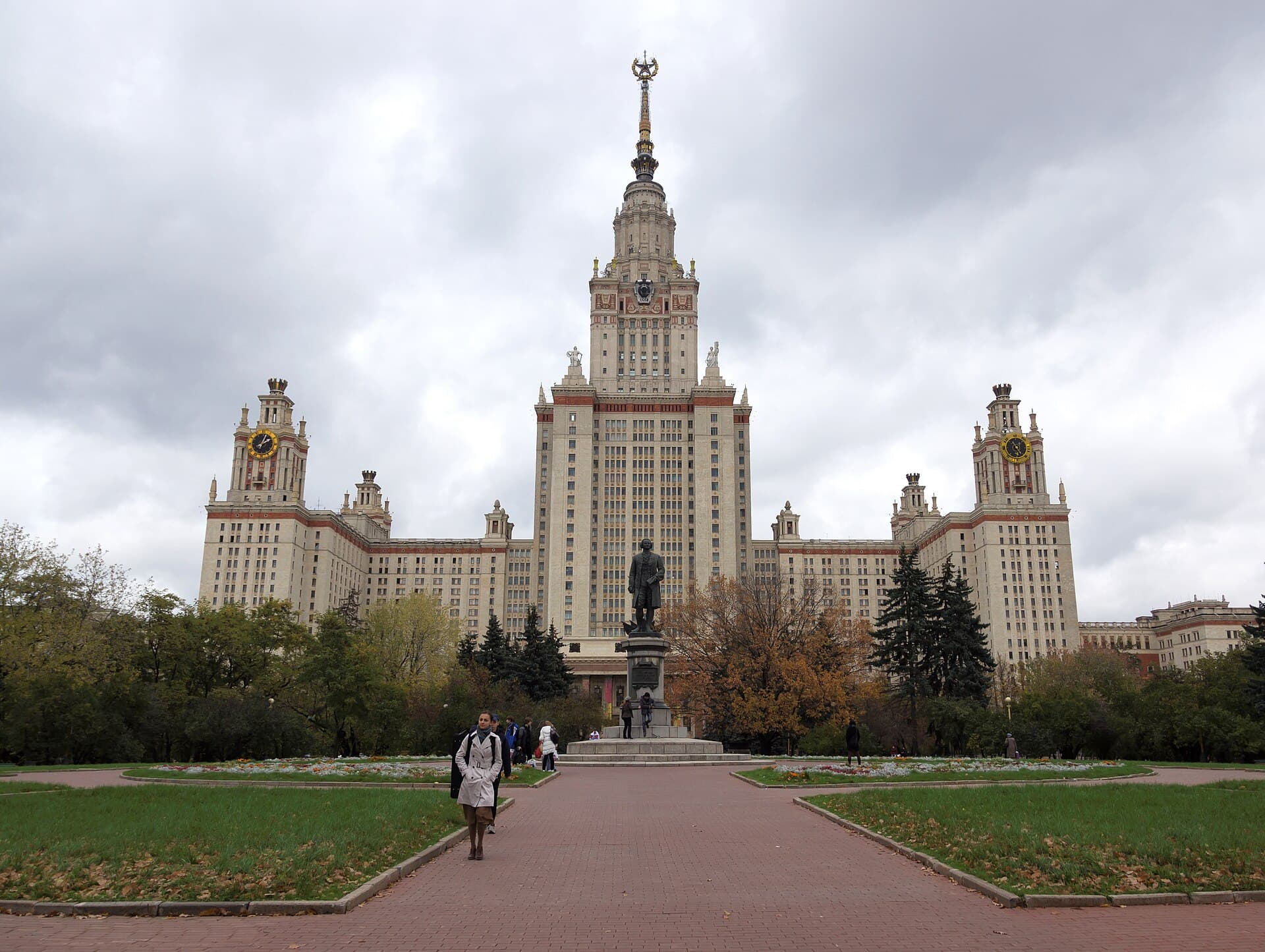
Moscow State University is the oldest university in Russia, founded by a decree that Empress Elizabeth signed on 12 January 1755 by the Julian calendar then used in the empire, 23 January by the Gregorian calendar. The proposal came from Mikhail Lomonosov, a fisherman's son from the White Sea coast who had become the first Russian member of the Imperial Academy of Sciences, and from Ivan Shuvalov, the empress's favourite and Russia's first minister of education. Saint Petersburg State University contests the title, tracing itself to an academy decreed by Peter the Great in 1724, though it has run as a university only since 1819.
The institution that grew from Elizabeth's decree now lives inside the more famous of the two facts about it. The Main Building on the Sparrow Hills, opened in 1953, is the largest of the seven towers Stalin ordered raised around Moscow after the war, and it held the record for the tallest building in Europe for 37 years. Several thousand Gulag prisoners worked on it, some quartered near the end on the twenty-fourth and twenty-fifth floors of the tower they were putting up. The university inside is at once the country's oldest place of learning, the working home of Lomonosov's successors, and a monument to the state that built it.
Lomonosov's plan gave the new university three faculties: philosophy, law and medicine. Every student began in philosophy, and unusually for a European foundation of the period there was no faculty of theology, because the Orthodox Church already ran its own schools for clergy. Professors lectured in Latin and also in Russian. The first classes were held in the spring of 1755 in the Principal Medicine Store on Red Square, which the university kept until 1787, when Catherine the Great moved it across Mokhovaya Street into a purpose-built home by Matvei Kazakov. Napoleon's invasion undid that work: the buildings and collections burned in the fire of 1812, and the restoration, by Domenico Giliardi, was finished in 1819.
The nineteenth century ran between autonomy granted and autonomy withdrawn. A statute of 1804 created an elected university council, one of 1835 stripped most of it away, and the charter of 1863 was the most liberal of the three, with about 1,500 students then enrolled across four faculties. In 1911, protesting at troops on the campus and the dismissal of professors, more than 130 of the teaching staff resigned together and thousands of students were expelled.
After the revolution of 1917 the university abolished tuition fees and opened a preparatory faculty for the children of workers and peasants; medical teaching was separated off in 1930. In 1940, at its 185th anniversary, the institution was renamed for Lomonosov. The first group of students and staff left for the front on 25 June 1941 and, by the university's own count, about 3,000 never returned; a memorial and an eternal flame were set beside the first teaching building in 1975. Constraint came with expansion: from 1970 the university operated a quota limiting the admission of Jewish students, and the practices of its mathematics department in the two decades that followed have been documented at length since.
The date of the founding decree acquired a second life. The twelfth of January was the feast of Saint Tatiana, and also the name day of Shuvalov's mother, so the university's birthday and the saint's day fell together. A Church of Saint Tatiana was built on the campus in 1791, the Orthodox Church named her the patron saint of students, and the celebration spread to every university town in the empire. The church still keeps the Julian calendar, on which 12 January now falls on 25 January, and that is the date Russia keeps as its students' day. One institution's founding anniversary became a country's holiday.
Since 1953 most of the faculties have stood on the Sparrow Hills in the south-west of the city, a wooded escarpment about 80 metres above the Moskva River that was called the Lenin Hills from 1935 until the older name was restored in 1999. The university puts the campus at 1.2 million square metres and describes it as a city inside the city. A student can pass a whole term without leaving it.
The Main Building holds the administration, the Museum of Earth Sciences and the faculties of mechanics and mathematics, geology, geography, and fine and performing arts. The older premises on Mokhovaya Street still house journalism, psychology and the Institute of Asian and African Countries. The university counts 41 faculties and 40 research institutes, together with a scientific library, four museums and a botanical garden.
Stalin's decree of January 1947 ordered a ring of tall buildings around Moscow, eight planned and seven completed by 1953. The tower on the Sparrow Hills was the first commission of the set. Boris Iofan, the leading architect of the era, bid for it and lost it, because his draft placed the building on the very edge of the escarpment, where the ground was liable to slip. The job went instead to Lev Rudnev, who set the tower some 800 metres back from the drop and took a Stalin Prize for the design in 1949.
The finished building rises 240 metres to the tip of its spire, with the roof at 182 metres, a spire of 58 metres above that, and a five-pointed star weighing twelve tons at the top. The central block runs to 36 storeys. Its frame consumed more than 40,000 tons of steel and 130,000 cubic metres of concrete. It opened on 1 September 1953, stayed the tallest building in Europe for 37 years until the Messeturm went up in Frankfurt in 1990, and is still the tallest educational building anywhere. Vera Mukhina's sculpture of a student couple stands on the facade; in the square before the entrance is Nikolai Tomsky's bronze of Lomonosov.
Several thousand Gulag prisoners worked on the site, and as the building neared completion some were quartered on the twenty-fourth and twenty-fifth floors, which cut the cost of transporting them and the number of guards required. Others were prisoners whose sentences had been commuted on condition that they serve out the remainder working in Moscow; the historian Katherine Zubovich traces individual cases through the archives in Moscow Monumental, which also counts the tens of thousands of ordinary residents evicted and rehoused from the plots chosen for the towers.
Lomonosov set the standard the university has measured itself against ever since. Born in 1711 near the White Sea to a prosperous peasant fisherman, he reached Moscow at nineteen and went on to study at Marburg under Christian Wolff. He formulated a law of the conservation of mass, deduced from the transit of Venus in 1761 that the planet carries an atmosphere, and reshaped the Russian literary language through his work on grammar and versification. He died in 1765, ten years after the decree he had proposed.
By the university's own count, eleven of Russia's Nobel laureates were either its graduates or its professors. The graduates include Igor Tamm, who took his degree in 1918 and shared the 1958 physics prize; Boris Pasternak, who left in 1913 and won the 1958 prize in literature; Andrei Sakharov, who graduated in physics in 1942, worked on Soviet thermonuclear weapons and received the Peace Prize in 1975 as the country's best-known dissident; Vitaly Ginzburg and Alexei Abrikosov, who shared the 2003 physics prize; and Mikhail Gorbachev, who graduated in law in 1955. The professors include Pyotr Kapitsa, Lev Landau, Ilya Frank and Alexander Prokhorov in physics, and Nikolay Semyonov in chemistry.
Mechanics and mathematics, shortened everywhere to Mekhmat, has been the university's strongest suit. Andrey Kolmogorov entered as a student in 1920, became a professor in 1931 and in 1935 took the first chair of the department of probability theory. His Foundations of the Theory of Probability of 1933 gave the subject the axiomatic basis it still rests on, and his papers from 1941 onward set the terms for the study of turbulence. Five of the faculty's mathematicians have taken the Fields Medal, among them Sergei Novikov, who graduated in 1960 and won in 1970. The medical faculty, before it was hived off, qualified Anton Chekhov as a physician in 1884; he went on practising, largely without payment, for the rest of his life.
Two other universities in this archive show the same imperial century from the other side. Vilnius University was the great school of the Polish-Lithuanian Commonwealth before the partitions brought it under Russian rule, and Nicholas I closed it in 1832 as punishment for its part in the November Uprising, leaving the city without a university for 87 years. The University of Tartu was refounded by Alexander I in 1802 as the Imperial University of Dorpat and spent the century as a German-speaking scientific centre inside the same empire. Moscow was the metropolitan university of that system; Vilnius and Tartu were what the system did at its edges.
A 2024 survey of Russia's largest universities counted 39,282 students at Moscow State. It sits between 101st and 150th in the Academic Ranking of World Universities for 2024 and 105th in the QS rankings for 2026, the highest placing of any Russian institution. Viktor Sadovnichy, a mathematician, has been rector since 1992 and president of the Russian Union of Rectors since 1994.
In March 2022 Sadovnichy was the lead signature on a statement by the Russian Union of Rectors endorsing the invasion of Ukraine. Foreign partners ended or suspended their arrangements in response, among them Yale University, the University of Potsdam, the Hamburg University of Applied Sciences and the business school of the University of Hong Kong, while the University of St Andrews suspended a joint master's programme. Academia Europaea suspended Sadovnichy's membership, and the university's place in two international academic networks was cancelled or suspended the same year.
The Main Building is not open to the general public. Visitors from outside the university must be approved in advance by a host inside it and present a passport at the door, so most people see the tower from the outside. The outside is in any case the point: the forecourt, with Tomsky's Lomonosov turned towards the entrance, gives the view the building was designed to produce, and that ground is open.
A few minutes north, the Sparrow Hills observation platform stands 85 metres above the Moskva River and looks back across the whole city. The older buildings on Mokhovaya Street, near Manezhnaya Square, are a short metro ride into the centre and are where the imperial institution can still be seen rather than the Soviet one. The liveliest date in the university's year is 25 January, Tatiana's Day. Entry requirements for Russia have changed considerably since 2022 and need checking well in advance.
History
Campus and academics
Eight hundred metres back from the cliff
Scholarship
The university today
Visiting
References and resources
- Moscow State University: History and Traditions (official)
- Wikipedia: Moscow State University
- Wikipedia: Main building of Moscow State University
- Wikipedia: Seven Sisters (Moscow)
- Wikipedia: Imperial Moscow University
- Wikipedia: Tatiana Day
- Wikipedia: List of Moscow State University people
- Wikipedia: Sparrow Hills
- Wikipedia: Mikhail Lomonosov
- Wikipedia: Andrey Kolmogorov
- Princeton University Press: Katherine Zubovich, Moscow Monumental