Heritage · University
University of Tehran: History and Overview
Founded in 1934, the University of Tehran is Iran's oldest modern university, heir to the Dar ul-Funun polytechnic of 1851. Its main gate, designed in 1965 by a student of its own fine arts faculty, has become the emblem of Iranian higher education, and its Dehkhoda Institute keeps the largest dictionary of the Persian language.Written to last.
By Confinity Heritage Editorial · 2026-08-25 · 8-minute readQuiet tools, kept out of the way.
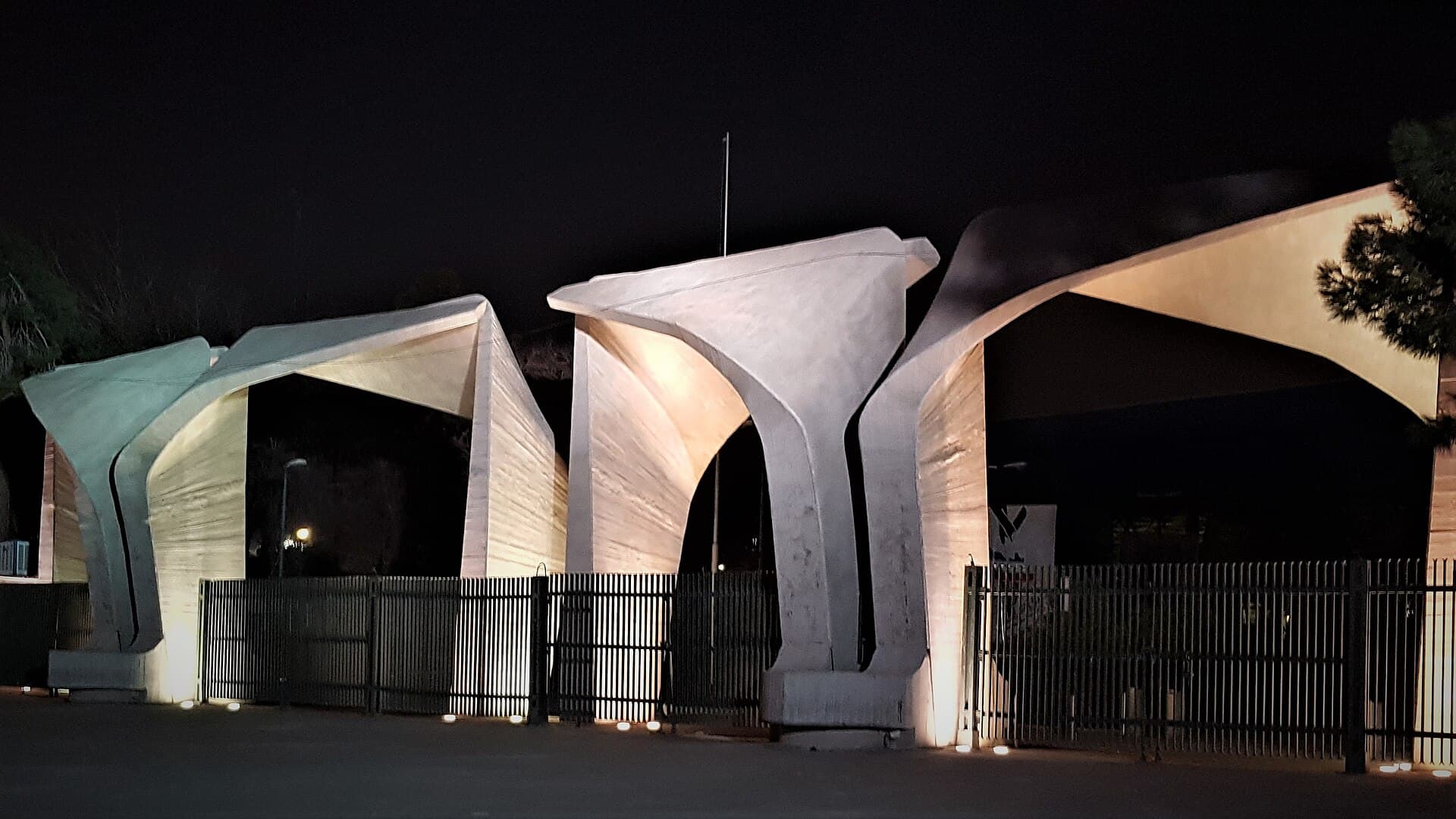
The University of Tehran is Iran's oldest and most prestigious modern university, founded in 1934 in the capital and known across the country by an affectionate epithet: daneshgah-e madar, the mother university. The name is earned twice over. Most of Iran's universities trace their founding faculty, their curricula or their charters back to this campus on Enghelab Avenue, and much of the country's modern intellectual life first took institutional form inside its gates.
Those gates are worth pausing on. The main entrance, a pair of curved concrete wings raised in the 1960s, was designed by a student of the university's own fine arts faculty, and the silhouette has since become the logo of the university itself and, by extension, the emblem of higher education in Iran. A university that wears a student's drawing as its official seal, and that keeps the largest dictionary of the Persian language in one of its institutes, is a particular kind of memory institution.
The founding thread begins eighty years before the university did, with a school and a statesman. In 1851 Mirza Taghi Khan, known as Amir Kabir, chief minister to the young Naser al-Din Shah and the great modernizing figure of Qajar Iran, established the Dar ul-Funun in Tehran: a polytechnic offering instruction in medicine, engineering, military science and the natural sciences, staffed at first by European instructors. It was the first modern institution of higher learning in Iran. Amir Kabir did not live to see what he had started. Court intrigue brought his dismissal in late 1851, around the time the school opened its doors, and within weeks he was dead, killed at the Fin Garden in Kashan on the orders of the court he had served. The school he founded outlasted him by generations, training the physicians, engineers and translators of late Qajar Iran, and a scatter of other colleges of law, medicine and political science grew up alongside it.
In 1934 the Iranian parliament passed the law that gathered this inheritance into a single university. The founding came under Reza Shah, with the education minister Ali Asghar Hekmat as its persistent advocate, and the Jalaliyeh garden on the northern edge of the city of that era was chosen as the site. The new University of Tehran absorbed the existing colleges, many of them descended from the Dar ul-Funun, and opened with six faculties spanning law, medicine, engineering, science, letters and theology. In 1937 it became the first Iranian university to admit women, and the campus filled through the following decades as the city grew around it until Enghelab Avenue, once the northern margin, ran through the centre of Tehran.
The university's political century must be told plainly, because there is scarcely an Iranian political moment that did not pass through this campus. On 7 December 1953, months after the coup that removed Prime Minister Mohammad Mosaddegh, security forces entered the Faculty of Engineering during protests held ahead of a visit by the American vice president Richard Nixon, and three students were shot dead. The date, 16 Azar in the Iranian calendar, has been marked ever since as Student Day in Iran, one of the country's most durable dates of memory. In the 1970s the campus was a centre of opposition to the Pahlavi state, and since the 1979 revolution the university grounds have hosted Tehran's main Friday prayers. Student movements returned to the campus at intervals in the decades that followed, in 1999 and afterward, and the university has remained a place where the country's arguments with itself become visible.
The main campus was laid out in the 1930s to a master plan shaped by a group of European and Iranian architects, among them the French architect and archaeologist Andre Godard, who directed Iran's archaeological service, designed the National Museum of Iran, and served as the first dean of the university's fine arts faculty. Working with Roland Dubrulle, Maxime Siroux, Nikolai Markov, Mohsen Foroughi and others, the planners produced a campus of restrained early modern buildings set among plane trees and long axial walks, one of the first pieces of deliberate modern campus planning in the Middle East.
The famous entrance came a generation later. In 1965 the university held a competition for a new main gate, and the winning design belonged to Korosh Farzami, a student in its own faculty of fine arts. His answer was a pair of sculptural concrete wings that curve toward each other without touching, read variously as an open book, a bird and a stylised tulip. The form proved so recognisable that the university adopted it as its official logo, and the gate now appears on the reverse of Iran's 50,000 rial banknote. Lit at night over Enghelab Avenue, it is the image of Iranian higher education.
Today the university teaches across more than twenty faculties and colleges, from law, letters and theology to engineering, science and world studies, with satellite campuses beyond Tehran and a research output that leads the country's league tables.
Two of the university's possessions say the most about what it is, and neither is a building of state. The first is a dictionary. Ali-Akbar Dehkhoda, a satirist and constitutional-era journalist turned lexicographer, spent some four decades compiling the Loghatnameh, a dictionary of Persian that set out to record the whole of the language: every word, every proper name, every citation from a thousand years of poetry and prose. Parliament put the project under public support in 1945, and after Dehkhoda's death in 1956 the work passed to his collaborators, first Mohammad Moin and later Jafar Shahidi, under the Dehkhoda Dictionary Institute, which became part of the University of Tehran. The completed dictionary runs to more than two hundred fascicles and remains the largest ever compiled for Persian. The institute still maintains it and teaches Persian to students from abroad, so the university is, literally, the keeper of a language's memory.
The second is the gate. Universities normally take their emblems from heraldry, from founders' arms or mottoes granted by kings. The University of Tehran took its emblem from a design competition won by one of its own students, and has worn his concrete tulip on its letterhead, its banners and the national currency for six decades. A dictionary that holds a language and a gate drawn by a student: between them they describe an institution that both keeps the country's inheritance and trusts its young people to add to it.
The university's roll of scholars begins with the generation that built modern Persian letters. Dehkhoda himself presided over the dictionary institute's early years. Badiozzaman Forouzanfar, professor of Persian literature, produced the critical editions of Rumi's works that scholars still cite, and trained much of the field's next generation. Mohammad Moin, the first person to earn a doctorate in Persian literature at the university, went on to compile his own widely used Persian dictionary. Simin Daneshvar took her doctorate in Persian literature there and became the first major Iranian woman novelist with Savushun in 1969; her husband Jalal Al-e Ahmad, among the most influential Iranian essayists of the century, began doctoral study at the university before leaving to write. In the sciences, Mahmoud Hessaby taught physics at the university for more than half a century from its founding years and is remembered as the father of modern physics teaching in Iran. Prime ministers, presidents and chief justices of every era of modern Iranian politics have studied or taught on the campus.
The University of Tehran enters its tenth decade with more than forty thousand students across its Tehran campuses and satellite sites, and it remains the reference point of the country's academic life, first choice of the entrance examination's highest scorers. Its position resembles that of Al-Azhar University in Cairo: an institution so woven into its country's story that its anniversaries, its examinations and its commemorations belong to the national calendar rather than merely the academic one. Each 16 Azar the campus marks Student Day, and each generation of students passes under a gate designed by one of their predecessors.
The university stands on Enghelab Avenue in central Tehran, and though the campus itself is a working university with controlled entry, its most famous sight belongs to the street. The main gate faces the avenue directly and is best seen lit after dark. The stretch of Enghelab Avenue facing the campus is Tehran's book district, lined for blocks with bookshops and publishers' storefronts, so a walk past the university is a tour of the country's reading life. The National Museum of Iran, designed by the same Andre Godard who helped plan the campus, lies a short distance to the south.