Heritage · University
Istanbul University: History and Overview
Istanbul University dates its own founding to 1453 and the medreses of the Ottoman conquest, though its continuous modern line runs from the Darulfunun of 1900 and the university reform of 1933. That reform filled its new chairs with scholars driven out of German universities by the Nazis, among them Erich Auerbach, who wrote Mimesis in Istanbul during the Second World War.Written to last.
By Confinity Heritage Editorial · 2026-08-25 · 8-minute readQuiet tools, kept out of the way.
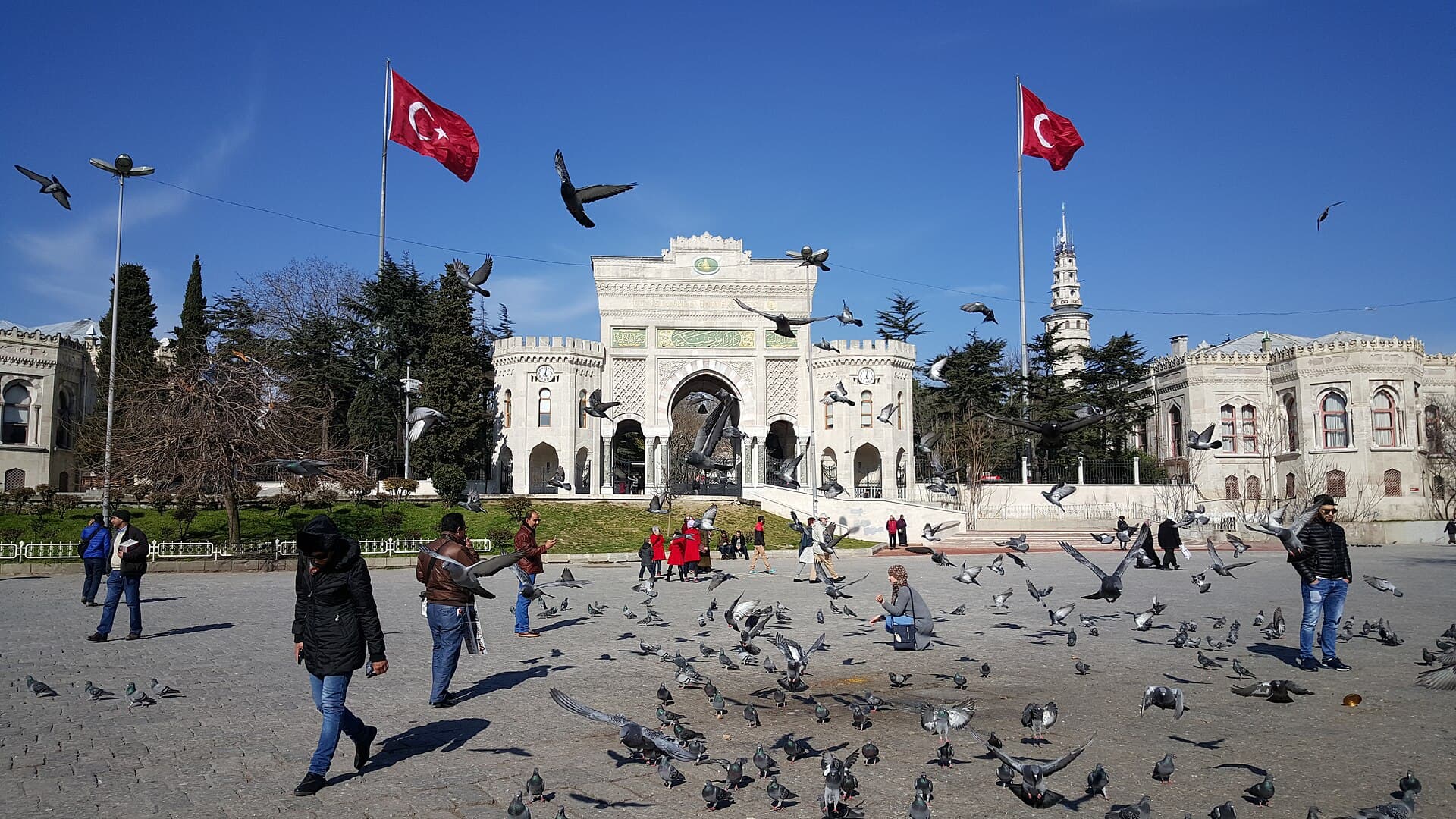
Istanbul University stands behind a wide neo-Renaissance gate on Beyazit Square, in the oldest quarter of Turkey's largest city. It is the country's most prominent public university and among its largest, and it reaches further back for its origins than any other institution in the Republic: it dates itself to 1453 and the medreses established in the days after the Ottoman conquest of Constantinople.
That claim and the institution's documented modern line are two different things, and the university's own pages carry both. Behind the gate the grounds climb the third hill between the Grand Bazaar and the Suleymaniye Mosque, with the Beyazit fire tower standing above the plane trees. The same site has held a house of sciences under a sultan, a university rebuilt by a republic, and, for one extraordinary decade, a faculty made largely of exiles from Europe.
The university's own account of its beginning starts the day after the conquest, with teaching in rooms beside Hagia Sophia and at the Zeyrek medrese in the converted Church of the Pantokrator, and continues into the Sahn-i Seman, the eight colleges Mehmed II raised beside his mosque. The Faculty of Letters states that the university's history traces back to those medreses of 1453, and the date appears on the university's crest. It is best read as the institution's own reckoning rather than as a settled historical fact: the Ottoman medrese was a different kind of school from the research university that now claims descent from it, and the unbroken line to the present runs through the nineteenth century instead.
That line begins with the Darulfunun, the House of Sciences, an attempt to build a European-style university inside the Ottoman state. A first effort was announced in 1846, and lectures opened on 13 January 1863, but they amounted to public conferences and lapsed. A second body, the Darulfunun-u Osmani, opened on 20 February 1870 and closed again; a third ran within the imperial lycee from 1874 to 1881. The version that endured was the Darulfunun-u Sahane, reorganised on 1 September 1900 with departments of theology, letters, mathematics, science and philology. Renamed Istanbul Darulfunun in the years that followed, it won scientific and administrative autonomy in 1919 and became an institution of the new Republic in 1924.
Then, in 1933, it was abolished. A law dated 31 May closed the Darulfunun, and on 1 August the new Istanbul University opened in its place. Roughly half of the old teaching staff were not reappointed. The government judged that the Darulfunun had failed the Republic's scientific ambitions, and the reform created, in a single summer, many chairs that had to be filled from somewhere.
The Beyazit campus occupies the site of the Seraskerat, the Ottoman Ministry of War, and the triple-arched gate fronting the square was built as its entrance. It has become the university's emblem, and its image was carried on the reverse of the 500 lira banknote issued between 1971 and 1984. Inside stands the Beyazit Tower, an 85-metre stone shaft completed in 1828 by the architect Senekerim Balyan as a fire watchtower for a city built largely of timber; it still signals the weather to the city below through coloured lamps: red for snow, green for rain, yellow for fog.
The setting is one of the densest historical quarters in Istanbul. The Bayezid II Mosque closes the square on one side, the Grand Bazaar begins a short walk east, and the Suleymaniye complex crowns the slope above. The Faculty of Letters and Faculty of Sciences occupy buildings put up in 1951 by the architects Emin Onat and Sedat Hakki Eldem.
The university teaches through seventeen faculties, from medicine, law, letters and sciences to aquatic sciences, theology, architecture, and computer and information technologies. Institutes, a conservatory and vocational schools sit alongside them, spread across nine campuses. Enrolment runs to roughly 58,800 students across 112 academic units, taught by some 4,300 academic staff. In 2018 a second institution, Istanbul University-Cerrahpasa, was separated out, taking the Cerrahpasa medical faculty and the units at Avcilar with it.
The vacancies of 1933 met a supply created three months earlier. Germany's civil service law of April 1933 removed Jewish and politically unwanted academics from their posts, and the pathologist Philipp Schwartz, himself dismissed from Frankfurt, founded the Notgemeinschaft deutscher Wissenschaftler im Ausland, the emergency association for German scientists abroad, in Zurich that year. It placed around 150 academics, most of them in Turkey, and Schwartz went on to direct pathology at Istanbul himself.
The names that arrived are a partial roll call of interwar German scholarship. Leo Spitzer, dismissed from Cologne, served from 1933 to 1936 as the first professor of Latin languages and director of the School of Foreign Languages, then left for Johns Hopkins. The economist Fritz Neumark taught finance and economics from 1933 and later returned to Germany to serve twice as rector of Frankfurt. Richard von Mises held the new chair of pure and applied mathematics from 1933 until 1939, and Hans Reichenbach headed the philosophy department from 1933 to 1938 before going on to Los Angeles. The emigration reached beyond Istanbul: Ernst Reuter, who would become mayor of West Berlin after the war, spent his Turkish years in Ankara, where he introduced urban planning as a university subject.
The scholar who left the deepest mark came in 1936. Erich Auerbach, driven from his chair at Marburg, succeeded Spitzer and held the Istanbul chair of western languages and literatures until 1947. Between 1942 and 1945, with Europe at war and his own country closed to him, he wrote Mimesis: Dargestellte Wirklichkeit in der abendländischen Literatur, published in Switzerland in 1946 and in English in 1953 as Mimesis: The Representation of Reality in Western Literature. Twenty chapters, each opening from a single passage, trace how Western writing renders the real, from Homer and the Book of Genesis through Dante and Montaigne to Virginia Woolf.
Auerbach set down the conditions of the work in his epilogue. The book was written during the war in Istanbul, where, he wrote, "the libraries are not well equipped for European studies." He had to do without periodicals, without most recent scholarship, and in places without reliable critical editions; the book carries no footnotes. The shortage became the method. With the commentary out of reach, he read the texts, and built five hundred pages of argument from close attention to the passages themselves. A founding work of European literary memory was written in exile, in a city that had taken in the people Europe expelled, and the missing library is part of what shaped it.
The university's Turkish scholarly line is long. Fuat Sezgin took his doctorate at Istanbul in 1950 under the German orientalist Hellmut Ritter, left his post in 1960, and from Frankfurt produced the multi-volume Geschichte des Arabischen Schrifttums, the standard reference on science in the Islamic world. The novelist Halide Edib Adivar returned to Turkey in 1939 to become professor of English literature in the Faculty of Letters. Aziz Sancar graduated top of his class from the Faculty of Medicine in 1969 and shared the 2015 Nobel Prize in Chemistry for mechanistic studies of DNA repair. Orhan Pamuk graduated from the Institute of Journalism in 1976 and won the Nobel Prize in Literature in 2006.
Two institutions read well beside it. Humboldt University of Berlin is where much of the scholarship that reached Beyazit in 1933 had been formed, and from which it was expelled; Cairo University, founded in 1908, is the nearest regional parallel.
Istanbul University remains the reference institution of Turkish higher education, and its faculties of medicine, law and letters have supplied much of the country's professional and academic leadership for a century. Its library system holds substantial manuscript and rare-book collections, and its press publishes scholarly journals across the disciplines. The 2018 division reduced its size without moving it from the centre of national academic life.
The campus fronts Beyazit Square in Fatih, one stop from the Grand Bazaar on the T1 tram at Beyazit-Kapali Carsi. Security staff hold the gatehouse and may ask for identification, so carry a passport or card. The grounds beyond are lawns and plane trees rather than an exhibition, and the tower at their centre is a weather beacon rather than an attraction, best photographed from the square itself or from the slope below Suleymaniye. Around the square, the Beyazit State Library of 1884 is open to readers, the Sahaflar Carsisi second-hand book market runs between the mosque and the Grand Bazaar, and the walk uphill to the Suleymaniye complex takes about ten minutes.