Heritage · University
Cairo University: History and Overview
Founded in 1908 as the Egyptian University, Cairo University was paid for by public subscription, with Princess Fatma Ismail giving land, farm revenues and jewels to endow it. From its Giza campus beneath the great dome it grew into Egypt's largest university, home of Taha Hussein and Naguib Mahfouz.Written to last.
By Confinity Heritage Editorial · 2026-08-25 · 8-minute readQuiet tools, kept out of the way.
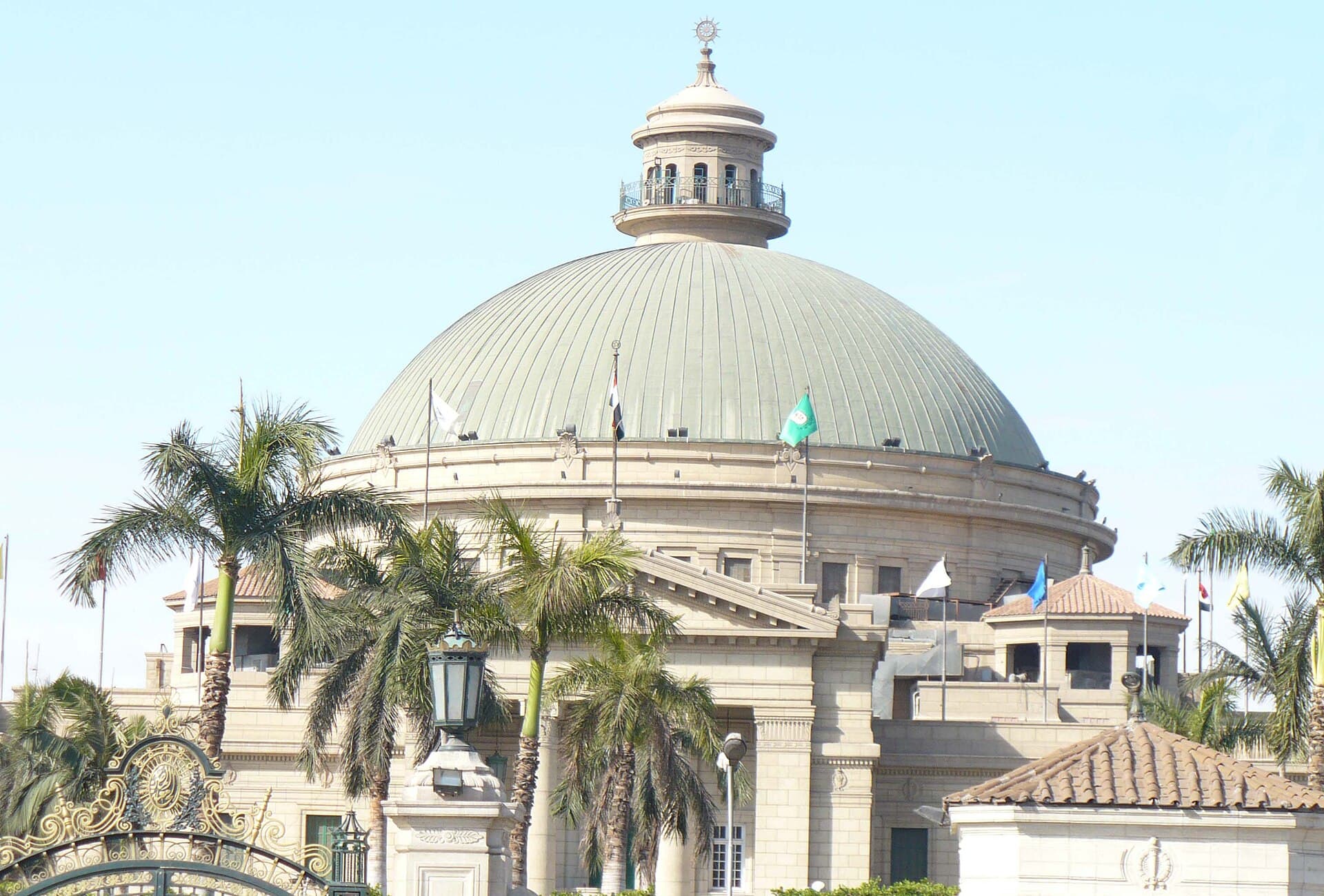
Cairo University stands on the west bank of the Nile in Giza, and the dome of its main building is one of the silhouettes every citizen of Egypt can draw from memory. It appears on banknotes, in films, behind newsreaders, at the head of a broad avenue that runs toward the river. The university beneath the dome is the country's largest, and it began in 1908 not as a royal decree or a colonial project but as a subscription drive: a modern university that ordinary Egyptians, from princesses to villagers, paid for themselves.
That founding story, and the story of the blind student who earned its first doctorate and became the most famous man of letters in the Arabic language, are what set this institution apart. Egypt already possessed one of the oldest seats of learning on earth in Al-Azhar University, a thousand years of religious scholarship in the heart of the old city. The new university was built to stand alongside it and do something different: teach literature, science, law and medicine in the modern manner, under national rather than foreign control.
The campaign for an Egyptian university took shape in the first years of the twentieth century, driven by the nationalist and reformist circles around figures such as Mustafa Kamil, Saad Zaghloul and Qasim Amin. Egypt was under British occupation, and higher education meant either the religious curriculum of Al-Azhar or study abroad for the few who could afford it. A committee began collecting donations in 1906, and the gifts came from every level of society, small sums from clerks and farmers recorded alongside large ones from notables. The decisive endowment came from Princess Fatma Ismail, a daughter of Khedive Ismail, who gave land for the institution, assigned it the revenues of her agricultural estates, and put a portion of her own jewels toward the building fund. The story of the princess's jewels became part of the university's founding legend, and it carries a plain truth: this was a university bought by its own public.
The Egyptian University opened on 21 December 1908 as a small private institution offering evening lectures in the humanities, with Prince Ahmad Fuad, the future king, as its first rector. It admitted women to lectures in its early years, decades before most of its European contemporaries would have found that unremarkable. Money was always short, and in 1925 the state took the project over, refounding it as a full public university with faculties of arts, science, law and medicine. The medical faculty was not new. It absorbed the Qasr al-Ainy school of medicine, founded in 1827 under Muhammad Ali with the French physician Clot Bey, which had been training Egyptian doctors for nearly a century before the university existed. The teacher-training college Dar al-Ulum, established in 1871 to bring classical Arabic learning into modern classrooms, later joined as a faculty as well, so the university gathered up older lineages of Egyptian scholarship as it grew.
The institution was renamed Fuad I University in honour of the king, and after the revolution of 1952 it received its present name, Cairo University, in 1953. Its students were rarely far from the country's politics. Students of the university and the higher schools marched in the nationwide uprising of 1919 against British rule; the campus felt the purges and reorganisations of the Nasser years; and in 2011 its students were among the crowds in the streets during the January uprising. Through all of it the university kept teaching, and its graduates kept filling the professions, the ministries and the newspapers of the Arab world.
The university moved in stages to its permanent campus in Giza, laid out from the late 1920s on open ground near the west bank of the Nile, across the road from the Giza Zoo and its older botanical gardens. The centrepiece is the main ceremonial building, whose broad dome rises over the great assembly hall at the head of the campus axis. There is no bell tower and no spire; the low dome against the sky is the whole signature, and it has served as the backdrop for graduations, state addresses and film scenes for the better part of a century. Around it spread the faculties, from arts and law near the old core to engineering, and the vast medical campus of Qasr al-Ainy with its teaching hospitals closer to the river in Cairo proper.
Today the university teaches across more than twenty faculties and institutes covering the humanities, law, economics and political science, mass communication, science, engineering, agriculture, pharmacy, dentistry and medicine. Enrolment is on a scale few universities anywhere match: more than 200,000 students by recent official counts, taught by tens of thousands of academic staff. Qasr al-Ainy remains one of the largest medical schools and hospital complexes in Africa and the Middle East, and the Faculty of Dar al-Ulum continues its old mission as a centre for Arabic language and Islamic studies within a secular university.
Two stories carry the university's memory, and they belong together. The first is the founding subscription, sealed by a princess's jewels, which made the institution a public possession from its first day. The second is what that public investment returned, in the person of Taha Hussein.
Hussein was born in 1889 in a village in Upper Egypt and lost his sight at the age of three after an eye infection was treated with village remedies. He memorised the Quran as blind boys of his generation did, and was sent to Al-Azhar at thirteen. When the new Egyptian University opened in 1908 he enrolled in its first intake, and in 1914 it awarded him its first doctorate, for a thesis on Abu al-Ala al-Maarri, the blind poet-philosopher of medieval Syria. A blind village boy writing the new university's first dissertation on a blind master of the classical canon: the symmetry was noticed at the time and has never been forgotten. The university then sent him to France, where he took a second doctorate at the Sorbonne, and he returned to teach at the institution that had formed him, rising to professor of Arabic literature and dean of the Faculty of Arts. The Arab world came to call him Amid al-Adab al-Arabi, the Dean of Arabic Letters.
His memoir The Days (al-Ayyam), serialised in 1926 and published as a book in 1929, told the story of his village childhood and his education in spare third-person prose, and became the founding autobiography of modern Arabic literature, read by generations of schoolchildren since. The same year brought his most dangerous book. In On Pre-Islamic Poetry he applied sceptical historical method to the oldest layer of the Arabic canon, arguing that much of it was composed later than tradition held. The book provoked formal accusations of insulting religion; the public prosecutor investigated and dismissed the case in 1927, a ruling that became a landmark for academic freedom in Egypt, though Hussein was later forced from his deanship for a time when his independence angered the government of the day. As minister of education from 1950 he abolished school fees in state secondary education, arguing that learning should be as free to Egyptians as the water they drink and the air they breathe. The line is quoted to this day. A man whose own education had depended on charity and a public subscription spent his last office making sure the next child would not need either.
The university's roll of graduates maps the modern history of Egypt and beyond. Naguib Mahfouz, who took his degree in philosophy in 1934 and went on to write the Cairo Trilogy, received the Nobel Prize in Literature in 1988, the first Arabic-language writer to do so; the streets he chronicled lie across the river from the campus where he studied. Boutros Boutros-Ghali graduated in law and later taught international law at the university before becoming Secretary-General of the United Nations. Mohamed ElBaradei took his law degree there in 1962 and shared the 2005 Nobel Peace Prize as head of the International Atomic Energy Agency. Yasser Arafat studied civil engineering on the Giza campus in the 1950s. Generations of Egypt's judges, physicians, engineers, journalists and ministers, and many of the Arab world's, passed under the same dome.
Its scholarly weight is institutional as well as individual. Qasr al-Ainy gave Egypt its modern medical profession and still trains a large share of it. Dar al-Ulum shaped how classical Arabic is taught across the region. The university's presses, journals and faculties made Cairo the publishing and intellectual capital of the Arabic language for much of the twentieth century, and in citation-based international rankings Cairo University regularly places among the leading universities of Africa and the Arab world.
Cairo University remains Egypt's largest and most prominent public university, a city-within-a-city of lecture halls, hospitals, hostels and playing fields on the Giza bank. Admission runs through the national examination system, and its degrees still carry particular weight in law, medicine, engineering and mass communication, fields in which it has trained the region's practitioners for a century. Its central library and faculty collections hold deep archives of Arabic manuscripts, theses and periodicals, including the accumulated record of the institution's own founding subscription and early decades. The dome building continues to host graduations and state occasions, and the university marks its founding generation in stone and name: a main hall named for Ahmed Lutfi el-Sayyed, its first rector as a state university, and memorials to Princess Fatma Ismail and Taha Hussein, the benefactor and the graduate who together explain what the place is for.
The campus lies in central Giza, reached by the Cairo Metro's Cairo University station and by the bridges from downtown Cairo across the Nile. Access to the grounds is controlled and the place is not set up for sightseers, but the dome and the main facade are visible from the long approach of University Avenue, and the surrounding district holds the Giza Zoo and the Orman botanical garden, both laid out on former khedivial estate land. Visitors heading on toward the Pyramids of Giza pass the Grand Egyptian Museum on the same bank of the river, so a single day in Giza can take in the country's newest great museum and the university its public bought for itself more than a century ago.