Heritage · Landmark
Hagia Sophia: History, Architecture and Visitor Guide
Byzantine cathedral completed in 537, a mosque after 1453, a museum from 1935 to 2020, and a mosque again since 2020, in Istanbul's UNESCO-listed old city.Written to last.
By Confinity Heritage Editorial · Updated 2026-07-31 · 7-minute readQuiet tools, kept out of the way.
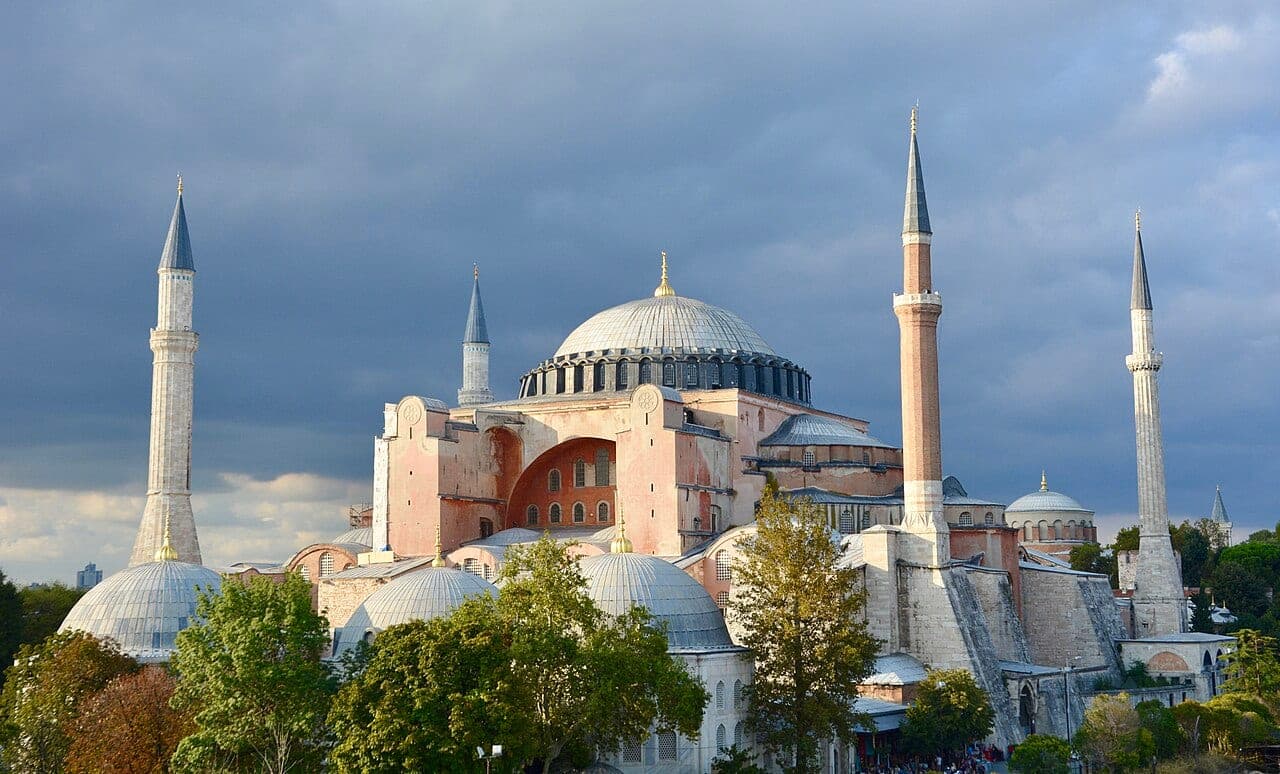
Hagia Sophia, in Istanbul, Turkey, is among the most influential buildings in architectural history and among the most contested in cultural history. Completed in 537 AD as the principal cathedral of the Byzantine Empire, it served as a church for roughly nine centuries, became a mosque after the Ottoman conquest of Constantinople in 1453, opened as a museum in 1935, and returned to use as a mosque in 2020. Its Greek name means "Holy Wisdom." The building sits in the Sultanahmet district on the historic peninsula and forms part of the Historic Areas of Istanbul, inscribed on the UNESCO World Heritage List in 1985 under cultural criteria (i), (ii), (iii) and (iv).
The present structure was commissioned by the Byzantine emperor Justinian I after an earlier church on the site was destroyed during the Nika riots of 532. Built in under six years by the architects Anthemius of Tralles and Isidore of Miletus, it was dedicated in 537 and remained the largest cathedral in the Christian world for nearly a thousand years, serving as the seat of the Ecumenical Patriarch of Constantinople. Part of the original dome collapsed after earthquakes in 558 and was rebuilt to a steeper profile, completed in 562. During the Fourth Crusade the building was used as a Roman Catholic cathedral under the Latin occupation of 1204–1261, then returned to Eastern Orthodox use.
On 29 May 1453, Constantinople fell to the Ottomans under Sultan Mehmed II, who converted the church into a mosque. Over the following centuries the Ottomans added four minarets, a mihrab, a minbar and calligraphic roundels. In 1934 the government of the Turkish Republic, led by Mustafa Kemal Atatürk, issued a decree ending the building's use as a mosque, and it opened as a museum in 1935. On 10 July 2020, Turkey's Council of State annulled the 1934 decree, and a presidential decree issued the same day reopened the building for Muslim worship; the first Friday prayers were held on 24 July 2020. The decision drew a range of international responses: UNESCO expressed regret and called on Turkey to preserve the site's universal value, while Greece, the United States, the World Council of Churches, the Russian Orthodox Church and Pope Francis voiced concern. Turkish officials described the change as a matter of national sovereignty.
The defining feature of Hagia Sophia is its central dome, roughly 31 metres (about 102 feet) in diameter and rising some 55 metres above the floor. The dome rests on four pendentives, curved triangular sections of masonry that carry the weight of a circular dome down onto four massive piers set in a square plan. This large-scale use of pendentives allowed a round dome to sit over a square space, an engineering solution that had not been attempted at such a scale before. A ring of some forty windows around the dome's base admits light in a way that made the dome appear, to Byzantine observers, almost to float. Half-domes and semi-domes extend the central space east and west, producing an interior of exceptional volume. The building's structural and spatial ideas shaped later architecture, influencing Byzantine church design and, after 1453, the great Ottoman imperial mosques developed by the architect Mimar Sinan.
 The dome rides on a ring of forty windows, which is what makes it look unsupported from below. Photograph by Ronan Reinart, CC BY-SA 3.0, via Wikimedia Commons.
The interior was decorated over several centuries with gold-ground Byzantine mosaics, including images of Christ, the Virgin and Child in the apse, and imperial portraits. Figural images were removed during the iconoclast period of the eighth and ninth centuries and restored afterward. After the 1453 conversion to a mosque, the figurative mosaics were gradually covered with plaster or whitewash, consistent with Islamic practice regarding representational images in places of worship; the Swiss architects Gaspare and Giuseppe Fossati documented and re-covered many during restoration work in the 1840s. From 1931, Thomas Whittemore and the Byzantine Institute of America were authorised to uncover and conserve a number of the mosaics, work that continued during the museum decades. Since the 2020 reconversion, figurative mosaics in the direction of prayer are covered with curtains during prayer times and uncovered at other times, when the building is open to visitors.
Hagia Sophia carries meaning for several traditions and periods, and its successive uses reflect the layered history of the city itself. For Eastern Orthodox Christianity it was for centuries the foremost cathedral and the setting of imperial coronations and patriarchal liturgy. For the Ottomans and for Muslims it became a principal imperial mosque and a model that shaped later mosque architecture across the empire. During its years as a museum it was presented as shared cultural heritage open to visitors of all backgrounds. The building's changing status has repeatedly been read as a marker of political and religious identity, and the successive conversions have each been significant to different communities. UNESCO monitors the site as part of the Historic Areas of Istanbul and has asked that its value be preserved through the current arrangements.
Hagia Sophia is in the Fatih district, facing the Sultan Ahmed (Blue) Mosque across Sultanahmet Square. As a functioning mosque, entry is free of charge. Visitors are asked to dress modestly, to remove their shoes before entering the prayer area, and women are asked to cover their heads; the building is closed to sightseeing during the five daily prayer times and during Friday prayers. It sits within walking distance of Topkapı Palace, the Basilica Cistern and the Blue Mosque, so many visitors combine them in a single itinerary. Because opening arrangements and access rules can change, it is worth checking current official information before travelling.
The dome rides on a ring of forty windows, which is what makes it look unsupported from below. Photograph by Ronan Reinart, CC BY-SA 3.0, via Wikimedia Commons.
The interior was decorated over several centuries with gold-ground Byzantine mosaics, including images of Christ, the Virgin and Child in the apse, and imperial portraits. Figural images were removed during the iconoclast period of the eighth and ninth centuries and restored afterward. After the 1453 conversion to a mosque, the figurative mosaics were gradually covered with plaster or whitewash, consistent with Islamic practice regarding representational images in places of worship; the Swiss architects Gaspare and Giuseppe Fossati documented and re-covered many during restoration work in the 1840s. From 1931, Thomas Whittemore and the Byzantine Institute of America were authorised to uncover and conserve a number of the mosaics, work that continued during the museum decades. Since the 2020 reconversion, figurative mosaics in the direction of prayer are covered with curtains during prayer times and uncovered at other times, when the building is open to visitors.
Hagia Sophia carries meaning for several traditions and periods, and its successive uses reflect the layered history of the city itself. For Eastern Orthodox Christianity it was for centuries the foremost cathedral and the setting of imperial coronations and patriarchal liturgy. For the Ottomans and for Muslims it became a principal imperial mosque and a model that shaped later mosque architecture across the empire. During its years as a museum it was presented as shared cultural heritage open to visitors of all backgrounds. The building's changing status has repeatedly been read as a marker of political and religious identity, and the successive conversions have each been significant to different communities. UNESCO monitors the site as part of the Historic Areas of Istanbul and has asked that its value be preserved through the current arrangements.
Hagia Sophia is in the Fatih district, facing the Sultan Ahmed (Blue) Mosque across Sultanahmet Square. As a functioning mosque, entry is free of charge. Visitors are asked to dress modestly, to remove their shoes before entering the prayer area, and women are asked to cover their heads; the building is closed to sightseeing during the five daily prayer times and during Friday prayers. It sits within walking distance of Topkapı Palace, the Basilica Cistern and the Blue Mosque, so many visitors combine them in a single itinerary. Because opening arrangements and access rules can change, it is worth checking current official information before travelling.
History
Architecture
Art and mosaics
Cultural role
Visiting
References and resources
- UNESCO World Heritage Centre: Historic Areas of Istanbul: the inscription, boundaries and criteria for the World Heritage Site that includes Hagia Sophia.
- Encyclopaedia Britannica: Hagia Sophia: overview of the building's construction, architecture and history.
- Wikipedia: Hagia Sophia: detailed history, architecture and mosaics with sources.
- Al Jazeera: world reacts to Turkey reconverting Hagia Sophia: reporting on the July 2020 court ruling and international reactions.
- NPR: Hagia Sophia hosts first Friday prayers: coverage of the 24 July 2020 prayers.
- The Art Newspaper: mosaics covered during Muslim prayers: reporting on how the figurative mosaics are handled during prayer.