Heritage · University
Ghent University: History and Overview
Founded in 1817 by King William I of the Netherlands and taught first in Latin and then in French, Ghent University became in 1930 the first university in Belgium to teach entirely in Dutch. Its Book Tower, designed by Henry van de Velde, stands as the fourth tower of the Ghent skyline.Written to last.
By Confinity Heritage Editorial · 2026-08-25 · 8-minute readQuiet tools, kept out of the way.
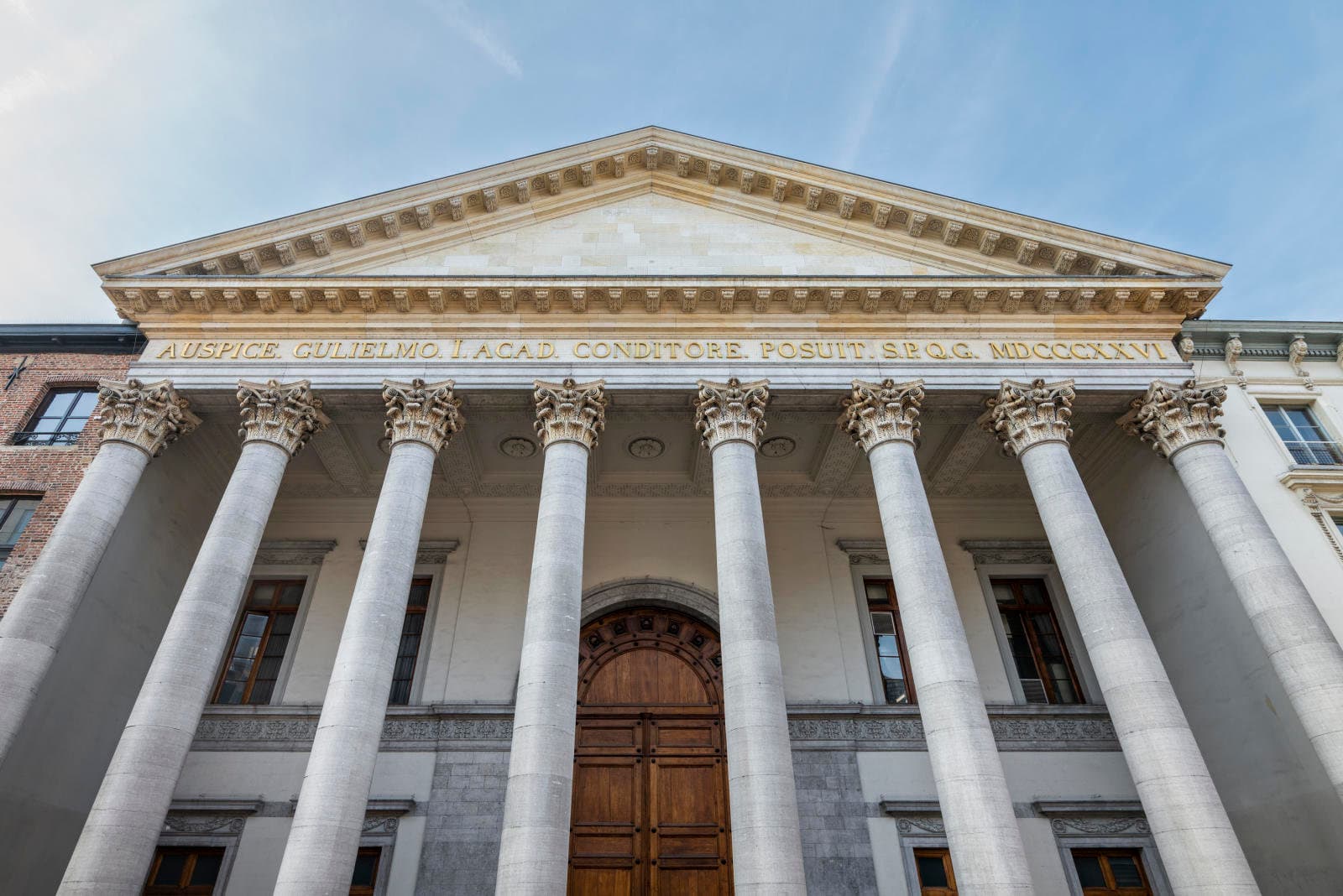
Ghent University is the largest university in the Flemish region of Belgium and one of the country's two great research institutions. It was founded in 1817, in the brief years when Ghent belonged to the United Kingdom of the Netherlands, and its ceremonial hall still says so: across the pediment of the Aula Academica, in gold capitals, an inscription records that the city raised the building under the auspices of William I, founder of the academy, in 1826. The Latin runs along a Corinthian portico in the middle of a shopping street, and most people who pass it are not reading it.
The line matters, because almost everything about the university's first century was settled by other people's languages. It opened teaching in Latin. It switched to French when Belgium became a country. It taught in French for a hundred years in a city where hardly anyone spoke French at home. What happened after that is the story this page is really about.
William I of the Netherlands founded three state universities in his southern provinces in 1817, at Ghent, Liege and Leuven, each with four faculties and Latin as the language of instruction. Ghent's first academic year opened with a few dozen students under its first rector, Jean-Charles Van Rotterdam. When the Belgian revolution of 1830 detached the south, the new state kept the university and made French its working language, a choice that set the institution at a permanent angle to the Dutch-speaking city around it.
The Flemish movement spent the second half of the nineteenth century pressing for that to change, and the campaign for a Dutch-speaking Ghent became one of its central demands. Progress was slow and then, in the First World War, disastrous: the occupying German administration reopened the university in 1916 as a Dutch-language institution, a move calculated to set Belgians against each other. The so-called von Bissing university collapsed with the occupation in 1918, and its collaborationist taint set the cause back by years, because every later argument for Dutch teaching then had to be defended against the memory of it.
The route back was legislative. A law of 1923 split the curriculum, part of the teaching in Dutch and part in French, an arrangement that satisfied nobody. Seven years later parliament finished the job: from the academic year 1930-31, Ghent taught wholly in Dutch, the first university in Belgium to do so. A generation of Flemish scholars had to build an academic vocabulary in their own language, coining and standardising terms that French and German had long since settled. The university has been Dutch-speaking ever since, and its history is now inseparable from the arrival of Flemish as a language of science.
Ghent has no single campus. Its faculties are spread across the city, which means the university is met as a series of buildings rather than a gate. The Aula Academica on Voldersstraat, designed by the city architect Louis Roelandt and completed in the 1820s, remains the ceremonial hall, its portico and rotunda still used for doctorates and formal sessions. The Faculty of Arts occupies the Blandijnberg, the modernist block on the hill above the old town; the sciences sit further out at the Sterre campus, with bioscience engineering along the Coupure canal and the medical faculty attached to the university hospital.
Today the university runs eleven faculties covering arts, law, sciences, medicine, engineering, economics, veterinary medicine, psychology, bioscience engineering, pharmacy and political and social sciences, teaching some fifty thousand students. Instruction is in Dutch at bachelor level and largely in English at master's level, and the university runs a global campus at Songdo in South Korea, opened in 2014, its first permanent teaching base outside Europe. The Ghent University Museum, which opened in 2020 in the botanical garden, is unusual among university collections in that its subject is not a discipline but the process of research itself, built around the doubt, error and revision behind scientific knowledge.
Ghent's skyline has three medieval towers: the belfry, St Bavo's Cathedral and St Nicholas's Church, lined up along the ridge of the old town. A fourth has stood among them since the Second World War, and it holds books.
The Boekentoren was designed by Henry van de Velde, the architect who had led the Weimar school that became the Bauhaus and who returned to Belgium in the 1920s. His university library, begun in the mid-1930s and finished under occupation in 1942, is a reinforced concrete stack rising about sixty-four metres, with a glazed belvedere at the top that was meant from the outset to be open to the public. Its narrow windows and stacked floors were arranged around the books rather than the view, and the belvedere was the reward for the climb.
The timing is the point. The tower was commissioned by an institution that had just become Flemish, and it went up in the decade after 1930 as the visible answer to a century of argument. A university that had spent its life speaking other people's languages put its library on the skyline beside the cathedral and the belfry, at their scale, in the plainest material available. After a long restoration campaign the tower and its reading rooms reopened in the 2020s, with the belvedere again receiving visitors. It remains one of the few university libraries anywhere that a city uses as a landmark for navigation.
Ghent's scientific record begins in its French century. August Kekulé held the chair of chemistry from 1858 to 1867, and it was at Ghent in 1865 that he published the ring structure of benzene, the idea that made structural organic chemistry possible. Twenty-five years later, at a jubilee dinner in Berlin, he described having arrived at it in a reverie of a snake seizing its own tail. The account is his own retelling in old age, and chemists have argued about it ever since, which has done nothing to reduce its fame.
Joseph Plateau, professor of physics at Ghent from 1835, matters more to this library's concerns. In 1832 he built the phenakistiscope, a spinning disc of drawn figures viewed through slots, which produced the first convincing moving image out of a sequence of still ones and stands at the head of everything that followed in cinema. Plateau lost his sight in the 1840s and kept working for another thirty-five years, dictating experiments and having results read back to him, including the studies of soap films that carry his name. The man who gave the world moving pictures spent most of his career unable to see them.
The line continues into the twentieth century. Corneille Heymans won the 1938 Nobel Prize in Physiology or Medicine for showing how the carotid sinus and the aorta regulate breathing, work done in the Ghent laboratory his father had founded. Leo Baekeland took his doctorate at Ghent in the 1880s before emigrating and inventing Bakelite, the first fully synthetic plastic. Maurice Maeterlinck, born in the city and sent to the university to read law, abandoned the profession for symbolist theatre and took the Nobel Prize in Literature in 1911. In the modern era the university's plant biotechnology group, led by Marc Van Montagu and Jozef Schell, developed the methods of transferring genes into plants that underpin much of contemporary crop science.
Ghent is consistently placed among the higher-ranked universities of continental Europe and appears in the top hundred of the Shanghai academic ranking. Its research is concentrated in biotechnology and the life sciences, where it anchors a dense cluster of institutes and spin-off companies in the city, alongside strengths in materials, veterinary science and the humanities. It belongs to the European ENLIGHT alliance of research universities, and its scale, around fifty thousand students, makes it the largest employer in Ghent.
For a comparison of models, KU Leuven offers the other Belgian tradition: older by four centuries, Catholic in foundation, and shaped by its own language split in 1968. Between them the two universities account for most of Flemish research output.
The Aula Academica on Voldersstraat can be seen from the street at any hour and opens for ceremonies and heritage days. The Book Tower is the essential visit: the reading rooms and the belvedere are accessible, and the climb ends with the three medieval towers at eye level across the roofs. The Ghent University Museum, in the botanical garden on Karel Lodewijk Ledeganckstraat, is open to the public year round, and the garden itself is free. All three sit within half an hour's walk of each other and of the old town.