Heritage · University
Gadjah Mada University: History and Overview
Founded on 19 December 1949 in Yogyakarta, while the revolution against Dutch rule was still unresolved, Gadjah Mada University is Indonesia's oldest national university. Its first lectures were held in the Sultan's own palace, and it still sends every student to live and work in a village.Written to last.
By Confinity Heritage Editorial · 2026-08-25 · 8-minute readQuiet tools, kept out of the way.
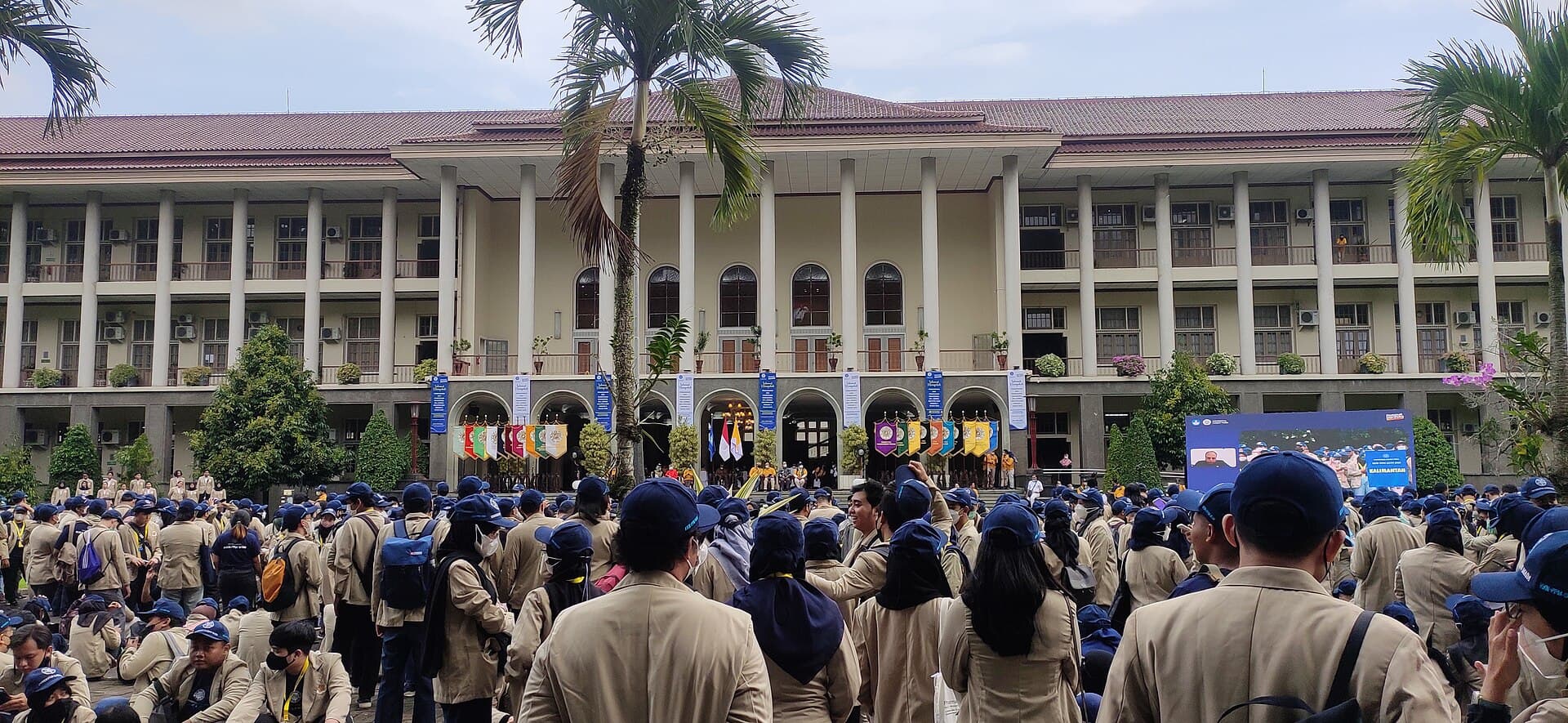
Most universities are founded in peacetime, by governments secure enough to think about the long term. Gadjah Mada University was not. It was declared on 19 December 1949 in Yogyakarta, the temporary capital of a republic still fighting for its existence, while the Dutch held Jakarta and the transfer of sovereignty was still days away. A nation that did not yet fully control its own territory decided that it needed a university, and built one out of the scattered colleges of the revolution. That decision made Universitas Gadjah Mada, usually shortened to UGM, the oldest national university of Indonesia, and it has shaped the institution's character ever since: a state university with a founding memory of independence, service and improvisation.
The founding image is hard to better. The new university had no campus, so Sultan Hamengkubuwono IX, the reigning ruler of Yogyakarta and a firm supporter of the republic, opened the grounds of his own Kraton, the walled royal palace, for its use. For its first years UGM held lectures in the pavilions of a living court, students taking notes where royal ceremonies were staged, until a purpose-built campus rose at Bulaksumur on the northern edge of the city. Few universities anywhere began inside the palace of a reigning monarch.
The university was established by government regulation in December 1949 as a merger of institutions that had been improvised during the war of independence. After the proclamation of independence in 1945 and the loss of Jakarta to the returning Dutch, republican educators had kept higher education alive in the territory the republic still held: an institute of higher learning already carrying the Gadjah Mada name operated in Yogyakarta, and a medical college had been set up in the nearby town of Klaten. When these and other revolutionary-era colleges were brought together, the republic gained its first full national university, with faculties spanning medicine, law, engineering, letters, agriculture and veterinary science.
The name was a deliberate act of memory. Gadjah Mada was the fourteenth-century mahapatih, or prime minister, of the Majapahit empire, the Java-based power whose reach across the archipelago later nationalists took as a precedent for Indonesia itself. Javanese tradition records his Palapa oath, the vow in which he swore to renounce worldly pleasure until the islands of the archipelago were brought under one rule. For a republic that had just fought to hold those same islands together, naming its first university after the author of that oath was a claim on the deep past: the new state presented itself as heir to an old unity, and gave its scholars the statesman's name to live up to.
Yogyakarta itself was part of the meaning. The city had served as the republican capital from 1946, and the Sultanate's support for the revolution earned the region its lasting special status, in which the Sultan serves as hereditary governor. Hamengkubuwono IX, who had risked his throne for the republic, became one of the university's great patrons; his gift of the Kraton grounds for the first lectures bound court and campus together from the start. In the 1950s the university moved north to Bulaksumur, where the Gedung Pusat, the pillared central administration building, and the Balairung, its great ceremonial hall, gave the young institution a permanent face. The Balairung remains the stage for UGM's graduations and formal occasions.
The decades that followed tracked the country's political history. Under the New Order the university trained a large share of the civil servants, engineers and economists who staffed the developmental state, while operating under the restrictions on campus politics that applied across Indonesia. In 1998, UGM students were among those who joined the nationwide demonstrations of the Reformasi movement that preceded the end of the Suharto era, and the campus has since been a steady contributor to the country's democratic public life.
The Bulaksumur campus spreads across the northern districts of Yogyakarta, a green quarter of boulevards, faculty clusters and student neighbourhoods with Mount Merapi visible to the north on clear days. Its centrepiece is the Gedung Pusat, the central building begun in the early 1950s, whose columned front and the Balairung hall behind it have become the university's emblem. Around it are grouped the faculties, the graduate school, the university library and mosque, teaching hospitals, and the sports and cultural facilities of one of the largest campuses in the country.
UGM is a comprehensive university in the fullest sense. It teaches across eighteen faculties, together with a graduate school and a vocational college, covering medicine and health sciences, engineering, agriculture, forestry, law, economics and business, the social and political sciences, cultural sciences, psychology, mathematics and the natural sciences. Tens of thousands of students study there, drawn from every province of Indonesia, which gives the campus a national character: admission to UGM has long been a recognised route by which talented students from distant islands enter national life.
The university is also a keeper of the culture of its home region. Its cultural sciences faculty maintains long-standing scholarship in Javanese language, literature and performing arts, the field often called Javanology, and gamelan and classical Javanese arts have a settled place in campus life. In a city that regards itself as the custodian of Javanese high culture, the university functions as the academic wing of that custodianship, editing texts, training researchers and keeping court traditions inside the curriculum of a modern research university.
Two threads tie the university's name to its practice. The first is the Palapa oath itself: UGM is named for a vow of unification, a promise that the archipelago's islands belonged together. The second is what the university does about it. Since the early 1970s UGM has required its students to complete Kuliah Kerja Nyata, or KKN, a period of community service in which teams of students are posted to villages, often far from Java, to live among residents and work on local problems: clean water, small enterprise, public health, schooling, disaster recovery.
UGM helped pioneer the programme nationally, and at UGM it has never been a token exercise. Every year thousands of its students are dispatched across the archipelago, from Aceh to Papua, and over the decades the posted students number in the hundreds of thousands. Many Indonesians in remote districts first meet their national university not through a lecture or a ranking but through a student team billeted in the village. It is a fitting practice for an institution named after a man who swore not to rest until the islands were one: the university does not simply invoke the oath, it sends its people out to keep it, island by island, village by village.
UGM's alumni roll runs through the centre of Indonesian public life. Joko Widodo, the seventh president of Indonesia, graduated from its Faculty of Forestry in 1985, and cabinet ministers, judges, governors and diplomats in every era of the republic have carried UGM degrees. Sultan Hamengkubuwono X, the current ruler and governor of Yogyakarta and son of the university's royal patron, studied law there, continuing the bond between palace and campus into a second generation.
The university's contribution to Indonesian letters and learning is as deep. The historian and novelist Kuntowijoyo studied and taught at UGM, producing both scholarship on Javanese society and admired fiction; the writer and sociologist Umar Kayam, author of some of the best-loved stories of modern Javanese life, was a professor there. Across economics, medicine, agriculture and engineering, UGM's faculties supplied much of the expertise on which the republic was built, and its historians, anthropologists and philologists have done much of the fundamental work on Java's past.
UGM describes itself as Indonesia's oldest national university, a phrasing chosen with care, since the University of Indonesia in Jakarta traces descent from older colonial schools; UGM's distinction is that it was founded whole, by the republic itself. It consistently places at or near the top of national league tables and among the leading Southeast Asian universities in international rankings. Its research spans tropical medicine, disaster science, food security, energy, governance and cultural studies, and its graduate school draws students from across the region.
The Bulaksumur campus is open and walkable, and the Gedung Pusat with the Balairung behind it is the natural first stop. The university sits within one of the richest heritage landscapes in Asia: the Kraton where its first lectures were held still stands at the heart of Yogyakarta's royal axis, the great Buddhist stupa of Borobudur lies about an hour to the northwest, and the Hindu temple towers of Prambanan rise just east of the city. A campus walk pairs naturally with a visit to the Kraton, the palace that sheltered the first classes. Lecture halls and departmental offices are in use through the week, so the sensible plan is the Balairung complex and the boulevard rather than the teaching blocks.