Heritage · Landmark
Prambanan: the temple rebuilt stone by numbered stone
On the plain between Yogyakarta and Mount Merapi, the towers of Prambanan rise where a ninth-century kingdom raised 240 temples to the Hindu gods. Earthquakes and centuries of neglect brought almost all of them down, and for the past hundred years Indonesia has been putting them back up, one numbered stone at a time, only as fast as the evidence allows.Written to last.
By Confinity Heritage Editorial · 2026-08-23 · 7-minute readQuiet tools, kept out of the way.
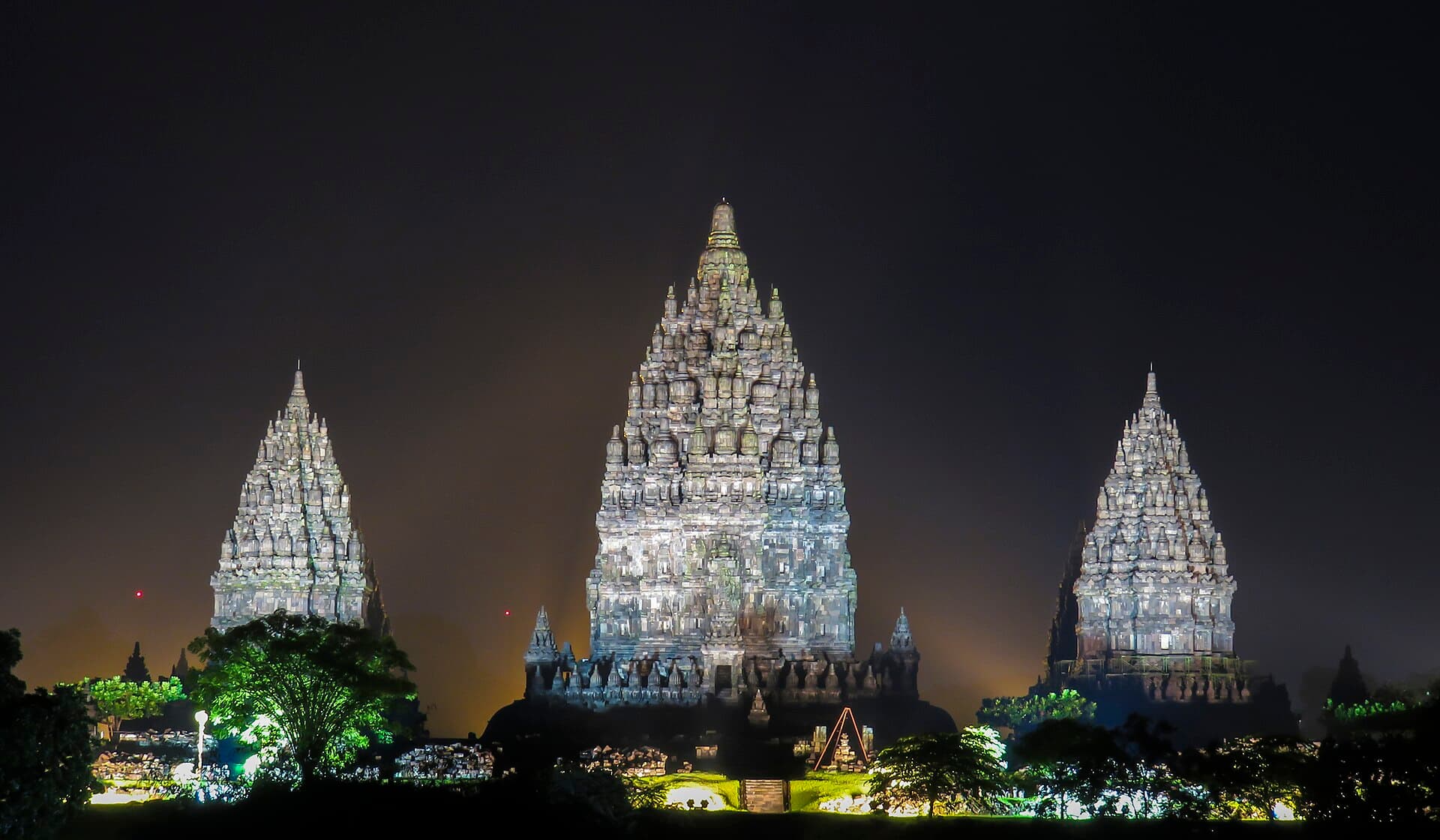
On the volcanic plain of Central Java, in modern Indonesia, a cluster of tall stone spires stands against the outline of Mount Merapi. This is Prambanan, the largest Hindu temple compound in Indonesia and one of the largest in Southeast Asia, raised around 850 CE by the kings of the Mataram kingdom and inscribed on the UNESCO World Heritage List in 1991. Its central tower, dedicated to Shiva, climbs 47 metres. The compound once held about 240 temples arranged in concentric courts, a whole city of shrines built to state, in stone, that the gods of India had taken root in Java.
Prambanan has a counterpart, and the pairing matters. Some fifty kilometres to the west, Borobudur had been completed by the Buddhist Shailendra line only a generation or so earlier. Prambanan is widely read as the answer of the Hindu Sanjaya line, under King Rakai Pikatan, whose marriage into the Shailendra family joined the two courts even as their monuments faced each other across one Javanese century: a mountain of quiet terraces for the Buddha, a forest of towers for Shiva, Vishnu, and Brahma. Almost everything else about that kingdom has vanished. Its two monuments remain, and Prambanan's survival, unlike Borobudur's, had to be won back piece by piece.
The Mataram kingdom of the eighth and ninth centuries left few written records, but its broad shape is legible in inscriptions and in stone. Two royal lines shared the rice plains of Central Java: the Shailendra, patrons of Buddhism, and the Sanjaya, patrons of Shiva. The Shivagrha inscription of 856 CE describes a great temple complex for Shiva whose dedication most scholars connect with Prambanan, placing its construction in the reign of Rakai Pikatan around the year 850. Successive kings added rows of smaller shrines around the central court, so that the finished ensemble was less a single building than a dynastic project sustained across decades.
The site was not chosen casually. The plain of Prambanan was the ceremonial heart of the kingdom, shadowed by Merapi, one of the most active volcanoes on earth. Javanese temples were built as replicas of Mount Meru, the cosmic mountain, and here the architects raised their Meru within sight of a real and restless one. The same volcano that lent the site its sacred geography would later help to empty it.
The plan of Prambanan is a mandala worked out on the ground. Three concentric square courts step inward toward the sanctuary. The outer courts held 224 small shrines called perwara temples, arranged in four neat rows, built by nobles as acts of devotion to the royal centre. The inner court, walled and raised, holds the principal temples. Three great towers stand in a line facing east: the Trimurti shrines of Brahma the creator to the south, Shiva the destroyer in the centre, and Vishnu the keeper to the north, faced by three smaller temples for their animal mounts, including Nandi the bull, who still kneels in stone before his lord.
The Shiva temple is the summit of the whole design, 47 metres tall and 34 metres on a side. Inside, four chambers open to the four directions: a three-metre statue of Shiva to the east, and his consort Durga, the sage Agastya, and his elephant-headed son Ganesha in the others. The compound, courts within courts and gods within chambers, was a diagram of the cosmos that a worshipper could enter, and at its centre stood the king's god, and behind the god, the king.
Like Borobudur, Prambanan is a book as well as a building, and it is read the same way, by walking. The balustrades carry a continuous relief cycle of the Ramayana, the epic of Prince Rama, his abducted wife Sita, and the demon king Ravana. A visitor who enters the Shiva temple from the east and circles it clockwise, keeping the wall to the right in the old rite of pradakshina, follows the story panel by panel: the exile, the golden deer, the theft of Sita, the alliance with the monkey general Hanuman. The narrative then continues on the Brahma temple to its conclusion, while the Vishnu temple carries scenes of Krishna.
The carving is among the finest in Javanese art, crowded with birds, musicians, and domestic details that keep a portrait of ninth-century Java in the margins of the epic. The reliefs did more than decorate. They fixed the Ramayana in the landscape of Java so firmly that the story outlived the religion that carved it, surviving the island's later conversion to Islam as shadow theatre, dance, and poetry, and eventually returning to the temple itself.
Long after the builders were forgotten, the people who lived among the ruins explained them with a story. A prince named Bandung Bondowoso, the legend runs, conquered the kingdom and demanded the hand of its princess, Roro Jonggrang. She set an impossible price: a thousand temples built in a single night. The prince summoned an army of spirits, and by the deep of night 999 temples stood finished. The princess woke the village women to pound rice and set fires in the east, and the roosters, fooled by the false dawn, began to crow. The spirits fled with one temple unbuilt. Discovering the trick, the prince cursed Roro Jonggrang to stone, and the villagers will tell you she stands there still, as the statue of Durga in the north chamber of the Shiva temple.
The legend is not history, but it is not nothing. It records how a community re-storied a monument it could no longer read, turning a field of collapsed shrines into the setting of a folk tale about pride and a bargain that could not be kept. The name stuck: local people still call the temple Roro Jonggrang, the slender maiden, and the tale kept the ruins charged with meaning through the centuries when their builders' names were lost.
Prambanan's active life was short. Around 930 CE the court of Mataram moved to East Java, a migration whose causes are debated but which many scholars link to eruptions of Merapi as well as to politics and trade. Deprived of its patrons, the compound was neglected, and the earthquakes that visit this stretch of Java did the rest. A major earthquake, often placed around the era of the great calamity Javanese sources record in the early eleventh century, brought many of the towers down. Villagers grew rice among the mounds and carted off temple stone for foundations.
Europeans took notice in 1733, when the Dutch surveyor C. A. Lons reported the ruins, and the site was surveyed under Thomas Stamford Raffles in the early nineteenth century. Rediscovery brought not rescue but decades of casual plunder: collectors removed sculpture, and the collapsed courts were treated as a quarry with a romantic reputation. By 1900 Prambanan was famous, catalogued, and still a heap.
The rebuilding began in 1918, when the Dutch colonial archaeological service started sorting the rubble, and turned serious in the 1930s with a commitment to anastylosis, the method that reconstructs a monument only from its own original stones, each one identified, numbered, and returned to its place. The rule is strict: a temple is rebuilt only when enough of its original fabric survives to justify the work, with new stone confined to filling gaps. The reconstruction of the Shiva temple outlasted the colonial power that began it and was completed in 1953, inaugurated by President Sukarno: newly independent Indonesia finished raising the tower a Dutch service had begun, and claimed the monument as a national symbol in the act.
The other great shrines followed across the later twentieth century, but the rule has a visible cost. Of the 224 perwara temples of the outer courts, only a handful have been rebuilt; the rest survive as low platforms and neat, sorted piles of stone, waiting for a completeness that may never come. The site is a working argument that a truthful ruin is worth more than a confident fake. The argument was tested again on 27 May 2006, when a magnitude 6.3 earthquake near Yogyakarta killed thousands and cracked and toppled parts of the temples. Conservators closed the inner zone, assessed every shrine, and repaired the damage over the following years, one more layer in a century of documented mending.
Prambanan did not return as a museum piece only. Since 1961 the Ramayana ballet has been performed on an open-air stage beside the compound, on full-moon nights against the floodlit towers, dancers and gamelan musicians acting out the same epic that is carved on the balustrades behind them. It closes a loop eleven centuries wide: the story the temple was built to tell is told again in its forecourt, in Javanese dance, for audiences of every faith.
Worship has returned as well. Indonesian Hindus, many from Bali and a growing community in Java, now celebrate major ceremonies at Prambanan, and the compound serves once more as a living temple on holy days. The UNESCO inscription of 1991 recognised the ensemble, with the nearby Buddhist temples of Sewu and Lumbung, as a masterpiece of the classical age of Java. The listing protects the stones; the ballet, the ceremonies, and the legend of the slender maiden keep them in use.
Prambanan exists twice over. It exists because a ninth-century king wanted the plain of Mataram to declare his gods and his line, and it exists because much later generations, colonial surveyors, Indonesian archaeologists, and conservators after each earthquake, agreed to reassemble what time had scattered under a discipline that forbids guessing. Every tower a visitor sees has been taken apart by the earth and put back by hand, stone by numbered stone, and the sorted piles in the outer courts are a promise that the work will continue only as fast as the evidence allows. Most monuments ask to be admired. Prambanan asks something rarer: to be continued. In the long human effort to keep what matters, it stands for the keepers as much as the builders, for the patience that treats every fragment as testimony and every restoration as a record that must still be true a century on.
A kingdom builds its answer
Two hundred and forty temples
Reading the Ramayana by walking
The princess and the thousand temples
Abandonment, ruin, and rediscovery
Anastylosis, or the patience of stone
A stage for the gods again
The monument that keeps being kept
References and resources
- UNESCO World Heritage Centre. "Prambanan Temple Compounds." World Heritage List, property no. 642, inscribed 1991. whc.unesco.org/en/list/642.
- Encyclopaedia Britannica. "Prambanan." britannica.com/place/Prambanan.
- Wikipedia. "Prambanan," "Rara Jonggrang," "Shivagrha inscription," and "Mataram Kingdom." Retrieved 2026.
- Borobudur Prambanan Ratu Boko Tourism Park. "Prambanan Temple" and "Ramayana Ballet Prambanan." borobudurpark.com.
- Jordaan, Roy E., ed. In Praise of Prambanan: Dutch Essays on the Loro Jonggrang Temple Complex. KITLV Press, 1996.