Heritage · Landmark
Borobudur: History, Architecture and Visitor Guide
Borobudur in Central Java is the world's largest Buddhist temple, a 9th-century Sailendra stupa-mandala with nine terraces, 504 Buddhas and 2,672 panels.Written to last.
By Confinity Heritage Editorial · Updated 2026-07-31 · 7-minute readQuiet tools, kept out of the way.
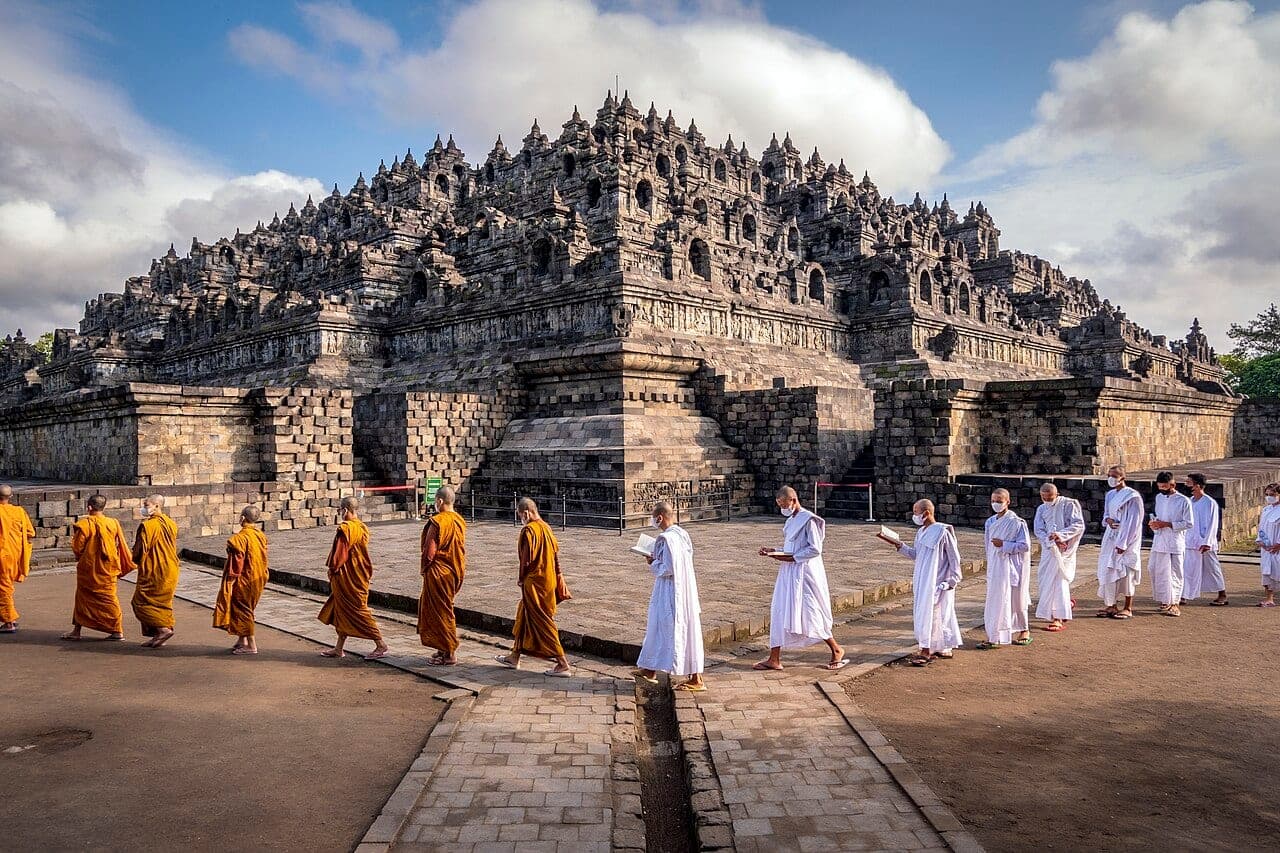
Borobudur rises from the fertile Kedu Plain of Central Java, a mountain of dark volcanic stone shaped into the largest Buddhist temple in the world (UNESCO). Built in the ninth century under the Sailendra dynasty, it is not a hollow building but a solid stepped pyramid that a pilgrim climbs, level by level, to a single great stupa at its summit (Britannica). Nine terraces carry more than 2,600 relief panels and 504 statues of the Buddha, making it a place of worship, a scripture in stone, and a high point of early Southeast Asian art (Wikipedia).
For centuries the temple lay quiet beneath volcanic ash and forest, before being cleared in the nineteenth century and rebuilt in the twentieth. Today it is both a UNESCO World Heritage Site, inscribed in 1991, and a living sanctuary where Buddhists gather each year for the festival of Vesak (UNESCO).
The Sailendra rulers of central Java raised Borobudur across roughly six decades, from about 780 to 833 CE, when Mahayana Buddhism flourished under their patronage (Wikipedia). The work was immense: an estimated two million blocks of andesite were fitted without mortar around a natural hill, then carved in place with the reliefs that cover it.
Within about two centuries the surrounding region declined and Javanese power shifted east, perhaps after volcanic eruptions (Britannica). Borobudur was gradually abandoned, and ash and tropical growth hid much of it from view.
The monument returned to wider attention in 1814. During the brief British administration of Java, the lieutenant governor Thomas Stamford Raffles heard of a great buried monument and sent the surveyor Hermann Cornelius to investigate; his team spent about two months clearing trees and earth to expose it (Wikipedia). Study continued through the century, though early decades also saw statues and reliefs looted.
The first major restoration came between 1907 and 1911, when the Dutch engineer Theodoor van Erp reset the upper terraces, rebuilt stupas, and improved drainage (Wikipedia). His work stabilised the monument but could not stop water seeping through the fill and weakening the foundations. The decisive rescue was a vast international campaign led by UNESCO with the Indonesian government between 1975 and 1982: workers dismantled the lower terraces stone by stone, cleaned and catalogued more than a million blocks, and laid new drains before rebuilding (UNESCO). In 1991 the restored temple, with the nearby temples of Mendut and Pawon, was inscribed on the World Heritage List.
Borobudur is built as a three-dimensional mandala, a diagram of the Buddhist universe that the pilgrim experiences by moving through it (Britannica). The plan is a great square with projecting corners, rising through nine terraces: six square lower levels, three round upper levels, and a large central stupa crowning the whole (Wikipedia). The base measures roughly 118 metres on each side, and the monument stands about 35 metres high.
 On the three circular terraces, seventy-two perforated stupas each hold a seated Buddha, visible but not quite reachable. Photograph by CEphoto, Uwe Aranas, CC BY-SA 3.0, via Wikimedia Commons.
The ascent is arranged as a journey through three levels of Buddhist cosmology. The lowest zone represents Kamadhatu, the realm of desire; the square galleries form Rupadhatu, the realm of form; and the open circular terraces near the summit represent Arupadhatu, the formless realm beyond attachment (Wikipedia). Pilgrims traditionally walk clockwise around each level, a practice known as pradaksina, keeping the monument on their right as they rise.
Along the galleries run some 2,672 relief panels, of which about 1,460 are narrative, illustrating the life of the Buddha and teachings on action, cause, and the path to enlightenment (Wikipedia). Niches around the terraces hold 504 seated Buddha statues. On the three circular platforms stand 72 bell-shaped stupas of perforated stone, each sheltering a Buddha figure partly visible through the openings, an image of enlightenment glimpsed but not yet fully grasped. At the centre rises a single sealed stupa, empty within, standing for the formless absolute.
Borobudur is not only an ancient site but a place of continuing devotion. Each year at Vesak, the festival marking the birth, enlightenment, and passing of the Buddha, Buddhists from across Indonesia and abroad gather for prayer and candlelit processions, walking between the temples of Mendut and Pawon and on to Borobudur (Wikipedia). For the Buddhist community of Java the monument remains a sacred centre rather than merely a relic.
Beyond its religious life, Borobudur is one of the enduring symbols of Indonesia, and a reminder that the archipelago was, more than a thousand years ago, a centre of learning and art connected to the wider Buddhist world of Asia.
The temple lies in Magelang Regency, about 40 kilometres northwest of Yogyakarta, the usual base for visitors, which is reached by air, rail, and road (Britannica). Many travellers combine it with the Hindu temples of Prambanan, another World Heritage Site nearby.
To protect the ancient stone from the wear of heavy footfall, access to the upper terraces is now managed carefully. The number allowed to climb each day is limited by a quota, visitors are asked to be accompanied by licensed local guides, and those going up wear soft woven sandals, called upanat, designed to reduce abrasion on the steps (Wikipedia). Because these rules change from time to time, visitors should check current requirements and book climbing tickets in advance, and dress modestly in keeping with the sacred character of the site.
Borobudur sits close to the active volcano Merapi and is exposed to heavy tropical rain, so its survival has depended on repeated care. Water is the constant threat, seeping into the fill behind the terraces and eroding the carvings, which is why the 1907–1911 and 1975–1982 restorations both concentrated on drainage as much as on resetting stone (UNESCO). Ash is also a hazard: after the 2010 eruption of Merapi, conservators cleaned acidic ash from the monument to protect the reliefs.
The temple has also suffered deliberate harm. On 21 January 1985 a group of bombers detonated explosives that damaged nine stupas on the upper terraces; no one was hurt, and the stupas were afterwards repaired (Wikipedia). Conservation remains a continuing effort, combining monitoring, restoration, and the visitor limits above, so that a monument more than a thousand years old can be handed on intact.
On the three circular terraces, seventy-two perforated stupas each hold a seated Buddha, visible but not quite reachable. Photograph by CEphoto, Uwe Aranas, CC BY-SA 3.0, via Wikimedia Commons.
The ascent is arranged as a journey through three levels of Buddhist cosmology. The lowest zone represents Kamadhatu, the realm of desire; the square galleries form Rupadhatu, the realm of form; and the open circular terraces near the summit represent Arupadhatu, the formless realm beyond attachment (Wikipedia). Pilgrims traditionally walk clockwise around each level, a practice known as pradaksina, keeping the monument on their right as they rise.
Along the galleries run some 2,672 relief panels, of which about 1,460 are narrative, illustrating the life of the Buddha and teachings on action, cause, and the path to enlightenment (Wikipedia). Niches around the terraces hold 504 seated Buddha statues. On the three circular platforms stand 72 bell-shaped stupas of perforated stone, each sheltering a Buddha figure partly visible through the openings, an image of enlightenment glimpsed but not yet fully grasped. At the centre rises a single sealed stupa, empty within, standing for the formless absolute.
Borobudur is not only an ancient site but a place of continuing devotion. Each year at Vesak, the festival marking the birth, enlightenment, and passing of the Buddha, Buddhists from across Indonesia and abroad gather for prayer and candlelit processions, walking between the temples of Mendut and Pawon and on to Borobudur (Wikipedia). For the Buddhist community of Java the monument remains a sacred centre rather than merely a relic.
Beyond its religious life, Borobudur is one of the enduring symbols of Indonesia, and a reminder that the archipelago was, more than a thousand years ago, a centre of learning and art connected to the wider Buddhist world of Asia.
The temple lies in Magelang Regency, about 40 kilometres northwest of Yogyakarta, the usual base for visitors, which is reached by air, rail, and road (Britannica). Many travellers combine it with the Hindu temples of Prambanan, another World Heritage Site nearby.
To protect the ancient stone from the wear of heavy footfall, access to the upper terraces is now managed carefully. The number allowed to climb each day is limited by a quota, visitors are asked to be accompanied by licensed local guides, and those going up wear soft woven sandals, called upanat, designed to reduce abrasion on the steps (Wikipedia). Because these rules change from time to time, visitors should check current requirements and book climbing tickets in advance, and dress modestly in keeping with the sacred character of the site.
Borobudur sits close to the active volcano Merapi and is exposed to heavy tropical rain, so its survival has depended on repeated care. Water is the constant threat, seeping into the fill behind the terraces and eroding the carvings, which is why the 1907–1911 and 1975–1982 restorations both concentrated on drainage as much as on resetting stone (UNESCO). Ash is also a hazard: after the 2010 eruption of Merapi, conservators cleaned acidic ash from the monument to protect the reliefs.
The temple has also suffered deliberate harm. On 21 January 1985 a group of bombers detonated explosives that damaged nine stupas on the upper terraces; no one was hurt, and the stupas were afterwards repaired (Wikipedia). Conservation remains a continuing effort, combining monitoring, restoration, and the visitor limits above, so that a monument more than a thousand years old can be handed on intact.
History
Architecture and meaning
Cultural role
Visiting
Preservation
References and resources
- UNESCO World Heritage Centre: Borobudur Temple Compounds: inscription, the international restoration campaign, and site description.
- Encyclopaedia Britannica: Borobudur: dating, Sailendra construction, and architectural overview.
- Wikipedia: Borobudur: construction, dimensions, reliefs, cosmology, rediscovery, restorations, and the 1985 bombing.