Heritage · University
University of Copenhagen: History and Overview
Founded in 1479 under papal permission granted to King Christian I, the University of Copenhagen is Denmark's oldest university. Its buildings burned with the city in 1728 and again in the British bombardment of 1807, yet it rebuilt each time and went on to house Niels Bohr's institute, the birthplace of quantum mechanics' Copenhagen interpretation, and the Arnamagnæan Collection of Icelandic saga manuscripts.Written to last.
By Confinity Heritage Editorial · 2026-08-24 · 8-minute readQuiet tools, kept out of the way.
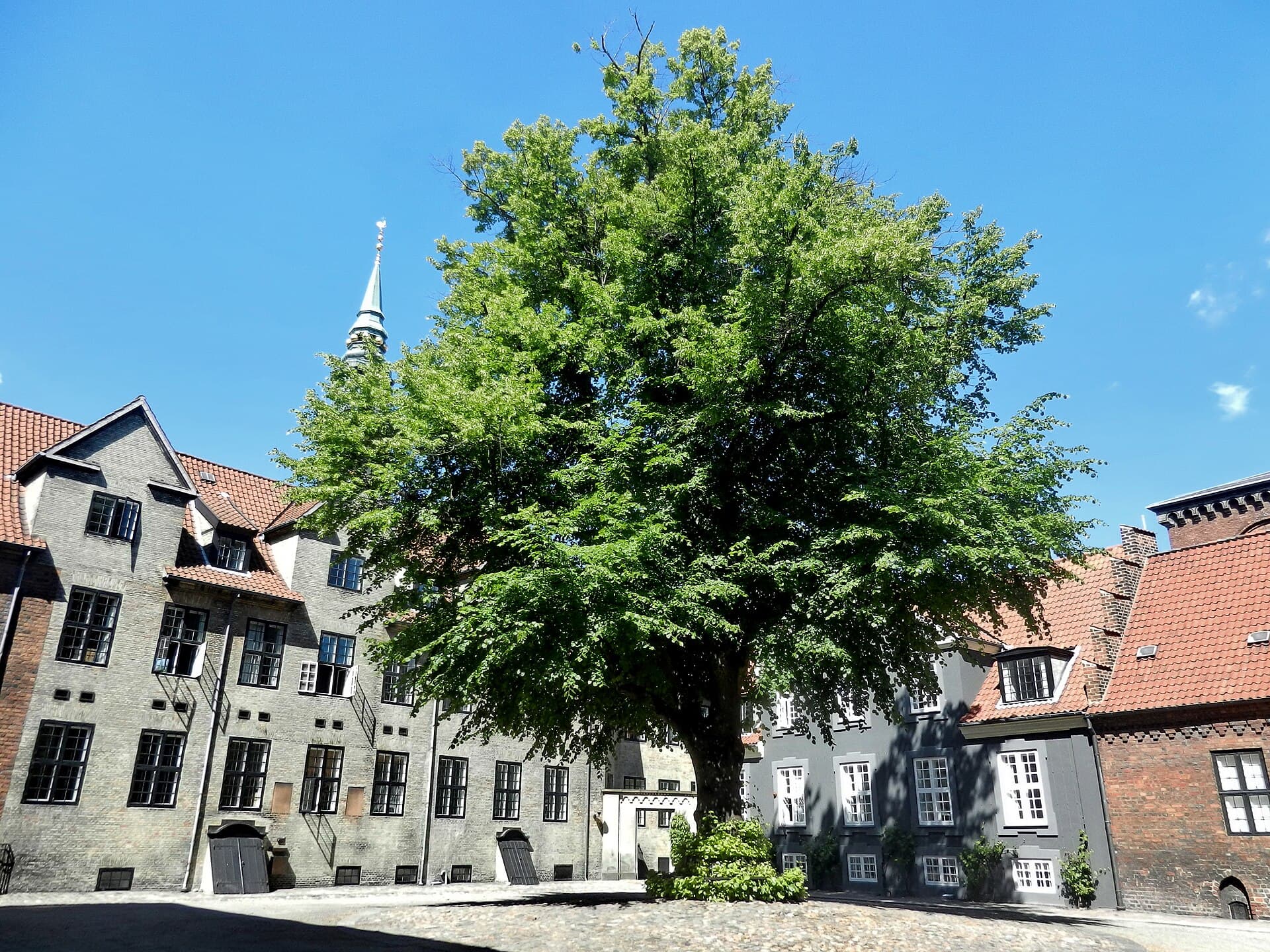
The University of Copenhagen is Denmark's oldest university and one of the oldest in Northern Europe, founded on 1 June 1479 after Pope Sixtus IV granted King Christian I permission to establish a place of higher learning in his capital. Its ceremonial heart still stands at Frue Plads in the centre of the old city, a neoclassical main building beside the Church of Our Lady, Copenhagen's cathedral, church and university facing the same small square.
For anyone concerned with how memory survives, Copenhagen is a sobering and finally hopeful case. The university has burned twice, losing its library and much of its early written record, and twice rebuilt itself around the gap. What it keeps today is remarkable: the institute where Niels Bohr and his visitors argued quantum mechanics into its modern form, and the medieval Icelandic manuscripts Denmark spent a quarter of a century handing back.
The founding followed a pattern common to late medieval Europe. Christian I sought papal sanction, received a bull from Sixtus IV in 1475, and opened the university four years later on the model of the University of Cologne, with the four classical faculties of theology, law, medicine and philosophy. It arrived two years after Uppsala University in Sweden, and the two remain the Nordic region's senior institutions. The Reformation interrupted everything: teaching collapsed in the turmoil of the 1530s, and Christian III re-established the university in 1537 as a Lutheran institution charged with training the clergy of the new Danish church.
Then came the fires. In October 1728 a blaze consumed much of Copenhagen, and the university burned with the city. Its buildings were gutted and the University Library, housed in the loft above Trinitatis Church, was destroyed, taking tens of thousands of volumes and with them a large part of the documentary record of medieval Denmark. Whole categories of source material for early Danish history ceased to exist in a single night. The university rebuilt, only for catastrophe to return. In September 1807 the British fleet bombarded Copenhagen to seize the Danish navy, and the shells wrecked the university quarter along with the cathedral beside it. The present main building at Frue Plads, designed by Peder Malling, rose from that rubble between 1831 and 1836, and the rebuilt cathedral rose beside it.
The nineteenth century brought steady widening. Women were admitted from 1875, and Nielsine Nielsen took a degree in medicine in 1885, the first Danish woman to graduate from a university. Through the twentieth century the old four-faculty college grew into a large research university spread across the city, though its formal ceremonies still return to Malling's hall on Frue Plads.
The university today is organised into six faculties, covering health and medical sciences, humanities, law, science, social sciences and theology, taught across four campus areas: North Campus and City Campus in central Copenhagen, South Campus on Amager, and Frederiksberg Campus to the west. Around 37,000 students study there, making it one of the largest universities in the Nordic countries.
The Frue Plads building remains the symbolic centre, its interior still used for doctoral conferrals and formal occasions. The university's scientific past is written across the city as well. The Round Tower on Købmagergade was built in the mid seventeenth century as the university's astronomical observatory, part of the Trinitatis complex that also held the ill-fated library. The Botanical Garden and the Natural History Museum of Denmark belong to the university, and a few streets north, on Blegdamsvej, stands a modest yellow-brick building with an outsized place in the history of physics.
Niels Bohr took his doctorate at Copenhagen in 1911, won the university's chair of theoretical physics, and in 1921 opened the Institute for Theoretical Physics. Through the 1920s and 1930s the institute on Blegdamsvej became the home address of the new quantum mechanics. Werner Heisenberg worked there when he developed the uncertainty principle, Wolfgang Pauli, Paul Dirac and George Gamow passed through its rooms, and the understanding of quantum theory hammered out in Bohr's long, patient arguments with his visitors became known, after the city, as the Copenhagen interpretation. Heisenberg returned in September 1941, by then head of Germany's atomic research, for a private conversation with Bohr that ended their friendship; what was said remains disputed, and the ambiguity became the subject of Michael Frayn's play Copenhagen. In 1943, warned of imminent arrest, Bohr fled across the sound to Sweden, where he pressed the Swedish government to receive Danish refugees; in the same weeks the Danish resistance and ordinary citizens ferried more than seven thousand Danish Jews to safety across the same water. The institute was renamed the Niels Bohr Institute in 1965, on what would have been his eightieth birthday, and the Niels Bohr Archive beside it keeps his papers and correspondence for scholars.
The university's other great holding is far older. Árni Magnússon, an Icelandic-born professor at Copenhagen, spent decades gathering the manuscripts of medieval Iceland, the sagas, law codes and Eddic poetry in which the Norse world wrote itself down. The 1728 fire reached his house and destroyed most of his printed books, but the manuscripts themselves were largely carried to safety, and on his death in 1730 he left the collection to the university. The Arnamagnæan Collection that bears his name was inscribed in UNESCO's Memory of the World Register in 2009. Its most striking chapter is an act of return. After long negotiation, Denmark agreed to transfer the manuscripts of Icelandic origin to Iceland, and in April 1971 a Danish naval vessel carried the first of them, including the Codex Regius of the Poetic Edda and the great Flateyjarbók, into Reykjavik harbour before waiting crowds. The transfers continued until 1997, dividing the collection between Copenhagen and Reykjavik. It stands as one of the few completed repatriations of a national written memory, and the Copenhagen institute still studies, conserves and teaches from the portion that remains.
The university's scientific roll call begins early. Tycho Brahe enrolled as a boy in 1559, and it was during his student years in Copenhagen that an eclipse turned him toward astronomy, the vocation he pursued at his island observatory of Uraniborg. Ole Rømer studied at Copenhagen before joining the Paris Observatory, where in 1676 his timings of the eclipses of Jupiter's moon Io gave the first demonstration that light travels at a finite speed; he returned to Copenhagen as professor of astronomy. In April 1820, during a lecture demonstration at the university, Hans Christian Ørsted noticed a compass needle swing beside a wire carrying electric current. That small twitch of a needle was the discovery of electromagnetism, the first evidence that electricity and magnetism were one subject, and the physics of the following century flowed from it.
The humanities have their own towering graduate. Søren Kierkegaard entered the university in 1830 to read theology and defended his dissertation, On the Concept of Irony, in 1841. He rarely left the city; his philosophy was walked out along its streets, and the university, the cathedral and the pastors it trained were the antagonists of his late polemics. The Nobel roll is long for a small country: Niels Ryberg Finsen in 1903 for light therapy, August Krogh in 1920 for the physiology of capillaries, Bohr himself in 1922, Henrik Dam for the discovery of vitamin K, Aage Bohr and Ben Mottelson at the Niels Bohr Institute in 1975, the immunologist Niels K. Jerne in 1984, and Morten Meldal in 2022 for click chemistry.
Copenhagen consistently ranks among the leading universities of continental Europe and at or near the top of the Nordic region. It is a member of the International Alliance of Research Universities and the League of European Research Universities, and its research strengths run from quantum physics and climate science to protein science, archaeology and the study of the very manuscripts Árni Magnússon saved. The Niels Bohr Institute remains a working research centre rather than a museum, its historic building honoured as a site of exceptional significance by the European Physical Society.
The historic core sits at Frue Plads in central Copenhagen, a short walk from Strøget, with the main building's facade and the cathedral forming one of the city's calmest squares. The building is a working university and opens fully only on occasion, but the square, the Round Tower, the university's Botanical Garden and the Natural History Museum of Denmark are all open to visitors. On Blegdamsvej the Niels Bohr Institute carries its plaques for those who want to stand where quantum mechanics was argued out. Copenhagen is compact; the whole of this history can be walked in an afternoon.