Heritage · University
Babeș-Bolyai University: History and Overview
Babeș-Bolyai University in Cluj-Napoca is Romania's largest university, formed in 1959 when the Romanian-language Victor Babeș University and the Hungarian-language Bolyai University were made one institution. Its line runs back through the Hungarian Royal University of 1872 to a Jesuit college chartered by Stephen Báthory in 1581. It teaches in Romanian, Hungarian and German, each language a separate line of study with its own vice-rector.Written to last.
By Confinity Heritage Editorial · 2026-08-25 · 8-minute readQuiet tools, kept out of the way.
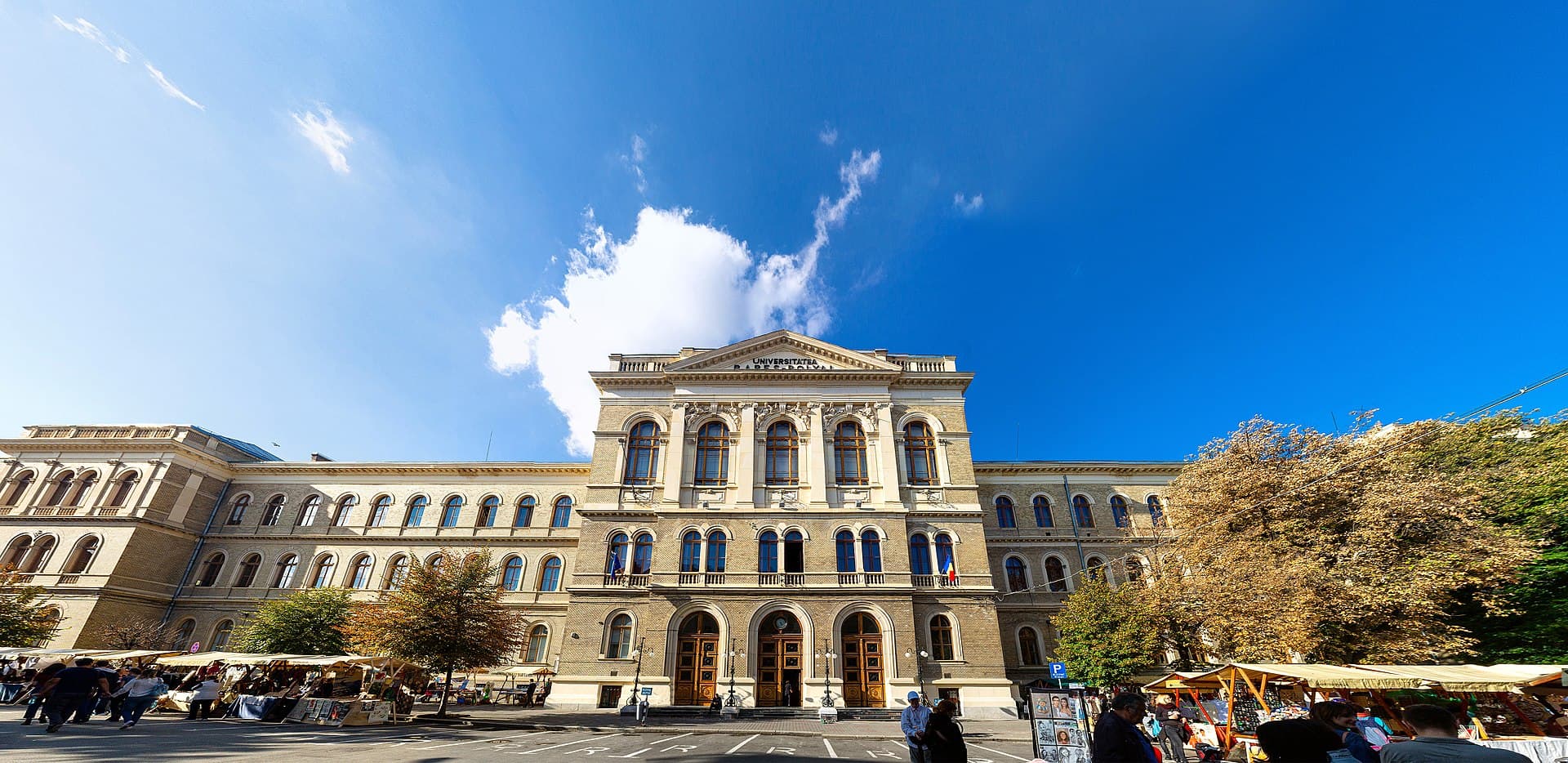
The main building of Babeș-Bolyai University takes up most of a block on Mihail Kogălniceanu Street in Cluj-Napoca: a pale central pavilion under a pediment, long brick wings either side, stalls trading on the pavement in front. It is the largest university in Romania, and the name across the pediment was assembled from two men who never held a post in the building. Victor Babeș was a Romanian bacteriologist; János Bolyai, born in this city, was the Hungarian mathematician who worked out a geometry in which Euclid's parallel postulate does not hold.
Cluj changed states three times between 1919 and 1945, and the university changed the language it taught in each time. Hungarian until 1919, Romanian after the Treaty of Trianon, Hungarian again under the Second Vienna Award of 1940, Romanian again from 1945, then two universities running side by side in one city, then one. Since 1995 the arrangement has been written into the timetable: three lines of study, Romanian, Hungarian and German, each with its own vice-rector, its own secretariat and its own regulations.
Ștefan Báthory, Prince of Transylvania and King of Poland, asked Pope Gregory XIII in 1578 for permission to found a Jesuit college in Cluj, and the royal foundational diploma of the Academia Claudiopolitana Societatis Jesu followed on 12 May 1581. It taught in Latin, in faculties of philosophy and theology, with the right to confer the degrees of baccalaureus, magister and doctor. Teaching ran until about 1607, when the Jesuits were banned from Transylvania, and resumed in the autumn of 1698. By 1776 the Universitas Claudiopolitana had all four classical faculties; in 1784 Joseph II reduced it to a lyceum, and university-level work passed to a surgical-medical institute and an academy of law.
József Eötvös, Hungary's education minister, proposed in 1870 that a new university at Kolozsvár teach in Hungarian, Romanian and German, a plan the Romanian elite welcomed. He died in 1871. The Hungarian Royal University that Franz Joseph I legislated into being in 1872 taught in Hungarian only. It opened with four faculties and 258 students, absorbed the two older institutes, took the emperor's name in 1881 and admitted women from 1895. Between 1872 and 1918 more than 40,000 students studied there, among them more than 2,600 Romanians, including Iuliu Maniu and the poet George Coșbuc. The son of the minister who wanted three languages gave his name, much later, to Eötvös Loránd University in Budapest.
The handover of 1919 was not amicable. Rector István Schneller and his council refused in May to swear allegiance to the Romanian king; he signed the transfer record under protest, and King Ferdinand I's decree of 12 September turned the Royal Hungarian Franz Joseph University into a Romanian university from 1 October. Those who would not take the oath left, and re-established their university at Szeged in 1921. Vasile Pârvan gave the inaugural lecture on 3 November 1919, to an institution of four faculties and 1,871 students. The University of Tartu reopened in Estonian that same year, contemporary and unalike: Tartu's professors were inventing scholarly vocabulary for a language that had never carried it, while Cluj's were taking over a working university from the people who had built it.
The Second Vienna Award of 30 August 1940 gave Northern Transylvania to Hungary. The Romanian university was split and moved out that September, letters, medicine and law to Sibiu and the sciences to Timișoara. The Franz Joseph University came back from Szeged and taught in Hungarian until the end of the war. Romanian administration returned in the spring of 1945; decrees of 29 May transferred the buildings back and created a Hungarian-language state university in their place, named Bolyai that December after two Transylvanian mathematicians, Farkas Bolyai and his son János. The Romanian institution became Victor Babeș University in 1948. For fourteen years the city had two state universities, one in each language.
The central building at Mihail Kogălniceanu 1 went up in three stages between 1893 and 1902, neo-Renaissance in style, covering 4,226 square metres and holding the ceremonial Aula Magna. It stands at the end of the street where the Jesuits had built their college and church.
The Central University Library at Clinicilor 2 was built between 1906 and 1909 on the model of the university library at Basel. Its collections are older than the building: a contract signed on 29 August 1872 handed over the holdings of the Transylvanian Museum Society. Its name has followed the state that owned it, the Ferdinand I University Library from 1927 and the Lucian Blaga Central University Library since 1992.
The interwar Romanian university built its research institutes quickly. Emil Racoviță's Institute of Speleology, Alexandru Borza's botanical garden, the astronomical observatory and Sextil Pușcariu's Museum of the Romanian Language all date from the 1920s. The garden had been founded in 1872 by Sámuel Brassai and was taken over by the Romanian university in 1920; it carries Borza's name now.
The official site lists twenty-three faculties. Four are faculties of theology, Orthodox, Greek-Catholic, Reformed and Roman Catholic, a combination the university believes no other in Europe maintains.
Decisions taken by the Romanian state and party leadership between March and July 1959 ended the two-university arrangement, and the single institution began work that September as Babeș-Bolyai University, with six faculties and the archaeologist Constantin Daicoviciu as its first rector. The party's general secretary then was Gheorghe Gheorghiu-Dej; Ceaușescu did not take the leadership until 1965. The university's own history records the arithmetic plainly: 702 teaching positions afterwards, against 782 before. Of the 4,502 students enrolled in 1959-60, 3,159 were Romanian, 1,285 Hungarian and 36 German.
The two communities use different verbs for what happened. The 2024 charter and the official history call it a unification, two universities merged into one institution carrying both traditions. Hungarian accounts call it an abolition. English Wikipedia's article on Hungarians in Romania says the Bolyai University was disbanded in 1959 by Romanian communist authorities; its article on Romanianization calls the result an almost exclusively Romanian-language institution and notes that several Hungarian professors took their own lives. One of them was László Szabédi, a poet and translator on the Bolyai staff who had been given the first class of the Order of the Star of the Romanian People's Republic in 1958; he died by suicide in Cluj on 18 April 1959. The disagreement runs backwards too. The Hungarian account holds that the Franz Joseph University was closed in 1945 without a legal successor; the Romanian one treats the whole line from 1581 as a single institution.
The name was a settlement of a sort, and neither half of it fits neatly. Victor Babeș, born in Vienna in 1854 to a Romanian family from the Banat, taught in Budapest and from 1887 in Bucharest, never in Cluj. János Bolyai was born in Kolozsvár in 1802 and left young for the military academy in Vienna; he did the work as a serving army engineer, published it in 1832 as a twenty-four-page appendix to his father's textbook, and died in 1860 at Marosvásárhely, now Târgu Mureș, where his grave and his manuscripts remain. Between them the two names covered both communities, and neither man had belonged to the place.
The Hungarian share kept narrowing afterwards. In 1989 the university had 5,619 students and a teaching staff of 470 Romanians, 81 Hungarians and 6 Germans. From 1995 the institution reorganised itself as a multicultural university with three lines of study defined on linguistic criteria, and the 2024 charter makes the arrangement structural rather than ornamental: Article 13 declares the multicultural character and equal opportunity for instruction in the three languages, and the vice-rectors for the Hungarian and German lines are appointed on the recommendation of the staff of those lines. None of it has closed the argument. A campaign backed by the Democratic Alliance of Hungarians in Romania still presses for the Hungarian section to be separated out again as an independent Bolyai University.
The Hungarian university's mathematics was its strongest suit. Lipót Fejér, Alfréd Haar and Frigyes Riesz all taught at Kolozsvár, and the results attached to their names are still standard equipment in analysis. Sámuel Brassai, the polymath who was prorector at the opening in 1872, and the archaeologist Béla Pósta were colleagues of theirs.
Emil Racoviță joined the Romanian university in 1919 as head of biology, having sailed to Antarctica aboard the Belgica with Roald Amundsen among the crew. On 26 April 1920 he founded in Cluj the first institute of speleology anywhere in the world. He was rector in 1929-30 and died in the city in 1947.
In 1922 Munich rejected Hermann Oberth's doctoral dissertation on rocket flight as utopian. Augustin Maior, a professor at Cluj, offered him the chance to defend it there instead, and Oberth did so successfully on 23 May 1923, publishing it privately that June as Die Rakete zu den Planetenräumen. He was a Transylvanian Saxon from Sibiu, fluent in German, Hungarian and Romanian.
Lucian Blaga, whose name the library has carried since 1992, applied to the Romanian university in 1924 and was turned down, his habilitation thesis on the philosophy of style rejected. He lost his chair and his seat in the Romanian Academy in 1948, and spent the years after as a librarian in Cluj, forbidden to publish. Klaus Iohannis graduated from the Faculty of Physics in 1983.
Enrolment grew with the country's expansion of higher education: 41,690 students in 2015, and 48,620 in 2021. In 2015, 17 of the then 21 faculties ran teaching in Hungarian and 9 in German, alongside 337 Romanian degree programmes, 119 in Hungarian and 18 in German.
The education ministry classifies it as a university of advanced research and education, and it has ranked first in Romania in the national metaranking since 2016. It was placed in the 761-770 band of the QS World University Rankings for 2026. Among the older universities of central Europe it keeps company with Charles University in Prague and the Jagiellonian University in Kraków, neither of which has had to run its teaching in three languages at once.
The central building at Mihail Kogălniceanu 1 is a listed historic monument, and the Central University Library at Clinicilor 2 is a short walk away. The Alexandru Borza botanical garden in the south of the city covers more than fourteen hectares with over ten thousand species, and was listed as a historic monument in 2010. The Hajongard cemetery on Avram Iancu Street, founded in the sixteenth century, holds three of these men in one field: Sámuel Brassai, prorector of the Hungarian university of 1872, Emil Racoviță, rector of the Romanian one, and Constantin Daicoviciu, first rector of the merged university.
History
Campus and academics
What 1959 settled, and what it did not
Scholarship
The university today
Visiting
References and resources
- Babeș-Bolyai University: History (official)
- Charter of Babeș-Bolyai University, 2024 (official)
- Babeș-Bolyai University: Faculties (official)
- Lucian Blaga Central University Library: Short history (official)
- Wikipedia: Babeș-Bolyai University
- Wikipedia: Franz Joseph University
- Wikipedia: Hungarians in Romania
- Wikipedia: Romanianization
- Wikipedia: János Bolyai
- Wikipedia: Victor Babeș
- Wikipedia: Emil Racoviță
- Wikipedia: Hermann Oberth
- Wikipedia: Cluj-Napoca Botanical Garden
- Wikipedia: Hajongard cemetery