Heritage · University
University of Tartu: History and Overview
Founded in 1632 by King Gustavus Adolphus of Sweden, the University of Tartu is Estonia's national university and one of the oldest in northern Europe. Its white-porticoed main building anchors a small city of learning where the Estonian flag began as a student society's banner and the Struve Geodetic Arc has its first point.Written to last.
By Confinity Heritage Editorial · 2026-08-25 · 8-minute readQuiet tools, kept out of the way.
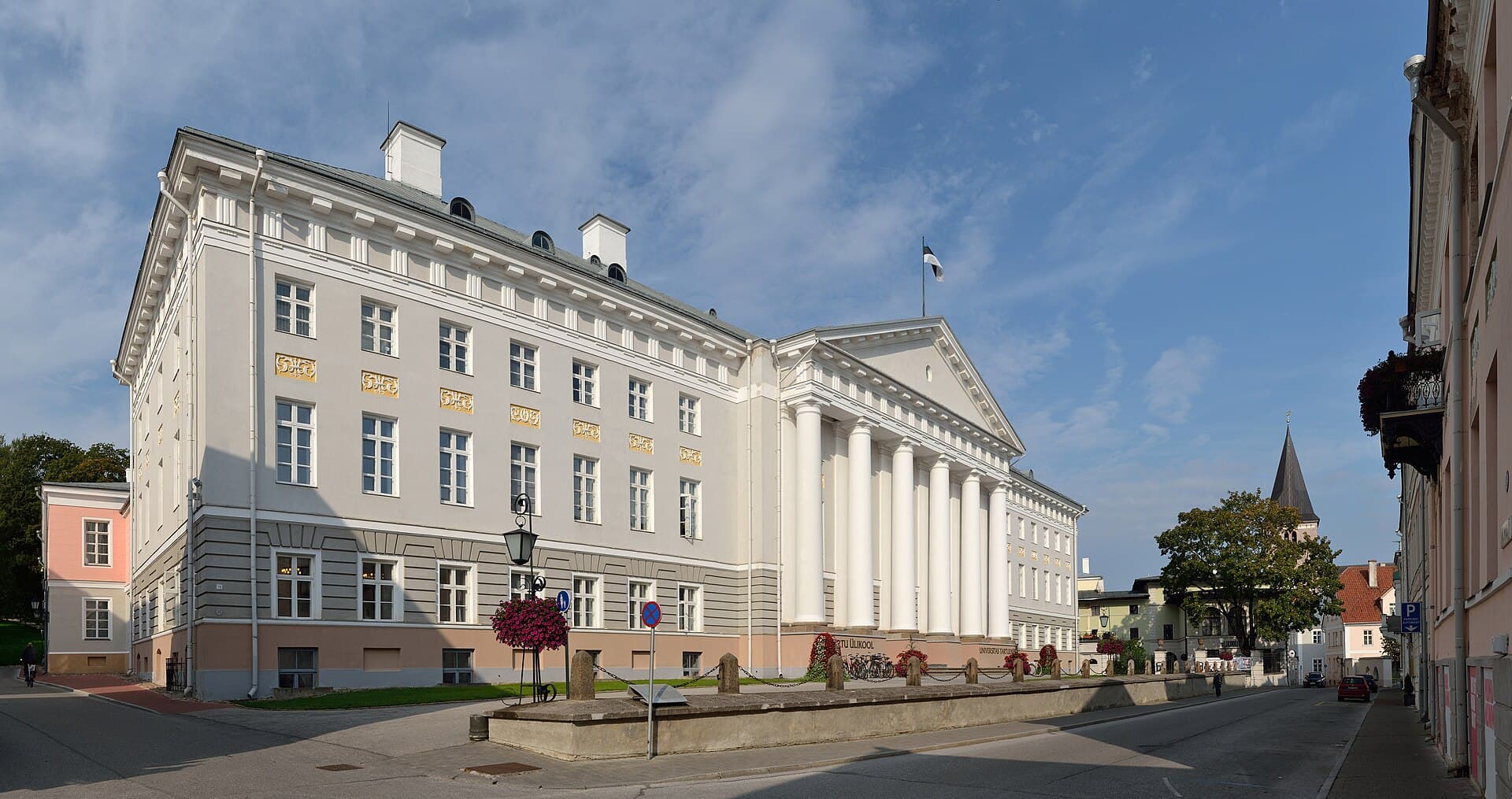
The University of Tartu is Estonia's national university and one of the oldest in northern Europe, founded in 1632 when Estonia was a province of the Swedish empire and refounded twice since, each time in a different language. Its main building, a neoclassical hall with a white six-columned portico completed in 1809, stands in the centre of a small southern Estonian city where roughly one resident in five is a student. Behind it rises Toome Hill, a wooded park holding the ruins of a medieval cathedral, an old observatory, and the statues of the scholars the university remembers best.
Few universities carry a nation's memory as literally as this one. The blue, black and white flag that flies over Estonia began in 1884 as the banner of a Tartu student society. The scientific tradition that produced the founder of embryology grew here in German, the language of the nineteenth-century university, and in 1919 the same institution became the first university anywhere to teach in Estonian.
King Gustavus II Adolphus of Sweden signed the founding decree on 30 June 1632, and the Academia Gustaviana opened that October with faculties of philosophy, law, theology and medicine, operating under the privileges of Uppsala. The king, then at the height of his campaigns in the Thirty Years' War, was planting in Livonia a university on the model of Uppsala University, whose great expansion he had driven at home; Tartu became the second university of the Swedish realm. He did not live to see it grow, falling at the Battle of Lützen a few weeks after the opening.
The academy's early centuries were repeatedly broken by war. Fighting between Sweden and Russia forced a move to Tallinn in 1656, and teaching ceased altogether in 1665. The university returned to Tartu in 1690, was evacuated to the coastal town of Pärnu in 1699, and closed in 1710, when the Great Northern War delivered the region to Russia. For nearly a century Tartu had no university at all.
The refounding came in 1802, under Emperor Alexander I, as the Imperial University of Dorpat, the German name of the town. Its language of instruction was German, its professors largely drawn from the German universities, and through the nineteenth century it became one of the empire's strongest scientific centres, a German-speaking academic island between St Petersburg and the Baltic. The observatory, the botanical garden, the clinics and the main building itself all date from this era.
The next transformation was the deepest. When Estonia declared independence in 1918, the university reopened on 1 December 1919 as the national university of the new republic, teaching in Estonian for the first time. No university had ever taught in the language, so its professors had to build the scholarly vocabulary as they went, coining Estonian terms for anatomy, law, chemistry and philosophy where none existed. It was the academic coming-of-age of the language, and it happened within a single generation.
The Soviet occupation that began in 1940 fell hard on the university. Professors and students were among those deported to the Soviet interior, others fled west in 1944, and the institution spent the following decades as Tartu State University under close ideological control. Estonian nevertheless remained a language of instruction, and the university served, quietly, as a keeper of the national culture through those years. With the restoration of Estonian independence in 1991 it regained its autonomy and its name.
The university's centre is the main building on Ülikooli Street, designed by its first architect Johann Wilhelm Krause and completed in 1809. Its white portico of six Tuscan columns has become the emblem of the institution. The assembly hall inside remains the setting for matriculation and doctoral ceremonies.
Toome Hill, a few minutes' walk behind it, is the university's memory made landscape. The ruined choir of the thirteenth-century cathedral was rebuilt in the 1800s to house the university library and now holds the University of Tartu Museum. Nearby stand the old anatomical theatre, two footbridges known as Angel's Bridge and Devil's Bridge, and the observatory of 1810.
 The old observatory on Toome Hill, first point of the Struve Geodetic Arc. Photograph by Vaido Otsar, CC BY-SA 3.0 EE, via Wikimedia Commons.
The observatory is more than a period piece. It was here that Friedrich Georg Wilhelm von Struve began the chain of survey triangulations that eventually ran 2,820 kilometres from the Norwegian Arctic to the Black Sea, measured between 1816 and 1855 to establish the size and shape of the Earth. The Struve Geodetic Arc was inscribed by UNESCO in 2005 across ten countries, and the Tartu observatory is its first point, the origin from which the whole arc was reckoned.
Today the university teaches across four faculties covering arts and humanities, social sciences, medicine and science and technology, with more than 13,000 students and academic buildings spread through the town.
Two traditions show how closely the university and the nation are entwined. The first is the flag. In 1881 the Estonian Students' Society, the first association of ethnic Estonian students at what was then a German-language university, chose blue, black and white as its colours. In the spring of 1884 Paula Hermann sewed the society's first flag in a kitchen on Tartu's Veski Street, and because public display of Estonian national colours was unsafe under imperial rule, the banner was consecrated in a semi-secret service at Otepää on 4 June 1884. When Estonia won independence in 1918, that student tricolour became the national flag. The original still exists, preserved by the society at the Estonian National Museum: a country whose flag began as a student society's is a rare thing, and Tartu remembers it every year on Flag Day.
The second tradition is smaller and happier. On Toome Hill stands the statue of Karl Ernst von Baer, unveiled in 1886, and every Walpurgis Night, 30 April, the student corporations process up the hill and wash the bronze scholar's head with champagne. The custom took shape in the Soviet decades, when medical graduates began shampooing the statue, and it now opens the student spring festival, the mayor handing the city to the students for the day. It is living memory of an easy, affectionate kind: a nineteenth-century naturalist kept warm by the annual attention of twenty-first-century students.
The German-language Dorpat of the nineteenth century produced an outsized share of the era's science. Karl Ernst von Baer took his medical degree here in 1814, went on to discover the mammalian ovum in 1827 and to found modern embryology, and returned to spend his last years in Tartu, where he died in 1876. Wilhelm Ostwald, a founder of physical chemistry, studied and taught at Dorpat before his career in Leipzig and received the Nobel Prize in Chemistry in 1909. Jakob von Uexküll, whose concept of the Umwelt, the perceptual world of an animal, shaped biology, semiotics and philosophy alike, studied zoology here in the 1880s. Struve, the measurer of the Earth, directed the observatory for two decades before founding Pulkovo.
The twentieth century added a different kind of school. From the 1950s the literary scholar Juri Lotman worked at Tartu, and the Tartu-Moscow school of semiotics that formed around him made the university a fixed point on the map of the humanities, a position its semiotics department still holds.
The University of Tartu is Estonia's largest and highest-ranked university, regularly placed in the top few hundred worldwide and counted among the most cited one per cent of research institutions in a dozen fields, from clinical medicine to environmental science. It is a member of the Coimbra Group of long-established European universities and works closely with the technology sector of e-Estonia, the country's digital state, for which its computer science and genomics programmes serve as the main talent engine. Its core mandate is unchanged in law and in practice: it is the national university, responsible for scholarship in and about the Estonian language.
Tartu is two hours from Tallinn by bus or train, and the university quarter is compact and walkable. The main building's museum rooms and its historic student lock-up can be visited, and the University of Tartu Museum in the cathedral ruins on Toome Hill tells the institution's whole story, with the old observatory and the botanical garden nearby. The hill itself is a public park, free to wander, with the von Baer statue near its crown. Late April, when the student spring days fill the town, is the liveliest time to come; term time shows the university as it is, a working institution in a small city it has shaped for almost four centuries.
The old observatory on Toome Hill, first point of the Struve Geodetic Arc. Photograph by Vaido Otsar, CC BY-SA 3.0 EE, via Wikimedia Commons.
The observatory is more than a period piece. It was here that Friedrich Georg Wilhelm von Struve began the chain of survey triangulations that eventually ran 2,820 kilometres from the Norwegian Arctic to the Black Sea, measured between 1816 and 1855 to establish the size and shape of the Earth. The Struve Geodetic Arc was inscribed by UNESCO in 2005 across ten countries, and the Tartu observatory is its first point, the origin from which the whole arc was reckoned.
Today the university teaches across four faculties covering arts and humanities, social sciences, medicine and science and technology, with more than 13,000 students and academic buildings spread through the town.
Two traditions show how closely the university and the nation are entwined. The first is the flag. In 1881 the Estonian Students' Society, the first association of ethnic Estonian students at what was then a German-language university, chose blue, black and white as its colours. In the spring of 1884 Paula Hermann sewed the society's first flag in a kitchen on Tartu's Veski Street, and because public display of Estonian national colours was unsafe under imperial rule, the banner was consecrated in a semi-secret service at Otepää on 4 June 1884. When Estonia won independence in 1918, that student tricolour became the national flag. The original still exists, preserved by the society at the Estonian National Museum: a country whose flag began as a student society's is a rare thing, and Tartu remembers it every year on Flag Day.
The second tradition is smaller and happier. On Toome Hill stands the statue of Karl Ernst von Baer, unveiled in 1886, and every Walpurgis Night, 30 April, the student corporations process up the hill and wash the bronze scholar's head with champagne. The custom took shape in the Soviet decades, when medical graduates began shampooing the statue, and it now opens the student spring festival, the mayor handing the city to the students for the day. It is living memory of an easy, affectionate kind: a nineteenth-century naturalist kept warm by the annual attention of twenty-first-century students.
The German-language Dorpat of the nineteenth century produced an outsized share of the era's science. Karl Ernst von Baer took his medical degree here in 1814, went on to discover the mammalian ovum in 1827 and to found modern embryology, and returned to spend his last years in Tartu, where he died in 1876. Wilhelm Ostwald, a founder of physical chemistry, studied and taught at Dorpat before his career in Leipzig and received the Nobel Prize in Chemistry in 1909. Jakob von Uexküll, whose concept of the Umwelt, the perceptual world of an animal, shaped biology, semiotics and philosophy alike, studied zoology here in the 1880s. Struve, the measurer of the Earth, directed the observatory for two decades before founding Pulkovo.
The twentieth century added a different kind of school. From the 1950s the literary scholar Juri Lotman worked at Tartu, and the Tartu-Moscow school of semiotics that formed around him made the university a fixed point on the map of the humanities, a position its semiotics department still holds.
The University of Tartu is Estonia's largest and highest-ranked university, regularly placed in the top few hundred worldwide and counted among the most cited one per cent of research institutions in a dozen fields, from clinical medicine to environmental science. It is a member of the Coimbra Group of long-established European universities and works closely with the technology sector of e-Estonia, the country's digital state, for which its computer science and genomics programmes serve as the main talent engine. Its core mandate is unchanged in law and in practice: it is the national university, responsible for scholarship in and about the Estonian language.
Tartu is two hours from Tallinn by bus or train, and the university quarter is compact and walkable. The main building's museum rooms and its historic student lock-up can be visited, and the University of Tartu Museum in the cathedral ruins on Toome Hill tells the institution's whole story, with the old observatory and the botanical garden nearby. The hill itself is a public park, free to wander, with the von Baer statue near its crown. Late April, when the student spring days fill the town, is the liveliest time to come; term time shows the university as it is, a working institution in a small city it has shaped for almost four centuries.
History
Campus and academics