Heritage · University
Eötvös Loránd University: History and Overview
Founded in 1635 at Nagyszombat by Cardinal Péter Pázmány, moved to Buda in 1777 and to Pest in 1784, Eötvös Loránd University is Hungary's oldest university in continuous operation. It carries the name of the physicist whose torsion balance showed inertial and gravitational mass to be a single quantity, the result Einstein leaned on when he set out general relativity.Written to last.
By Confinity Heritage Editorial · 2026-08-25 · 8-minute readQuiet tools, kept out of the way.
Eötvös Loránd University, known across Hungary by its initials ELTE, is the country's oldest university in continuous operation. It began a long way from Budapest. Péter Pázmány, the Archbishop of Esztergom, signed its founding documents in 1635 at Nagyszombat, the town now called Trnava in Slovakia, and handed it to the Jesuits as a Catholic school of theology and philosophy. The city it stands in, the language it teaches in and the name above its door have all changed since.
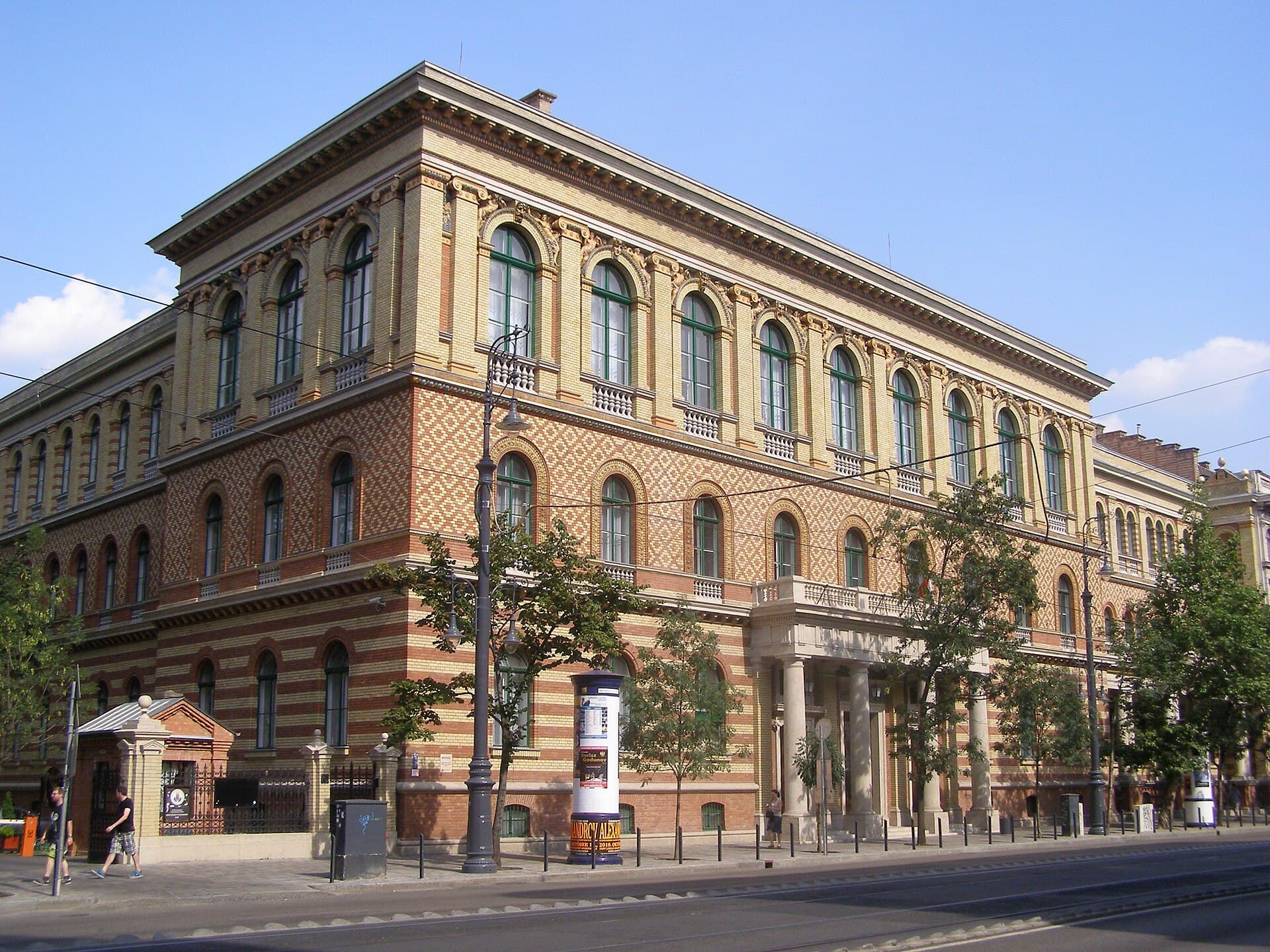
What has stayed is a set of addresses in the middle of Pest. The Faculty of Law occupies a neo-Baroque block on Egyetem tér, raised over the ground of a suppressed Pauline monastery whose church still stands beside it. The Faculty of Humanities works out of neo-Renaissance ranges on Múzeum körút built for a different university. Inside the law building hangs a tablet the faculty keeps for its own students of 1956.
The university had two faculties at first, humanities and theology, and the right to confer degrees. Law was added in 1667 and medicine in 1769, which made it a university in the full sense. After the Jesuit order was suppressed, Maria Theresa moved the institution to Buda in 1777, and in 1784, under Joseph II, it crossed the river to Pest. German replaced Latin as the language of instruction in the same year, and Hungarian was authorised in 1860.
The names track the politics of each era. It was the Jesuit university of Nagyszombat, then the Royal Hungarian University from 1769, the Royal University of Pest after the move, the University of Budapest from 1873, and from 1921 the Royal Hungarian Pázmány Péter University, after its founder. In September 1950 it took the name it still carries, that of Loránd Eötvös, who had held its chair of experimental physics.
The renaming came with a wider reorganisation under the Communist government. In 1950 the Roman Catholic theology faculty was detached by state order and continued as a separate academy; in early 1951 the medical faculty was made independent, and it is now Semmelweis University. The university also lost, for a period, its centuries-old authority to award doctorates. Its buildings were left to decay for years after 1956, and student numbers rose steeply after 1989.
Egyetem tér 1-3 has held the lawyers since the university reached Pest, when the faculty was given the buildings of the dissolved Pauline monastery on the square. The present block went up in 1898-1900 to designs by Sándor Baumgarten and Zsigmond Herczegh, in the neo-Baroque then favoured for Hungarian public architecture.
Beside it stands the University Church, built by the Paulines. Its foundation stone was laid in 1723 and the interior finished around 1770, probably to designs by András Mayerhoffer; the carved oak pews and pulpit are among the finest Baroque woodwork in the city. It passed to the university in 1786, after the order was dissolved.
The ranges at Múzeum körút 4 to 8 went up in the early 1880s for the Technical University, in neo-Renaissance style by Imre Steindl, who later built the Hungarian Parliament. The Faculty of Humanities moved in during 1911 and shares them now with the Faculty of Economics.
The University Library and Archives is older than any of it. Founded in 1561 at Nagyszombat, it travelled with the university to Buda and then to Pest, and in 1780 became the first library in Hungary entitled to a copy of everything published in the country. Its home at Ferenciek tere 6, built in 1873-1876 by Antal Szkalnitzky and the younger Henrik Koch, was the first building in Hungary designed as a library, and it holds some two hundred codices and 1,200 incunabula.
ELTE runs nine faculties: humanities, law, science, economics, informatics, education and psychology, special needs education, primary and pre-school education, and social sciences. Three of them, science, informatics and social sciences, sit downriver on the modern Lágymányos campus.
Students at the Technical University across the Danube drew up sixteen demands on 22 October 1956 and called a march for three o'clock the following afternoon. The interior ministry banned it at midday on the 23rd and lifted the ban that afternoon. ELTE's rector's council met that morning and decided that the university's leadership would join it. ELTE students and technical students converged at the Bem statue on the Buda side; by evening the crowd had reached Parliament, the Stalin statue came down at about ten, and shots were fired at the Radio building. The revolution had begun.
The law faculty was already in motion. On 17 October a student forum called the Hajnóczy Circle held its founding meeting in the Egyetem tér building and adopted four demands, among them that 15 March be restored as a national holiday and that Russian be made optional. After the 23rd the building's central position made it a hub: the Revolutionary Student Committee met there, and weapons were issued from the Szerb utca side to the new national guard.
What came next the faculty records in its own words. Teachers left the country, and students faced disciplinary proceedings, expulsion and prison. A tablet to the faculty's dead of 1956 hangs inside the Egyetem tér building, and each October the faculty council and the student union lay a wreath at it. It is not a national monument and it is on no tourist route. It is the record a university keeps of what happened to the people enrolled in it.
Loránd Eötvös (1848-1919) was the son of József Eötvös, the novelist who twice served as Hungary's minister of education. He became a full professor at Pest in 1872, took the chair of experimental physics in 1878, and served as rector in 1892-93. He held his father's ministry himself in 1894-95, presided over the Hungarian Academy of Sciences from 1889 to 1905, and in 1895 founded the residential college that carries the family name, which ELTE still runs.
His experiment went after a coincidence buried in Newton's mechanics. Inertial mass measures how hard a body is to accelerate; gravitational mass measures how strongly gravity pulls on it. Nothing requires the two numbers to agree, yet every measurement said they did. Eötvös hung bodies of different materials from the arms of a torsion balance and watched for the faint twist that would appear if the Earth's pull and the outward effect of its rotation acted on the two samples in different proportion. The twist never came. With Dezső Pekár and Jenő Fekete, between 1906 and 1909, he brought the agreement between the two masses to about one part in two hundred million.
The result mattered more after his death than during his life. Einstein's general theory of relativity, set out in 1916, rests on the two masses being a single quantity, which is what lets gravity be treated as the shape of spacetime rather than a force acting within it. Eötvös had supplied the evidence before the theory needed it, and Einstein cited the experiment in the 1916 paper before writing in January 1918 to thank him.
The generation of scientists who left Budapest between the wars is usually described in a lump, so it is worth saying which of them belonged here. Leó Szilárd and Eugene Wigner enrolled at the Technical University, and Edward Teller went to Karlsruhe. John von Neumann is the firm link: he took his mathematics doctorate at the University of Budapest in 1926, summa cum laude, while finishing a chemical engineering degree at ETH Zurich. John Harsanyi took a pharmacy diploma here in 1944 and a doctorate in philosophy and sociology in 1947, and shared the Nobel Memorial Prize in Economics in 1994. George de Hevesy began in chemistry at Budapest, and Albert Szent-Györgyi led the biochemistry department after the war. Ferenc Krausz read theoretical physics at ELTE from 1981 to 1985 and shared the 2023 Nobel Prize in Physics; László Krasznahorkai graduated from the humanities faculty in 1983.
ELTE teaches around 33,000 students across its nine faculties, in Budapest and at the Savaria University Centre in Szombathely, which joined in 2017. In the 2026 QS ranking it came 595th globally and first in Hungary, and some 5,300 international students are enrolled on programmes taught without Hungarian. It stands with Charles University in Prague and the Jagiellonian University in Kraków among the long-established universities of central Europe.
Egyetem tér is a few minutes on foot from Ferenciek tere station on metro line M3, with Kálvin tér about the same distance the other way. The University Church at Papnövelde utca 5-7 is a parish church and opens outside service times; the carved Pauline woodwork is the reason to step inside. The University Library at Ferenciek tere 6 registers outside readers: a free card for reading on site, borrowing cards from about 1,500 forints, identification at the desk. The Múzeum körút ranges face the garden of the Hungarian National Museum, the best vantage point for Steindl's facades, and the courtyards on Egyetem tér are quietest in the late afternoon.