Heritage · University
Al-Mustansiriya University: History and Overview
Two institutions in Baghdad answer to the name Mustansiriya: a brick madrasa built for the Abbasid caliph al-Mustansir, which taught all four Sunni schools of law and kept a water clock in its entrance hall, and a public university founded by Iraq's teachers' union in 1963. The madrasa outlived the caliphate that paid for it. The university that borrowed its name has spent its own lifetime under sanctions, looting and bombing.Written to last.
By Confinity Heritage Editorial · 2026-08-25 · 8-minute readQuiet tools, kept out of the way.
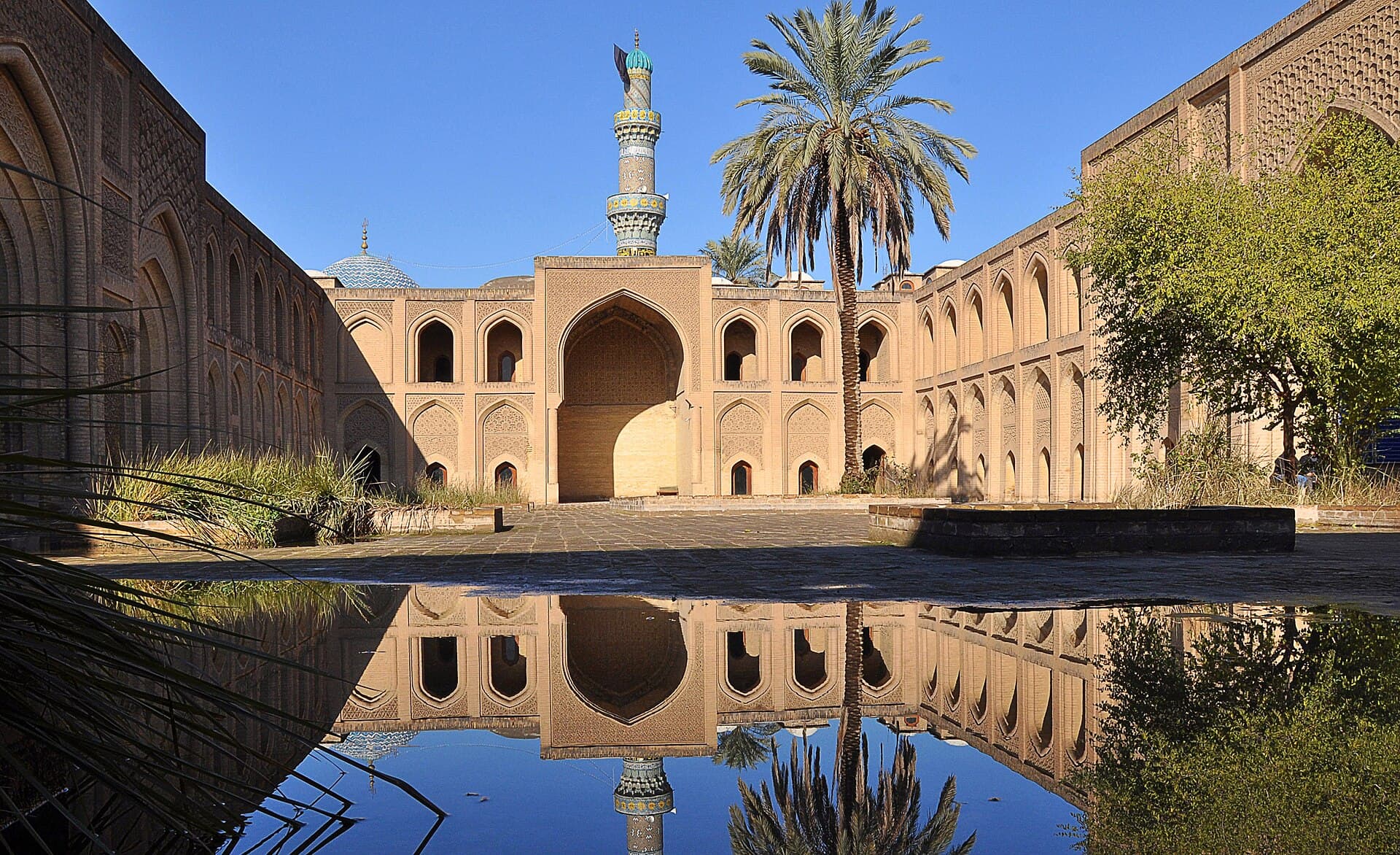
Two institutions in Baghdad answer to the name Mustansiriya. One is a courtyard of sand-coloured brick on the east bank of the Tigris, raised for an Abbasid caliph in the 1230s and one of the very few intact buildings left from Abbasid Baghdad. The other is a public university of around thirty-three thousand students, founded in 1963 by Iraq's teachers' union, its colleges scattered across the modern city about three kilometres away. The second took its name from the first, and the taking was an argument. The reference entries follow it: they date the institution's inception to 1227, not 1963.
The line it claims has been cut more than once. Teaching in the old madrasa was suspended under Timur, and had stopped altogether by the seventeenth century; the building then spent three hundred years as barracks, uniform store and caravanserai. What the founders of 1963 inherited was not a faculty, a curriculum or a library, but a name, a city, and a set of walls that had declined to fall down.
Abu Ja'far al-Mansur ibn al-Zahir, who ruled under the regnal title al-Mustansir bi'llah from 1226 to 1242, commissioned the school that carries his name in 625 AH, 1227 CE. Construction took about six years. The madrasa was inaugurated in 631 AH, a Hijri year that straddles the end of 1233 and most of 1234, which is why sources give one date or the other; the cost is reported at 700,000 dinars. Its distinction was structural as much as scholarly: it was the first school to teach all four Sunni schools of law, Hanafi, Maliki, Shafi'i and Hanbali, inside one institution, a corner of the building assigned to each.
Al-Mustansir was the penultimate caliph to rule in Baghdad. His son al-Musta'sim was the last, and when the Mongol army took the city in 1258 the Abbasid caliphate ended. The madrasa did not. Parts of the complex were damaged and later repaired, and by 1281 the historian and librarian Ibn al-Fuwati had been appointed its director. Timur destroyed Baghdad twice, in 1392 and 1400, carrying its scholars and architects off to Samarkand; studies were suspended and much of the library dispersed. The Ottomans took the city in 1534 and its remaining books went to Istanbul as spoils. A revival attempted in 1589 is said to have closed its doors in 1638. Restoration of the fabric began in 1944, and in 1960 the Iraqi government opened the complex as a monument; it has been under the Directorate of Antiquities since 1973.
The modern university started small and private. The Republic of Iraq Teachers' Union founded it in 1963, mainly to run evening courses for people already in work. In 1964 it was granted semi-state status and public funding, absorbed al-Shahab University, a private institution set up by the Iraqi Association of Economists, and moved to a campus north of the centre; its first cohort, 1,077 students, graduated in 1967. A 1966 law turned Iraq's private universities into public ones and Mustansiriya briefly became a college of the University of Baghdad, before being reconstituted separately in 1968; the colleges it ran in Mosul and Basra were detached to help form the universities there.
What followed took most of that away. United Nations sanctions through the 1990s cut Iraqi campuses off from the equipment, journals and textbooks that research runs on, and pushed academic salaries to a level that drove staff abroad. Looters entered the university on 9 April 2003, the day the government fell, and stripped laboratories and offices. The Iraq National Library and Archive was looted and burned on 10 and 12 to 13 April that year, losing an estimated 60 per cent of its archival material and a quarter of its books. Abdul-Latif Ali al-Mayah, a political scientist who chaired the university's centre for Arab studies, was shot dead in his car on 19 January 2004, the morning after criticising the Iraqi Governing Council on television. By January 2007 the Iraqi Association of University Lecturers counted around 300 academics killed nationally, and the Ministry of Higher Education reported that more than 3,250 had left the country between February and August 2006.
On the afternoon of 16 January 2007, car bombs and a suicide bomber struck students and staff leaving the campus. Iraq Body Count records 69 to 70 deaths; reported wounded run from 169 to 200. Two days later the director-general of UNESCO, Koichiro Matsuura, called on the government to defend the basic human right of young Iraqis to education. On 25 February a suicide bomber killed at least 41 people, most of them students, at the business school annex of the same university.
The colleges are spread across the city rather than gathered behind a wall. The main campus lies on Palestine Street on the Rusafa side of Baghdad, the same bank of the Tigris as the medieval school; the colleges of medicine and dentistry sit away from it, attached to the Yarmouk and Karama teaching hospitals.
Fourteen colleges appear on the university's own English pages: medicine, dentistry, pharmacy, nursing, engineering, science, law, arts, education, basic education, management and economics, political science, physical education and sport science, and touristic science. Alongside them run national centres for diabetes, for genetics and cancer research, and for haematology, and the Mustansiriyah Center for Arab and International Studies.
The plan of the old madrasa is a two-storey rectangle around a long open court, built on the four-iwan scheme that later schools across the Islamic world would copy. Each iwan, the great vaulted recess opening onto the courtyard, was given to one of the four schools of law. The brickwork does the decorating: muqarnas vaulting, arabesque, zigzags and star and polygon figures worked into the surface, with an inscription over the main gate naming the patron. It was faced in farshi, the sand-coloured brick of Karbala.
Inside were a Dar al-Hadith and a Dar al-Qur'an, a school of medicine under a senior physician with ten students attached to him, and a hospital in the complex so that those students could practise where they learned, along with a bath house, a pharmacy, a kitchen and a food store. Students were given lodging, clothing, bread and a monthly stipend, and thirty orphans were housed on the same terms. The caliph's founding gift to the library is put at 80,000 volumes; later reports of 400,000 or more are probably inflated.
In 1235 a water-powered clock was completed in the entrance hall, announcing the hours of prayer and the time by day and by night. Ibn al-Fuwati, who lived in Baghdad and later ran the place, described golden falcons in golden bowls that opened their beaks on the hour and dropped bronze ball bearings, doors that turned from gold to silver as each hour passed, and planets that climbed a painted sky with the sun and glowed after dark. Ibn Battuta, passing through in 1327, found the teacher seated under a small wooden canopy, two assistants repeating everything he dictated.
What happened to the books in 1258 is not agreed. One account has them thrown into the Tigris during the sack; another has the collection surviving, only to be merged with the library of the Nizamiyya in 1393 and to disappear after that. Either way the building came through, and it is now one of roughly a dozen structures left in Baghdad from the city's Abbasid centuries. The upper walls carry scarring from car bombs, the river wall was blackened by rubbish fires lit after 2003, and the foundations are threatened by groundwater that rises and falls with the Tigris at its back. Iraq's Ministry of Culture, Tourism and Antiquities launched a rehabilitation project on 5 February 2021 aimed mainly at that water. The madrasa has been on Iraq's UNESCO Tentative List since 28 March 2014, inside a larger nomination covering the Rusafa riverfront from the school to the Abbasid Palace. It has not been inscribed.
The Assyrian sites north of the capital pose the same question from the opposite end. At Nineveh and Nimrud the institutions vanished twenty-six centuries ago and the objects survive, mostly abroad. Here the objects are largely gone, the library twice over, and the institution is the thing being claimed.
Most Arab universities of the modern era decline the inheritance. Cairo University dates itself from the public subscription of 1908 and leaves the thousand years of al-Azhar to al-Azhar; the American University of Beirut dates itself from 1866 and no further back. Mustansiriya's founders chose otherwise, and put a thirteenth-century courtyard inside a twentieth-century institution's account of itself.
The graduates of the modern university are writers and professionals rather than laureates. Alia Mamdouh took a degree in psychology in 1971 and became one of the significant Iraqi novelists of her generation, editing magazines in Baghdad before leaving in 1982 for Beirut and eventually Paris. Betool Khedairi took a BA in French literature in 1988 and published her first novel, A Sky So Close, in Beirut in 1999. Rahim AlHaj studied Arabic literature here alongside composition at the Baghdad Conservatory under Munir Bashir, was imprisoned twice in the late 1980s for music critical of the government, and left Iraq in 1991 on false papers his mother sold nearly everything to buy; he reached the United States as a political refugee in 2000. Three careers, three departures. The exodus that the sanctions years began is legible in the alumni list itself.
Enrolment stands at about 33,759 students with roughly 4,595 academic staff, on figures the university supplies to the international rankings, and admission runs through the national examination system as it does across Iraqi public higher education. The institution has been rebuilding for two decades: laboratories restocked, a college of nursing added to the original thirteen.
The medieval school it is named for is not on the campus and is not used for teaching. The university holds it, the Directorate of Antiquities oversees it, and the relationship is closer to custody than to continuity. That is the honest version of the claim, and it is still a substantial one. Baghdad has lost almost every other building that could have made the same argument.
The madrasa stands in Rusafa on the Tigris embankment, beside the Asifiyah Mosque, whose tiled minaret rises behind the courtyard, within walking distance of Rasheed Street, the Qishla clock tower and the Abbasid Palace. Access has been unreliable for years: visitors have found the gates shut or the guards instructed to admit nobody, and the complex closed for maintenance in 2020 with the work slowed by the pandemic. The Abbasid Palace, the Qishla, the National Museum and the National Library have all reopened; the madrasa is the obvious next candidate. The university's campuses are working sites with controlled entry, not places to tour.
History
Campus and academics
The four corners and the water clock
Scholarship
The university today
Visiting
References and resources
- Mustansiriyah University (official)
- UNESCO World Heritage Centre: Historical Features of the Tigris River in Baghdad Rusafa, Tentative List, submitted 28 March 2014
- Schwartzstein, Peter. "What the Restoration of Iraq's Oldest University Says About the Nation's Future." Smithsonian Magazine, 4 September 2019
- Al-Monitor: Baghdad's Mustansiriya Madrassa ready for World Heritage List, 11 March 2021
- ICESCO Islamic World Heritage Portal: The Mustansiriya Madrassah
- Iraq Body Count: incident k5154, Mustansiriya University, Baghdad, 16 January 2007
- UN News: Iraq, after university bombing, UNESCO urges Government to defend right to education, 18 January 2007
- Associated Press via NBC News: Suicide bomber kills 41 at Baghdad college, 25 February 2007
- QS Top Universities: Mustansiriyah University profile
- Wikipedia: Mustansiriyya Madrasa
- Wikipedia: Al-Mustansiriya University
- Wikipedia: Al-Mustansir (Baghdad)
- Wikipedia: Iraq National Library and Archive
- Wikipedia: Violence against academics in post-invasion Iraq
- Wikipedia: Abdul-Latif Ali al-Mayah