Heritage · Landmark
Nimrud: the Assyrian capital that survives elsewhere
An Assyrian king rebuilt this city as his seat of government and cut the record of its opening feast into stone, counting the guests: 69,574 of them, fed for ten days. Twenty-eight centuries later the palace was bulldozed and blown apart in the space of six weeks, and the reason a great deal of it still exists is that most of it had already been carried somewhere else.Written to last.
By Confinity Heritage Editorial · 2026-08-25 · 7-minute readQuiet tools, kept out of the way.
A low mound above the Tigris in northern Iraq carries the remains of the city the Assyrians called Kalhu and the Hebrew Bible calls Calah. Local usage named it Nimrud, after the hunter-king of Genesis. From the 870s BC it served for some 150 years as the working capital of the largest empire yet assembled. It is not a World Heritage Site: Iraq placed it on its Tentative List in July 2000 and it has never been inscribed.
In 2015 the group then holding northern Iraq attacked the site with jackhammers, bulldozers and explosive, and by the time Iraqi forces retook the ground most of the excavated city was gone. A visitor in London, New York or Mumbai can still stand before the carved walls of Nimrud's throne room. Both sentences are true, and the reason they are both true is uncomfortable.
Kalhu was already old when Ashurnasirpal II, who ruled Assyria from 883 to 859 BC, made it his seat of government. He moved the court from Ashur, walled some 360 hectares, planted an orchard of trees collected on campaign, and raised on the citadel terrace the Northwest Palace.
When the work was done he held a party, and then had the party written down. The Banquet Stele, a sandstone block of 154 lines found near the throne-room door by Max Mallowan in 1951, spends most of its length on the building works before reaching the guest list. The king counted his invitations: 47,074 men and women from across the country, 5,000 delegates from Suhu, Tyre, Sidon and elsewhere, 16,000 residents of Kalhu and 1,500 palace officials. His total is 69,574 guests, fed for ten days on 10,000 jars of beer and 10,000 skins of wine. He washed them, anointed them with oil, and sent them home content. The date is usually given as 879 BC, though some Assyriologists place it later.
The palace was faced, room after room, with gypsum slabs carved in low relief: the king at war, the king hunting, and above all the apkallu, winged protective spirits holding a bucket and a cone. Across almost every slab, cutting through the figures, ran the same block of cuneiform, the Standard Inscription, reciting the king's titles, ancestry, campaigns and building works.
At the doorways stood the lamassu: colossal guardians with a bull's or a lion's body, a bird's wings and a bearded human head, cut with five legs so that they read as standing from the front and striding from the side. The heaviest weigh close to thirty tons. At the north end of the citadel a ziggurat rose beside the temple of Ninurta, the war god Ashurnasirpal credited with his victories. It was still the tallest thing on the mound in 2014.
Mallowan had dug the palace's domestic wing in 1951 without lifting the baked-brick pavement. From 1988 an Iraqi team under Muzahim Mahmoud Hussein noticed that some of those bricks sat at odd angles, took up the floor, and found vaulted tombs sealed beneath.
There were four, built for royal women in the ninth and eighth centuries BC before those women died; two had escaped ancient robbery and modern looting. They yielded the queens Yaba, Banitu and Atalia, and in a bronze coffin a young woman whose gold seal names her as Hama, queen of Shalmaneser. She wore a cap-shaped crown of gold and lapis lazuli, a form with no known parallel. Between them the tombs gave up 613 pieces of gold and precious stone: the only Neo-Assyrian royal burials ever recovered with dress and grave goods in position.
The find came in the worst decade for it. Iraq was at war and then under embargo, the reports appeared only in Arabic, and the objects went into a vault of the Central Bank in Baghdad. The bank was bombed in 1991 and in 2003, the vault held, and the gold was located again on 5 June 2003. It is why the richest thing Nimrud ever produced was three hundred kilometres away in 2015.
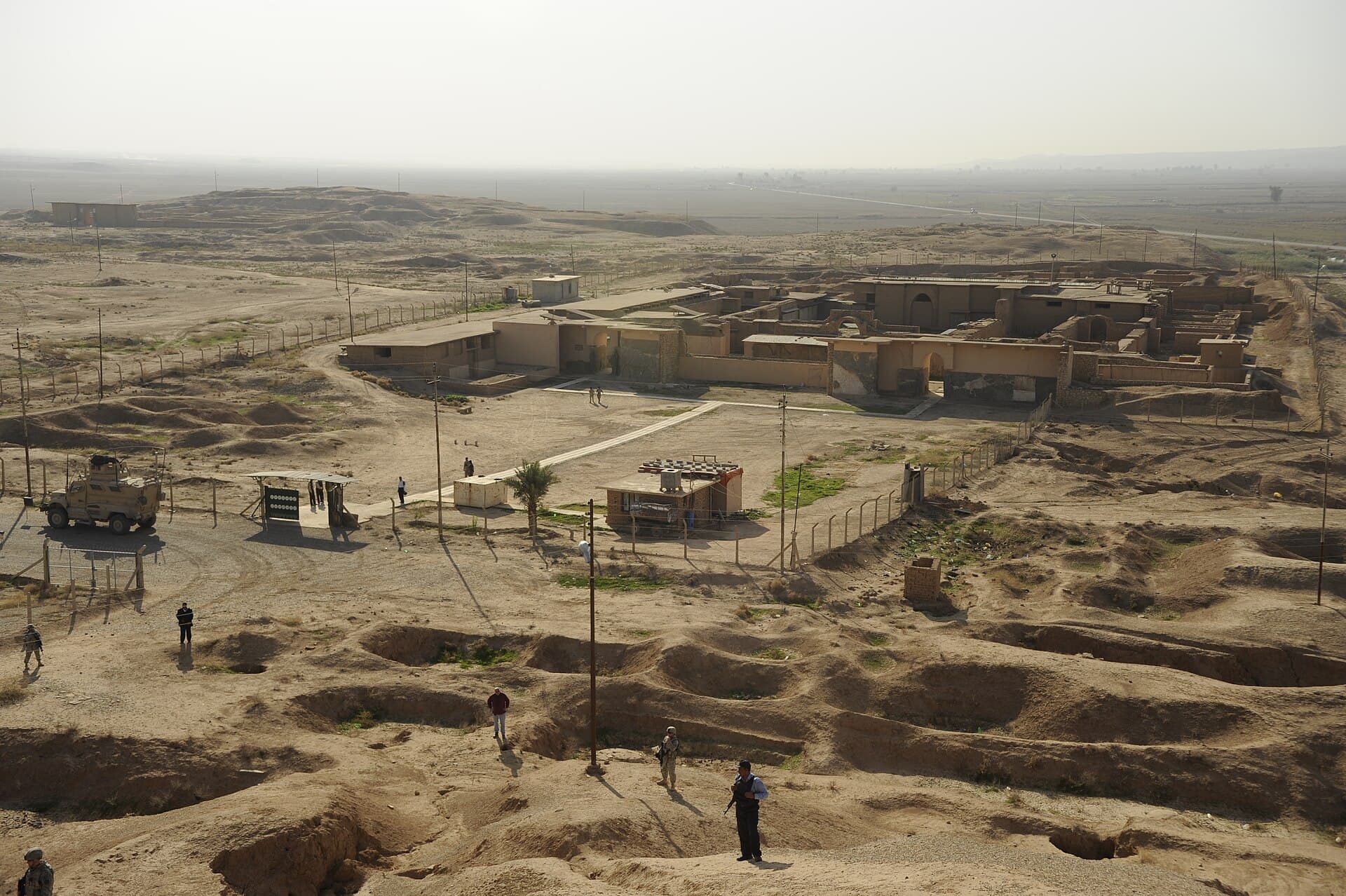
The photograph at the top of this page was taken at Nimrud in November 2008 by a US Air Force photographer, an ordinary record shot of a standing site. Seven years later most of what it shows had ceased to exist, and the picture changed category. It is now evidence.
The attack came in stages. On 26 February 2015 a video from the Mosul Cultural Museum showed men taking hammers and drills to Assyrian sculpture: a colossal lion from Nimrud, two lamassu, Ashurnasirpal's throne base and the Banquet Stele. On 5 March the Iraqi antiquities ministry announced that Nimrud had been bulldozed. Satellite analysis by the American Schools of Oriental Research put a heap of smashed relief panels on the ground by about 7 March, and dated the detonation to after 1 April. A video published on 11 April showed the sequence: sledgehammers, power tools, a bulldozer at the walls, barrels packed, three blasts.
Iraqi forces retook the site on 13 November 2016. A UNESCO-led assessment reached the mound on 14 December 2016 and found considerable damage to the ziggurat, the structures and the reliefs, with emergency protection needed to stop surviving fragments being looted. Around ninety percent of the excavated city was gone. In March 2017 the Smithsonian and the State Department announced a $400,000 project to help Iraq's State Board document and stabilise the ground, and the Nimrud Rescue Project has since run Iraqi-led recovery missions. The work is not finished.
Austen Henry Layard began cutting into the mound in November 1845 and worked there, with a break, until 1851. The Nimrud Project describes what he did without much charity: he tunnelled along the walls chasing carved stone, like a natural historian collecting specimens abroad for a museum at home.
The criticisms are real and belong on this page. The method destroyed what it was not looking for: mud-brick walls and cuneiform tablets were invisible to men digging by lamplight for gypsum, and much of both went out with the spoil. Nothing was photographed, and Layard's books cast Assyria as a decadent biblical empire whose fall made a lesson for Victorian readers. Permission came by diplomatic pressure on a distant Ottoman administration, and nobody asked the people on the mound. The reliefs went to the British Museum because Britain had the consular reach, the navy and the money.
Also true: 76 museums in twenty countries now hold material from Nimrud, thirty-six in the United States and thirteen in the United Kingdom. Many American slabs came by a stranger route than empire, bought in Mosul by missionaries and shipped home to their old colleges in New England. When the palace was blown up, the decorative scheme of its throne room had been outside Iraq for over a century and a half, and it survived.
Those two paragraphs do not cancel out, and it is worth resisting the pull to make them. Preservation by removal is not an argument anyone can make in advance. It is retrospective luck, read backwards from an outcome nobody in 1847 intended, and defends the past only for those prepared to accept it as a licence for the present. Nor does dispersal reliably preserve. In October 2018 an apkallu slab from Room S of this palace, sent to the Virginia Theological Seminary by an American missionary in 1859, sold at Christie's for about $31 million, tripling its estimate. The Assyriologist Zainab Bahrani noted that the 2015 destruction very likely raised that price, so the seller profited from the loss. A market valuing Assyrian stone in eight figures is itself an incentive to loot at Nimrud, as people did in the 1990s and 2014.
Where the arguments meet is narrower than either side admits, and it is real. Both want the material to exist, catalogued and reachable by Iraqi scholars and the Iraqi public. Both accept that decisions about the site belong to Iraq. They part on the question each asks. Repatriation asks who ought to hold a thing; preservation asks whether the thing is still there to be held, and an answer to one is not an answer to the other. The Iraqi-American artist Michael Rakowitz, who has spent years rebuilding rooms of this palace out of Arabic newspaper and food packaging, refuses to separate them: removal and iconoclasm are chapters of one argument about who is allowed to keep what.
The same logic runs through the digital effort, and it long predates the destruction. In the early 1990s the American archaeologist Samuel Paley began a virtual-reality model of the Northwest Palace. It could not have come from the standing building, which had lost its walls; it came from photographs of stones in museums. Factum Arte then spent a decade in those same collections making 3D scans, and in May 2014 delivered a full-scale facsimile of the throne room's east end to the University of Mosul. Weeks later the city fell.
Then came the crowd. Project Mosul was founded in February 2015, within days of the museum video, by Matthew Vincent, Chance Coughenour and Marinos Ioannides, and it asked the public for their holiday snapshots. Volunteers sorted uploads by object, ran matched sets through photogrammetry software, and built models of things that no longer existed. Renamed Rekrei, Esperanto for "recreate", it has taken in 337 images of Nimrud and carries reconstructions including a lamassu. The Nimrud Project's Eleanor Robson is measured about what such work does: it prepares the ground for restoration and new research. It is not the thing itself.
None of it is over. The Banquet Stele was hammered, not destroyed. It is in Mosul, where since 2018 a consortium led by Iraq's State Board of Antiquities and Heritage has been rebuilding the Mosul Cultural Museum, with the Louvre helping Iraqi staff conserve and reconstruct the stele, the throne base and the lion of Nimrud. The tally of the king's 69,574 guests, chiselled at by men who wanted the record gone, is being put back together. Palmyra, attacked in the same campaign, is in the same slow condition.
What Nimrud shows is that a record kept in one place is a record with one point of failure. The palace was safe on its mound for twenty-eight centuries, and then it was not. What survived did so because it had been copied, drawn, photographed, scanned, carried off, argued over and spread thin across seventy-six collections. That is not a justification of how the spreading happened. It is the awkward fact underneath it.
A king builds a capital and invites 69,574 people
Stone that talked, and the bulls at the doors
The queens under the floor
Bulldozers, barrels, and what the assessments found
A great deal of Nimrud is not at Nimrud
The record that was held in many hands
References and resources
- UNESCO World Heritage Centre. "Nimrud." Tentative List, Iraq, submitted 7 July 2000, criteria (i)(ii)(iii). whc.unesco.org/en/tentativelists/1463.
- The Nimrud Project at Oracc. Eleanor Robson and others, "Nimrud: Materialities of Assyrian Knowledge Production," including the 1850 and 2015 site essays and the catalogue of 76 museums worldwide. oracc.museum.upenn.edu/nimrud.
- UN News. "UNESCO sends mission to assess extent of damage at Nimrud archaeological site in Iraq." 15 December 2016. news.un.org.
- Smithsonian Cultural Rescue Initiative. "IRAQ: The Stabilization of Nimrud" and the Nimrud Rescue Project. culturalrescue.si.edu.
- Musée du Louvre. "Rehabilitation plans for Iraq's Daesh-damaged Mosul Cultural Museum." Press release, 11 May 2023. presse.louvre.fr.
- Hussein, Muzahim Mahmoud, ed. McGuire Gibson, trans. Mark Altaweel. Nimrud: The Queens' Tombs. Baghdad and Chicago, 2016.
- Danti, Michael, Scott Branting and Susan Penacho. "Monitoring Cultural Heritage in Syria and Northern Iraq by Geospatial Imagery." Geosciences 7 (2017): 95.
- Hyperallergic. "After $31 Million Sale of 3,000-Year-Old Assyrian Relief, Experts and Artists Denounce Christie's." November 2018. hyperallergic.com.
- Rekrei, formerly Project Mosul. Crowdsourced photogrammetric reconstructions, Nimrud collection. rekrei.org/locations/nimrud.