Heritage · Landmark
Nineveh: the king who collected everything
Assyria's last capital held a room of clay tablets gathered by a king who sent scribes across his empire with orders to copy whatever they found. The city was sacked and burned in 612 BC, the fire hardened the clay where it fell, and the collection came back out of the ground twenty-five centuries later carrying the fullest surviving text of the Epic of Gilgamesh.Written to last.
By Confinity Heritage Editorial · 2026-08-25 · 7-minute readQuiet tools, kept out of the way.
Across the Tigris from modern Mosul in northern Iraq, two flat-topped mounds and a long ridge of fallen earthwork mark the last capital of Assyria. Sennacherib came to the throne in 705 BC and rebuilt Nineveh as his seat of government, running a wall of about twelve kilometres around some 750 hectares and piercing it with gates that most accounts number at fifteen. For roughly half a century before 612 BC it was the largest city in the world. It is not a World Heritage Site: Iraq submitted "The Ancient City of Nineveh" to its Tentative List on 7 July 2000, and no nomination has followed.
The wall is not why the name survives. Under the citadel mound at Kuyunjik lay rooms full of broken clay, and what was written on it turned out to be the largest single deposit of Mesopotamian learning anyone has found.
Sennacherib's Nineveh was built for effect. He abandoned Dur-Sharrukin, the capital his father Sargon II had raised and barely occupied, and began a rebuilding that took in a vast new palace on Kuyunjik, a widened street plan, and a water system reaching roughly 65 kilometres into the hills, with sections of its stone aqueduct still standing at Jerwan. Population estimates run past 100,000 and possibly to 150,000, about twice Babylon at the time.
The gates carried names rather than numbers. Nergal, Shamash, Adad, Halzi, and Mashki, the gate of the watering places that ran down toward the river. Six have been fully excavated, another was found in 2021 beside a water tunnel driven under a stretch of wall thirty-one metres thick, and the remainder lie under farmland or under the eastern suburbs of Mosul, which have spread across roughly a third of the ancient enclosure.
Ashurbanipal, who ruled from 668 to about 630 BC, could read and write in a court where kings usually could not, and he assembled his collection on purpose. He wrote to officials across Mesopotamia telling them what to look for and to send it in: rituals, prayers, incantations, omen series, anything sitting in a temple library or in the private hands of an exorcist or a diviner. Scribes went out to copy what could not be moved. When Babylon fell to him in 648 BC, some two thousand tablets and three hundred writing boards came north as loot.
What separates this from a hoard is the housekeeping. The tablets were made to a standard, in fine clay, carefully ruled, in a trained hand. Most carry a colophon at the foot recording that the copy had been checked against an original, noting where the original was broken, and stating that the tablet belonged to the palace of Ashurbanipal. It is generally described as the oldest library gathered and catalogued to a plan rather than accumulated by habit, and the British Museum's project on it calls the collection the largest and broadest ever put together in three and a half thousand years of cuneiform culture.
Austen Henry Layard's workmen opened the first room of tablets late in 1849, in Sennacherib's South-West Palace. Hormuzd Rassam found a second deposit a few years later in Ashurbanipal's North Palace, on the far side of the same mound. Nobody recorded which tablet came from where, and within a short time of reaching Europe the two groups had been mixed past separating.
Smith was a banknote engraver who taught himself cuneiform in his lunch hours at the British Museum and was eventually paid to sort the Nineveh fragments. In 1872, working through a tray of them, he read a passage about a boat grounding on a mountain and a bird sent out to look for dry land.
He announced it to the Society of Biblical Archaeology on 3 December 1872, with the prime minister, William Gladstone, in the room. Colleagues said afterwards that when the meaning landed he began pulling at his clothes and running about. What he had was the eleventh tablet of the Standard Babylonian Epic of Gilgamesh, catalogued as K.3375, and its flood narrative is centuries older than the version in Genesis. The Daily Telegraph paid for him to return to Kuyunjik the next year to hunt for the missing lines, and he found some.
Sun-dried clay is not a durable medium. Left in a damp room it softens; buried in wet ground it goes back to mud. Nothing in Ashurbanipal's collection was fired on purpose.
In 612 BC a coalition of Babylonians, Medes and Scythians besieged Nineveh for roughly three months and took it. The palaces were looted and set alight, and the burning did the work of a kiln. The tablets baked where they lay, under collapsing upper floors, and came out hard enough to sit in the ground for twenty-five centuries.
The same accident preserved the Hittite state archive at Hattusa, which came through the end of the Bronze Age because the buildings holding it burned. In both places the catastrophe that ended the civilisation is the reason anyone can read it. That is not a comforting rule and it does not generalise. Alexandria makes the point from the other side: there was no single spectacular fire, only expulsions, funding cuts, political disorder and the slow failure of papyrus, and the collection went all the same. Papyrus and parchment last by being copied again before they perish, which takes an unbroken institution and a continuous supply of people who care. Clay lasts by being abandoned in a disaster. Almost every ancient library ran on the first model, which is most of the reason so little of them is left.
Nearly all of the material is in London. The British Museum's database counts 30,943 tablets from the Nineveh collection, the Ashurbanipal Library Project puts the surviving total at close to 32,000 tablets and fragments, and the number of distinct works underneath that, once joins are made, is probably nearer ten thousand. Smaller groups sit in the Hermitage, the Louvre, the Vatican and the Penn Museum.
The argument this sets off is the one Nimrud sets off, and it should not be given the same answer, because the objects do not behave the same way. A carved palace slab is legible to anybody who walks past it, and most of its value travels with it. A cuneiform tablet is a brick to almost everyone alive. It yields nothing without a reader trained for years in a dead script and two dead languages, and it yields far less alone than it does beside the rest: joins between fragments, duplicate manuscripts of one composition, colophons naming the same scribe. The scholarly worth of this material has depended on it being held together and catalogued, which for most of a century meant a small number of specialists with access to one room.
That part is changing. The Ashurbanipal Library Project, running at the British Museum with the University of Mosul since 2002, has photographed the whole library at high resolution, each tablet built from fourteen exposures so the wedges read in relief, and pushed images and catalogue records out through the Cuneiform Digital Library Initiative and the museum's own database, so that the entire library is available in new high-quality images. A collaboration with LMU Munich between 2020 and 2023 worked through the colophons to establish how the collection was actually built. Fragment matching has since moved partly to software: the electronic Babylonian Library has assembled hundreds of thousands of lines of transliterated text and used string alignment to place pieces nobody had joined by hand, including a late manuscript of Gilgamesh recognised in 2022.
That settles nothing about who should hold the originals, and the traffic runs both ways. On 7 December 2021 Iraq took back the Gilgamesh Dream Tablet, looted in 1991 and later bought by Hobby Lobby for the Museum of the Bible, after a United States forfeiture action, and put it on display in Baghdad.
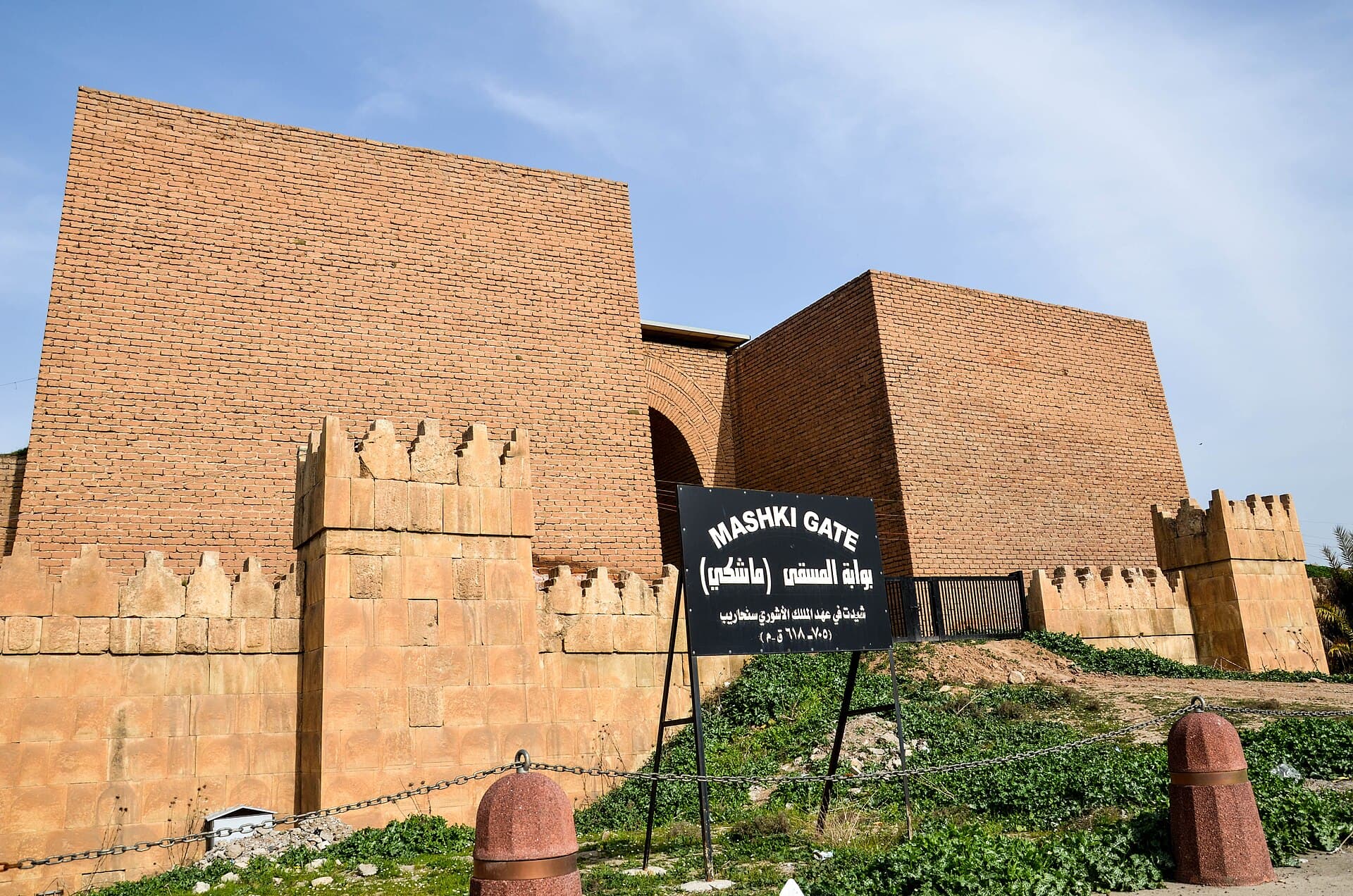
The photograph at the top of this page shows the Mashki Gate as it stood for four decades. It is not an Assyrian structure in the strict sense. Iraqi archaeologists excavated the gateway and rebuilt it in mudbrick in the 1970s, partly to shelter the original foundations and partly because a city needs something to point at. It stood beside the main road at the edge of Mosul and became a fixture of the skyline.
In April 2016 the group then holding the city bulldozed it, along with the Adad Gate on the northern wall and long stretches of rampart. UNESCO's director-general condemned the destruction of the two gates on 18 April 2016, noting that the reconstructions had been doing structural work as well as symbolic, protecting the ancient foundations beneath them. Sennacherib's throne room on Kuyunjik was bulldozed in the same period, and its broken reliefs lay open to the weather until 2022.
Work has run the other way since. The Adad Gate has been cleared of hundreds of tonnes of rubble, conserved and re-roofed by an Iraqi and Italian team, and since 2023 it has served as the entrance to an archaeological park at Kuyunjik. At Mashki, Iraq's State Board of Antiquities and Heritage and the Nineveh Inspectorate have worked since 2022 with the Penn Museum's Iraq Heritage Stabilization Program on a reconstruction funded in part by the ALIPH Foundation, the rebuilt gate intended to hold a visitor and education centre. Clearing the wreckage exposed ground nobody had dug, and in 2022 the team found seven damaged alabaster reliefs from Sennacherib's reign, carved with vines, palms and mountains, reused as building material when the gate was first raised. Penn's Richard Zettler called them the first Assyrian reliefs to come out of the ground in seventy-five years.
Nineveh has been wrecked by people who wanted it gone twice over, twenty-six centuries apart, and both times something surfaced that would not have surfaced otherwise. That is luck, not a lesson. Whatever lesson there is sits in what Ashurbanipal did: he did not only gather texts, he had them checked, labelled and marked as belonging somewhere. Layard's men undid part of that in a season by tipping two libraries into the same crates, and it has taken a hundred and seventy years of cataloguing to start putting the order back. The tablets came through the fire. What almost did not come through was knowing what they were.
Twelve kilometres of wall and fifteen gates
A king who sent people out to copy things
What George Smith found in December 1872
The accident that made the clay permanent
Thirty thousand tablets in Bloomsbury
Mashki, Adad, and the years since 2016
A collection is not a pile
References and resources
- UNESCO World Heritage Centre. "The Ancient City of Nineveh." Tentative List, Iraq, submitted 7 July 2000, criteria (i)(ii)(iii)(iv)(v)(vi). whc.unesco.org/en/tentativelists/1465.
- Taylor, Jonathan. "What is the Library?" and "About the project." The Ashurbanipal Library Project, Department of the Middle East, The British Museum, at Oracc, 2022. oracc.museum.upenn.edu/asbp.
- UNESCO World Heritage Centre. "Director-General of UNESCO condemns new destructions in the ancient city of Nineveh, Iraq (Mosul)." 18 April 2016. whc.unesco.org/en/news/1483.
- Penn Museum. "Penn Museum and Iraqi Archaeologists Uncover 2,700-Year-Old Artifacts, After Destruction by ISIS." Press release, 25 October 2022. penn.museum.
- ALIPH Foundation. "The Mashki Gate Restoration, Mosul." aliph-foundation.org.
- Fincke, Jeanette C. "The British Museum's Ashurbanipal Library Project." Iraq 66 (2004): 55 to 60.
- Wikipedia. "Nineveh," "Library of Ashurbanipal," "George Smith (Assyriologist)," "Battle of Nineveh (612 BC)" and "Destruction of the Library of Alexandria." Retrieved 2026.
- Jiménez, Enrique, and others. The electronic Babylonian Library, Ludwig-Maximilians-Universität München. ebl.lmu.de.