Heritage · University
Cornell University: History and Overview
Founded in 1865 by Ezra Cornell and Andrew Dickson White, Cornell University opened with a charter promising instruction in any study to any person. From East Hill above Cayuga Lake it keeps an unusual set of records, from the chimes of McGraw Tower to the arXiv preprint server and a copy of the Gettysburg Address in Lincoln's hand.Written to last.
By Confinity Heritage Editorial · 2026-08-23 · 8-minute readQuiet tools, kept out of the way.
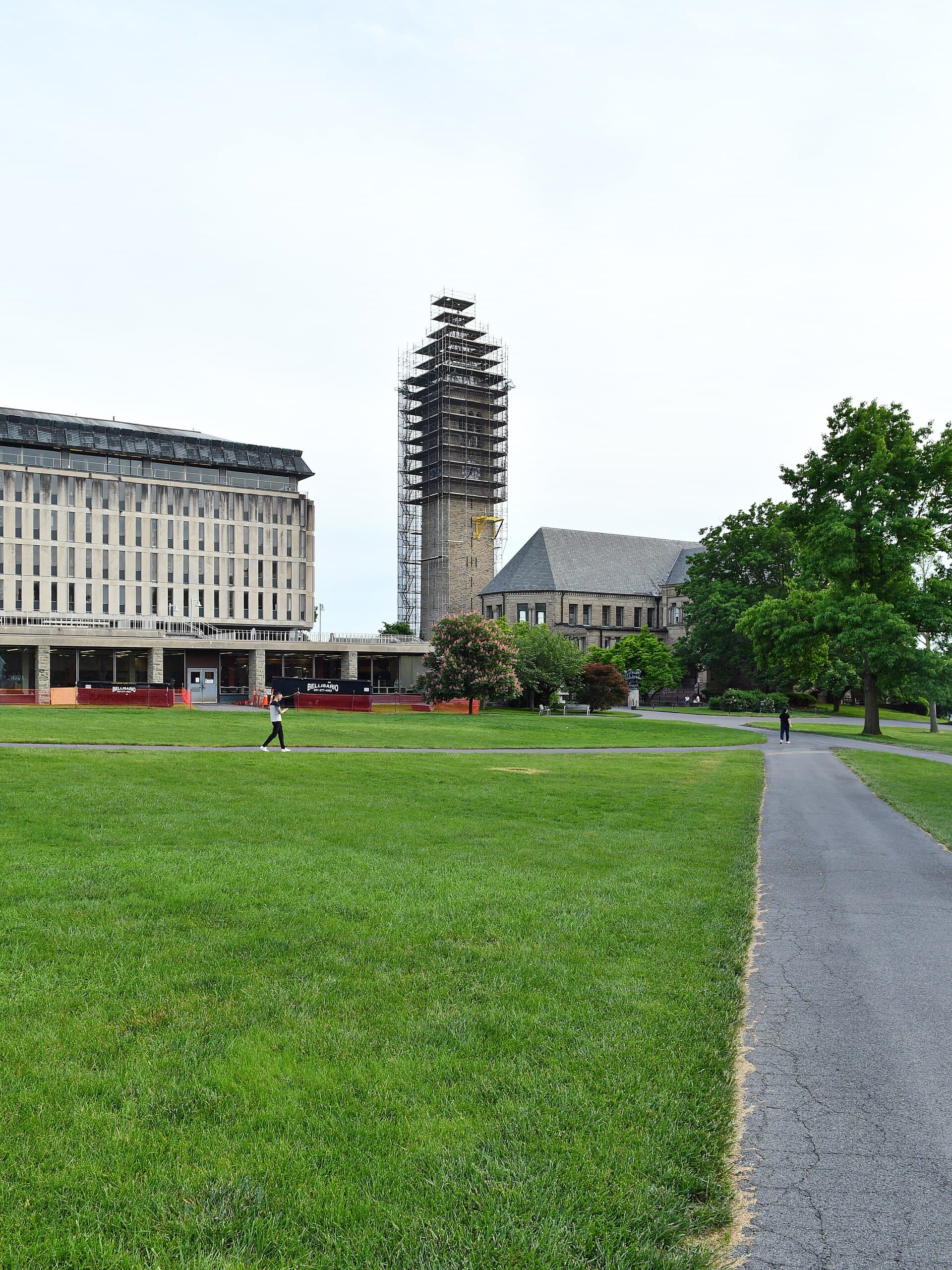
Cornell University stands on East Hill above the town of Ithaca, New York, looking down the length of Cayuga Lake, the longest of the Finger Lakes of the United States. It was founded in 1865 on a sentence its co-founder wrote himself. "I would found an institution where any person can find instruction in any study," Ezra Cornell declared, and the university has spent a century and a half treating those words as a working charter rather than a motto carved over a door. It was nonsectarian in a landscape of denominational colleges, admitted women within five years of opening, and opened its doors without regard to race or creed earlier than nearly any of its American peers.
For an institution so young by the standards of the old universities, Cornell has become an unusually serious keeper of records. Its library holds one of the five copies of the Gettysburg Address in Abraham Lincoln's own hand, its Lab of Ornithology maintains the largest archive of wildlife sound on earth, and since 2001 its library has operated arXiv, the preprint server through which much of the world's physics, mathematics and computer science first reaches the public.
Cornell was chartered by the New York State Legislature on 27 April 1865, in the closing weeks of the American Civil War, as the state's land-grant institution under the Morrill Act of 1862. Its two founders were an unlikely pair who met in the State Senate. Ezra Cornell was a self-taught Quaker farmer and mechanic who had made a fortune building the Western Union telegraph network; Andrew Dickson White was a young historian and legislator with firm ideas about what a modern university should be. Cornell gave his farm on East Hill and an endowment of five hundred thousand dollars; White drafted the charter and became the first president. Cornell's shrewd management of the state's federal land scrip, much of it invested in Wisconsin timber lands, eventually yielded more than any other land-grant college realized from the same act.
The university that opened on 7 October 1868 broke the mold of American higher education in several directions at once. It had no religious test for students or faculty, at a time when most colleges were governed by a denomination. It taught agriculture and mechanics beside classics and moral philosophy, refusing the era's ranking of practical and liberal studies. Its opening class of 412 students was the largest any American institution had enrolled to that date. Women were admitted from 1870, and the Sage College for women opened in 1875, making Cornell one of the first major American universities to educate men and women together. From its earliest years it also enrolled Black students and international students, as a matter of policy rather than accident.
The founding arrangement gave Cornell a hybrid character it retains to this day. It is a private university, governed by its own trustees and endowment, yet it carries a public mission on behalf of New York State. Four of its colleges, known as the statutory colleges, are supported by state funds and operated by Cornell under contract: Agriculture and Life Sciences, Human Ecology, Industrial and Labor Relations, and Veterinary Medicine. Through them Cornell runs the state's cooperative extension system, carrying research out to farms and communities across New York.
The campus covers the crest of East Hill, bounded on two sides by gorges that the last glaciation cut through the shale. Fall Creek to the north and Cascadilla Creek to the south drop toward Cayuga Lake through a series of waterfalls, crossed by footbridges that students use daily; the gorges give the campus its most repeated views and its unofficial slogan, "Ithaca is gorges." At the head of Libe Slope stands McGraw Tower, a masonry clock tower 173 feet high, completed in 1891 beside Uris Library. It holds the Cornell Chimes, a set of 21 bells whose first nine rang at the opening ceremonies of 1868, among the oldest and largest chimes in continuous use in North America. Student chimesmasters, chosen through a demanding annual competition, climb the 161 steps to play concerts as often as three times a day during term, from the morning changes to Broadway tunes and requests.
Academically the university spans more than a dozen colleges and schools on the Ithaca campus, from engineering, arts and sciences, and business to the statutory colleges. Several of its schools are fields Cornell effectively invented as university subjects. The School of Hotel Administration, founded in 1922, was the first collegiate program in hospitality anywhere, and its students still run a working teaching hotel on campus. The College of Veterinary Medicine ranks among the leading veterinary schools in the world. The Lab of Ornithology, founded in 1915 and housed at Sapsucker Woods sanctuary outside the central campus, has become the hub of global citizen science on birds: its eBird platform gathers hundreds of millions of observations a year from volunteers, and its Macaulay Library holds the world's largest scientific archive of wildlife audio and video recordings.
Every university library keeps books. Cornell's also keeps the daily working record of entire sciences. In 1991 the physicist Paul Ginsparg created arXiv, an electronic archive where physicists could post papers before journal publication, and when he joined the Cornell faculty in 2001 the archive came with him to the university's library. It has run from Cornell ever since, and it changed how science communicates. More than two million papers in physics, mathematics, computer science and neighboring fields sit in the archive, freely readable by anyone, and in many of those fields a result is considered public the day it appears on arXiv, months or years before a journal prints it.
The older kind of memory is kept underground in the Carl A. Kroch Library, home of the Division of Rare and Manuscript Collections. Its best-known treasure is the Bancroft copy of the Gettysburg Address, one of only five copies of the speech in Lincoln's handwriting and the only one in private university hands, written out by the president in 1864 for the historian George Bancroft. Around it sit collections running from medieval manuscripts and early printed books to the papers of the university's founders, a major archive of the anti-slavery movement, and one of the world's great collections on witchcraft.
Cornell's people run through the history of twentieth-century thought and letters. Toni Morrison took her master's degree in English at Cornell in 1955, decades before the Nobel Prize in Literature; Ruth Bader Ginsburg graduated in 1954, first in her class. E. B. White, class of 1921, carried the plain-prose gospel of his Cornell professor William Strunk into The Elements of Style. Richard Feynman spent his first postwar years on the faculty, from 1945 to 1950, and it was at Cornell that he worked out the diagrams and path-integral methods that later earned the Nobel Prize in Physics. Carl Sagan taught astronomy at Cornell from 1968 until his death in 1996, directed its Laboratory for Planetary Studies, and wrote Cosmos in Ithaca. More than sixty Nobel laureates have studied or taught at the university.
Cornell enrolls roughly 26,000 students across its campuses, the majority in Ithaca, with a medical college in New York City and a branch in Qatar. In 2017 it opened Cornell Tech, a graduate campus on Roosevelt Island in Manhattan built around applied computing, engineering and entrepreneurship. The university remains both a member of the Ivy League and New York's land-grant institution, a combination no other American university shares. The founding sentence has proved durable as identity rather than slogan: "any person, any study" remains the shorthand by which the university explains itself, and the range of its colleges, from labor relations to veterinary medicine to hotel administration, is the argument made concrete.
The Ithaca campus is open to visitors year round, and walking it is the best way to understand the place: the arts quad with its statues of the two founders, Libe Slope falling away toward the town and the lake, and the gorge trails along Fall Creek and Cascadilla Creek, spectacular in spring melt and in autumn color. McGraw Tower's chimes concerts are free to hear, and visitors can climb the tower during scheduled times to watch the chimesmasters play. The Herbert F. Johnson Museum of Art, in a concrete tower designed by I. M. Pei in 1973, holds a strong Asian collection and offers one of the best views of Cayuga Lake from its upper floor, free of charge. Birdwatchers can visit Sapsucker Woods, and the Division of Rare and Manuscript Collections mounts public exhibitions in Kroch Library, where the Gettysburg Address is displayed on occasion.