Heritage · Museum
Victoria and Albert Museum: Art, Design & History
The Victoria and Albert Museum in South Kensington is the world's largest museum of applied arts, decorative arts, and design, with more than 2.8 million objects spanning 5,000 years of human making. Grown from the 1851 Great Exhibition and named for Queen Victoria and Prince Albert, it gathers ceramics, textiles, fashion, sculpture, and design under one roof.Written to last.
By Confinity Heritage Editorial · Updated 2026-07-31 · 7-minute readQuiet tools, kept out of the way.
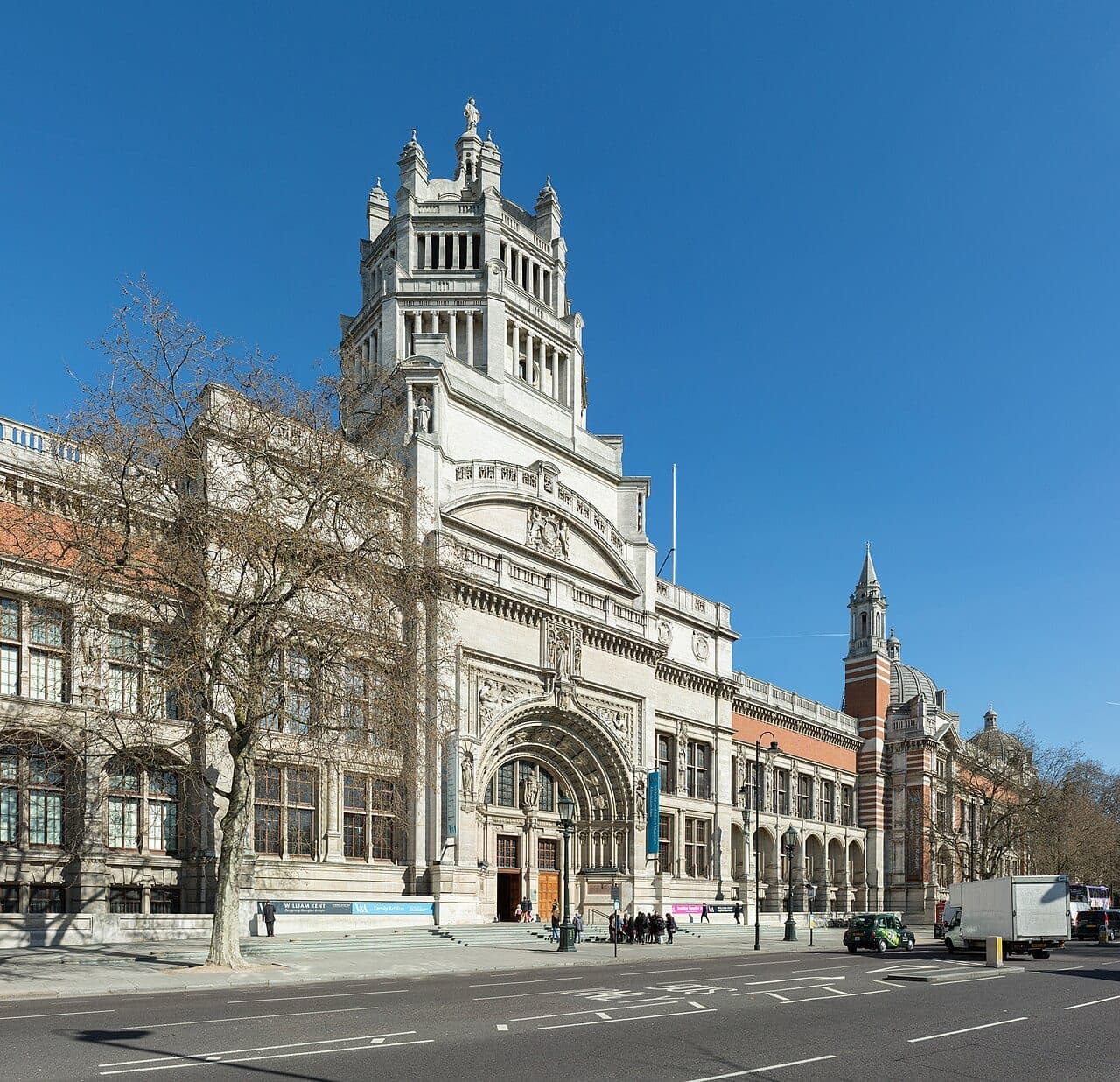
The Victoria and Albert Museum, known to almost everyone as the V&A, occupies a large block of South Kensington in London and holds the world's largest collection of applied arts, decorative arts, and design. Its permanent holdings run to more than 2.8 million objects and cover roughly 5,000 years of human making, from ancient ceramics to contemporary fashion. Unlike a picture gallery, the V&A was built around the made object: the pot, the chair, the printed cloth, the carved screen, the wedding dress. Admission to the permanent galleries is free.
The museum was founded on a practical idea rather than a purely aesthetic one. It grew out of the Great Exhibition of 1851, the vast display of manufactures held in the Crystal Palace in Hyde Park, and its early purpose was to raise the standard of British design and manufacturing by giving craftspeople, students, and the public good examples to study. That founding aim, art and industry brought together for the benefit of both, still runs through the institution and explains why its collection reaches from Renaissance sculpture to product design. It was named the Victoria and Albert Museum in 1899, in memory of Prince Albert and in honour of the queen who laid the foundation stone of its grandest building.
The V&A traces its origin to the profits and the ambitions of the Great Exhibition of 1851, the international showcase of industry and design organised in part by Prince Albert and the civil servant Henry Cole. The exhibition's surplus was used to buy an estate in South Kensington for a cluster of educational and cultural institutions, and a portion of the objects shown there formed the seed of a new teaching collection.
That collection opened in 1852 as the Museum of Manufactures, first housed at Marlborough House, with Cole as its guiding figure. Cole, who had helped run the Great Exhibition and held strong views on design education, became the museum's founding director and shaped its acquisitions around the belief that good design could be taught by example. In 1857 the museum moved to its permanent site in South Kensington and took the name the South Kensington Museum. In its early decades it opened in the evenings by gaslight so that working people could visit after their shifts, an unusual step for the period.
The site grew piecemeal through the second half of the nineteenth century, and by the 1890s the museum needed a coherent front and a name to match its stature. In 1899 Queen Victoria laid the foundation stone for a large new building designed by Aston Webb, and on the same occasion the institution was renamed the Victoria and Albert Museum. The Webb building, with its ornate facade and central tower, opened to the public in 1909 and gave the museum the grand Cromwell Road frontage it presents today.
The scale of the V&A is easier to grasp by discipline than by number. Its holdings are among the most comprehensive anywhere for ceramics, glass, textiles, costume, silver, ironwork, jewellery, furniture, sculpture, prints, drawings, and photographs. The museum holds the largest collection of Italian Renaissance sculpture outside Italy and one of the most important collections of Islamic art in the West, numbering well over 19,000 objects.
Several works anchor the collection. The Raphael Cartoons, seven large designs painted by Raphael around 1515 as patterns for woven hangings in the Sistine Chapel, are among the greatest surviving works of the Italian Renaissance and have been on loan from the Royal Collection since 1865. The Ardabil Carpet, made in mid-sixteenth-century Iran, is one of the oldest dated carpets in the world and among the largest and finest ever produced. Tipu's Tiger, a near life-size wooden automaton made for the ruler Tipu Sultan of Mysore in the 1790s, shows a tiger mauling a European soldier and contains an organ that once produced growls and cries; it was taken by British forces after the fall of Seringapatam in 1799 and remains one of the museum's most studied objects.
The fashion and textile galleries hold clothing across several centuries, from seventeenth-century court dress to modern couture, and the museum runs an active programme of costume and design exhibitions. Its Asian collections, covering China, Japan, Korea, South Asia, and the Islamic world, fill dedicated galleries, and the National Art Library, housed within the museum, is a major research collection on the arts of the book. Behind the displayed objects lies a far larger reserve: the great majority of the collection is held in storage and study collections used by researchers and, increasingly, opened to public view.
The V&A's main site covers roughly 12.5 acres and contains around 145 galleries, which makes a single visit necessarily selective. The Aston Webb building on Cromwell Road presents the ceremonial face, while behind it a warren of courts, staircases, and top-lit galleries preserves the layered growth of the Victorian museum. The interiors are themselves part of the collection, including the original refreshment rooms of the 1860s, decorated by leading designers of the day and among the earliest museum restaurants anywhere.
 Aston Webb's front of 1909 is carved with the sculptors, painters and craftsmen whose work is inside, which is unusual: most museums put the donors there. Photograph by Jordiferrer, CC BY-SA 4.0, via Wikimedia Commons.
The most extraordinary spaces are the Cast Courts, two vast top-lit halls opened in 1873 to display full-size plaster casts of celebrated European sculpture and architecture. Here a cast of Michelangelo's David is shown near copies of medieval tombs and Renaissance doorways, and the Roman Trajan's Column rises in two halves because it is too tall to display in one piece even in so large a room. The courts were made so that students and visitors who could not travel across Europe could still study its monuments at full scale, and they are now valued as historic objects in their own right, recording details of originals that have since weathered or been damaged.
At the heart of the building lies the John Madejski Garden, an open courtyard redesigned in 2005 around an elliptical stone water feature that can be drained for events. It gives the museum a calm outdoor centre and a route between galleries. In 2017 the museum opened the Exhibition Road Quarter, a new entrance, courtyard, and underground gallery designed by Amanda Levete's practice, adding a large column-free space for temporary exhibitions.
From its beginning the V&A was meant to teach as much as to display. It was founded alongside the schools that became the Royal College of Art, and its collection was assembled to give designers and manufacturers models of quality to learn from. That educational purpose continues through its exhibitions, its research, and its influence on how design is understood and valued.
The V&A has also grown into a family of sites. In London it runs Young V&A in Bethnal Green, which opened in 1872 as a branch museum, spent many years as the Museum of Childhood, and reopened in 2023 after a major redevelopment aimed at children and families. In Scotland, V&A Dundee, designed by Kengo Kuma, opened on the city's waterfront in 2018 as the first design museum in Scotland. The museum also cares for the V&A Wedgwood Collection in Staffordshire, and it has opened new sites in east London: the V&A East Storehouse, which gives public access to the working stores, and the V&A East Museum on the former Olympic park.
Like other large museums whose collections were formed during the imperial era, the V&A holds objects whose ownership is contested. The museum has said that a number of items are the subject of restitution claims or disputed histories, among them Tipu's Tiger and objects taken from Maqdala in Ethiopia in 1868 and from the Asante kingdom in present-day Ghana. British law limits what the national museums can permanently give away, and the V&A has pursued long-term loans and shared arrangements in some cases while continuing to research the provenance of its holdings. These questions are the subject of ongoing public and scholarly debate, and different parties hold sharply different views on where such objects should reside.
The Victoria and Albert Museum is on Cromwell Road, London SW7 2RL, in South Kensington, with a second entrance on Exhibition Road. Entry to the permanent galleries is free, while major temporary exhibitions are ticketed and often need to be booked in advance. The museum is usually open daily, with later opening on Friday evenings, though hours and exhibition schedules change and are worth checking on the official website before a visit.
The nearest Underground station is South Kensington, connected to the museum by a pedestrian tunnel and served by the District, Circle, and Piccadilly lines. The V&A sits within the cluster of institutions that grew from the same Victorian project, with the Natural History Museum and the Science Museum a short walk away, so many visitors combine them. Given the size of the collection, most people choose a few departments rather than attempting the whole building in one day, and the John Madejski Garden and the historic refreshment rooms make natural places to pause.
Aston Webb's front of 1909 is carved with the sculptors, painters and craftsmen whose work is inside, which is unusual: most museums put the donors there. Photograph by Jordiferrer, CC BY-SA 4.0, via Wikimedia Commons.
The most extraordinary spaces are the Cast Courts, two vast top-lit halls opened in 1873 to display full-size plaster casts of celebrated European sculpture and architecture. Here a cast of Michelangelo's David is shown near copies of medieval tombs and Renaissance doorways, and the Roman Trajan's Column rises in two halves because it is too tall to display in one piece even in so large a room. The courts were made so that students and visitors who could not travel across Europe could still study its monuments at full scale, and they are now valued as historic objects in their own right, recording details of originals that have since weathered or been damaged.
At the heart of the building lies the John Madejski Garden, an open courtyard redesigned in 2005 around an elliptical stone water feature that can be drained for events. It gives the museum a calm outdoor centre and a route between galleries. In 2017 the museum opened the Exhibition Road Quarter, a new entrance, courtyard, and underground gallery designed by Amanda Levete's practice, adding a large column-free space for temporary exhibitions.
From its beginning the V&A was meant to teach as much as to display. It was founded alongside the schools that became the Royal College of Art, and its collection was assembled to give designers and manufacturers models of quality to learn from. That educational purpose continues through its exhibitions, its research, and its influence on how design is understood and valued.
The V&A has also grown into a family of sites. In London it runs Young V&A in Bethnal Green, which opened in 1872 as a branch museum, spent many years as the Museum of Childhood, and reopened in 2023 after a major redevelopment aimed at children and families. In Scotland, V&A Dundee, designed by Kengo Kuma, opened on the city's waterfront in 2018 as the first design museum in Scotland. The museum also cares for the V&A Wedgwood Collection in Staffordshire, and it has opened new sites in east London: the V&A East Storehouse, which gives public access to the working stores, and the V&A East Museum on the former Olympic park.
Like other large museums whose collections were formed during the imperial era, the V&A holds objects whose ownership is contested. The museum has said that a number of items are the subject of restitution claims or disputed histories, among them Tipu's Tiger and objects taken from Maqdala in Ethiopia in 1868 and from the Asante kingdom in present-day Ghana. British law limits what the national museums can permanently give away, and the V&A has pursued long-term loans and shared arrangements in some cases while continuing to research the provenance of its holdings. These questions are the subject of ongoing public and scholarly debate, and different parties hold sharply different views on where such objects should reside.
The Victoria and Albert Museum is on Cromwell Road, London SW7 2RL, in South Kensington, with a second entrance on Exhibition Road. Entry to the permanent galleries is free, while major temporary exhibitions are ticketed and often need to be booked in advance. The museum is usually open daily, with later opening on Friday evenings, though hours and exhibition schedules change and are worth checking on the official website before a visit.
The nearest Underground station is South Kensington, connected to the museum by a pedestrian tunnel and served by the District, Circle, and Piccadilly lines. The V&A sits within the cluster of institutions that grew from the same Victorian project, with the Natural History Museum and the Science Museum a short walk away, so many visitors combine them. Given the size of the collection, most people choose a few departments rather than attempting the whole building in one day, and the John Madejski Garden and the historic refreshment rooms make natural places to pause.
History and founding
The collection
The building
Cultural significance
Visiting
References and resources
- Victoria and Albert Museum, official site: visitor information, galleries, and the online collection.
- V&A: About us: the museum's account of its history, mission, and collection.
- V&A: Trajan's Column: the story of the Cast Courts and the column's plaster cast.
- Encyclopaedia Britannica: Victoria and Albert Museum: overview of the museum's founding and collections.
- Wikipedia: Victoria and Albert Museum: detailed history, architecture, and holdings with sources.
- Museums Association: V&A renames childhood museum: reporting on the Young V&A redevelopment.