Heritage · Museum
The Grand Egyptian Museum: Tutankhamun's New Home at Giza
The Grand Egyptian Museum at Giza is the largest archaeological museum devoted to a single civilization. Two decades in the making, it opened fully on 1 November 2025, uniting Tutankhamun's complete burial assemblage for the first time since 1922.Written to last.
By Confinity Heritage Editorial · 2026-08-24 · 7-minute readQuiet tools, kept out of the way.
The first object a visitor meets at the Grand Egyptian Museum is a king who has been standing for 3,200 years. The colossal granite statue of Ramses II, eleven metres tall and weighing over eighty tons, fills the entrance atrium and faces the light that pours through the building's tall glass front. For half a century the statue stood in a traffic circle in central Cairo, wrapped in exhaust fumes and vibration, until a famous overnight procession in August 2006 carried it slowly out of Ramses Square on a flatbed convoy while crowds lined the streets to watch a pharaoh leave the city. It waited years for its museum to be finished. So did everyone else.
The Grand Egyptian Museum, known widely as the GEM, stands on the desert plateau at Giza in Egypt, about two kilometres from the pyramids it was built to face. Announced in 2002 and fully opened on 1 November 2025, it is billed as the largest archaeological museum in the world devoted to a single civilization, with grounds covering roughly 500,000 square metres. Its headline promise is one no museum has been able to make before: the complete burial assemblage of Tutankhamun, around 5,000 objects, displayed together for the first time since Howard Carter opened the tomb in 1922. This article covers the long road to opening day, the collection and the building that holds it, and what it means for a civilization to finally house its own record beside its greatest monuments.
The project began with an announcement in 2002, when the Egyptian government declared its intention to build a new national museum at Giza to relieve the overcrowded Egyptian Museum in Tahrir Square, a building opened in 1902 whose galleries and basements held far more than they could ever show. An international architectural competition followed, and it drew an extraordinary field: 1,557 entries from more than 80 countries. The winner, announced in 2003, was Heneghan Peng, a small practice based in Dublin that had never built anything on this scale. The foundation stone was laid in 2005.
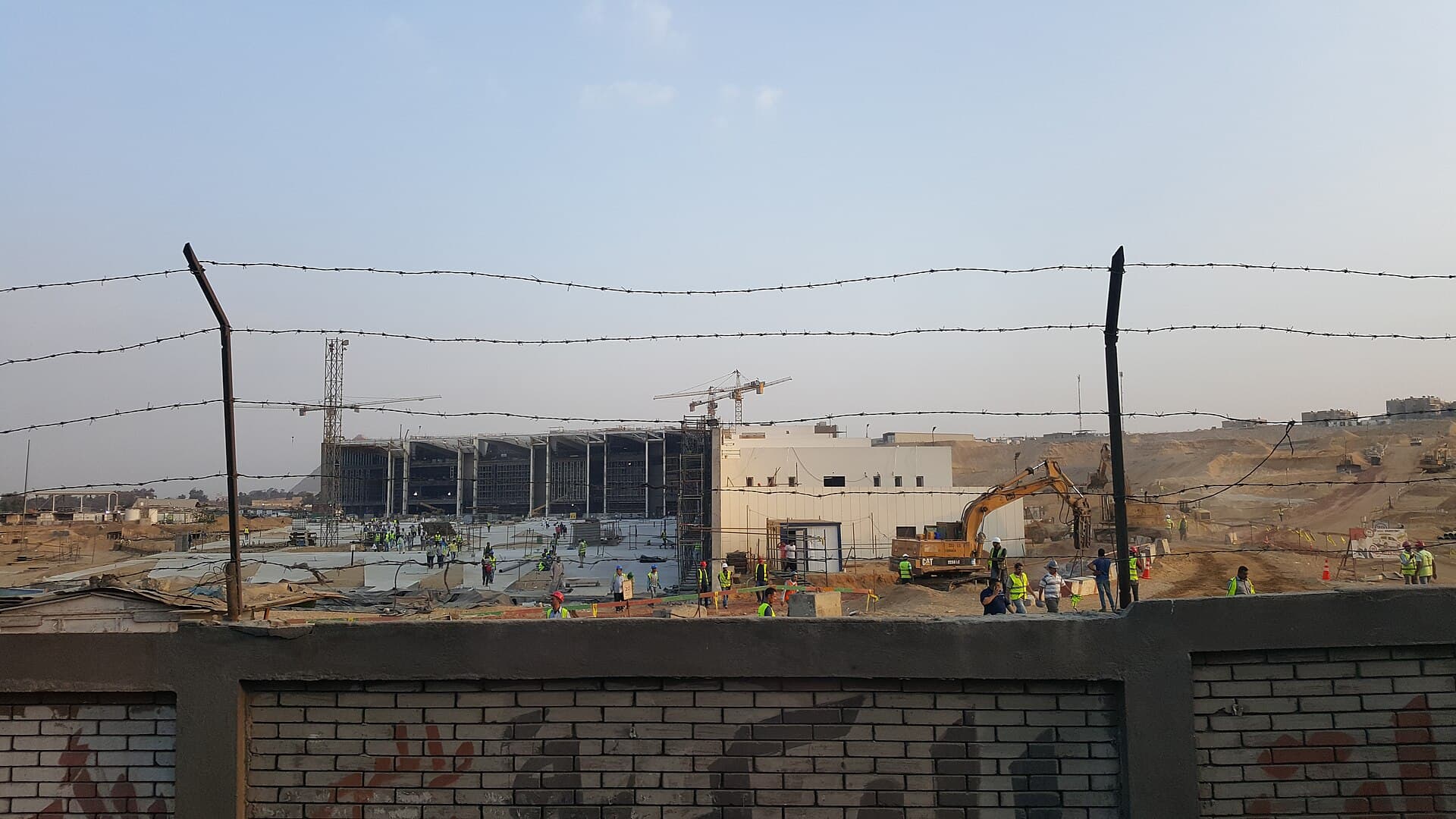
What followed was two decades of the kind of history that museums usually only exhibit. The 2011 revolution upended the Egyptian state and its finances, and years of political instability slowed the work. Tourism collapsed and recovered and collapsed again. Financing leaned heavily on large loans from Japan, the budget grew past a billion dollars, and the pandemic swept away another round of target dates. Through it all the building slowly rose, and the museum became a fixture of a strange genre of journalism: the opening that was always two years away.
The end came in stages. Limited trial visits began in late 2023, giving small numbers of visitors access to the atrium and commercial areas. In October 2024 the museum partially opened its main galleries, holding back only its centrepiece. The full grand opening came on 1 November 2025, a state ceremony attended by dozens of heads of state, after which the Tutankhamun galleries opened to the public at last. A project announced when the objects' custodians were young had taken the better part of their careers to complete.
The arrival sequence is the museum's first argument. Past the Ramses colossus in the atrium, the route climbs the Grand Staircase, a broad flight of steps rising six storeys through the building with dozens of monumental statues, sarcophagi and columns arranged along the ascent. Kings, gods and officials line the climb in loose chronological order, so that the visitor walks upward through three thousand years of sculpture. At the top, the reward is not an object but a window: a framed, direct view of the pyramids on the plateau beyond, the monuments the entire building is angled toward.
The Tutankhamun galleries are the collection's heart. When Carter opened the tomb in the Valley of the Kings in 1922, he found the only substantially intact royal burial ever recovered from ancient Egypt, and its contents were dispersed over the following century between display, storage and travelling exhibitions. The GEM reunites the whole assemblage, around 5,000 objects, most of which had never been publicly exhibited anywhere. The gold mask and coffins are here, but so are the things that surrounded them: the dismantled gilded shrines that nested around the sarcophagus, the chariots, the beds and thrones, the ritual figures, the sandals, the linen, the food provisions for the afterlife. Seen together, they stop being treasures and become what they were: the complete furnishing of one young man's death, packed by people who believed it would be needed.
A separate building on the grounds holds the solar boats of Khufu, the full-size cedar vessels buried beside the Great Pyramid around 2500 BC to carry the king in the afterlife. The first, excavated in 1954 and long displayed in a cramped structure at the pyramid's foot, was moved intact to the GEM in 2021 in another slow engineering procession across Giza. The main galleries beyond hold tens of thousands of objects spanning the prehistoric period to the Greco-Roman era, arranged by epoch and theme.
The old Egyptian Museum in Tahrir has not been emptied or retired. It remains open with deep collections of its own, including the royal material that suits its historic galleries, and the two institutions now operate as siblings: the century-old building in the city's heart, and the new one at the desert's edge.
Heneghan Peng's design begins from geography. The site sits on the escarpment where the Nile valley meets the desert plateau, and the building is cut into that fifty-metre level change, its form a long wedge whose walls fan out along sightlines aligned toward the pyramids of Khufu, Khafre and Menkaure. The visitor rises through the building as the plateau rises, so that architecture, landscape and monuments read as one composition. It is a rare case of a museum whose principal exhibit stands two kilometres outside its walls: the Pyramids of Giza are the final gallery.
The front elevation is a vast translucent screen of stone, a wall patterned with Sierpinski triangles and faced in alabaster that glows when lit from within, turning the building into a lantern at the desert's edge after dark. Inside, the spaces are calibrated to the scale of the collection; few museums need an atrium sized for an eighty-ton statue, or a staircase engineered to carry colossi.
The complex's quietest achievement opened years before the museum did. The GEM Conservation Center, running since 2010, is one of the largest conservation facilities in the region. Its staff spent more than a decade preparing the collection for display, including some of the most delicate work in the field: stabilising Tutankhamun's fragile textiles and sandals, and reassembling and conserving his chariots. By the time the galleries opened, the museum had already trained a generation of Egyptian conservators on its own collection.
The museum's opening shifted a long argument. Some of the most famous objects of Egyptian civilization are held abroad: the Rosetta Stone in the British Museum, the bust of Nefertiti in Berlin, the Dendera zodiac ceiling in the Louvre. Egypt has formally and repeatedly requested their return, and one argument long made against it was that Egypt lacked facilities to match the institutions holding them. The GEM does not settle the dispute, but it changes the ground on which it stands: there is now a purpose-built, conservation-led museum at Giza with room and expertise for anything that might come home.
The museum is also the most visible statement of how Egypt presents its own past. For a century, the fullest tellings of ancient Egypt were split between Cairo's overstuffed galleries and the great collections of London, Paris, Berlin, Turin and New York. The GEM gathers the national share of that story into a single sequence, told at Giza, in sight of the monuments, by the state that inherited them.
Ancient Egypt is the most self-documented civilization of the ancient world. For three thousand years it recorded itself compulsively: king lists and tax receipts, tomb walls painted with daily life, letters, spells, inventories, and burials packed with the objects a person would need to remain themselves after death. Tutankhamun's tomb is the extreme case, a complete personal record sealed in a single room, and the reason its reunited contents matter is not their gold but their completeness. Nothing is missing. The record survives whole.
What the Grand Egyptian Museum preserves is that habit of self-documentation, given at last a home built to its scale and set beside the monuments that began it. A civilization spent millennia making sure it would be remembered; the museum is the shelf, finally large enough, on which its memory now rests.
The museum stands on the Cairo-Alexandria desert road at Giza, close to the pyramids plateau and about a half-hour drive from central Cairo depending on traffic. It is open daily, and tickets are sold online through the official site as well as at the museum, with separate pricing for international and Egyptian visitors. Checking the site before travelling is worthwhile, as ticketing arrangements have continued to evolve since the full opening.
Allow at least half a day. The building rewards an unhurried arrival, and the Grand Staircase alone can absorb an hour. Many visitors pair the museum with the pyramids themselves in a single day; doing the museum first gives the plateau a context that changes how it reads. The Tutankhamun galleries draw the heaviest crowds, and early entry slots are the calmest way to meet them.