Heritage · Museum
National Gallery of Art: America's Museum on the Mall
The National Gallery of Art holds the United States' national art collection on the National Mall, free to every visitor. It began as one man's gift and grew into a public inheritance spanning two landmark buildings and a sculpture garden.Written to last.
By Confinity Heritage Editorial · Updated 2026-07-31 · 7-minute readQuiet tools, kept out of the way.
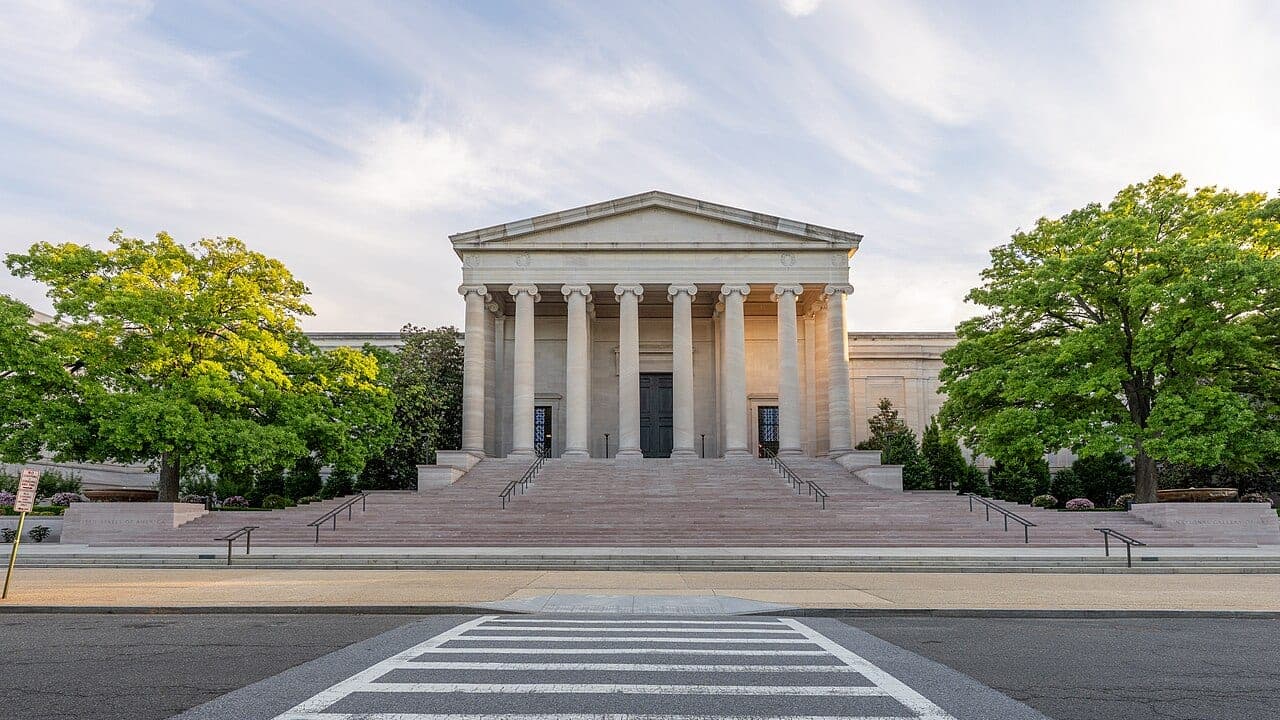
On the National Mall in Washington, D.C., in the open ground between the Capitol and the monuments, the National Gallery of Art keeps a share of what the United States has chosen to remember. It is the country's national art museum, and admission has never cost anything. Anyone can walk in from Constitution Avenue, stand in front of a portrait that Leonardo da Vinci painted in Florence in the 1470s, and walk out again without paying a cent. The place was built on a plain and demanding idea: that the finest things a civilization makes should be held in common, cared for on behalf of people who will never meet the donors, the curators, or one another.
The Gallery began as an act of remembrance dressed as a gift. Andrew W. Mellon, financier and former Secretary of the Treasury, spent the last years of his life assembling paintings and then gave them, together with the money to build a home for them, to the nation. He asked that the museum not carry his name, so that other collectors would feel free to add their own holdings to a shared collection rather than to a personal monument. What he set in motion is now one of the largest gatherings of art in the country, divided between two very different buildings and an outdoor garden, and administered as a partnership between the federal government and private citizens.
Mellon began collecting in earnest while serving as Secretary of the Treasury during the 1920s. Among his boldest purchases were paintings sold quietly by the Soviet government from the imperial collection of the Hermitage in Leningrad between 1930 and 1931, a group that included Raphael's "Alba Madonna" and Jan van Eyck's "Annunciation" (Wikipedia). By the middle of the decade he had resolved to give what he had gathered to the American people. In a 1936 letter to President Franklin D. Roosevelt he offered his collection along with funds to construct a building, and in 1937 Congress accepted the offer by joint resolution, formally creating the National Gallery of Art (Our History).
Mellon chose the American architect John Russell Pope to design the building. Neither man lived to see it finished. Mellon and Pope died within a day of each other in late August 1937, only months after excavation of the foundations had begun, so the work was completed by others according to their intentions (Wikipedia). President Roosevelt dedicated the completed West Building on March 17, 1941, accepting it on behalf of the country.
Mellon's refusal to attach his own name proved to be a shrewd act of stewardship. Because the museum belonged to no single family, other great collectors were willing to give. Within a few years the founding collection was joined by major gifts from Samuel H. Kress, Joseph Widener, Chester Dale, and Lessing J. Rosenwald, so that a collection begun by one man rapidly became the shared work of many (Britannica).
The single most famous work in the Gallery is a small portrait of a young Florentine woman. "Ginevra de' Benci," painted by Leonardo da Vinci around 1474, is the only painting by Leonardo on public view in the Americas (Wikipedia). The Gallery acquired it in February 1967 from Prince Franz Josef II of Liechtenstein, whose family had held the panel for more than two centuries, paying what was then a record price for any painting (Wikipedia). To keep the picture within reach of the public, rather than a private vault, is exactly the kind of preservation the museum was founded to perform.
Around it hangs a deep collection of European painting. The Gallery holds four paintings by or attributed to Johannes Vermeer, one of the larger groups of his rare surviving work in any museum, among them "Woman Holding a Balance" and "Girl with the Red Hat." Nearby are self-portraits and other canvases by Rembrandt, several Raphaels including the "Alba Madonna" and the "Small Cowper Madonna," and works by Botticelli, Titian, El Greco, and the French Impressionists. The strength across the early Italian, Dutch, and Flemish schools reflects the tastes of the founding donors, many of whom bought with a museum, rather than a drawing room, already in mind.
The American holdings run unusually deep, as befits a national gallery. Visitors find portraits by Gilbert Stuart and John Singleton Copley, seascapes and hunting scenes by Winslow Homer, the quiet interiors of Mary Cassatt, and canvases by James McNeill Whistler and George Bellows. Beyond the paintings the collection extends to sculpture, decorative arts, and a very large body of works on paper: the print rooms alone hold roughly 75,000 prints, many of them arriving through the gift of Lessing Rosenwald (Wikipedia). Together these holdings let a single museum trace European and American art across several centuries under one roof.
Pope's West Building, opened in 1941, is a temple to that idea in neoclassical form. Faced in Tennessee pink marble and built around a domed rotunda modeled on the Roman Pantheon, it was among the largest marble structures in the world when it was finished, its long axial galleries designed to lead the eye from room to room in an unbroken sequence (Britannica). The style was deliberately in keeping with the federal architecture of the Mall, tying the young museum to the older monuments around it.
 The West Building rotunda, modelled on the Pantheon, with a cast of Giambologna's Mercury at the centre of the fountain. Photograph by John Menard, CC BY-SA 2.0, via Wikimedia Commons.
The second building could hardly look more different. As the collection grew, the Gallery needed room, and it held an awkward trapezoidal plot east of Pope's building. The architect I.M. Pei answered the difficult site with a composition of interlocking triangles, an atrium flooded with light from above, and sharp geometric masses that read as modern from every angle. Paul Mellon, Andrew's son, and President Jimmy Carter dedicated the East Building on June 1, 1978 (Wikipedia). To bind the new work to the old, Pei clad it in the same Tennessee marble Pope had used, drawn from the same quarries, so that two buildings separated by nearly forty years and by opposite ideas of design share a single skin. An underground concourse links them beneath the plaza.
Across Constitution Avenue lies the third element, the Sculpture Garden, which opened to the public on May 23, 1999. Spread across roughly six acres, it arranges modern and contemporary sculpture around a central pool and fountain that becomes an ice rink in winter, turning a corner of the Mall into a place for rest as much as for viewing (Wikipedia).
The Gallery occupies a particular constitutional niche that explains both its national character and its independence. It was created by Congress and it receives federal money to operate, yet it is governed by its own Board of Trustees rather than by the officials who run the nearby Smithsonian museums. Four trustees serve because of the offices they hold, the Chief Justice of the United States, the Secretary of State, the Secretary of the Treasury, and the Secretary of the Smithsonian Institution, and they sit alongside five private citizens (20 U.S.C. 72). Federal appropriations pay for the building and its upkeep, while the art itself and much of the endowment have come from private gifts. That balance is why the Gallery is often described as a public-private partnership, associated with the federal establishment yet administered on its own terms (Philanthropy Roundtable).
The most visible expression of that founding bargain is the price of a ticket, which has always been nothing. Free admission was written into the museum's purpose from the start, and it has held ever since (Wikipedia). Among the major art museums of the United States the Gallery is unusual in charging no general admission at all, a policy that quietly reasserts the principle behind Mellon's gift each time a visitor walks in without reaching for a wallet.
In February 1928 the Soviet government ordered the State Hermitage Museum in Leningrad to draw up a list of works it could sell abroad. The first Five Year Plan needed foreign currency, and the state had already disposed of jewellery, furniture and icons taken from the church and the old nobility. An agency called Antiquariat was created to handle the sales, and the Hermitage was instructed to produce 250 paintings worth at least 5,000 roubles each (Wikipedia).
Word reached Mellon through Knoedler and Company, the New York dealers he regularly used. A consortium of Matthiesen in Berlin, Colnaghi in London and Knoedler bought the pictures from the Soviet government and offered them to Mellon, who held the right of first refusal. By the end of 1931 he had taken twenty-one paintings for a total of $6,654,000. Jan van Eyck's "Annunciation" came in June 1930 for $502,899. Raphael's "Alba Madonna," which Nicholas I had bought for the Hermitage in 1836, came in April 1931 for $1,166,400, the largest sum paid for any painting up to that time (Wikipedia). With them went Titian's "Venus with a Mirror," Botticelli's "Adoration of the Magi," Raphael's "Saint George and the Dragon," and portraits by Rembrandt, Frans Hals and Anthony van Dyck. The Gallery's own provenance records trace both the van Eyck and the Raphael from the Imperial Hermitage through the three dealers to Mellon, to his charitable trust on 5 June 1931, and to the nation in 1937 (National Gallery of Art).
Mellon was under investigation for tax fraud through the years the gift was arranged. An inquiry into his returns opened in 1933, and between February 1935 and May 1936 the Board of Tax Appeals heard the government's case against him. The Roosevelt administration accepted the museum regardless. Mellon died on 26 August 1937, and the Board cleared him of fraud a few months afterwards, though his estate paid to settle what remained (Wikipedia). The purchases and the tax case are usually recounted together.
The Soviet sales stopped in 1934, possibly after Joseph Orbeli, then the Hermitage's deputy director, wrote to Stalin protesting them; Orbeli took charge of the museum that year. For decades afterwards the Gallery declined to lend the paintings back, fearing they would not return. That changed under Mikhail Piotrovsky, and in 2002 Titian's "Venus with a Mirror" hung again in St Petersburg, on loan to the museum that had sold it seventy-one years earlier.
The National Gallery of Art sits on the north side of the National Mall, along Constitution Avenue between roughly 3rd and 9th Streets NW, within walking distance of the Capitol and the Smithsonian museums. Entry to the permanent collection is free and requires no ticket. The West Building, the East Building, and the underground concourse that joins them can all be seen in a single visit, and the Sculpture Garden lies a short walk to the west. The Gallery is generally open every day, with reduced hours on some holidays and closures on Christmas Day and New Year's Day. Several stations on the Washington Metro serve the Mall, and the surrounding streets connect the museum to the wider run of national monuments and memorials. Because the collection is large, most visitors do better to choose a few galleries and give them time than to try to see everything at once.
The West Building rotunda, modelled on the Pantheon, with a cast of Giambologna's Mercury at the centre of the fountain. Photograph by John Menard, CC BY-SA 2.0, via Wikimedia Commons.
The second building could hardly look more different. As the collection grew, the Gallery needed room, and it held an awkward trapezoidal plot east of Pope's building. The architect I.M. Pei answered the difficult site with a composition of interlocking triangles, an atrium flooded with light from above, and sharp geometric masses that read as modern from every angle. Paul Mellon, Andrew's son, and President Jimmy Carter dedicated the East Building on June 1, 1978 (Wikipedia). To bind the new work to the old, Pei clad it in the same Tennessee marble Pope had used, drawn from the same quarries, so that two buildings separated by nearly forty years and by opposite ideas of design share a single skin. An underground concourse links them beneath the plaza.
Across Constitution Avenue lies the third element, the Sculpture Garden, which opened to the public on May 23, 1999. Spread across roughly six acres, it arranges modern and contemporary sculpture around a central pool and fountain that becomes an ice rink in winter, turning a corner of the Mall into a place for rest as much as for viewing (Wikipedia).
The Gallery occupies a particular constitutional niche that explains both its national character and its independence. It was created by Congress and it receives federal money to operate, yet it is governed by its own Board of Trustees rather than by the officials who run the nearby Smithsonian museums. Four trustees serve because of the offices they hold, the Chief Justice of the United States, the Secretary of State, the Secretary of the Treasury, and the Secretary of the Smithsonian Institution, and they sit alongside five private citizens (20 U.S.C. 72). Federal appropriations pay for the building and its upkeep, while the art itself and much of the endowment have come from private gifts. That balance is why the Gallery is often described as a public-private partnership, associated with the federal establishment yet administered on its own terms (Philanthropy Roundtable).
The most visible expression of that founding bargain is the price of a ticket, which has always been nothing. Free admission was written into the museum's purpose from the start, and it has held ever since (Wikipedia). Among the major art museums of the United States the Gallery is unusual in charging no general admission at all, a policy that quietly reasserts the principle behind Mellon's gift each time a visitor walks in without reaching for a wallet.
In February 1928 the Soviet government ordered the State Hermitage Museum in Leningrad to draw up a list of works it could sell abroad. The first Five Year Plan needed foreign currency, and the state had already disposed of jewellery, furniture and icons taken from the church and the old nobility. An agency called Antiquariat was created to handle the sales, and the Hermitage was instructed to produce 250 paintings worth at least 5,000 roubles each (Wikipedia).
Word reached Mellon through Knoedler and Company, the New York dealers he regularly used. A consortium of Matthiesen in Berlin, Colnaghi in London and Knoedler bought the pictures from the Soviet government and offered them to Mellon, who held the right of first refusal. By the end of 1931 he had taken twenty-one paintings for a total of $6,654,000. Jan van Eyck's "Annunciation" came in June 1930 for $502,899. Raphael's "Alba Madonna," which Nicholas I had bought for the Hermitage in 1836, came in April 1931 for $1,166,400, the largest sum paid for any painting up to that time (Wikipedia). With them went Titian's "Venus with a Mirror," Botticelli's "Adoration of the Magi," Raphael's "Saint George and the Dragon," and portraits by Rembrandt, Frans Hals and Anthony van Dyck. The Gallery's own provenance records trace both the van Eyck and the Raphael from the Imperial Hermitage through the three dealers to Mellon, to his charitable trust on 5 June 1931, and to the nation in 1937 (National Gallery of Art).
Mellon was under investigation for tax fraud through the years the gift was arranged. An inquiry into his returns opened in 1933, and between February 1935 and May 1936 the Board of Tax Appeals heard the government's case against him. The Roosevelt administration accepted the museum regardless. Mellon died on 26 August 1937, and the Board cleared him of fraud a few months afterwards, though his estate paid to settle what remained (Wikipedia). The purchases and the tax case are usually recounted together.
The Soviet sales stopped in 1934, possibly after Joseph Orbeli, then the Hermitage's deputy director, wrote to Stalin protesting them; Orbeli took charge of the museum that year. For decades afterwards the Gallery declined to lend the paintings back, fearing they would not return. That changed under Mikhail Piotrovsky, and in 2002 Titian's "Venus with a Mirror" hung again in St Petersburg, on loan to the museum that had sold it seventy-one years earlier.
The National Gallery of Art sits on the north side of the National Mall, along Constitution Avenue between roughly 3rd and 9th Streets NW, within walking distance of the Capitol and the Smithsonian museums. Entry to the permanent collection is free and requires no ticket. The West Building, the East Building, and the underground concourse that joins them can all be seen in a single visit, and the Sculpture Garden lies a short walk to the west. The Gallery is generally open every day, with reduced hours on some holidays and closures on Christmas Day and New Year's Day. Several stations on the Washington Metro serve the Mall, and the surrounding streets connect the museum to the wider run of national monuments and memorials. Because the collection is large, most visitors do better to choose a few galleries and give them time than to try to see everything at once.
History and founding
The collection
The buildings
Cultural significance
Twenty-one paintings from the Hermitage
Visiting
References and resources
- Our History, the museum's official account of its founding and growth
- National Gallery of Art on Wikipedia, with detail on the buildings, collection, and governance
- National Gallery of Art at Encyclopaedia Britannica
- Ginevra de' Benci on Wikipedia, the story of the only Leonardo painting on public view in the Americas
- Andrew Mellon and the National Gallery of Art, on the founding gift and its conditions
- Board of Trustees, 20 U.S.C. 72, the statute defining the Gallery's governance
- Soviet sale of Hermitage paintings on Wikipedia, with the buyers, the prices, and a timeline of the works sold
- The Alba Madonna at the National Gallery of Art, whose provenance record runs from Raphael's patron to the Hermitage to Mellon
- The Annunciation at the National Gallery of Art, with the same chain of ownership for the van Eyck
- Andrew Mellon on Wikipedia, on the collector, the founding gift, and the tax case that ran alongside it