Heritage · Museum
The National Gallery, London: History and Visitor Guide
Founded in 1824, the National Gallery on London's Trafalgar Square holds the UK's national collection of Western European painting, free to enter.Written to last.
By Confinity Heritage Editorial · Updated 2026-07-31 · 7-minute readQuiet tools, kept out of the way.
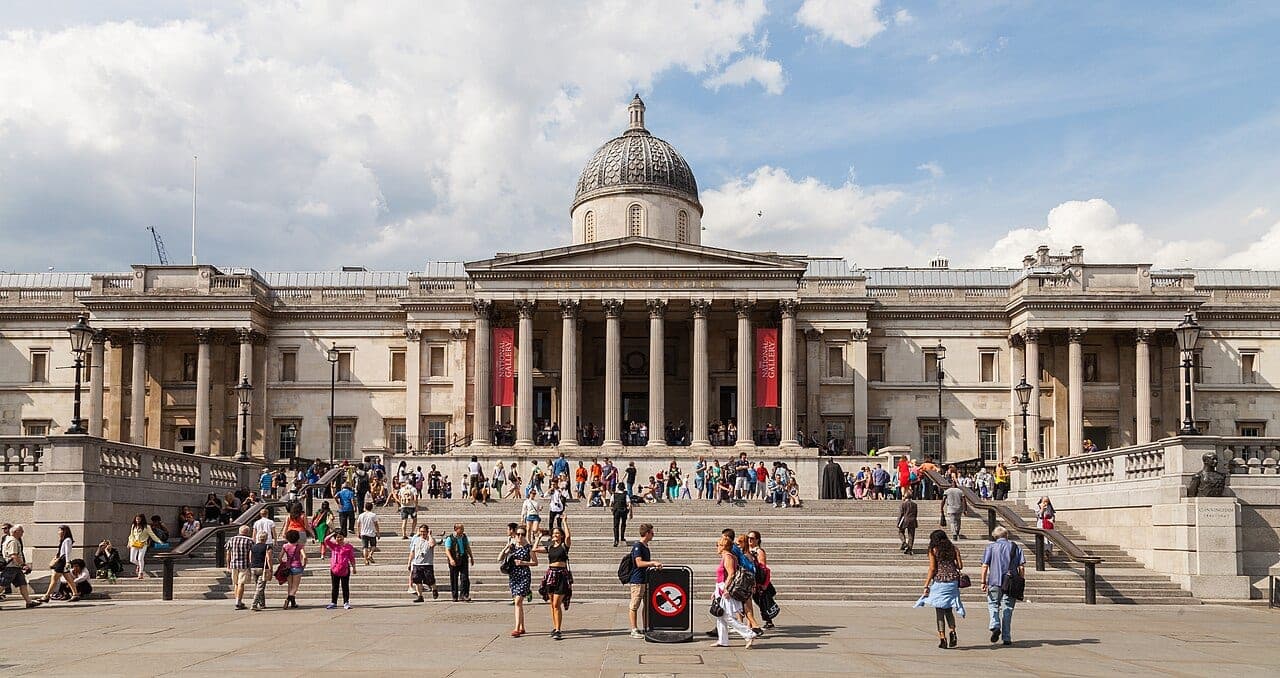
The National Gallery, on Trafalgar Square in central London, holds the United Kingdom's national collection of Western European painting, spanning the mid-13th century to about 1900. Founded in 1824, it is younger than many of Europe's great galleries and unusual in origin. It was not created by opening a royal or princely collection to the public, but assembled by the state through purchase and gift, beginning with a single group of pictures bought for the nation. Around 2,300 paintings now hang in its rooms, and, as has been true since it opened, entry to the permanent collection is free. This is the London institution on Trafalgar Square, distinct from the National Gallery of Ireland, the National Gallery of Art in Washington, and other galleries that share the name.
The gallery began in 1824, when the British government paid £57,000 for 38 paintings from the estate of John Julius Angerstein, a London merchant and Lloyd's underwriter who had died the previous year. The pictures were first shown to the public in Angerstein's former townhouse at 100 Pall Mall. The choice of model was deliberate: rather than nationalise an existing royal collection, as France had done at the Louvre, Parliament created a public collection from nothing and trusted it to grow through further purchases and private gifts.
The rooms in Pall Mall were cramped and visitor numbers soon outgrew them. A purpose-built home was commissioned from the architect William Wilkins on the newly laid-out Trafalgar Square, then being cleared at the edge of the old royal mews. Wilkins's long, low neoclassical building, with its central portico and shallow dome, opened to the public on 9 April 1838. For its first decades the gallery shared the building with the Royal Academy of Arts, which moved to Burlington House in 1868 and freed space for the growing collection. Further extensions followed through the 19th and 20th centuries, including new galleries and a domed vestibule designed by E. M. Barry in the 1870s.
The most significant modern addition is the Sainsbury Wing, which opened in 1991. Designed by the American architects Robert Venturi and Denise Scott Brown and paid for by three members of the Sainsbury family, it was built to display the early Renaissance paintings and is now regarded as a landmark of postmodern architecture. In 2024 the gallery marked its bicentenary with NG200, an £85 million programme of capital projects and exhibitions; on 10 May 2024 twelve displays opened on the same day at museums across the four nations of the United Kingdom. The refurbished Sainsbury Wing reopened as the gallery's main entrance on 10 May 2025, after a two-year renovation led by Selldorf Architects with Purcell.
The National Gallery is a collection of paintings rather than a general museum, and it was assembled to show the development of Western European painting for a broad public. It holds roughly 2,300 works, from the artists of late medieval Italy to the French Impressionists, a span often summarised as Giotto to Cézanne.
 Wilkins's building of 1838 was placed here deliberately: between the wealthy west of London and the poor east, so that both could reach it on foot. Photograph by Txllxt TxllxT, CC BY-SA 4.0, via Wikimedia Commons.
Among its best-known pictures is Jan van Eyck's Arnolfini Portrait of 1434, an oil painting of a merchant couple whose convex mirror and Latin inscription have been studied for centuries. Leonardo da Vinci's Virgin of the Rocks, one of two versions the artist painted, hangs in the Sainsbury Wing near the fragile chalk study known as the Burlington House Cartoon. Diego Velázquez's Rokeby Venus, painted about 1647–51 and the only surviving female nude by the Spanish master, was slashed by a suffragette in 1914 and later restored.
British painting is strongly represented through J. M. W. Turner, whose bequest brought works including The Fighting Temeraire of 1839, and John Constable, whose The Hay Wain of 1821 is among the most reproduced English landscapes. The later rooms carry the collection into the 19th century with Impressionist and post-Impressionist paintings, among them works by Monet, Renoir, Cézanne and Vincent van Gogh, whose Sunflowers is one of the gallery's most visited pictures. Titian, Botticelli, Holbein, Caravaggio, Rembrandt and Vermeer are all present, so that a single walk can follow the major traditions of Western painting in sequence.
From the outset the National Gallery was conceived as a public and educational institution as much as a display of fine pictures. Its central London site was chosen so that it would be reachable by rich and poor alike, and free admission has been kept for two centuries as an expression of that purpose. The collection has served generations of artists as a place to study and copy, and it remains one of the most visited art museums in the world, drawing more than 4.1 million people in 2025.
Its focus sets it apart from London's other great collections. Where the British Museum gathers objects from across human history, the National Gallery concentrates on a single art form and a single tradition, and it does so with a collection kept small enough to be seen in a day. That combination of quality, narrow focus and free access has made it a reference point for public galleries elsewhere.
The National Gallery occupies the north side of Trafalgar Square, London WC2N 5DN. Entry to the permanent collection is free, while major temporary exhibitions are ticketed. The gallery is generally open daily from 10am, with later opening on Fridays; because hours and exhibition schedules change, it is worth checking the official website before a visit.
The nearest Underground stations are Charing Cross and Leicester Square, with Embankment and Piccadilly Circus a short walk away, and many bus routes stop nearby. The main entrance is now through the refurbished Sainsbury Wing, which houses information, cloakrooms and step-free access; lifts serve the gallery floors, and wheelchairs can be borrowed. Free maps, guided tours and audio guides help visitors navigate a collection that, while smaller than some, rewards more than one visit.
Wilkins's building of 1838 was placed here deliberately: between the wealthy west of London and the poor east, so that both could reach it on foot. Photograph by Txllxt TxllxT, CC BY-SA 4.0, via Wikimedia Commons.
Among its best-known pictures is Jan van Eyck's Arnolfini Portrait of 1434, an oil painting of a merchant couple whose convex mirror and Latin inscription have been studied for centuries. Leonardo da Vinci's Virgin of the Rocks, one of two versions the artist painted, hangs in the Sainsbury Wing near the fragile chalk study known as the Burlington House Cartoon. Diego Velázquez's Rokeby Venus, painted about 1647–51 and the only surviving female nude by the Spanish master, was slashed by a suffragette in 1914 and later restored.
British painting is strongly represented through J. M. W. Turner, whose bequest brought works including The Fighting Temeraire of 1839, and John Constable, whose The Hay Wain of 1821 is among the most reproduced English landscapes. The later rooms carry the collection into the 19th century with Impressionist and post-Impressionist paintings, among them works by Monet, Renoir, Cézanne and Vincent van Gogh, whose Sunflowers is one of the gallery's most visited pictures. Titian, Botticelli, Holbein, Caravaggio, Rembrandt and Vermeer are all present, so that a single walk can follow the major traditions of Western painting in sequence.
From the outset the National Gallery was conceived as a public and educational institution as much as a display of fine pictures. Its central London site was chosen so that it would be reachable by rich and poor alike, and free admission has been kept for two centuries as an expression of that purpose. The collection has served generations of artists as a place to study and copy, and it remains one of the most visited art museums in the world, drawing more than 4.1 million people in 2025.
Its focus sets it apart from London's other great collections. Where the British Museum gathers objects from across human history, the National Gallery concentrates on a single art form and a single tradition, and it does so with a collection kept small enough to be seen in a day. That combination of quality, narrow focus and free access has made it a reference point for public galleries elsewhere.
The National Gallery occupies the north side of Trafalgar Square, London WC2N 5DN. Entry to the permanent collection is free, while major temporary exhibitions are ticketed. The gallery is generally open daily from 10am, with later opening on Fridays; because hours and exhibition schedules change, it is worth checking the official website before a visit.
The nearest Underground stations are Charing Cross and Leicester Square, with Embankment and Piccadilly Circus a short walk away, and many bus routes stop nearby. The main entrance is now through the refurbished Sainsbury Wing, which houses information, cloakrooms and step-free access; lifts serve the gallery floors, and wheelchairs can be borrowed. Free maps, guided tours and audio guides help visitors navigate a collection that, while smaller than some, rewards more than one visit.
History
The collection
Cultural role
Visiting
References and resources
- Encyclopaedia Britannica: National Gallery: overview of the gallery's founding, building and holdings.
- The National Gallery (official): visitor information, opening hours and the online collection.
- The National Gallery: collection overview: the scope and strengths of the paintings collection.
- The National Gallery: NG200: the 2024 bicentenary programme and the Sainsbury Wing refurbishment.
- Wikipedia: National Gallery: detailed history, architecture and list of key works with sources.