Heritage · Museum
The Anne Frank House: The Secret Annex and the Diary
The Anne Frank House preserves the Amsterdam canal house where eight people hid from Nazi persecution for two years, and where Anne Frank wrote her diary. The rooms of the Secret Annex are kept empty at Otto Frank's insistence, and the original diary is on display.Written to last.
By Confinity Heritage Editorial · 2026-08-23 · 7-minute readQuiet tools, kept out of the way.
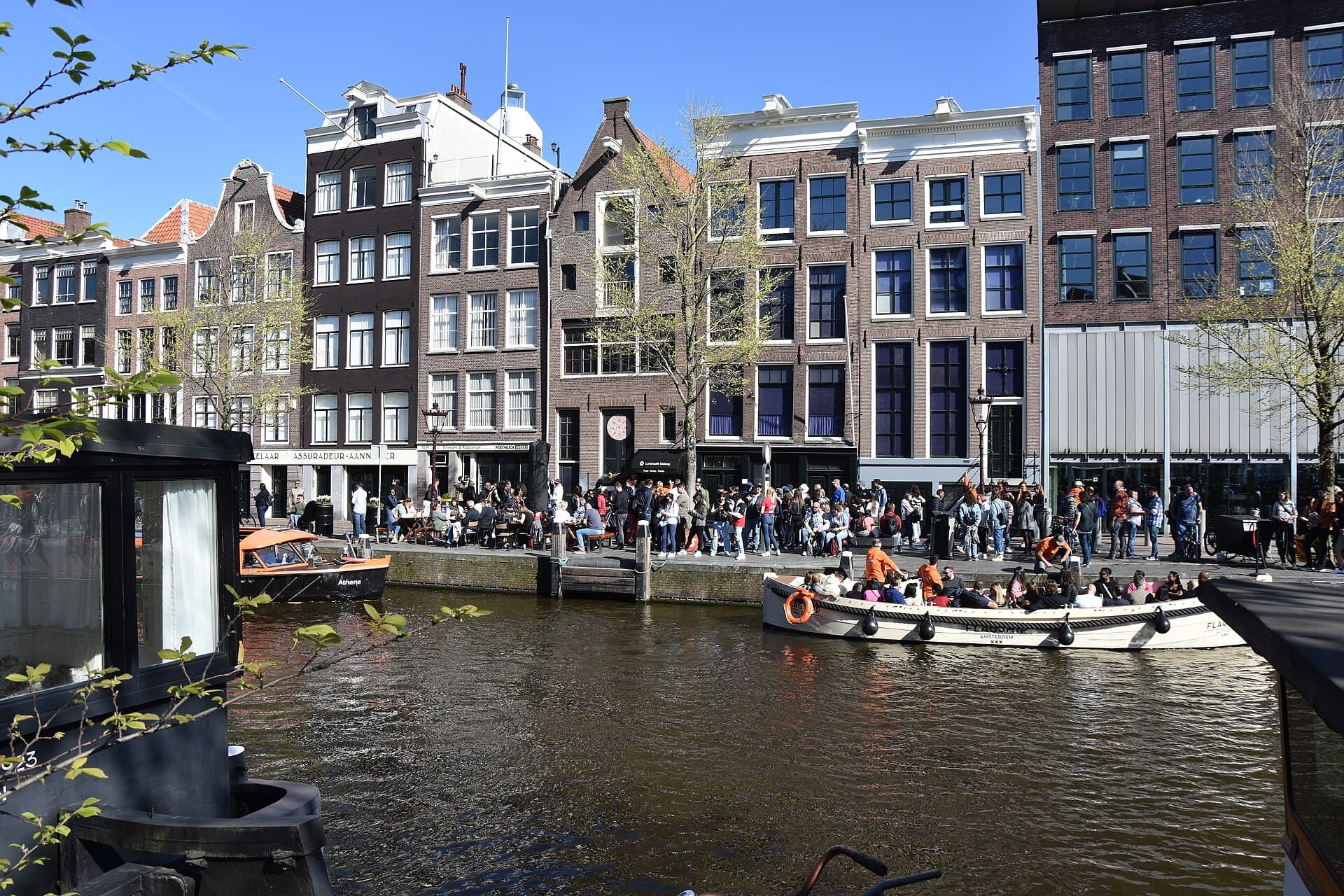
On the second floor of a canal house at Prinsengracht 263 in Amsterdam stands a grey bookcase filled with old office files. It swings away from the wall. Behind it, a steep staircase leads up into a set of hidden rooms where eight people lived for more than two years, in silence during working hours, never once stepping outside. One of them was a teenage girl who kept a diary. The bookcase is still there, and the rooms behind it are kept empty. That emptiness is the museum.
The Anne Frank House opened on 3 May 1960 and is now among the most visited museums in the Netherlands, drawing more than a million people a year to a building never designed to hold crowds. It preserves the hiding place of the Frank family, the offices of the business that concealed them, and the original red-checked diary in which Anne Frank recorded the life of the Secret Annex. This article covers how the house became a museum, what visitors see inside, the building itself, and why one adolescent's notebook became one of the most widely read documents of the twentieth century.
Otto Frank, a German Jewish businessman, moved his family from Frankfurt to Amsterdam in 1933, the year the Nazis came to power. In December 1940 his company Opekta, which sold pectin for making jam, moved into the canal house at Prinsengracht 263. The building had a front house facing the canal and, like many Amsterdam merchant houses, a separate annex at the rear. When the German occupation of the Netherlands turned to the systematic persecution of Jews, Otto quietly prepared the annex as a hiding place.
The family went into hiding on 6 July 1942, the day after Anne's older sister Margot received a call-up notice for a German labour camp. A week later they were joined by Hermann and Auguste van Pels and their son Peter, and in November 1942 by Fritz Pfeffer, a dentist. Eight people shared a few small rooms behind the bookcase, which the office staff had built to disguise the entrance. Four of Otto's employees sustained them at daily risk to their own lives: Miep Gies, Bep Voskuijl, Johannes Kleiman and Victor Kugler brought food, books, news and company for twenty-five months.
On 4 August 1944 the hiding place was discovered and everyone in it was arrested. How the annex was betrayed, or whether it was betrayed at all, has never been established. The eight were deported by way of Westerbork to Auschwitz. Of the eight, only Otto Frank survived. Anne and Margot were transported to Bergen-Belsen, where both died in early 1945, only weeks before the camp was liberated. Anne was fifteen.
After the arrest, Miep Gies and Bep Voskuijl found Anne's diary papers scattered on the annex floor. Gies kept them in her desk drawer, unread, intending to return them to Anne. When Otto came back from Auschwitz and learned that his daughters were dead, she handed him the papers. He published a version of the diary in June 1947 as Het Achterhuis, the rear annex.
The building itself nearly disappeared. In the 1950s the block was sold to a developer and slated for demolition. A campaign by Amsterdam citizens, carried by the newspapers and by the diary's growing readership, saved it. The Anne Frank Stichting was founded in 1957 to preserve the house, and the museum opened three years later with Otto Frank closely involved.
The route leads from the front house, through the offices where Kleiman, Kugler, Gies and Voskuijl worked above the warehouse, to the bookcase, and up the steep stairs into the annex itself. The rooms are small and the ceilings low, and the windows are kept blacked out as they were during the hiding, when a glimpse from a neighbouring building could have been fatal.
The annex contains almost no furniture. After the arrest, the occupying authorities had the rooms emptied, as they emptied the homes of deported Jews across the city. When the museum was established, Otto Frank insisted the annex remain unfurnished. He refused reconstruction. The bare rooms stand for what was taken away, and for the people who did not come back. A scale model shows how the rooms were furnished during the hiding, but the rooms themselves hold only what survived in place.
What survived in place is affecting out of proportion to its size. In the small room Anne shared with Fritz Pfeffer, the pictures she glued to the wall are still there: film stars, the young English princesses, art postcards, cut from the magazines the helpers brought in. On a doorpost are the pencil lines with which Otto and Edith marked the heights of Anne and Margot as they grew, the ordinary record of two children measured in a hiding place. Nearby hangs the map on which Otto tracked the Allied advance after D-Day.
The route ends in the museum's diary room, where the original diary is displayed, along with the notebooks and loose sheets of her rewritten version and her short stories. Seeing the handwriting itself, dense and quick, is for many visitors the centre of the whole house.
Prinsengracht 263 was built in 1635, during Amsterdam's great period of canal construction, as a merchant's house with a warehouse below, offices above, and an annex at the rear across a small courtyard. That layout, common along the canals, made the hiding possible: an annex invisible from the street, reached through a working business that gave the address a legitimate daily life.
The house was derelict when the Stichting took it over, and preserving it meant rebuilding much of the front house while keeping the annex untouched. In the 1990s the museum acquired the neighbouring building and added a modern entrance wing, opened in 1999, so that ticketing and exhibitions could move out of the historic rooms. A further renewal completed in 2018 rerouted the visitor path and added context on the persecution of the Jews of the Netherlands, of whom about three quarters were killed. Through all of it one principle has held: the annex is conserved, not restored, and not refurnished.
Anne Frank wrote her diary twice. She began it on her thirteenth birthday in June 1942 and kept it privately for nearly two years. In March 1944, the Dutch education minister in exile, speaking on Radio Oranje from London, appealed to his countrymen to keep diaries and letters so that the occupation could be documented after the war. Anne heard the broadcast in the annex and began rewriting her own diary for publication, editing, cutting and expanding it on loose sheets while continuing the original. Scholars call the first version A and the rewritten version B; the published book Otto assembled draws on both. She was not only a witness but a writer revising her work, and she knew it.
The book has been translated into some seventy languages. For millions of readers it is the first personal account of the Holocaust they encounter, one voice standing in for the million and a half Jewish children who were killed. That standing has made the diary a target of Holocaust deniers, who have claimed since the 1950s that it was forged. The claim has been tested and destroyed: after Otto Frank's death in 1980 the papers passed to the Dutch state, and forensic examination of the handwriting, ink, glue and paper confirmed the diary's authenticity in exhaustive detail, published in a critical edition of the full texts in 1986. The house's foundation carries that work forward, running educational programmes against antisemitism, racism and discrimination in dozens of countries.
The German occupation was an apparatus of erasure. It took the people of the annex, their belongings, their futures, and, in the case of seven of the eight, their lives, and it intended that no account of them should remain. What defeated that intention, in this one house, was a notebook a girl was given for her thirteenth birthday, a helper who kept the papers unread in a drawer, and a father who decided the world should read them.
That is what the Anne Frank House holds: the proof of how much a single preserved document can carry. The diary outlasted the regime that made it necessary. Against the machinery that processed millions into silence, one kept record returned a name, a voice, a sense of humour, a set of quarrels and hopes, an entire interior life. The empty rooms make the loss legible; the diary makes the person legible. Neither would be enough alone.
The museum stands at Prinsengracht 263-267 in central Amsterdam, beside the Westerkerk, about twenty minutes on foot from Central Station. Demand far exceeds the capacity of the narrow house, so entry is by timed ticket, sold online only for a specific date and slot; tickets are released weeks in advance and often sell out. There is no ticket sale at the door.
Allow at least an hour. The stairs to the annex are steep, as they were in 1942, and the upper rooms are not accessible to wheelchair users. An audio tour in multiple languages accompanies the route. The museum asks for quiet in the annex, and gets it; most visitors find that the rooms impose it themselves.