Heritage · Landmark
Sheikh Zayed Grand Mosque: a founder's marble vision
A field of white domes rises on the Abu Dhabi shore, large enough to gather tens of thousands beneath a single roofline. It is a working house of prayer, the resting place of the man who unified the Emirates, and one of the largest mosques on earth.Written to last.
By Confinity Heritage Editorial · Updated 2026-07-31 · 7-minute readQuiet tools, kept out of the way.
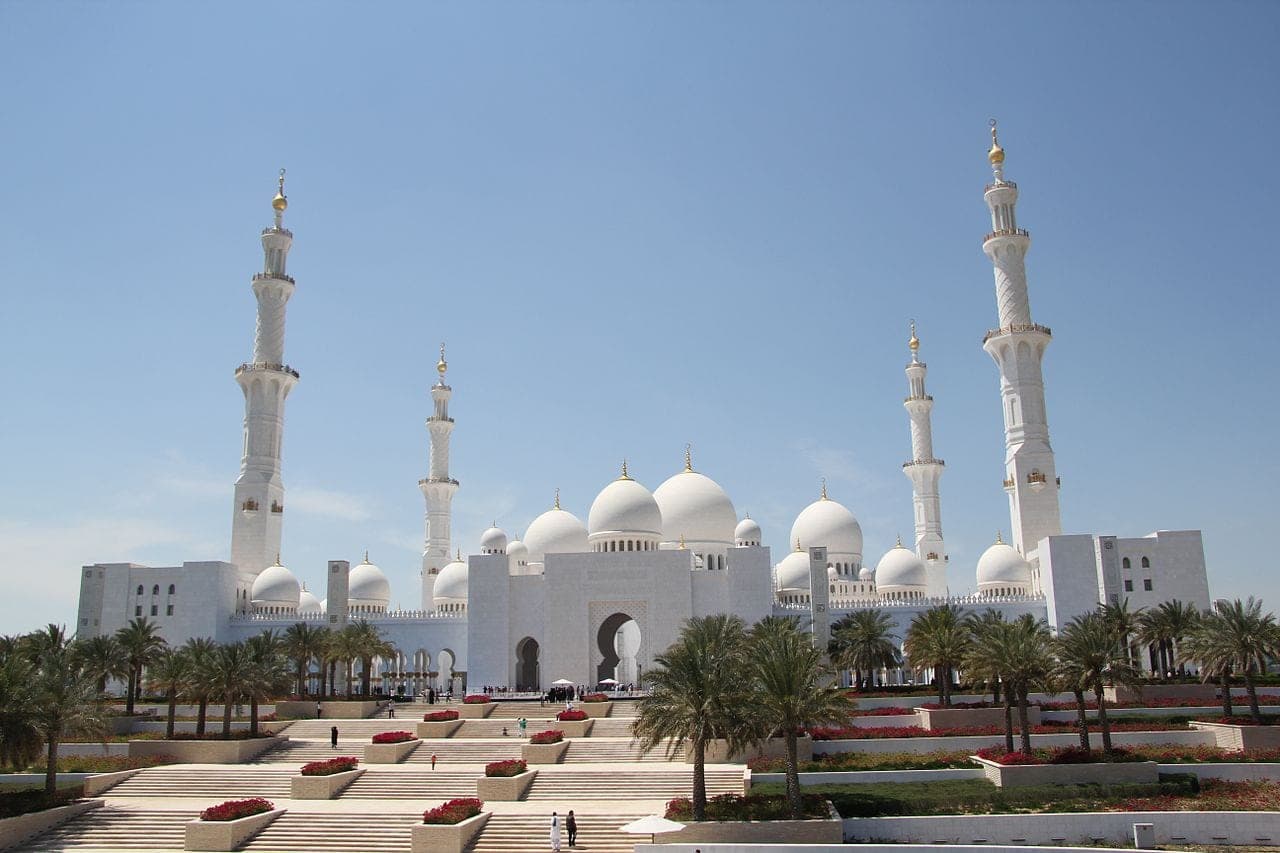
On the western edge of Abu Dhabi, where the desert gives way to a reclaimed shore, a field of white domes lifts above the road and the heat. The Sheikh Zayed Grand Mosque is one of the largest houses of worship in the world, wide enough to gather tens of thousands of people beneath a single roofline, and yet its first gift to a visitor is not scale but quiet. Marble the colour of milk catches the low sun and holds it, and the long reflecting pools that run along the courtyard double the arcades, so that the whole building seems to rest on its own image.
The mosque carries the name of Sheikh Zayed bin Sultan Al Nahyan, the founding president of the United Arab Emirates, who imagined it as a place where the many schools of Islamic art might meet and where people of every background might come to know one another better. He did not live to see it opened. He was laid to rest beside it, and certified reciters read the Qur'an over his grave in turn, without pause, through every hour of the day and night. For a country not yet forty years old, the building is at once a place of prayer, a memorial to the man who unified it, and a plain statement of who the Emirates hope to become.
Sheikh Zayed (1918–2004) was the architect of the modern Emirates. On 2 December 1971 he brought seven separate sheikhdoms together under one flag and became the first president of the new federation. Late in his life he set his mind on a national mosque that would do more than serve a single city. He wanted a building that drew the great traditions of Islamic architecture into one composition, and that carried a message of moderation, learning and welcome rather than grandeur alone.
Ground was broken in November 1996. The work took roughly eleven years, and the mosque opened for worship during Eid al-Adha in 2007, near the close of the pilgrimage season. It was an undertaking of unusual reach: more than three thousand workers and dozens of contracting companies, drawing craft and material from many nations, at a cost of around two billion dirhams. The finished complex covers more than twelve hectares, its walled footprint measuring some 290 by 420 metres, and it can hold in the region of fifty thousand worshippers across its halls and courtyards, with several thousand in the main prayer hall alone. Eighty-two domes in seven sizes crown the roofline, and four minarets rise above the corners of the courtyard to roughly a hundred and seven metres. Sheikh Zayed died in 2004, three years before the doors opened, and so the mosque became a memorial almost before it became a place of prayer.
The design, led by the Syrian architect Yousef Abdelky, is a considered synthesis rather than a copy of any one style. Its pointed, onion-profiled domes and slender finials recall the Mughal mosques of Lahore and the plains of northern India. Its arcaded courtyard and horseshoe arches echo the Moorish architecture of Andalusia and North Africa. Its proportions and its tall, tapering minarets answer to the Ottoman tradition of Anatolia and the wider Mediterranean. Designers looked in particular to the Badshahi Mosque in Lahore and to the Abu al-Abbas al-Mursi Mosque in Alexandria, and let those references speak to one another across the plan.
 Macedonian marble, Italian inlay, Iranian carpet-weaving and Moorish arches, assembled by craftsmen from dozens of countries into one building. Photograph by Guilhem Vellut, CC BY 2.0, via Wikimedia Commons.
The material is overwhelmingly white marble, quarried in Macedonia and supplemented by stone from Italy and India, chosen so the surfaces would stay pale and luminous under a fierce sun. What lifts the exterior beyond simple whiteness is the inlay. Across the courtyard paving and up the faces of the columns, craftsmen set semi-precious stones into the marble in trailing patterns of vines, leaves and blossom: lapis lazuli, amethyst, jasper, red agate and mother-of-pearl, cut and fitted by hand. The technique belongs to the same family as the pietra dura flowering on the Taj Mahal, and it gives the cool stone a living, growing quality. At dusk a lighting scheme shifts the domes gently through the phases of the moon, and the reflecting pools carry the whole facade down into still water.
Inside, the main prayer hall opens beneath the great central dome, its weight carried on marble columns clad in yet more floral inlay and mother-of-pearl. Two features hold every visitor. The first lies underfoot: the largest hand-knotted carpet in the world, a single field of about 5,627 square metres designed by the Iranian artist Ali Khaliqi and knotted by roughly 1,200–1,300 craftspeople over some two years. It carries more than two billion knots and weighs in the tens of tonnes, and fine tonal lines woven into its medallions quietly mark out the rows in which worshippers stand to pray.
The second feature hangs above: a set of seven chandeliers, made in Germany and dressed with millions of Swarovski crystals in gilded frames shaped to suggest date palms. The largest measures around ten metres across and fifteen metres tall, among the biggest of its kind ever installed in a mosque. Around the walls runs the calligraphy, drawn in the three classical hands of Kufic, Naskh and Thuluth by masters from the Emirates, Syria and Jordan. On the qibla wall, the wall that faces Makkah, the ninety-nine names of God are rendered in a spare Kufic script and lit so softly that the verses seem to surface from the marble rather than sit upon it.
For all its fame among photographers, the mosque is first a working place of worship. The five daily prayers are called from its minarets, the Friday congregation fills the halls, and at the two Eid festivals the courtyards gather crowds far larger still. Outside the hours of prayer, the mosque opens its doors to visitors of every faith and none, offering free guided tours and asking only that guests dress modestly and enter in a spirit of respect. That openness is deliberate. The mosque was built to be a meeting place for cultures, and it has become one of the region's foremost venues for interfaith exchange, hosting scholars, students and heads of state.
In February 2019 it welcomed Pope Francis, the first pontiff to visit the Arabian Peninsula, who met there with the Muslim Council of Elders during the signing of the Document on Human Fraternity. Set a little apart from the halls is the mausoleum of Sheikh Zayed himself, where the continuous recitation of the Qur'an has not stopped since he was buried. Visitors are asked to pass in silence. The grave keeps the building honest: whatever else the mosque is, it remains a place where a man is mourned and remembered.
In the years since it opened, the mosque has become the ceremonial heart of the Emirates. Foreign leaders are received there on state visits, national occasions are marked beneath its domes, and its image appears on currency, stamps and the pages of passports. During Ramadan its courtyards host large public iftars, and at Eid it draws families from across the country and beyond. Several million people pass through each year, which places it among the most visited sites in the Gulf.
Part of its hold on the national imagination is that it belongs to no single emirate or family faction: it carries the name of the founder and speaks for the whole federation. In a country assembled quickly from small coastal towns and desert interior, the mosque offers a shared address, a place where the idea of the Emirates as tolerant, outward-looking and rooted in faith is made visible in stone. It has, in a short time, become one of the images the nation chooses to show the world and to show itself.
A heritage of this kind is younger than most, and that youth is part of its meaning. The Sheikh Zayed Grand Mosque was conceived by one man as a gift to those who would come after him, and completed only once he was gone, so that memory was built into its purpose from the start. The reciters at the mausoleum keep a private grief and a public commemoration bound together in the same courtyard, hour after hour, year after year.
For anyone who thinks about how the living hold on to the dead, the mosque offers a clear example: a place made durable on purpose, where a name is spoken aloud so that it will not be lost, and where a whole community can gather around a single remembered life. The marble was chosen to last, the calligraphy to be read by generations who were not yet born, and the doors left open so that the remembering would not be done in private. That is what the building finally keeps, alongside the prayers: the memory of a founder, and the promise a young nation made to carry it forward.
Macedonian marble, Italian inlay, Iranian carpet-weaving and Moorish arches, assembled by craftsmen from dozens of countries into one building. Photograph by Guilhem Vellut, CC BY 2.0, via Wikimedia Commons.
The material is overwhelmingly white marble, quarried in Macedonia and supplemented by stone from Italy and India, chosen so the surfaces would stay pale and luminous under a fierce sun. What lifts the exterior beyond simple whiteness is the inlay. Across the courtyard paving and up the faces of the columns, craftsmen set semi-precious stones into the marble in trailing patterns of vines, leaves and blossom: lapis lazuli, amethyst, jasper, red agate and mother-of-pearl, cut and fitted by hand. The technique belongs to the same family as the pietra dura flowering on the Taj Mahal, and it gives the cool stone a living, growing quality. At dusk a lighting scheme shifts the domes gently through the phases of the moon, and the reflecting pools carry the whole facade down into still water.
Inside, the main prayer hall opens beneath the great central dome, its weight carried on marble columns clad in yet more floral inlay and mother-of-pearl. Two features hold every visitor. The first lies underfoot: the largest hand-knotted carpet in the world, a single field of about 5,627 square metres designed by the Iranian artist Ali Khaliqi and knotted by roughly 1,200–1,300 craftspeople over some two years. It carries more than two billion knots and weighs in the tens of tonnes, and fine tonal lines woven into its medallions quietly mark out the rows in which worshippers stand to pray.
The second feature hangs above: a set of seven chandeliers, made in Germany and dressed with millions of Swarovski crystals in gilded frames shaped to suggest date palms. The largest measures around ten metres across and fifteen metres tall, among the biggest of its kind ever installed in a mosque. Around the walls runs the calligraphy, drawn in the three classical hands of Kufic, Naskh and Thuluth by masters from the Emirates, Syria and Jordan. On the qibla wall, the wall that faces Makkah, the ninety-nine names of God are rendered in a spare Kufic script and lit so softly that the verses seem to surface from the marble rather than sit upon it.
For all its fame among photographers, the mosque is first a working place of worship. The five daily prayers are called from its minarets, the Friday congregation fills the halls, and at the two Eid festivals the courtyards gather crowds far larger still. Outside the hours of prayer, the mosque opens its doors to visitors of every faith and none, offering free guided tours and asking only that guests dress modestly and enter in a spirit of respect. That openness is deliberate. The mosque was built to be a meeting place for cultures, and it has become one of the region's foremost venues for interfaith exchange, hosting scholars, students and heads of state.
In February 2019 it welcomed Pope Francis, the first pontiff to visit the Arabian Peninsula, who met there with the Muslim Council of Elders during the signing of the Document on Human Fraternity. Set a little apart from the halls is the mausoleum of Sheikh Zayed himself, where the continuous recitation of the Qur'an has not stopped since he was buried. Visitors are asked to pass in silence. The grave keeps the building honest: whatever else the mosque is, it remains a place where a man is mourned and remembered.
In the years since it opened, the mosque has become the ceremonial heart of the Emirates. Foreign leaders are received there on state visits, national occasions are marked beneath its domes, and its image appears on currency, stamps and the pages of passports. During Ramadan its courtyards host large public iftars, and at Eid it draws families from across the country and beyond. Several million people pass through each year, which places it among the most visited sites in the Gulf.
Part of its hold on the national imagination is that it belongs to no single emirate or family faction: it carries the name of the founder and speaks for the whole federation. In a country assembled quickly from small coastal towns and desert interior, the mosque offers a shared address, a place where the idea of the Emirates as tolerant, outward-looking and rooted in faith is made visible in stone. It has, in a short time, become one of the images the nation chooses to show the world and to show itself.
A heritage of this kind is younger than most, and that youth is part of its meaning. The Sheikh Zayed Grand Mosque was conceived by one man as a gift to those who would come after him, and completed only once he was gone, so that memory was built into its purpose from the start. The reciters at the mausoleum keep a private grief and a public commemoration bound together in the same courtyard, hour after hour, year after year.
For anyone who thinks about how the living hold on to the dead, the mosque offers a clear example: a place made durable on purpose, where a name is spoken aloud so that it will not be lost, and where a whole community can gather around a single remembered life. The marble was chosen to last, the calligraphy to be read by generations who were not yet born, and the doors left open so that the remembering would not be done in private. That is what the building finally keeps, alongside the prayers: the memory of a founder, and the promise a young nation made to carry it forward.
A founder's dream in stone
Where three traditions meet
The room of light
A house of prayer and welcome
The nation's front room
What the marble remembers
References and resources
- Wikipedia: "Sheikh Zayed Grand Mosque." Overview of construction (1996–2007), architecture, dimensions, marble, carpet and chandeliers. https://en.wikipedia.org/wiki/Sheikh_Zayed_Grand_Mosque
- Sheikh Zayed Grand Mosque Centre (SZGMC), official site: "The Mosque and the Founder" and Islamic architecture pages. https://www.szgmc.gov.ae/
- Britannica: entry on Sheikh Zayed bin Sultan Al Nahyan, founding president of the United Arab Emirates. https://www.britannica.com/biography/Zayed-bin-Sultan-Al-Nahyan
- Guinness World Records: recognition of the mosque's hand-knotted carpet as the largest in the world. https://www.guinnessworldrecords.com/
- Abu Dhabi Media Office: coverage of the mosque's calligraphy and its Jusoor programme of cultural dialogue and tolerance. https://www.mediaoffice.abudhabi/
- The National (Abu Dhabi): reporting on the mosque's construction, scale and role in receiving state visitors. https://www.thenationalnews.com/