Heritage · Landmark
Blue Mosque (Sultan Ahmed Mosque): Istanbul's Ottoman Jewel
Raised for Sultan Ahmed I between 1609 and 1616, the Blue Mosque faces the Hagia Sophia across a public square in old Istanbul. Its six minarets and more than 20,000 handmade Iznik tiles have made it one of the most recognised mosques in the world.Written to last.
By Confinity Heritage Editorial · Updated 2026-07-31 · 7-minute readQuiet tools, kept out of the way.
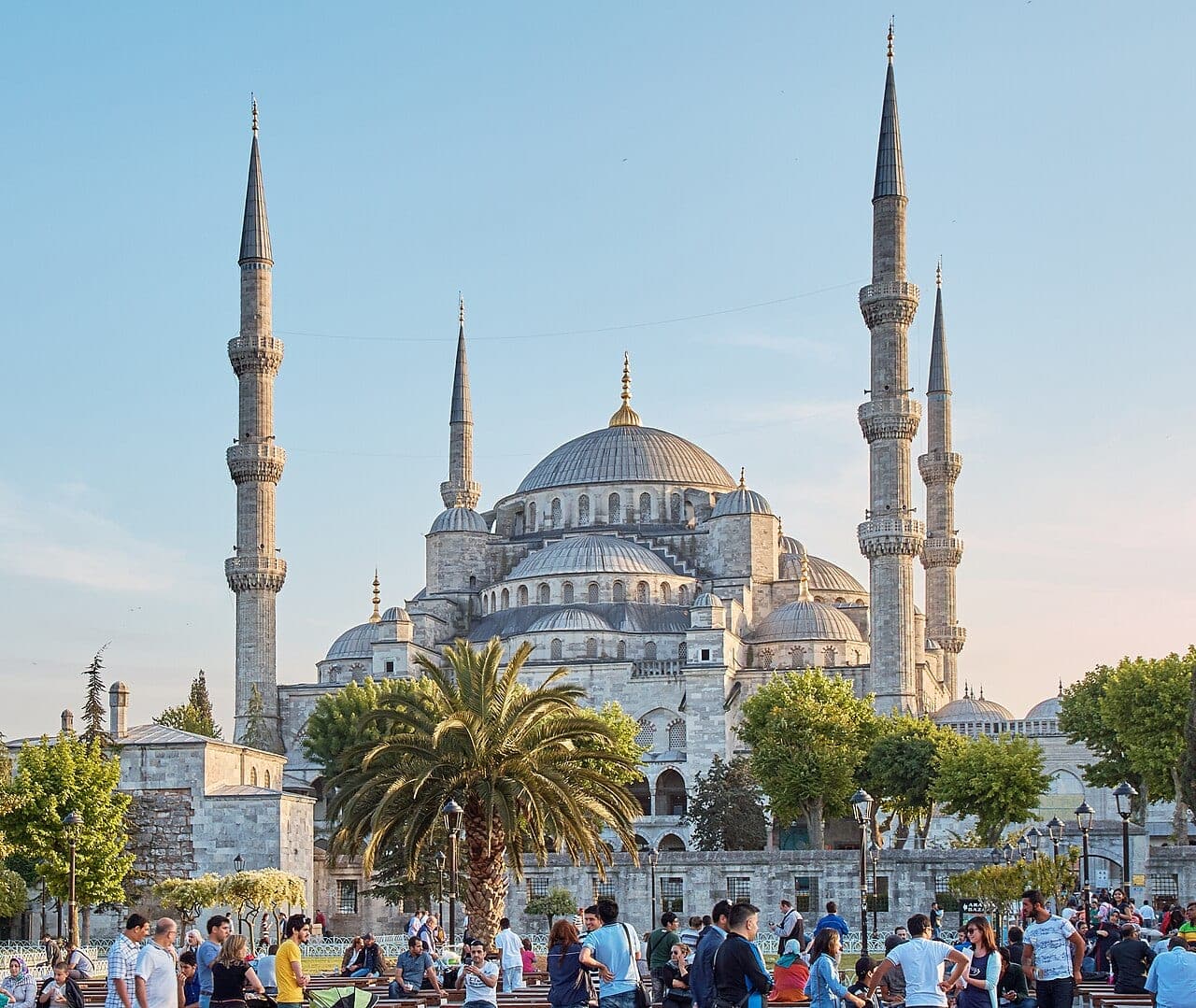
In the old heart of Istanbul, on the promontory where the city reaches toward the Sea of Marmara, the Blue Mosque has called worshippers to prayer for more than four hundred years. Known in Turkish as Sultanahmet Camii and in English as the Sultan Ahmed Mosque, it rises in a cascade of grey lead domes above a wide public square, its six slender minarets marking the skyline of the historic peninsula. Directly opposite, across that square, stands the Hagia Sophia, so that the two great buildings seem to answer one another in stone. Both fall within the Historic Areas of Istanbul, inscribed on the UNESCO World Heritage List in 1985 (UNESCO).
The mosque takes its familiar name from the tens of thousands of blue and green tiles that line its interior, glazed in the kilns of Iznik and set by hand across walls, galleries and piers. It remains an active house of worship, open to the five daily prayers, and it is also a place of memory. Sultan Ahmed I, who commissioned the building as a young man, lies in a tomb beside its walls, and the generations who have prayed and mourned within it have left the mosque layered with quiet remembrance. This archive records it not as a relic behind glass but as a living monument, still doing the work it was raised to do.
The mosque was the great project of Sultan Ahmed I, who came to the Ottoman throne in 1603 while still a boy of thirteen. Earlier sultans had often funded their imperial mosques from the spoils of military victory. Ahmed I had won no such campaign, and drawing on the state treasury for so vast a building attracted criticism at the time (Britannica). He pressed ahead regardless, wanting a mosque that would rival the Byzantine church converted centuries earlier into the imperial mosque of the conquerors, the Hagia Sophia.
Construction ran from 1609 to 1616, with the mosque inaugurated as that work drew to a close (Wikipedia). The site was itself heavy with history. It lay beside the ancient Hippodrome of Constantinople and over the ground of the former Byzantine imperial palace, so that Ahmed I planted his mosque on the symbolic centre of the old city, in full view of the Hagia Sophia. Several palaces had to be bought up and cleared to make room for it.
The design was entrusted to Sedefkar Mehmed Aga, an architect who had trained under the celebrated Mimar Sinan, the master of the classical Ottoman style. The Blue Mosque became the crowning achievement of Mehmed Aga's career, gathering the lessons of Sinan's long life into a single, deliberately grand statement. Ahmed I did not live long to enjoy it. He died in 1617, aged only twenty-seven, little more than a year after the mosque was completed.
The Blue Mosque is built on the classical Ottoman plan, in which a great central dome is supported and buttressed by a descending family of half domes. The main dome rises to about 43 metres above the floor, with a diameter of roughly 23.5 metres, and it rests on four massive fluted piers often nicknamed the elephant feet (Wikipedia). Around it, four semi-domes carry the load outward, and each of these is in turn flanked by smaller semi-domes, so that the eye is led down the exterior in a slow, rhythmic cascade from the summit to the corners. The prayer hall below is close to square, giving the interior a sense of open, gathered space.
The mosque is best known, from the outside, for its six minarets, an unusual and much discussed choice. At the time of building, the Great Mosque of Mecca, the Masjid al-Haram, was the pre-eminent mosque of Islam, and matching its number of minarets was seen by some as presumptuous. According to a well-worn tradition, the difficulty was resolved when Ahmed I paid for an additional minaret to be raised at the mosque in Mecca, restoring its precedence (Wikipedia). A popular story also holds that the six minarets arose from a misunderstanding, the architect mishearing an instruction for golden minarets, in Turkish altın, as six minarets, altı. Whatever the truth of the tale, the six towers remain a signature of the building.
In front of the prayer hall lies a spacious forecourt, or avlu, ringed by an arcade of domed bays and roughly as large as the covered hall itself. A hexagonal ablutions fountain sits at its centre. The whole composition, courtyard and mosque together, was conceived as a single ordered whole, approached through monumental gates and crowned by the ascending domes.
The colour that gives the mosque its English name comes from its tilework. More than twenty thousand handmade ceramic tiles, one detailed count putting the total at 21,043, cover the lower walls, the galleries and the piers (Wikipedia). They were made in Iznik, the town that produced the finest Ottoman ceramics, and they carry more than fifty different designs. Tulips, roses, carnations, cypress trees and fruit unfold in blues, greens and turquoise across the glazed surfaces, so that at close range the walls read as a garden rendered in fired clay. Demand for Ahmed I's mosque was so great that the sultan restricted the sale of Iznik tiles for other buildings while his own was under way.
 More than twenty thousand Iznik tiles line the lower walls, in some sixty patterns. The order for them nearly ruined the town that made them. Photograph by Bjorn Christian Torrissen, CC BY-SA 3.0, via Wikimedia Commons.
Light enters through a great many windows, historically some two hundred and sixty of them, once filled with coloured glass that softened and tinted the daylight (Wikipedia). Many of the original panes have been lost over the centuries and replaced with later glass, but the intended effect survives, a high interior lit by a shifting, filtered glow that plays across the tiles and the painted upper domes.
At the far wall, oriented toward Mecca, the mihrab is carved from finely worked marble and framed by a niche of stalactite-like muqarnas. Beside it the minbar, the stepped pulpit from which the Friday sermon is delivered, is likewise cut from carved marble and crowned by a conical cap. A raised royal gallery allowed the sultan to attend prayer in a measure of seclusion. Together these fittings turn the interior toward its single purpose, the gathering of the community in prayer.
The Blue Mosque has never ceased to be a working mosque. It holds the five daily prayers, fills for the Friday congregation, and draws large gatherings during Ramadan and the festivals, its minarets sounding the call to prayer over the surrounding square. For the people of Istanbul it is a parish as much as a landmark.
The remembrance woven into the site is embodied in the tomb, or turbe, that adjoins the complex. Begun in 1619 and completed by Ahmed I's son, Osman II, the mausoleum holds the sultan together with members of his family, among them his influential consort Kosem Sultan and several of his sons (Wikipedia). Visitors who come for the tiles often leave having also stood beside the resting place of the man who willed the whole ensemble into being.
Like any building of its age, the mosque needs constant care. In 2013 one of the minarets was found to have shifted slightly out of true, and between 2018 and 2023 the mosque underwent a comprehensive restoration, reopening in April 2023 after work on its domes, tiles and structure (Wikipedia). The effort was intended to secure the fabric for the generations who will pray and remember within it in the centuries to come.
Because it is an active place of worship, the Blue Mosque asks a little more of visitors than a museum would, and the courtesies are simple. Entry is free. The mosque closes to sightseers during the five daily prayer times and around the main Friday prayer, so it is best to plan a visit for the quieter stretches between them and to allow prayer to take priority whenever it is under way.
Modest dress is expected of everyone. Shoulders and knees should be covered, and women are asked to cover their hair with a scarf; head coverings and wraps are usually available to borrow at the entrance for those who arrive without them. Shoes are removed before stepping onto the carpet, and bags are provided to carry them. Inside, visitors are asked to keep their voices low, to avoid walking directly in front of anyone at prayer, and to be considerate with photography, particularly toward worshippers. Approached with that care, the mosque rewards the visit with one of the most serene interiors in the city.
More than twenty thousand Iznik tiles line the lower walls, in some sixty patterns. The order for them nearly ruined the town that made them. Photograph by Bjorn Christian Torrissen, CC BY-SA 3.0, via Wikimedia Commons.
Light enters through a great many windows, historically some two hundred and sixty of them, once filled with coloured glass that softened and tinted the daylight (Wikipedia). Many of the original panes have been lost over the centuries and replaced with later glass, but the intended effect survives, a high interior lit by a shifting, filtered glow that plays across the tiles and the painted upper domes.
At the far wall, oriented toward Mecca, the mihrab is carved from finely worked marble and framed by a niche of stalactite-like muqarnas. Beside it the minbar, the stepped pulpit from which the Friday sermon is delivered, is likewise cut from carved marble and crowned by a conical cap. A raised royal gallery allowed the sultan to attend prayer in a measure of seclusion. Together these fittings turn the interior toward its single purpose, the gathering of the community in prayer.
The Blue Mosque has never ceased to be a working mosque. It holds the five daily prayers, fills for the Friday congregation, and draws large gatherings during Ramadan and the festivals, its minarets sounding the call to prayer over the surrounding square. For the people of Istanbul it is a parish as much as a landmark.
The remembrance woven into the site is embodied in the tomb, or turbe, that adjoins the complex. Begun in 1619 and completed by Ahmed I's son, Osman II, the mausoleum holds the sultan together with members of his family, among them his influential consort Kosem Sultan and several of his sons (Wikipedia). Visitors who come for the tiles often leave having also stood beside the resting place of the man who willed the whole ensemble into being.
Like any building of its age, the mosque needs constant care. In 2013 one of the minarets was found to have shifted slightly out of true, and between 2018 and 2023 the mosque underwent a comprehensive restoration, reopening in April 2023 after work on its domes, tiles and structure (Wikipedia). The effort was intended to secure the fabric for the generations who will pray and remember within it in the centuries to come.
Because it is an active place of worship, the Blue Mosque asks a little more of visitors than a museum would, and the courtesies are simple. Entry is free. The mosque closes to sightseers during the five daily prayer times and around the main Friday prayer, so it is best to plan a visit for the quieter stretches between them and to allow prayer to take priority whenever it is under way.
Modest dress is expected of everyone. Shoulders and knees should be covered, and women are asked to cover their hair with a scarf; head coverings and wraps are usually available to borrow at the entrance for those who arrive without them. Shoes are removed before stepping onto the carpet, and bags are provided to carry them. Inside, visitors are asked to keep their voices low, to avoid walking directly in front of anyone at prayer, and to be considerate with photography, particularly toward worshippers. Approached with that care, the mosque rewards the visit with one of the most serene interiors in the city.
History
Architecture
The blue interior