Heritage · Country
United Arab Emirates Culture and Heritage
In two generations the United Arab Emirates travelled from pearling dhows and palm-frond houses to a federation of towers, yet it keeps the falcon, the date palm and the desert well at the centre of its self-understanding. A guide to the seven emirates, their Bedouin and oasis heritage, and the customs by which Emiratis remember their dead.Written to last.
By Confinity Heritage Editorial · Updated 2026-07-31 · 8-minute readQuiet tools, kept out of the way.
The United Arab Emirates is best known for its skylines, but its memory runs the other way, down into the sand and the sea. For thousands of years the people of this coast lived by two hard disciplines: the diver holding his breath on the pearl banks of the Gulf, and the herder reading water in the desert. The federation that flies its flag today was founded only in 1971, yet it rests on one of the longest records of human settlement in Arabia, and the country has spent part of its oil wealth on remembering where it came from.
That effort is deliberate. The founding president, Sheikh Zayed bin Sultan Al Nahyan, warned that a nation without a past has neither present nor future, and the state he built treats heritage as something to be documented, taught and physically preserved. The result is a country that holds, without strain, a 5,000-year-old oasis irrigated by hand-dug channels and a museum under a perforated dome that scatters what its architect called a rain of light. With Bedouin hospitality, Islamic faith and the traditions of falconry, camel and majlis carried forward, the Emirates offer a close study in how a young state keeps faith with a very old land.
The United Arab Emirates occupies the south-eastern corner of the Arabian Peninsula, on the southern shore of the Gulf, with the Gulf of Oman to its east. It borders Saudi Arabia and Oman, and much of its interior belongs to the Rub al Khali, the Empty Quarter. The land is mostly desert and gravel plain, softened by scattered oases and, in the north-east, by the Hajar Mountains of Ras al Khaimah. Fresh water was for most of history the country's scarcest resource, shaping where people could live.
The federation joins seven emirates, each still led by its own hereditary family: Abu Dhabi, the largest and the capital; Dubai; Sharjah; Ajman; Umm al Quwain; Ras al Khaimah; and Fujairah, the only one facing the Gulf of Oman. The population has grown to roughly ten million, but Emirati citizens are a minority in their own country, living among a large expatriate workforce drawn mainly from South Asia and other Arab states. That reality gives heritage work its urgency: a national identity must be actively transmitted.
Abu Dhabi. The federal capital sits on a low island. Its name means "father of the gazelle", after a hunting party that, by tradition, tracked a gazelle to a freshwater spring on the island in the eighteenth century. The ruling Al Nahyan family settled there, and the fort they raised over the well, Qasr Al Hosn, became the seed of the city. Oil made Abu Dhabi one of the wealthiest capitals on earth, and it has invested heavily in culture, from the Sheikh Zayed Grand Mosque to the museums of Saadiyat Island.
Dubai. A creek-side pearling and trading town that turned itself, within living memory, into a global port and aviation hub. Its rulers, the Al Maktoum family, dredged the creek and built free zones, and after oil revenues arrived in 1969 pursued trade, tourism and finance. Burj Khalifa, the tallest building in the world, now sits a short drive from the wind-tower houses of the old Al Fahidi district, the new city and the remembered one.
Sharjah. The third emirate has taken culture as its calling card. Under Sheikh Sultan bin Muhammad Al Qasimi, a ruler and historian, Sharjah restored its souqs and heritage quarter, founded the Sharjah Biennial in 1993, and built more than a dozen museums. UNESCO named it Cultural Capital of the Arab World in 1998 and World Book Capital for 2019 (UNESCO).
Al Ain. The garden city on the Omani border grew from a cluster of oases and is the ancestral home of Abu Dhabi's ruling family. Sheikh Zayed governed it before he led the nation, and in 2011 its date gardens, forts and archaeological mounds became the first UAE site inscribed on the World Heritage List, its aflaj channels and 1,200-hectare oasis a living link to five thousand years of settled life (UNESCO World Heritage Centre).
Human presence on this coast is very old, and organised society here reaches back to the Bronze Age. From roughly 2600 to 2000 BC the Umm al Nar culture flourished along the shore and interior, building great round communal tombs and trading across the Gulf. To the scribes of Mesopotamia this land was Magan, a source of copper and of the diorite from which Sumerian kings carved statues, and its copper reached as far as the Indus Valley (The National). At Hili near Al Ain, carved tombs and one of the oldest known examples of the aflaj irrigation system record the shift to settled farming fed by underground water channels.
 The falaj carries water by gravity from underground sources to the date palms, and the system at Al Ain has been running for around three thousand years. Photograph by Flounder Lee, CC BY-SA 4.0, via Wikimedia Commons.
Islam reached the region in the seventh century, during the lifetime of the Prophet Muhammad, and has been the faith of its people ever since; the mosque at Al Bidya in Fujairah is among the oldest surviving on the coast. For centuries the economy turned on the sea. Pearling was the great industry of the Gulf, and each summer fleets of dhows sailed to the banks where divers, working without breathing apparatus, brought up oysters by the thousand.
European powers arrived by sea. After a period of conflict the British imposed the General Maritime Treaty of 1820, followed by the Perpetual Maritime Truce of 1853, which gave the region its long-used name, the Trucial States (Encyclopaedia Britannica). The Exclusive Agreement of 1892 bound the rulers to conduct foreign affairs only through Britain. The pearl economy then collapsed in the late 1920s and 1930s, ruined together by the global depression and the Japanese invention of the cultured pearl.
Oil changed everything. The offshore Umm Shaif field was found off Abu Dhabi in 1958 and exports began in the early 1960s; Dubai discovered its Fateh field in 1966 and shipped its first oil in 1969. When Britain announced in 1968 that it would withdraw from the Gulf, Sheikh Zayed of Abu Dhabi and Sheikh Rashid bin Saeed Al Maktoum of Dubai led negotiations to bind the sheikhdoms together. On 2 December 1971 six emirates proclaimed the United Arab Emirates, with Ras al Khaimah joining in early 1972; Sheikh Zayed became the first president and is remembered as the Father of the Nation (UAE Government).
The national language is Arabic, in the Gulf dialect for daily speech and in Modern Standard Arabic for writing and public life; the older poetry of the region belongs to a Bedouin Arabic rich in the vocabulary of desert and sea. English is widely used in commerce and among the expatriate community, but Arabic remains the language of law and faith, and Arabic calligraphy is honoured as an art form.
The country's name describes its structure. An emirate is an imarah, a territory governed by an amir or emir, and the union of seven such territories gives the state its full Arabic name, Al Imarat al Arabiyah al Muttahidah. The place names read like a gazetteer of desert life: Abu Dhabi means "father of the gazelle"; Al Ain means simply "the spring" that made the oasis possible; and Dubai's name has been linked to older words for a small creek. Each records what mattered here: water, game and trade.
At the heart of Emirati identity sit a few traditions that predate the state and that the state has worked to safeguard. Falconry is the oldest and most beloved. Bedouin hunters once trained wild-caught falcons to take houbara bustard and hare in the desert winter, releasing them again in spring. Falconry is inscribed on UNESCO's Representative List of the Intangible Cultural Heritage of Humanity as a tradition shared by many nations, and the UAE, a leading champion, runs falcon hospitals and passport schemes that treat the birds as national treasures (The National).
The camel is the desert's other partner, once the measure of wealth and now the star of racing tracks that have themselves joined the UNESCO lists. Social life turns on the majlis, where hosts receive guests, settle disputes and offer the small cups of cardamom-scented coffee, gahwa, that open every visit; the majlis was inscribed in 2015 as a shared Gulf tradition and gahwa the following year. Poetry runs through all of it, above all the Nabati verse of the desert, chanted, memorised and improvised. Among the crafts, Al Sadu, the geometric weaving of Bedouin women who spun goat and camel hair into tent panels and rugs, is protected by UNESCO as an endangered skill now taught to a new generation.
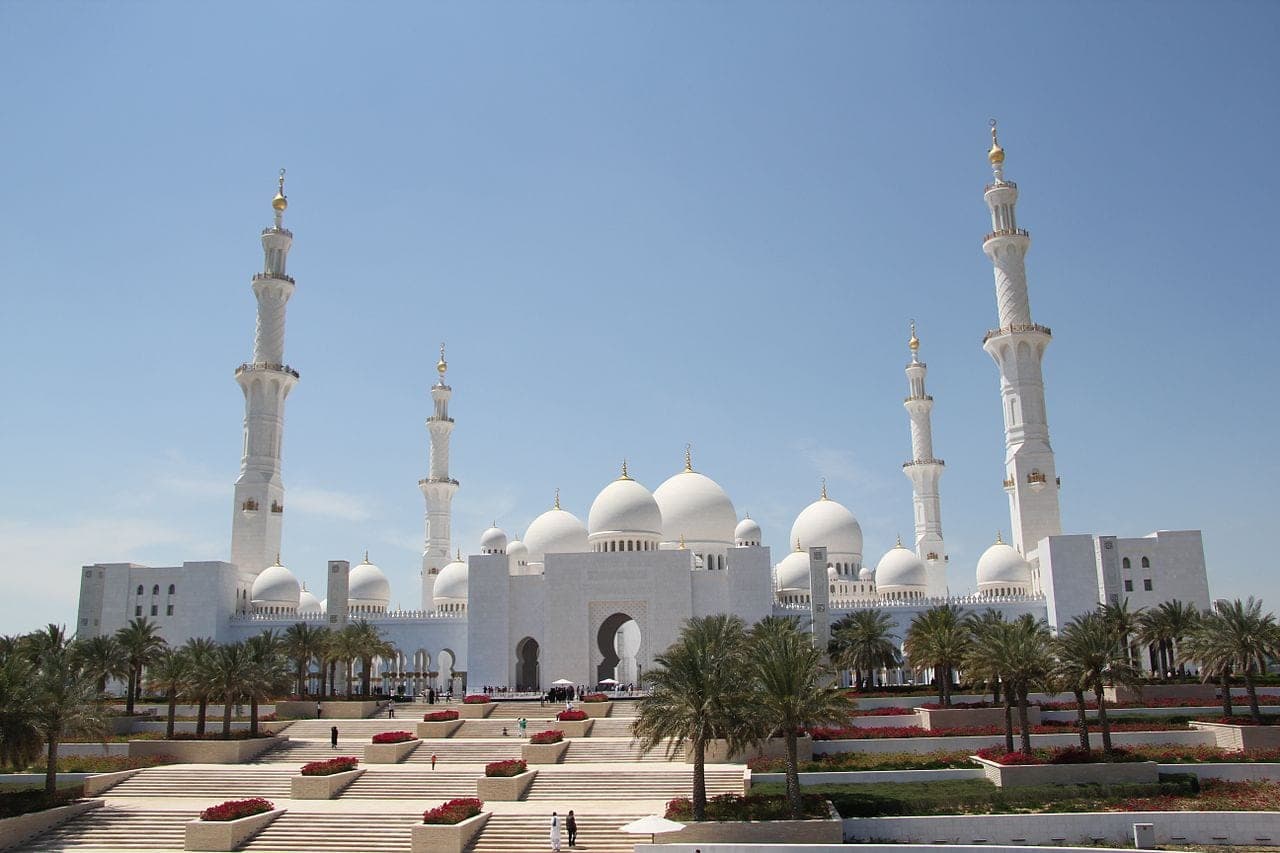
Islam is the religion of the Emirati people and the official religion of the state, and its rhythms order the calendar: the five daily prayers, the fast of Ramadan, the two Eid festivals, and the pilgrimage to Mecca. Most Emiratis are Sunni Muslims, with a Shia minority. The Sheikh Zayed Grand Mosque in Abu Dhabi has become the country's spiritual landmark, opened in 2007 and able to hold some 40,000 worshippers beneath 82 domes, with reflecting pools and a vast hand-knotted carpet; its founder, Sheikh Zayed, is buried in its grounds (Wikipedia).
Alongside this Muslim foundation, the UAE has cultivated a public policy of religious tolerance. Its large migrant population includes Christians, Hindus, Sikhs, Buddhists and others, and churches, temples and gurdwaras operate openly. In 2019 Abu Dhabi hosted the signing of the Document on Human Fraternity by Pope Francis and the Grand Imam of Al-Azhar, and the Abrahamic Family House on Saadiyat Island, opened in 2023, gathers a mosque, a church and a synagogue on a single site. The state frames this coexistence as an extension of Arabian hospitality.
Death in the Emirates is met with the customs of Islam, which favour speed, simplicity and restraint. When a Muslim dies, the body is washed, usually by relatives of the same sex, and wrapped in plain white cloth, the kafan; burial follows as soon as possible, generally within a day. The community gathers for the funeral prayer, Salat al Janazah, offered standing and in silence, as a collective plea for God's mercy. The body is laid in a simple grave, on its right side and turned toward Mecca, and graves are kept deliberately modest, often marked by nothing more than plain stones (Islamic funeral guide).
Mourning is measured. The family receives condolences, ta'ziya, for three days, when relatives and neighbours call to sit with the bereaved, recite from the Quran and bring food so the household need not cook. Loud wailing is discouraged, in keeping with the belief that death is a return to God; quiet tears are accepted. A widow observes a longer withdrawal, the iddah of four months and ten days. These rites are shared across the Muslim world, but on this coast they carry an added Bedouin inheritance of clan solidarity, in which the extended family and tribe share the loss and close ranks around the survivors. The majlis, the same room that hosts celebrations, becomes the place of mourning, and the duty to offer condolence is among the strongest of social obligations.
Emirati family history is tribal, and the tribe is written into the way the country is governed.
The seven emirates are ruled by families, the Al Nahyan, Al Maktoum, Al Qasimi and the rest, whose genealogies are documented and consequential, and the wider population places itself by tribe and clan across a territory that ignored modern borders until very recently. A Bedouin family may have branches in Saudi Arabia, Oman and Qatar and know exactly how they connect.
Before oil the economy was pearling and trade, and the same ledgers of advances, debts and shares that survive in Bahrain and Kuwait document the working population of the coast. Sharia court registers hold marriage and inheritance.
The British Residency in the Gulf produced the most substantial written record of the Trucial States, from the treaties of the nineteenth century to independence in 1971. Those India Office files, including the genealogical tables British political agents compiled of ruling families and tribes, have been digitised and published free by the Qatar Digital Library and the British Library, which makes them the most accessible source for Emirati history.
The National Archives in Abu Dhabi holds the federal series and has run an extensive oral history programme, recording the generation that remembers the pearling and the years before oil.
Around nine in ten residents of the country are not citizens, so the great majority of families here are documented in India, Pakistan, Bangladesh, the Philippines and Egypt.
The centrepiece of Emirati preservation is the Cultural Sites of Al Ain, inscribed by UNESCO in 2011 as the country's first World Heritage property. The serial site gathers the Bronze Age tombs of Jebel Hafit, the settlements and aflaj channels of Hili, the wells of Bidaa Bint Saud, and the great oases, evidence of continuous desert occupation from the Neolithic to the present. The Al Ain Oasis, with more than 147,000 date palms watered by the ancient falaj system, is open to visitors with an eco-centre explaining the engineering of underground water (Department of Culture and Tourism Abu Dhabi).
Abu Dhabi has restored Qasr Al Hosn, its oldest stone building, raised around 1761 as a watchtower over the island's freshwater well and long the seat of the ruling family; it reopened in 2018 as a museum and archive. On Saadiyat Island the state built the Louvre Abu Dhabi, opened in 2017 under Jean Nouvel's perforated dome of nearly 8,000 stars, presenting the arts of many civilisations side by side, with the Zayed National Museum following in the same district (Britannica). Sharjah has pursued a quieter programme, restoring its heritage quarter and building museums of Islamic civilisation, local heritage and art, while the country documents its intangible traditions through the UNESCO lists, on which more than a dozen Emirati and shared Gulf elements are inscribed.
The National Library and Archives of the UAE, in Abu Dhabi, is the custodian of the country's documentary memory, holding official records, maps and the correspondence of the Trucial period, much of it now digitised from foreign archives. Its oral history programme has recorded elders who remember the years before oil, the pearling voyages and the founding of the union, so that first-hand testimony survives its witnesses.
The museums have joined the effort. Louvre Abu Dhabi publishes its collection online, while Sharjah's museums and Abu Dhabi's culture authority catalogue tangible and intangible heritage, from falaj systems to Al Sadu patterns, keeping the country's manuscripts, photographs and recorded voices searchable for scholars and families tracing their own history.
Modern Emirati culture carries its heritage into new forms. National dress remains everyday wear for many, the white kandura for men and the black abaya for women, and Arabic coffee and dates still open a meeting as they open a poem. Televised poetry contests such as the Nabati programme Million's Poet draw large audiences, and National Day each 2 December turns the founding of the union into a public act of remembrance.
The UAE has also become a meeting point for global culture, hosting film festivals, art fairs, book fairs and the World Expo held in Dubai across 2021 and 2022. Residents from across Asia, Africa, the Arab world and the West have made the country's cities plural in food, language and worship, while the state works to keep Emirati identity legible to the generations growing up amid the towers.
The oasis that outlasted empires. The aflaj channels of Al Ain have carried water by gravity from the mountains to the date gardens for some five thousand years and still do; their inscription as the country's first World Heritage site in 2011 recognised one of the longest continuous agricultural traditions in Arabia.
A fort that became a nation's memory. Qasr Al Hosn began as a single watchtower over a desert well around 1761 and grew into the home of Abu Dhabi's rulers; restored and reopened in 2018, it now holds the emirate's archives and tells the story of the leap from pearling settlement to modern capital.
Traditions written into the world's record. By championing falconry, the majlis, Al Sadu weaving, Arabic coffee, camel racing and calligraphy for UNESCO's intangible heritage lists, the UAE has won recognition and protection for practices that a single oil-fuelled generation might otherwise have let slip.
Old faith, open doors. In building the Sheikh Zayed Grand Mosque and, beside it, the Abrahamic Family House, the country has paired a confident Islamic identity with a public embrace of other faiths, framing tolerance as part of its Arabian heritage rather than a break from it.
The falaj carries water by gravity from underground sources to the date palms, and the system at Al Ain has been running for around three thousand years. Photograph by Flounder Lee, CC BY-SA 4.0, via Wikimedia Commons.
Islam reached the region in the seventh century, during the lifetime of the Prophet Muhammad, and has been the faith of its people ever since; the mosque at Al Bidya in Fujairah is among the oldest surviving on the coast. For centuries the economy turned on the sea. Pearling was the great industry of the Gulf, and each summer fleets of dhows sailed to the banks where divers, working without breathing apparatus, brought up oysters by the thousand.
European powers arrived by sea. After a period of conflict the British imposed the General Maritime Treaty of 1820, followed by the Perpetual Maritime Truce of 1853, which gave the region its long-used name, the Trucial States (Encyclopaedia Britannica). The Exclusive Agreement of 1892 bound the rulers to conduct foreign affairs only through Britain. The pearl economy then collapsed in the late 1920s and 1930s, ruined together by the global depression and the Japanese invention of the cultured pearl.
Oil changed everything. The offshore Umm Shaif field was found off Abu Dhabi in 1958 and exports began in the early 1960s; Dubai discovered its Fateh field in 1966 and shipped its first oil in 1969. When Britain announced in 1968 that it would withdraw from the Gulf, Sheikh Zayed of Abu Dhabi and Sheikh Rashid bin Saeed Al Maktoum of Dubai led negotiations to bind the sheikhdoms together. On 2 December 1971 six emirates proclaimed the United Arab Emirates, with Ras al Khaimah joining in early 1972; Sheikh Zayed became the first president and is remembered as the Father of the Nation (UAE Government).
The national language is Arabic, in the Gulf dialect for daily speech and in Modern Standard Arabic for writing and public life; the older poetry of the region belongs to a Bedouin Arabic rich in the vocabulary of desert and sea. English is widely used in commerce and among the expatriate community, but Arabic remains the language of law and faith, and Arabic calligraphy is honoured as an art form.
The country's name describes its structure. An emirate is an imarah, a territory governed by an amir or emir, and the union of seven such territories gives the state its full Arabic name, Al Imarat al Arabiyah al Muttahidah. The place names read like a gazetteer of desert life: Abu Dhabi means "father of the gazelle"; Al Ain means simply "the spring" that made the oasis possible; and Dubai's name has been linked to older words for a small creek. Each records what mattered here: water, game and trade.
At the heart of Emirati identity sit a few traditions that predate the state and that the state has worked to safeguard. Falconry is the oldest and most beloved. Bedouin hunters once trained wild-caught falcons to take houbara bustard and hare in the desert winter, releasing them again in spring. Falconry is inscribed on UNESCO's Representative List of the Intangible Cultural Heritage of Humanity as a tradition shared by many nations, and the UAE, a leading champion, runs falcon hospitals and passport schemes that treat the birds as national treasures (The National).
The camel is the desert's other partner, once the measure of wealth and now the star of racing tracks that have themselves joined the UNESCO lists. Social life turns on the majlis, where hosts receive guests, settle disputes and offer the small cups of cardamom-scented coffee, gahwa, that open every visit; the majlis was inscribed in 2015 as a shared Gulf tradition and gahwa the following year. Poetry runs through all of it, above all the Nabati verse of the desert, chanted, memorised and improvised. Among the crafts, Al Sadu, the geometric weaving of Bedouin women who spun goat and camel hair into tent panels and rugs, is protected by UNESCO as an endangered skill now taught to a new generation.
Islam is the religion of the Emirati people and the official religion of the state, and its rhythms order the calendar: the five daily prayers, the fast of Ramadan, the two Eid festivals, and the pilgrimage to Mecca. Most Emiratis are Sunni Muslims, with a Shia minority. The Sheikh Zayed Grand Mosque in Abu Dhabi has become the country's spiritual landmark, opened in 2007 and able to hold some 40,000 worshippers beneath 82 domes, with reflecting pools and a vast hand-knotted carpet; its founder, Sheikh Zayed, is buried in its grounds (Wikipedia).
Alongside this Muslim foundation, the UAE has cultivated a public policy of religious tolerance. Its large migrant population includes Christians, Hindus, Sikhs, Buddhists and others, and churches, temples and gurdwaras operate openly. In 2019 Abu Dhabi hosted the signing of the Document on Human Fraternity by Pope Francis and the Grand Imam of Al-Azhar, and the Abrahamic Family House on Saadiyat Island, opened in 2023, gathers a mosque, a church and a synagogue on a single site. The state frames this coexistence as an extension of Arabian hospitality.
Death in the Emirates is met with the customs of Islam, which favour speed, simplicity and restraint. When a Muslim dies, the body is washed, usually by relatives of the same sex, and wrapped in plain white cloth, the kafan; burial follows as soon as possible, generally within a day. The community gathers for the funeral prayer, Salat al Janazah, offered standing and in silence, as a collective plea for God's mercy. The body is laid in a simple grave, on its right side and turned toward Mecca, and graves are kept deliberately modest, often marked by nothing more than plain stones (Islamic funeral guide).
Mourning is measured. The family receives condolences, ta'ziya, for three days, when relatives and neighbours call to sit with the bereaved, recite from the Quran and bring food so the household need not cook. Loud wailing is discouraged, in keeping with the belief that death is a return to God; quiet tears are accepted. A widow observes a longer withdrawal, the iddah of four months and ten days. These rites are shared across the Muslim world, but on this coast they carry an added Bedouin inheritance of clan solidarity, in which the extended family and tribe share the loss and close ranks around the survivors. The majlis, the same room that hosts celebrations, becomes the place of mourning, and the duty to offer condolence is among the strongest of social obligations.
Emirati family history is tribal, and the tribe is written into the way the country is governed.
The seven emirates are ruled by families, the Al Nahyan, Al Maktoum, Al Qasimi and the rest, whose genealogies are documented and consequential, and the wider population places itself by tribe and clan across a territory that ignored modern borders until very recently. A Bedouin family may have branches in Saudi Arabia, Oman and Qatar and know exactly how they connect.
Before oil the economy was pearling and trade, and the same ledgers of advances, debts and shares that survive in Bahrain and Kuwait document the working population of the coast. Sharia court registers hold marriage and inheritance.
The British Residency in the Gulf produced the most substantial written record of the Trucial States, from the treaties of the nineteenth century to independence in 1971. Those India Office files, including the genealogical tables British political agents compiled of ruling families and tribes, have been digitised and published free by the Qatar Digital Library and the British Library, which makes them the most accessible source for Emirati history.
The National Archives in Abu Dhabi holds the federal series and has run an extensive oral history programme, recording the generation that remembers the pearling and the years before oil.
Around nine in ten residents of the country are not citizens, so the great majority of families here are documented in India, Pakistan, Bangladesh, the Philippines and Egypt.
The centrepiece of Emirati preservation is the Cultural Sites of Al Ain, inscribed by UNESCO in 2011 as the country's first World Heritage property. The serial site gathers the Bronze Age tombs of Jebel Hafit, the settlements and aflaj channels of Hili, the wells of Bidaa Bint Saud, and the great oases, evidence of continuous desert occupation from the Neolithic to the present. The Al Ain Oasis, with more than 147,000 date palms watered by the ancient falaj system, is open to visitors with an eco-centre explaining the engineering of underground water (Department of Culture and Tourism Abu Dhabi).
Abu Dhabi has restored Qasr Al Hosn, its oldest stone building, raised around 1761 as a watchtower over the island's freshwater well and long the seat of the ruling family; it reopened in 2018 as a museum and archive. On Saadiyat Island the state built the Louvre Abu Dhabi, opened in 2017 under Jean Nouvel's perforated dome of nearly 8,000 stars, presenting the arts of many civilisations side by side, with the Zayed National Museum following in the same district (Britannica). Sharjah has pursued a quieter programme, restoring its heritage quarter and building museums of Islamic civilisation, local heritage and art, while the country documents its intangible traditions through the UNESCO lists, on which more than a dozen Emirati and shared Gulf elements are inscribed.
The National Library and Archives of the UAE, in Abu Dhabi, is the custodian of the country's documentary memory, holding official records, maps and the correspondence of the Trucial period, much of it now digitised from foreign archives. Its oral history programme has recorded elders who remember the years before oil, the pearling voyages and the founding of the union, so that first-hand testimony survives its witnesses.
The museums have joined the effort. Louvre Abu Dhabi publishes its collection online, while Sharjah's museums and Abu Dhabi's culture authority catalogue tangible and intangible heritage, from falaj systems to Al Sadu patterns, keeping the country's manuscripts, photographs and recorded voices searchable for scholars and families tracing their own history.
Modern Emirati culture carries its heritage into new forms. National dress remains everyday wear for many, the white kandura for men and the black abaya for women, and Arabic coffee and dates still open a meeting as they open a poem. Televised poetry contests such as the Nabati programme Million's Poet draw large audiences, and National Day each 2 December turns the founding of the union into a public act of remembrance.
The UAE has also become a meeting point for global culture, hosting film festivals, art fairs, book fairs and the World Expo held in Dubai across 2021 and 2022. Residents from across Asia, Africa, the Arab world and the West have made the country's cities plural in food, language and worship, while the state works to keep Emirati identity legible to the generations growing up amid the towers.
The oasis that outlasted empires. The aflaj channels of Al Ain have carried water by gravity from the mountains to the date gardens for some five thousand years and still do; their inscription as the country's first World Heritage site in 2011 recognised one of the longest continuous agricultural traditions in Arabia.
A fort that became a nation's memory. Qasr Al Hosn began as a single watchtower over a desert well around 1761 and grew into the home of Abu Dhabi's rulers; restored and reopened in 2018, it now holds the emirate's archives and tells the story of the leap from pearling settlement to modern capital.
Traditions written into the world's record. By championing falconry, the majlis, Al Sadu weaving, Arabic coffee, camel racing and calligraphy for UNESCO's intangible heritage lists, the UAE has won recognition and protection for practices that a single oil-fuelled generation might otherwise have let slip.
Old faith, open doors. In building the Sheikh Zayed Grand Mosque and, beside it, the Abrahamic Family House, the country has paired a confident Islamic identity with a public embrace of other faiths, framing tolerance as part of its Arabian heritage rather than a break from it.
National Overview
Notable Cities
Historical Foundations
Linguistic and Etymological Roots
Cultural Identity
Religion and Spirituality
Remembrance and Mourning Traditions
Tracing a Family in United Arab Emirates
Heritage Preservation Efforts
Digital Heritage
Contemporary Cultural Influences
Success Stories
References and resources
- UNESCO World Heritage Centre: Cultural Sites of Al Ain. The Hafit, Hili, Bidaa Bint Saud and oasis areas, inscribed in 2011.
- Encyclopaedia Britannica: United Arab Emirates, History. The Trucial States, British treaties and the 1971 federation.
- UAE Government: Founders of the Union. Sheikh Zayed, Sheikh Rashid and the making of the federation.
- Department of Culture and Tourism Abu Dhabi: Al Ain Oasis. The falaj-watered oasis and its date palms.
- The National: UAE traditions on UNESCO's intangible heritage lists. Falconry, Al Sadu, majlis, gahwa and more.
- Britannica: Louvre Abu Dhabi. Jean Nouvel's museum on Saadiyat Island.
- Wikipedia: Sheikh Zayed Grand Mosque. The mosque's scale, opening and the founder's grave.
- Wikipedia: Qasr Al Hosn. Abu Dhabi's oldest building and its restoration.