Heritage · Landmark
Sanchi: the empty throne and the relics that returned
On a wooded hill in Madhya Pradesh stands a stone dome begun under Ashoka, doubled in size two centuries later and ringed by four gateways carved with the life of a man who never once appears in them. He is an empty throne, a parasol over nothing, a riderless horse walking out of a city gate. In 1851 two British officers cut into the smaller stupas on and around the hill and carried off the bones of the Buddha's two chief disciples. A hundred years later the bones came back.Written to last.
By Confinity Heritage Editorial · 2026-08-25 · 7-minute readQuiet tools, kept out of the way.
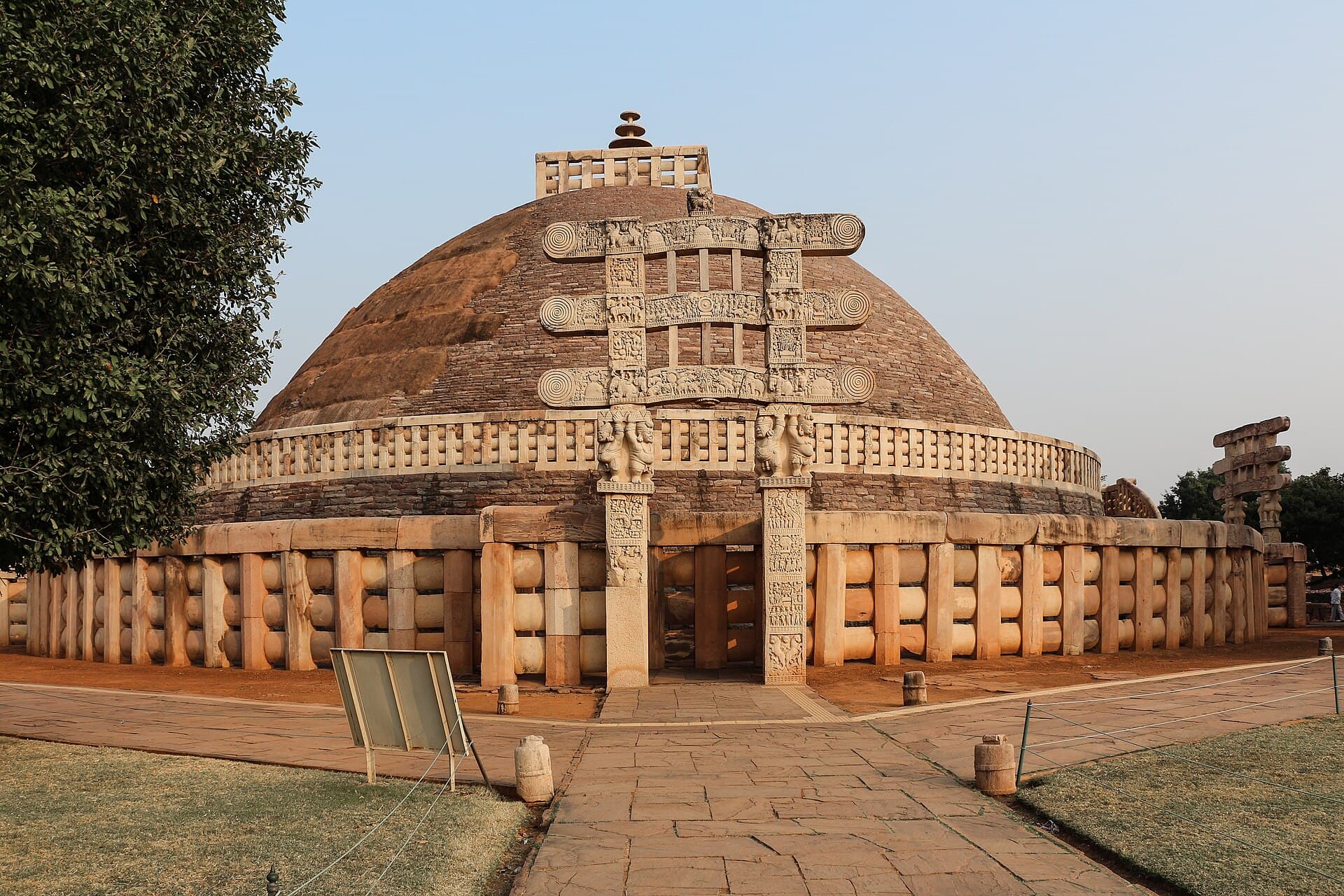
A low forested hill rises out of the plain in Raisen district, in Madhya Pradesh in central India, 45 kilometres from Bhopal and 10 from the old town of Vidisha. Roughly fifty monuments stand on its plateau: three large stupas, the stumps of monolithic pillars, temples and the foundations of monasteries, raised across some fifteen centuries. UNESCO, which inscribed the hill in 1989, calls it the oldest Buddhist sanctuary in existence.
The dome that dominates the plateau is usually described as Ashoka's, and it is not. Ashoka's stupa is inside it, in brick, at about half the width. The gateways are three centuries younger than that. And the man whose relics the whole hill is arranged around does not appear on any of them.
Sanchi is not a place the Buddha visited. It is a place a king picked. In the third century BC the Mauryan emperor Ashoka raised a hemispherical brick stupa here, about 20 metres across and ringed by a wooden railing, and set beside it a polished sandstone column more than 12 metres tall. Sri Lankan chronicles tie him to the district: as a young viceroy he married a banker's daughter at Vidisha, and their son Mahinda stopped here, at a hill the chronicles call Chetiyagiri, before carrying the teaching to Sri Lanka.
The column carries a battered copy of Ashoka's Schism Edict, which orders that any monk or nun who splits the community be put in white robes and made to live apart. Its capital, four lions back to back under what was probably a wheel, is in the site museum; the shaft came from the Chunar quarries as a single block over forty feet long.
What a visitor walks around is four eras stacked on one another. The brick core was damaged in the second century BC, possibly under the Shunga king Pushyamitra, then encased and nearly doubled: a stone skin, a flattened dome, a raised drum for circumambulation reached by a double staircase, and a plain balustrade at ground level, all of it about 150 BC. The finished dome measures 36.6 metres across and stands 16.46 metres high.
The four gateways, the toranas, came later, under the Satavahanas, dated from about 50 BC into the first century AD. The last major addition is Gupta, fifth century AD, when four shrines were built at the cardinal entrances. So the shape everyone photographs is Shunga, the carving Satavahana, the shrines Gupta, and Ashoka's contribution is buried in the middle.
The railings and gateways are stone pretending to be timber: the coping-stone joints are cut at a slant, the way a carpenter cuts wood, and the gateway is a wooden frame copied in stone. The railing also carries the names of the people who paid for it, and they are not kings. Hundreds of short Brahmi records run along it, most giving one pillar or bar donated by a monk, a nun, a householder, a village; the ivory carvers' guild of Vidisha paid for a panel, and three donors call themselves Yavanas, Greeks. In 1837 James Prinsep noticed that most of these texts ended in the same two characters, guessed the word was danam, gift, and broke Brahmi open with it.
The gateways tell stories from the Buddha's lives and the centuries after his death. He is in almost every one, and he is never drawn. Where the figure should be there is an empty throne with a footstool, a pair of footprints, a parasol over open air, a wheel, a stupa. In the Great Departure the horse Kanthaka leaves the palace gate with an empty saddle and a parasol above it. At Kapilavastu he rises into the air, and all that is carved is the slab of his walkway hanging in the sky with the crowd's heads tilted up toward it.
This is the aniconic convention of early Buddhist art, and it is not shyness or want of skill: the same carvers rendered elephants, dancers, city walls and Greek-clad visitors with confidence. A rule in the Sarvastivada monastic code holds that the Buddha's body may not be imaged, only his attendants, and a Pali commentary has him reject a memorial image because its form would come from somebody's mind and rest on nothing. What the reliefs give instead is everything around him: the seat he used, the tree he sat under, the road he walked, the watching faces. The absence is the subject. This is a tradition of remembrance that declined, on purpose, to make a likeness of the person it remembered.
Figural images begin elsewhere and later, at Mathura and in Gandhara around the turn of the era, including a relief at Isapur dated on style to about AD 15, and are made in quantity under the Kushans. Buddha figures do stand at Sanchi, but they are Kushan and Gupta work added long after the gateways. By the time the painted halls at the Ajanta Caves were finished in the 460s and 470s, the man was everywhere on the walls.
In 1851 Major Alexander Cunningham and Lieutenant Frederick Charles Maisey drove shafts through the middle of several stupas on the hill. In Stupa 3 they found an undisturbed chamber closed by a slab over five feet long, holding two stone boxes. Each lid carried a line of Brahmi: the southern read Sariputasa, of Sariputta, the northern Mahamogalanasa, of Maha Moggallana, the Buddha's two chief disciples. The placing was itself a statement: south to the right, north to the left, the positions the two men held in life. Inside were steatite caskets holding a few fragments of bone and two pieces of sandalwood. A few miles west at Satdhara they opened another stupa and found a second set of caskets with the same two names.
The officers divided the finds and took them to Britain. Maisey lent his share to the South Kensington Museum, later the Victoria and Albert, in 1866; it bought them from his son in 1921. Cunningham's went home in two ships, one of which sank. Marshall, writing his guidebook in 1918 as head of the Archaeological Survey, recorded that the caskets had since been lost. Half of them were in a display case in London.
The campaign to get them back began in the 1920s, led by the Maha Bodhi Society, founded at Colombo in 1891 by Anagarika Dharmapala. The museum refused for years, arguing that it also held Christian relics and could not start giving relics back. That changed in 1939, when the Government of India forwarded the request and the British government instructed the museum to comply for diplomatic reasons. The war delayed the transfer, which was carried out in 1947.
They went first to Sri Lanka, where an estimated two million people saw them at the Colombo Museum; the caskets followed in 1948. In 1949 Jawaharlal Nehru received them at Calcutta and handed them to the Maha Bodhi Society; they then toured northern India and Burma. In 1952 they were divided three ways: to the Kaba Aye Pagoda in Yangon, to the Society's temple in Colombo, and to Sanchi, into the Chetiyagiri Vihara, a building raised on the hill for the purpose with money from the Nawab of Bhopal. They are kept there now, shown once a year at a festival each November.
This is one of the few cases on this shelf where a thing taken was given back and put where it came from, and it belongs beside the cases that ended otherwise. The stele at Aksum was war loot and took sixty-eight years. These were taken by scholars, catalogued as art, and held by a museum whose curators thought their value artistic and historical only; recovering them took a national government rather than a court. And the return was not quite a restoration: on the standard account what came back in 1952 is the Satdhara set, and it went into a new vihara beside the hill rather than under the slab in Stupa 3. The hill got its dead back. It did not get its stupa back.
Sanchi had lain abandoned for about six hundred years when General Henry Taylor recorded it in 1818, overgrown but largely sound, gateways still standing. The damage came afterwards, from people who had read about it. In 1822 Captain Johnson, assistant political agent in Bhopal, opened the Great Stupa from top to bottom on one side looking for treasure. The breach he left in the south-west quadrant brought down the western gateway and part of the balustrade, and he is thought to have wrecked Stupas 2 and 3 as well, which until then had been in perfect repair. Marshall's verdict on 1851 was almost as hard: the caskets scarcely compensated for the damage.
In 1869, after Napoleon III asked for one of the carved gates, plaster casts of the eastern gateway went to the museums of Europe; the gate stayed. Not until 1881 did anyone try to repair the hill, when Major Cole cleared the jungle, filled Johnson's breach, and over two years re-erected the fallen south and west gateways and the small gate of Stupa 3.
John Marshall took the site on in 1912 and worked it until 1919. Most of the plateau was still buried, its monuments unsuspected. He cleared it, excavated south and east of the great dome, and rebuilt. The hardest job was the south-west quadrant, the one Johnson had opened ninety years earlier, by then close to collapse and likely to bring the south and west gateways down with it. Marshall dismantled that quarter of the stupa and put it back up. He reset the leaning columns of Temple 18, repaired Temple 45, rebuilt the dome, balustrade and crowning umbrella of Stupa 3, re-roofed three more temples, and built the museum. The work was paid for by Sultan Jahan Begum, the ruler of Bhopal, to whom he dedicated his volumes.
That history changes how the place reads: a monument taken apart and reassembled is a different kind of object from one nobody touched. The southern gateway carries blank new stone in all of its right jamb and half its left, supplied by Cole in 1882. The dome is Shunga masonry rebuilt in the 1910s over a Mauryan brick core nobody has seen since. The bones in the vihara down the slope spent eighty-one years in London. Sanchi is not a survival. It is a repair, made in the open by people who wrote down what they had done, and its faithfulness is a claim to be checked rather than a condition it was born with.
The hill Ashoka chose
Four campaigns in one mound
A stone railing that remembers wood
The man who is not in the carvings
The relics and their journey
The breach of 1822
What Marshall rebuilt
References and resources
- UNESCO World Heritage Centre. "Buddhist Monuments at Sanchi." World Heritage List, property no. 524, inscribed 1989. whc.unesco.org/en/list/524.
- ICOMOS. Evaluation of nomination, World Heritage List No 524, January 1989. whc.unesco.org/document/153660.
- Marshall, Sir John. A Guide to Sanchi. Calcutta: Superintendent, Government Printing, 1918. Available at archive.org.
- Cunningham, Alexander. The Bhilsa Topes, or Buddhist Monuments of Central India. London: Smith, Elder, 1854.
- Brekke, Torkel. "Bones of Contention: Buddhist Relics, Nationalism and the Politics of Archaeology." Numen 54, no. 3 (2007): 270-303.
- Daulton, Jack. "Sariputta and Moggallana in the Golden Land: The Relics of the Buddha's Chief Disciples at the Kaba Aye Pagoda." Journal of Burma Studies 4 (1999): 101-128.
- Archaeological Survey of India. "World Heritage Sanchi." asi.nic.in.
- Wikipedia. "Sanchi," "Relics of Sariputta and Moggallana," "Aniconism in Buddhism," and "Mathura art." Retrieved 2026.