Heritage · Landmark
The Ajanta Caves: painted prayer halls in a horseshoe gorge
Around thirty Buddhist temples and monasteries are cut into a horseshoe cliff of basalt above the Waghora river in Maharashtra, their walls carrying the finest surviving paintings of ancient India. Forgotten under jungle for thirteen centuries, they were found again by a tiger-hunting cavalry officer in 1819, and the long effort to copy their murals became one of the saddest stories in the history of art.Written to last.
By Confinity Heritage Editorial · 2026-08-23 · 7-minute readQuiet tools, kept out of the way.
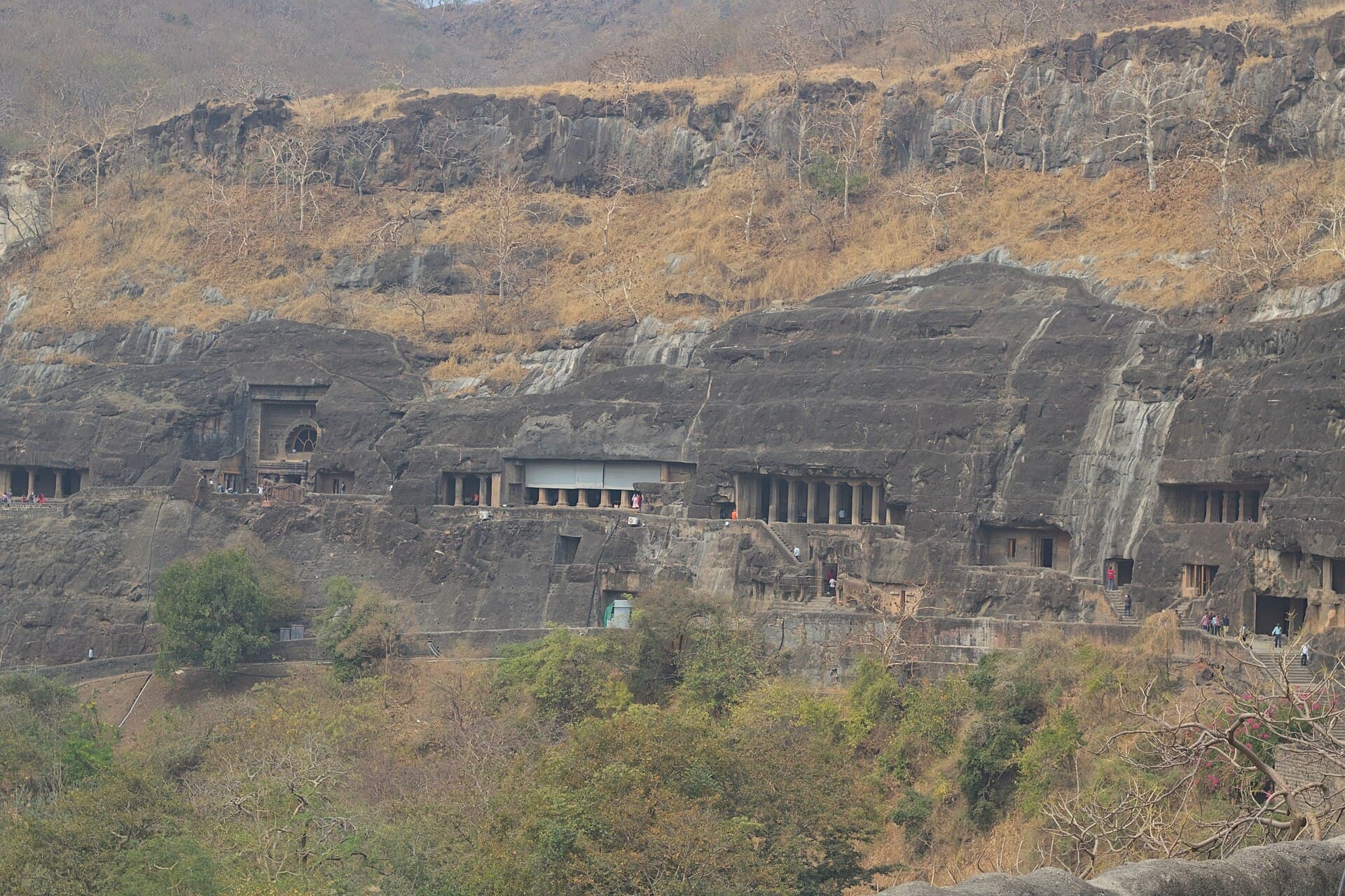
In the hills of northern Maharashtra, in western India, the Waghora river makes a tight horseshoe bend through a ravine of volcanic basalt. Cut into the outer curve of that bend, in a cliff about 76 metres high, are around thirty caves that are not caves at all but architecture: prayer halls and monasteries carved inward from the rock face, with columns, vaulted ceilings, shrines and doorways all hollowed from one geological mass. These are the Ajanta Caves, and on their walls survives the largest and finest body of painting to come down from ancient India, murals that UNESCO describes as masterpieces of Buddhist religious art whose influence reached across Asia. Ajanta joined the World Heritage List in 1983, among the first Indian sites ever inscribed.
The caves were made in two bursts separated by half a millennium, then abandoned and swallowed by forest for some thirteen hundred years. Their modern story begins with a British officer chasing a tiger in 1819, and continues through one of the saddest episodes in the history of art: two heroic campaigns to copy the paintings, forty years of labour in all, both largely destroyed by fire within decades. The murals that survived thirteen centuries of jungle proved more durable than their copies did in the museums of Victorian Britain, and that reversal has shaped how conservators think about the site ever since.
The first caves at Ajanta belong to the Satavahana period, around the second and first centuries BC, when Buddhism was spreading along the trade routes that crossed the Deccan plateau. Monastic communities favoured retreats close enough to the caravan roads for alms and patronage but removed enough for the monsoon months when wandering monks settled in one place. The Waghora gorge answered both needs. Into its rock the early sanghas cut a handful of excavations: two chaitya halls, the apsidal prayer halls of caves 9 and 10, each with a rock-cut stupa at its heart and a ribbed vault imitating the timber architecture of the day, along with plain dormitory monasteries. In the aniconic convention of early Buddhism, worship in these first caves centred on the stupa rather than on images of the Buddha in human form.
Then the work stopped, and for roughly four centuries the site stayed as it was, a small monastic settlement in a remote ravine.
Everything that makes Ajanta famous belongs to the second phase, and the second phase was astonishingly short. Under the emperor Harishena of the Vakataka dynasty, whose reign is generally placed around 460 to 477 AD, the gorge became a concentrated imperial project. Ministers and feudatory kings competed as patrons: Harishena's minister Varahadeva sponsored the great vihara of Cave 16, the local ruler Upendragupta caves 17 to 20. In about two decades, more than twenty new caves were excavated, among them the grandest chaitya halls at the site, caves 19 and 26, their facades carved with rows of Buddhas, and vihara after vihara in which the plain dormitory had evolved into a columned hall with monks' cells along the sides and a Buddha shrine at the rear, residence and temple in one building.
Then the work stopped again, this time abruptly. Around 480, in the disorder that followed Harishena's death and the collapse of Vakataka power, patronage failed and the artisans put down their tools, leaving several caves unfinished with their chisel marks still legible. The scholar Walter Spink, who spent a career reconstructing this chronology, argued that almost the whole later site was made inside a single generation. Monks lingered for a while; the Chinese pilgrim Xuanzang recorded an account of the cave monastery in the seventh century, apparently from hearsay. At some point the last resident left, and the forest began its long occupation.
What sets Ajanta apart from a hundred other rock-cut sites is paint. Nearly every later cave was once painted from floor to ceiling, and in caves 1, 2, 16 and 17 great stretches survive. The technique was not true fresco, which is worked into wet lime. Ajanta's painters applied a rough plaster of mud mixed with rock dust, vegetable fibre and rice husk to the carved basalt, finished it with a thin lime coat, and painted on the dry surface with pigments bound in glue, a method best described as tempera on dry plaster. Their colours were earth ochres, kaolin white, lamp black, local glauconite green, and a luminous blue ground from lapis lazuli carried from beyond the Hindu Kush.
The subjects are overwhelmingly the Jataka tales, stories of the Buddha's previous lives, unrolled across the walls as continuous narrative in which princes, elephants, sailors and serpent kings crowd together in palaces and forests. The painters gave ancient India its most complete self-portrait: costume and jewellery, musical instruments, shipping, court ceremony, faces of every rank and origin. Flanking the shrine doorway of Cave 1 are the site's emblems, the bodhisattvas Padmapani and Vajrapani, each larger than life, one holding a blue lotus, their downcast eyes carrying an expression of compassion that painters across Buddhist Asia would echo for a thousand years.
On 28 April 1819, a party of British officers from the Madras army was hunting tiger in the ravines of the Waghora when one of them, John Smith of the 28th Cavalry, noticed a shaped arch high in the scrub across the gorge: the horseshoe window of the Cave 10 chaitya, the oldest prayer hall at the site. Smith crossed the river, climbed to the opening, and walked into a hall that had stood silent for thirteen centuries, its floor deep in debris, its pillars still carrying paint. Then, standing on the rubble, he scratched his name and the date across a painted bodhisattva on one of the pillars: John Smith, 28th Cavalry, 28 April 1819. The graffito is still there, well above head height now that the debris he stood on has been cleared, an act of casual vandalism that has itself become part of the historical record, the first line in the site's modern biography.
The Deccan has a way of holding and returning its monuments. The granite city of Hampi, far to the south, waited under thorn scrub for its own rediscovery; Ajanta had waited far longer, and word of the painted caves spread quickly through the learned societies of Europe.
What followed was a double tragedy, told in canvas and fire. The paintings were recognised at once as irreplaceable, and since they could not be moved, they would be copied. In 1844 the Madras army officer Robert Gill was commissioned to paint full-size facsimiles. He settled at Ajanta and gave it the rest of his life, working in dim halls by lamplight and mirror-light through heat, fever and isolation, and over the years sent some thirty large canvases to England. They were hung at the Crystal Palace in Sydenham, where a fire in December 1866 destroyed all but a handful. Gill, by then also one of the site's first photographers, went back and started again. He died in 1875 and is buried nearby at Bhusawal.
The second campaign was led by John Griffiths, principal of the Bombay School of Art, who brought parties of his Indian students to the caves each season from 1872. Over thirteen years they produced around three hundred canvases, which were shipped to the South Kensington Museum, now the Victoria and Albert Museum, where a fire in 1885 destroyed a large part of the collection. Two generations of labour, more than forty years of it, had been reduced to fragments in under thirty. Later copyists fared little better: many of the tracings made by the Japanese artist Arai Kampo between 1916 and 1918 were lost in the fires that followed the Great Kanto earthquake of 1923. The losses matter because every copy is a record of the murals at a moment in time; each fire burned evidence, leaving photography and the fragile originals themselves as the primary archive of what Ajanta looked like before a century of change.
The originals, meanwhile, have needed rescuing from their rescuers. In the early 1920s the government of Hyderabad, in whose territory the caves then lay, engaged Italian restorers who fixed the flaking paint with coats of shellac. The varnish held the surface but darkened as it aged, dimming the murals behind an amber film and trapping grime. Much modern conservation by the Archaeological Survey of India, which has managed the site since Indian independence, has been the patient undoing of such interventions: thinning the old coatings with solvents, consolidating loose plaster, and monitoring the microclimate of the halls.
The other pressure is love. Ajanta draws visitors by the hundreds of thousands, each of whom brings humidity, carbon dioxide, dust and light into chambers that kept their paintings partly because they were dark, dry and empty. The response has been to manage the encounter: restricted numbers and timed viewing, low light levels, and a visitor centre nearby with full-scale replicas of the most important painted caves, so that crowds can study the murals closely while the originals receive a fraction of the exposure.
Ajanta's history keeps returning to one unsettling lesson. The paintings survived thirteen hundred years of monsoon, bats, smoke and jungle better than their copies survived thirty years of civilisation, with its exhibition halls, storerooms and gaslight. The buildings meant to protect the record burned; the abandoned gorge preserved it. That is why the caves are now kept as they are, in near darkness, behind managed doors, visited briefly and gently. The original is its own best archive, the one witness that has never yet failed, and the duty it imposes is not restoration or reproduction but keeping: holding conditions steady, undoing old harms slowly, and passing the walls on with as little of our own century added as possible. John Smith's scratched name endures as the counter-example, a reminder that every generation touches what it inherits, and that the lightest touch is the one the future will thank us for.
A gorge chosen for silence
Harishena's twenty years
The painted walls
A signature scratched across a bodhisattva
The copies that burned
Keeping the caves
The original as its own archive
References and resources
- UNESCO World Heritage Centre. "Ajanta Caves." World Heritage List, property no. 242, inscribed 1983. whc.unesco.org/en/list/242.
- Archaeological Survey of India. "Ajanta Caves, Aurangabad." Ticketed monuments, Maharashtra. asi.nic.in.
- Encyclopaedia Britannica. "Ajanta Caves." britannica.com/place/Ajanta-Caves.
- Walter M. Spink. "Ajanta: History and Development." Brill, 2005 onward, multiple volumes.
- Victoria and Albert Museum. Collection records for the Griffiths copies of the Ajanta murals. vam.ac.uk.
- Wikipedia. "Ajanta Caves," "Robert Gill (artist)," and "Vakataka dynasty." Retrieved 2026.