Heritage · Landmark
Santiago de Compostela: the cathedral at the end of the road
A hermit's lights over a Galician wood, a Roman tomb read as an apostle's grave, and a road that has carried walkers to the same doorway for eleven centuries. The cathedral raised over that grave holds Master Mateo's carved portico and the largest censer in the Christian world, and it held, until one July night in 2011, the manuscript that first told pilgrims how to get there.Written to last.
By Confinity Heritage Editorial · 2026-08-25 · 7-minute readQuiet tools, kept out of the way.
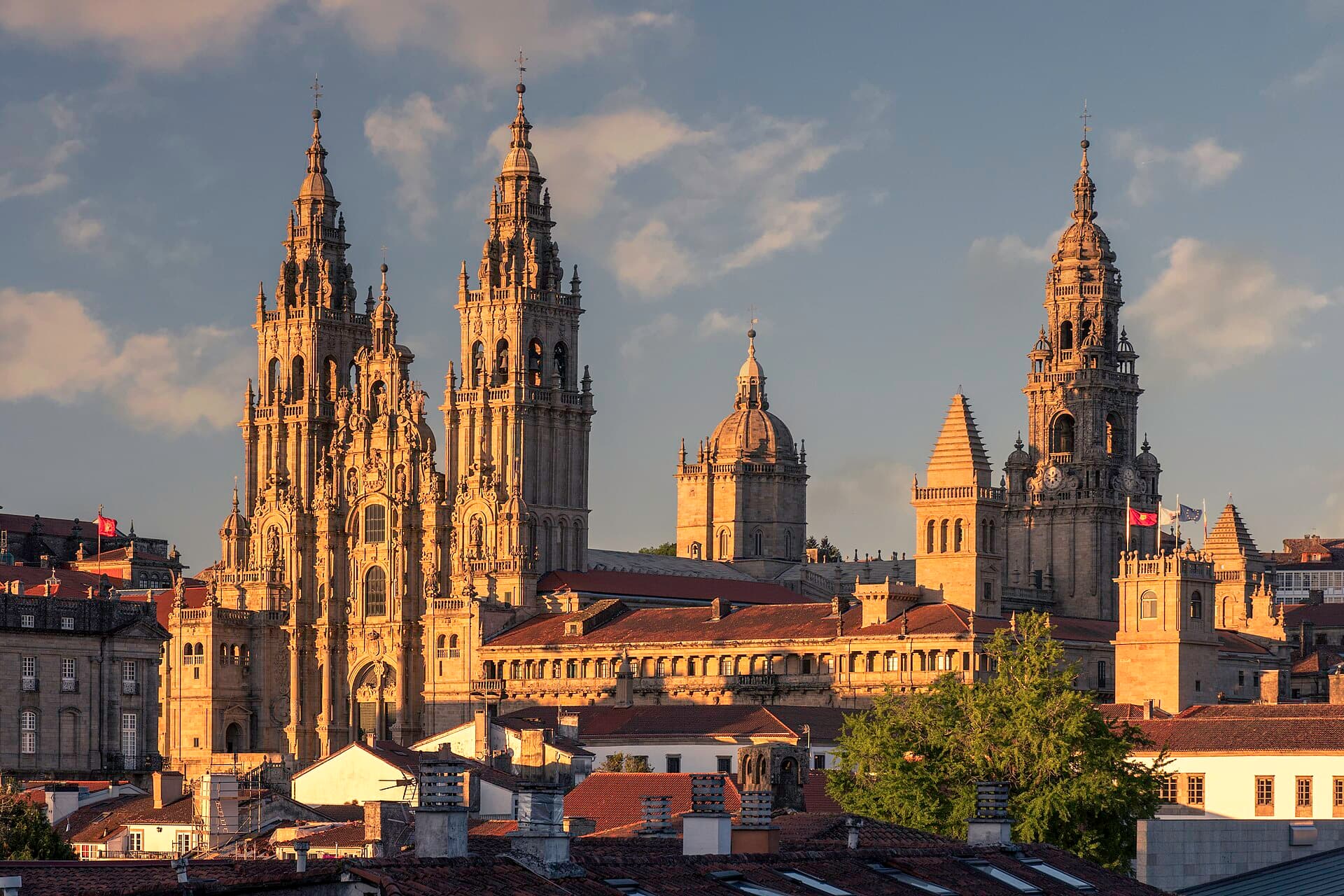
In the granite northwest of Spain, in the Galician city of Santiago de Compostela, a cathedral stands over a grave. Its west front rises above the Praza do Obradoiro in two baroque towers of weathered stone, lichen-grey in rain and yellow at sunset, and behind that eighteenth-century screen sits a Romanesque church begun in 1075. The old town has been on the UNESCO World Heritage List since 1985, and the roads that lead to it were inscribed separately, as a property in their own right, in 1993.
The grave is the reason for everything else. Early in the ninth century, by tradition, a hermit named Pelagius saw strange lights over a wood in the Galician hills. Teodomiro, bishop of nearby Iria, went to look, identified the Roman-era tomb he found there as that of James the Greater, apostle of Jesus, and carried the news to King Alfonso II of Asturias. A chapel went up on the spot. And people began to walk.
A small church rose in about 829, replaced by a larger pre-Romanesque one around 899. In 997 that building was burned by Al-Mansur, commander of the armies of the caliph of Cordoba, a century before al-Andalus produced the palaces of the Alhambra. Christian captives were made to carry the church bells south to Cordoba, where they were hung in the great mosque. The tomb was left untouched, and the shrine was soon busier than before.
Construction of the present cathedral began in 1075 under Alfonso VI and Bishop Diego Pelaez, on the plan of the pilgrimage church of Saint-Sernin at Toulouse and in Galician granite, a stone that resists carving and holds damp. Work stopped and restarted for over a century before the building was consecrated in 1211. The result is very large: roughly 100 metres long, 70 across the transept, 75 to the top of the towers, with room for some 1,200 people and an ambulatory that lets a line of visitors pass behind the high altar without interrupting the mass in front.
Fernando de Casas Novoa completed the Obradoiro facade in 1740, wrapping the Romanesque west end in tiers of granite, glass and twin towers. It is partly theatre and partly a raincoat: the carved doorway behind it had stood open to Atlantic weather for five and a half centuries.
Ferdinand II contracted a sculptor known as Master Mateo in 1168 at a hundred maravedis a year. The lintel of the doorway he built carries the date 1188, and almost nothing is known of him beyond the contract and the stone.
The Portico da Gloria is three arches holding more than two hundred figures. Christ sits in the centre showing his wounds, ringed by the twenty-four elders of Revelation, tuning and playing recognisable medieval instruments: an organistrum worked by two men, harps, citterns, a row of violas. On the central column stands a Tree of Jesse, the first known appearance of that subject in Iberian sculpture, worn into five deep hollows by the fingers of arriving pilgrims. Kneeling at its base is a small figure labelled architect, taken to be Mateo's self-portrait and known as the Santo dos Croques, the saint of head-bumps, because visitors used to knock their foreheads against his to catch some of his talent. Both habits are now discouraged, and the stone, carved to be seen painted, still holds traces of its colour.
The building is the destination. The monument is the road. UNESCO's inscription covers nearly 1,500 kilometres of northern routes and the 738-kilometre French Route that overtook them in the eleventh century, together with the churches, bridges and hospices raised along them to serve people walking. It is one of the few World Heritage properties whose value lies in an activity rather than a structure.
What made the road navigable was a book. The Codex Calixtinus was compiled in the twelfth century, most likely in the late 1130s or early 1140s, and credited pseudonymously to Pope Calixtus II; the French cleric Aymeric Picaud is often named as its compiler. Its five books gather liturgy, miracle stories, the arrival of the apostle's body in Galicia, and a chronicle of Charlemagne. The fifth changed things. It sets out the routes and their stages, names the rivers safe to drink from and the ones that will kill a horse, lists the hospices and the shrines worth stopping at, and describes, with considerable rudeness, the peoples a traveller will meet along the way. It is usually called the first guidebook, and modern route guides still follow its stages.
The effect was mechanical. A pilgrimage carried by word of mouth became a described itinerary, so a stranger from Flanders could plan a journey to a Galician town he had never seen. Traffic followed, and with it money, masons and manuscripts; the Council of Europe named the Camino its first Cultural Route in 1987. The same corridor carried learning, in the century that also produced the University of Salamanca.
The Codex Calixtinus is one manuscript. It lived in the cathedral archive, in a safe with no camera pointed at it and a key staff had noticed being left in the lock. In early July 2011 it went missing; the court that later heard the case placed the theft between 30 June and 5 July.
It was recovered on 4 July 2012 in a garage in Milladoiro outside the city, inside a bin bag inside a cardboard box under a pile of rubbish, along with other manuscripts from the same archive and more than a million euros in cash. The garage belonged to Jose Manuel Fernandez Castineiras, a freelance electrician who had worked at the cathedral for about twenty-five years before losing the job. In February 2015 a court sentenced him to ten years for theft and money laundering, finding that he had also taken some 2.4 million euros from the cathedral's collections over more than a decade.
The point is worth stating plainly. A road walked by millions of people over eleven hundred years survives as a route because somebody wrote it down. The written-down version turned out to be one object in one cupboard, and one man with a bin bag removed it for a year. The book came back. It did not have to.
Hanging from a pulley in the dome above the crossing is the Botafumeiro, the largest working censer in the Christian world. Made by the goldsmith Jose Losada in 1851 in brass and bronze under a skin of silver, it stands about 1.6 metres tall, weighs 80 kilograms empty, and is loaded with around 40 kilograms of charcoal and incense. Eight red-robed tiraboleiros haul on the ropes, and after roughly seventeen pulls it sweeps a 65-metre arc across the transept, rising more than 20 metres at each end at something close to 70 kilometres an hour.
It is spectacular, and it began as sanitation. The practice dates to about the eleventh century and is mentioned in the Codex Calixtinus. Pilgrims arrived after weeks on foot, unwashed, in the clothes they had walked in, and many slept inside the cathedral. Incense on that scale covered the smell, and in an age of recurring plague it was believed to purify the air against disease. The ritual meaning came with it and outlasted the reason.
Arriving is a documented act. To receive the compostela, the certificate the cathedral has issued for centuries, a pilgrim must cover at least the final 100 kilometres on foot or on horseback, or 200 by bicycle, ending at the cathedral, and carry a credencial stamped along the way to prove it. The office also asks that the journey be made for religious or spiritual reasons, in the old formula devotionis affectu, voti vel pietatis, out of devotion, vow or piety. Those who walk for other reasons receive a certificate of distance instead. The compostela is written in Latin, with the recipient's name rendered into Latin too, so a pilgrim leaves holding a document addressed to a version of themselves that does not otherwise exist.
Fewer than a thousand compostelas were issued in 1985. In 2024 the office recorded 499,239, and in 2025 the figure reached 530,919. Those totals count only those who finish at Santiago and ask for the certificate, so the number who set out is higher.
The cathedral sits on an older cemetery, and it has been dug. Excavations beneath the floor from the 1940s onward, led by the archaeologist Manuel Chamoso Lamas, uncovered a Roman-era necropolis with later burials over it: the site was a burying ground long before it was a shrine. In 1955 the same work turned up an inscribed slab naming Teodomiro, bishop of Iria, and recording his death in the year corresponding to AD 847.
In 2024 a team publishing in Antiquity applied radiocarbon dating, isotope analysis and ancient DNA to the remains beneath that slab. They were a single older adult male, and the radiocarbon range came out at AD 673 to 820, close to the documented death date without matching it, a gap the authors attribute partly to a diet including seafood.
The relics themselves have their own modern history. They were hidden in 1589, when the archbishop feared an English raid on the coast, and were lost for nearly three centuries, until excavations behind the high altar in 1878 and 1879 under the canon and historian Antonio Lopez Ferreiro recovered bones beneath the apse. Pope Leo XIII declared them authentic in the bull Deus Omnipotens of 1884.
What the evidence establishes is a Roman cemetery, a ninth-century cult centre, and a bishop buried in it who was real. What it cannot establish is whose bones lie in the silver reliquary in the crypt. The Church has never rested the claim on archaeology, and the archaeology has never been able to settle it. The pilgrimage has run for eleven centuries with the question open.
Most great buildings ask you to look at them. This one asks you to arrive at it. The Portico was carved to be the first thing seen after the last kilometre; the incense was lit for people who had slept rough; the certificate is issued on evidence of a journey rather than a donation. Take the walking away and the cathedral becomes a fine Romanesque church in a baroque coat, which is a smaller thing than what it is.
What Santiago keeps is a habit rather than an object: a route held in the legs of strangers, written down once in the twelfth century so it could be handed on. That written record spent a year in a bin bag in a garage. The road went on being walked by half a million people a year, which is the other way a thing gets remembered, and the harder one to steal.
From a light in the woods to a church of granite
Master Mateo's doorway of glory
A thousand years of walked memory
The cupboard, the bag and the garage
The censer and the crowd it was built for
Earning the compostela
Under the floor: what is known and what is believed
The road and the room
References and resources
- UNESCO World Heritage Centre. "Santiago de Compostela (Old Town)." World Heritage List, property no. 347, inscribed 1985. whc.unesco.org/en/list/347.
- UNESCO World Heritage Centre. "Routes of Santiago de Compostela: Camino Frances and Routes of Northern Spain." World Heritage List, property no. 669, inscribed 1993, boundaries modified 2015. whc.unesco.org/en/list/669.
- Perez-Ramallo, P., et al. "Unveiling Bishop Teodomiro of Iria Flavia? An attempt to identify the discoverer of St James's tomb." Antiquity 98 (2024). cambridge.org/core/journals/antiquity.
- Pilgrim's Reception Office (Oficina del Peregrino), Santiago de Compostela. "The Compostela." oficinadelperegrino.com.
- American Pilgrims on the Camino. "Statistics for the Camino de Santiago." americanpilgrims.org/statistics.
- The Local (Spain). "Codex thief of Santiago jailed for ten years," 18 February 2015. thelocal.es.
- Wikipedia. "Santiago de Compostela Cathedral," "Codex Calixtinus," "Portico of Glory," "Botafumeiro" and "Camino de Santiago." Retrieved 2026.