Heritage · Landmark
Mount Athos: the monastic republic of the Holy Mountain
On the easternmost finger of the Halkidiki peninsula, twenty Orthodox monasteries have governed themselves under the same constitutional tradition for more than a thousand years. Mount Athos keeps its own time, its own calendar, and the world's richest surviving library of Greek medieval manuscripts, maintained by the simple mechanism of never stopping.Written to last.
By Confinity Heritage Editorial · 2026-08-23 · 7-minute readQuiet tools, kept out of the way.
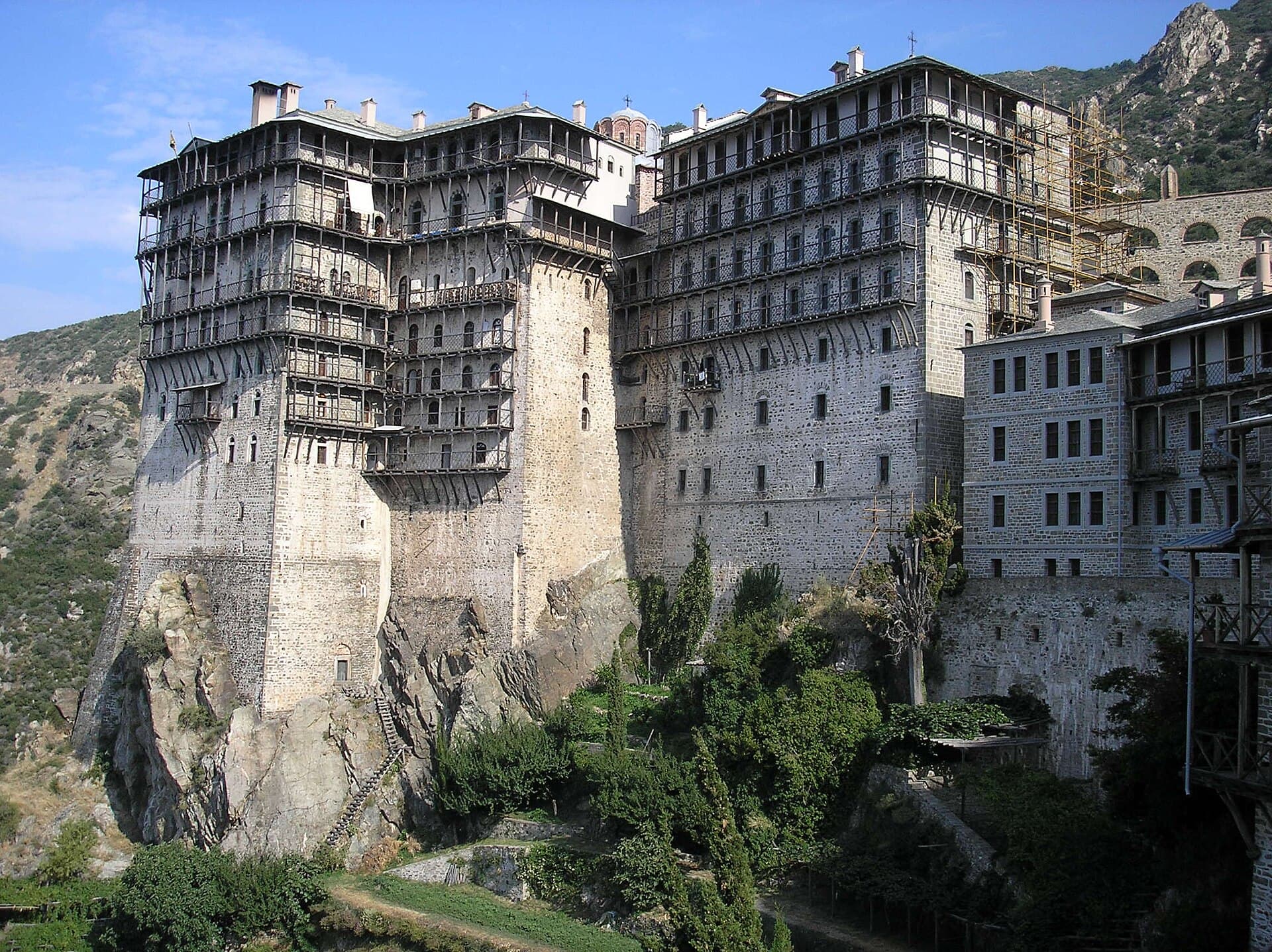
The easternmost of the three long fingers that the Halkidiki peninsula extends into the Aegean belongs, in a real constitutional sense, to its monks. The Athos peninsula runs some fifty kilometres out from the mainland of northern Greece, narrow and thickly wooded, until it ends in a marble pyramid 2,033 metres high that gives the whole territory its name. Orthodox Christians call it simply the Holy Mountain. Along its coasts and ridges stand twenty ruling monasteries and a scattering of smaller settlements, a landscape of towers, domes, and timber balconies that has been inscribed on the UNESCO World Heritage List since 1988 as one of the rare properties recognised for both cultural and natural value.
What sets Athos apart is not any single building but the continuity of the institution. Monastic life on the peninsula is documented from the ninth century, its oldest surviving charter was issued in 972, and the community that charter organised has been in session ever since. The same houses have kept the same rites, copied and guarded the same books, and governed themselves under the same constitutional tradition through the Byzantine Empire, the Ottoman centuries, and the modern Greek state. Athos is often called the world's oldest surviving republic. It is more accurate, and stranger, to call it a working memory institution with a coastline.
Hermits were living on Athos well before its written history begins. Tradition remembers solitaries such as Peter the Athonite in the caves of the peninsula, and by the middle of the ninth century Athonite monks were sufficiently established to appear in the records of the Byzantine world. The decisive moment came in 963, when the monk Athanasius the Athonite, backed by his friend and patron the emperor Nikephoros II Phokas, founded the Great Lavra at the south-eastern end of the peninsula. It was the first of the large communal monasteries and it remains first in the Athonite order of precedence today.
Athanasius's model spread quickly. Within a century the peninsula carried dozens of foundations, and Athos became the standard against which Orthodox monasticism measured itself, as later monastic landscapes such as the rock pillars of Meteora would in their turn look to Athonite practice. Emperors endowed the monasteries with land and privileges, and the Mountain settled into its lasting double character: withdrawn from the world, yet tied to it by pilgrims, patrons, and manuscripts.
The community is fixed at twenty ruling monasteries, a number closed since the eighteenth century, ranked in a formal order with Great Lavra at its head. Seventeen are Greek. Three carry the traditions of other Orthodox nations: the Russian monastery of St. Panteleimon, the Serbian Hilandar, founded in 1198 by St. Sava and his father, and the Bulgarian Zografou. Each ruling monastery owns a share of the peninsula's territory, and everything else on Athos exists as a dependency of one of the twenty.
Those dependencies form a whole graded landscape of monastic life. Sketes are villages of monks gathered around a central church. Cells, or kellia, are farmhouses held by two or three monks under an elder. At the far southern tip, on the sea cliffs of Karoulia, hermits occupy huts and caves reached by paths, ladders, and in the steepest places by chains, the most austere settlements in the Orthodox world. A monk may move between these forms across a lifetime, from the common table of a great monastery to a cliff dwelling with a single companion, without ever leaving the jurisdiction of the Mountain.
Athos governs itself from Karyes, the small town at the centre of the peninsula, where each ruling monastery sends one representative to the Holy Community, a standing council that has met in some form for over a thousand years. The founding document of this arrangement is the typikon of 972, signed by the emperor John I Tzimiskes and written on a goatskin parchment, which is why it is known as the Tragos, the goat. The charter itself is still kept at Karyes, the oldest surviving constitutional document in continuous reference anywhere in Europe.
The modern Greek state absorbed this arrangement rather than replacing it. Under Article 105 of the Greek constitution, the Athos peninsula is a self-governing part of Greece: the monasteries administer their own affairs under their charter, a civil governor appointed by the foreign ministry represents the state, and monks admitted to a monastery acquire Greek citizenship with their tonsure, whatever their nationality. A Russian, Serbian, Romanian, or American novice becomes, by entering the community, a citizen of Greece and a subject of a constitution first drafted when Byzantium still ruled the Aegean.
The Mountain's most debated rule is the avaton, the prohibition on women entering the peninsula, which has stood for more than a millennium. Its rationale lies in Athonite tradition: the peninsula is held to be the garden of the Mother of God, dedicated to the Virgin Mary alone, and the exclusion is understood by the monks as a condition of that dedication and of undistracted monastic life. The rule is written into the community's charters, is backed by Greek law, and extends even to most female animals.
The avaton has a standing place in European debate. The European Parliament passed a resolution in 2003 questioning its compatibility with modern equality principles, and the issue resurfaces periodically in public life. Greece maintains the rule, citing the Mountain's self-governing status and the declaration attached to its European accession. Women who wish to see Athos view its monasteries from boats that pass offshore.
Life on the Mountain runs on a clock and a calendar the rest of Europe abandoned. The monasteries keep the Julian calendar, thirteen days behind the civil one, so that feasts fall on the old reckoning. Most houses also keep Byzantine time, in which the day begins at sunset: clocks are adjusted through the year so that the twelfth hour falls as the sun goes down, and the great cycle of services is hung on that frame. Vespers, compline, the midnight office, matins, and the liturgy divide the night and morning, alongside the manual work that feeds and repairs the community.
Bells and the hammered wooden semantron sound in the dark, and meals are taken to the reading of texts. The arrangement is not a performance of the past. It is the past, still running, because no generation of monks ever saw a reason to stop it.
The libraries are the Mountain's quietest treasure. Across the twenty monasteries, Athos holds by most counts the richest surviving collection of Greek medieval manuscripts in the world, thousands of codices ranging from early Gospel books to music, philosophy, and monastic rules, together with icons, imperial chrysobulls with their golden seals, and archives of property deeds and correspondence running back a thousand years. These collections were never assembled by a museum. They accumulated in place, catalogued, copied, and defended by the very institution that produced them, which is why so much survived the losses that emptied other Byzantine libraries. Modern scholarship reaches them through microfilm campaigns and digitization projects such as the Mount Athos Repository, which has put thousands of items online.
Survival was never guaranteed. The monasteries are ranges of stone and timber, their upper storeys carried on wooden balconies, and fire has always been their great enemy. Simonopetra, the most photographed of them all on its cliff above the sea, lost its library to flames in 1891; a fire at Serbian Hilandar in 2004 destroyed roughly half the monastery, and its restoration has taken decades. Every generation of Athonite monks has been, among its other duties, a fire watch standing over a millennium of paper.
The twentieth century nearly ended the story through attrition. Early in the century the Mountain held several thousand monks, swollen by a great Russian presence at St. Panteleimon; wars, revolution, and the closing of the communist world cut off recruits, until only around 1,100 mostly elderly monks remained by the early 1970s. Observers wrote of Athos then as a place in terminal decline.
The opposite happened. From the 1970s a revival gathered pace, led by young and often highly educated monks drawn from Greek universities and, after 1989, from across the Orthodox world. The population has climbed back to roughly 2,000, the average age has fallen, and abandoned sketes and cells have been reoccupied and repaired. Pilgrimage has grown with it, managed through the diamonitirion, a permit issued for a set number of visitors each day, with a small additional quota for non-Orthodox men, arranged through the pilgrim offices in Thessaloniki and Ouranoupoli. The ferry from Ouranoupoli remains the only ordinary way in; there is no road onto the peninsula, and the Mountain intends to keep it that way.
Athos keeps what it keeps by a method almost embarrassing in its simplicity: continuity. The charter of 972 survives because the council it created still meets and still needs it. The manuscripts survive because the services they serve are still sung, on the old calendar, at the old hours. The buildings survive because monks live in them, and rebuilt them each time they burned. Most institutions preserve their past by setting it apart, in archives and glass cases, from the life that made it. The Holy Mountain never made that separation. Its records, rites, and constitution have come down a thousand years the way a fire is kept overnight, banked and tended, handed from one watch to the next, never once allowed to go out.
A finger of land given to prayer
Twenty monasteries and the smaller settlements
A republic within the republic
The avaton
Days kept on Byzantine time
The memory of the Orthodox world
Emptying and return
The institution that never stopped
References and resources
- UNESCO World Heritage Centre. "Mount Athos." World Heritage List, property no. 454, mixed inscription 1988. whc.unesco.org/en/list/454.
- Encyclopaedia Britannica. "Mount Athos." britannica.com/place/Mount-Athos.
- Wikipedia. "Mount Athos," "Great Lavra," "Hilandar Monastery," and "Monastic republic." Retrieved 2026.
- Mount Athos Repository. Digitized manuscripts, documents, and objects from the Athonite monasteries. repository.mountathos.org.
- Friends of Mount Athos. Pilgrim guidance and notes on the monasteries. athosfriends.org.
- Hellenic Republic. Constitution of Greece, Article 105, on the Holy Mountain's self-governing status.