Heritage · Landmark
Aksum: the stelae field and the stone that came home
On a plateau in northern Ethiopia stand blocks of granite carved to look like tower houses, raised by a kingdom that traded with Rome and India and struck its own gold coins. The largest lies broken where it fell. Another was taken to Rome in 1937 as a trophy of occupation, stood in an Italian square for sixty-eight years, and came home in three pieces.Written to last.
By Confinity Heritage Editorial · 2026-08-25 · 7-minute readQuiet tools, kept out of the way.
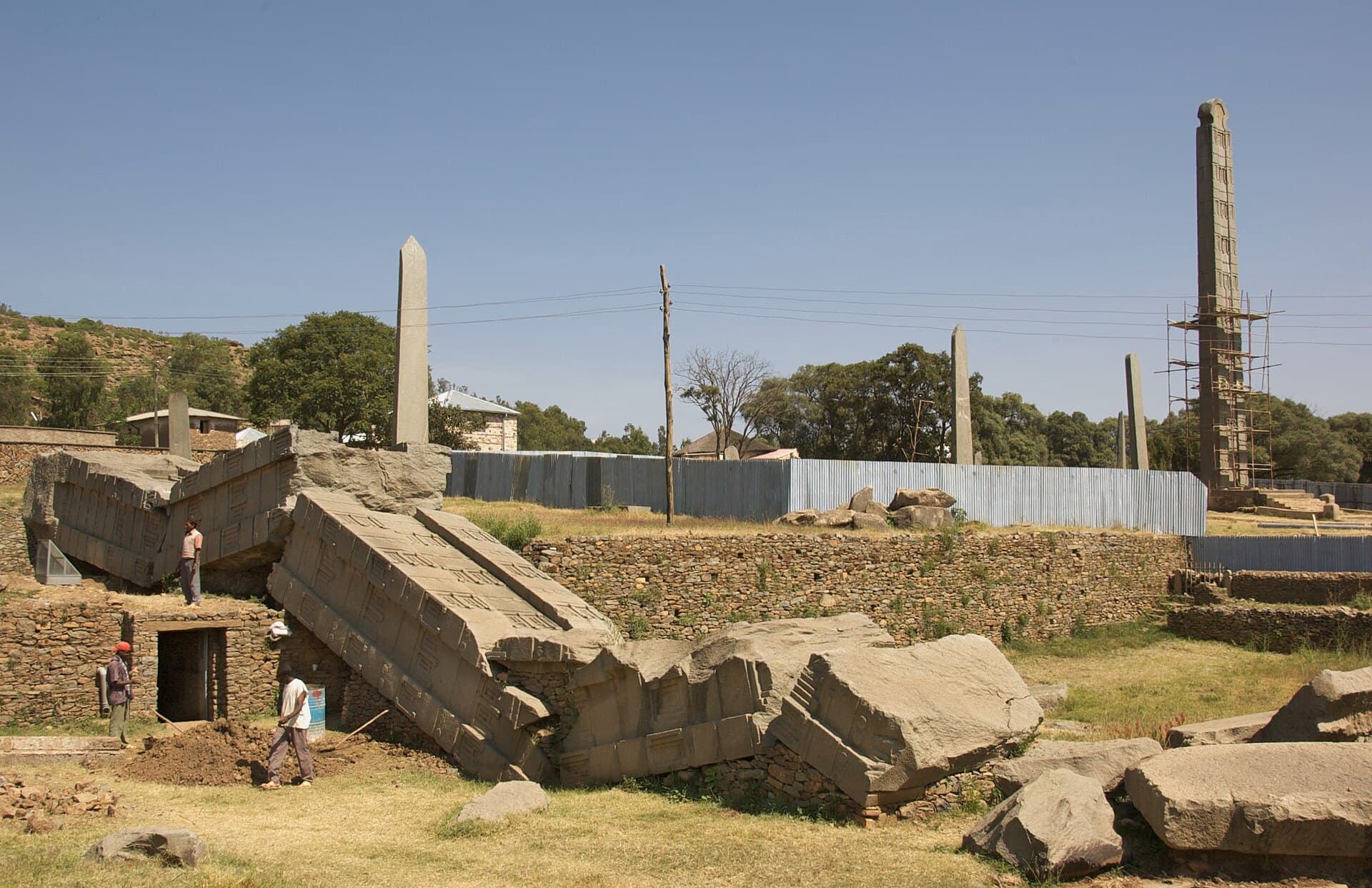
Aksum stands on a high plateau in the Tigray Region of northern Ethiopia, a little over 2,100 metres above the sea, below the Adwa mountains. It was the capital of the Aksumite kingdom, which UNESCO dates from the 1st to the 8th centuries AD and describes as the most powerful state between the Eastern Roman Empire and Persia, set at the meeting of Africa, Arabia, and the Greco-Roman Mediterranean. The ruins were inscribed on the World Heritage List in 1980.
What a visitor sees first are the stelae. They are single blocks of granite, quarried whole, dressed, then carved so that each one reads as a tall building with storeys stacked above a doorway. Hundreds stand in the fields around the town, most small and rough, a handful enormous. The largest of all never stood at all: it lies broken across the ground where it fell. And one of the great stelae is not where its makers left it, because for most of the twentieth century it stood in Rome.
By the first century AD a Greek merchant's handbook, the Periplus of the Erythraean Sea, already called Aksum a metropolis. Its wealth came from position: fleets worked the Red Sea through the port of Adulis, inland routes carried ivory out of the Sudan, and the kingdom sat between the Roman world and the Indian Ocean.
Coins are the clearest signal of how the kingdom saw itself. From around AD 270, in the reign of Endybis, Aksum struck its own currency in gold, silver, and bronze, with legends in Ge'ez and in Greek, making it one of the first African states to mint coinage of its own. Aksumite coins have been found as far apart as Caesarea and southern India. They also record the turn to Christianity: around 340, under King Ezana, the disc and crescent of the older gods disappear from the dies and a cross takes their place. Ethiopian tradition credits the conversion to Frumentius, Ezana's tutor and the first bishop of Aksum. The church founded in that generation is the tradition that later cut the rock-hewn churches of Lalibela out of the highland stone.
Aksum's political power faded after the eighth century and the capital moved south. The town did not stop mattering. Ethiopian emperors were still being crowned there a thousand years later.
The great stelae are grave markers. Beneath them lie built chambers, and the size and finish of the marker tracked the rank of the dead below. The earliest are plain and rough; over time they were dressed smooth, then carved into something without close parallel anywhere: a stone cut to imitate a timber-and-stone tower of the Aksumite style, with a false door at the base, rows of false windows climbing the shaft, and the projecting beam ends that Ethiopian builders call monkey heads rendered in granite. Metal plates were once fixed to their faces. The sockets survive.
Three stelae are on a different scale from the rest. King Ezana's Stele, about 21 metres tall, is the only one of the three never broken; it has stood since the fourth century. The second is the Obelisk of Axum, 24 metres and 160 tonnes. The third is the Great Stele, and it is the one that stops people.
The Great Stele measures 33 metres and lies where it came down, in pieces, across the ground it was meant to dominate. It broke, most likely, during the attempt to raise it, and nobody tried again. Had it stood it would have been the largest single block of stone ever set upright by human beings anywhere; UNESCO calls it possibly the largest monolithic stele that ancient human beings ever attempted to erect. What survives is not a monument but a failure at monumental scale, left where it happened.
Two kilometres to the north-east, on a low hill, are the twin tombs that local tradition assigns to the sixth-century king Kaleb and his son Gebre Meskel. They belong to the period after the stelae stopped, when royal burial went underground. Steps descend into chambers of irregular blocks cut to lock together without clamps, the joints in the southern tomb finer than anything else at the site. One room holds three sarcophagi, and one carries a cross of the kind found on Aksumite coins.
In October 1935 Italian troops took Aksum. In 1937, during the occupation, the fallen 24-metre stele known since as the Obelisk of Axum was cut into three pieces and hauled by truck to the Red Sea port of Massawa, five trips over two months. It reached Naples by ship on 27 March 1937. In Rome it was restored, reassembled, and raised at Porta Capena in front of the Ministry for Italian Africa, then unveiled on 28 October 1937, the fifteenth anniversary of the March on Rome. A bronze Lion of Judah, emblem of the Ethiopian monarchy, was taken in the same operation and set up outside Termini station.
Under a 1947 agreement Italy undertook to return both. The lion went back in 1967. The stele did not. Fifty years passed in proposals, technical objections, and competing accounts of what had been agreed, until in April 1997 the Italian president Oscar Luigi Scalfaro accepted the Ethiopian request. On 27 May 2002 lightning struck the stele in Rome and did considerable damage. Dismantling began in November 2003, and the return was held up again: the runway at Aksum was too short for a cargo aircraft carrying even a third of the stone, the roads north from Addis Ababa were judged unfit for the load, and Massawa, the port it had left by, was now in Eritrea and closed to Ethiopia. The runway was lengthened for the purpose.
On 19 April 2005 the middle section flew home aboard an Antonov An-124, described at the time as the heaviest single item of air freight ever carried. The second followed on 22 April and the last on 25 April. The pieces then sat in storage for three years while Ethiopia worked out how to raise them without disturbing what lay beneath. Reassembly began in June 2008 with a team appointed by UNESCO and led by the engineer Giorgio Croci, the sections joined this time by aramid fibre bars rather than the steel used in Rome, so the stone would not again draw lightning. It was standing by the end of July 2008 and was unveiled on 4 September, sixty-eight years after it left.
A short walk from the stelae field, under a shelter, stands the Ezana Stone. It carries a fourth-century inscription, from a reign usually dated AD 330 to 356, recording Ezana's conversion and his campaigns, including the one against Meroe that brought down the Kingdom of Kush. The text is set out in Ge'ez, in the South Arabian language Sabaean, and in Greek.
A trilingual inscription is worth more to a historian than three separate ones. Where a known language sits beside a less known one, saying the same thing, the unknown becomes readable: vocabulary, grammar, and the values of individual signs can be fixed by comparison. The choice of languages is itself evidence, because it names the audiences a king wanted to reach. Greek was for the Red Sea traders and the Roman world behind them, Sabaean for the Arabian shore across the water, Ge'ez for home. That Ge'ez tradition continued in manuscript for another sixteen centuries, and the Institute of Ethiopian Studies at Addis Ababa University holds one of the largest collections of those manuscripts anywhere.
The Church of Our Lady Mary of Zion is the holiest site of the Ethiopian Orthodox Tewahedo Church. A church is said to have stood here since Ezana's reign, destroyed and rebuilt more than once; the old church standing today was raised by the Emperor Fasilides in 1665. Beside it is a much larger cathedral begun in 1955 under Haile Selassie. Between the two stands a small building, the Chapel of the Tablet, paid for from the private funds of the Empress Menen Asfaw.
The tradition of the Ethiopian church holds that the Ark of the Covenant is kept in that chapel, brought from Jerusalem by Menelik I, son of Solomon and the Queen of Sheba, as told in the Kebra Nagast. This is a claim of faith and long usage rather than a documented fact. Admittance is closed to everyone except a single guardian monk, who is named for life by his predecessor, lives on the grounds, and does not leave them. Entry has been refused even to the Patriarch, and, while the monarchy lasted, to the Emperor. No independent examination has been permitted, and scholars both Ethiopian and foreign have questioned the account. The tradition is old, continuous, and central to Ethiopian Christian identity; the object it describes has never been available to be tested.
Fighting reached Aksum early in the Tigray conflict of 2020 to 2022. Ethiopian and Eritrean forces took the town on 19 November 2020. Amnesty International later documented the killing of civilians there on 28 and 29 November, naming more than 240 of the dead, stating that it could not independently verify the total, and concluding that the events may amount to a crime against humanity. Researchers working on Tigrayan heritage have recorded damage and looting at religious and archaeological sites across the region, including the vandalising of the church at Aksum after the killings in its grounds. Reports of losses from the archaeological museum have circulated, but restrictions on access have limited independent verification. Hostilities ended with the agreement signed at Pretoria in November 2022. Visitor traffic, the town's main outside income, stopped for the duration and has been slow to return.
Very few objects taken in war are ever put back. Most of those arguments are still running. The Obelisk of Axum is an exception, and unusual in its particulars as well as its outcome: cut in three to be carried off, raised as a trophy in a foreign capital, left standing there through an empire's collapse and two republics, struck by lightning, flown home in a Soviet-built freighter, and set upright again on the ground it was quarried for.
It stands now within sight of the Great Stele, which never rose at all, and of Ezana's stele, which never came down. Three answers to the same intention, in one field: the one that failed, the one that lasted, and the one that was taken and returned. A town keeps what it can and loses what it cannot hold, and sometimes, after long enough, part of it comes back.
A kingdom between three continents
The stelae field
The Obelisk of Axum and its return
Three languages on one stone
The chapel of the tablet
War in Tigray
A stone that came home
References and resources
- UNESCO World Heritage Centre. "Aksum." World Heritage List, property no. 15, inscribed 1980. whc.unesco.org/en/list/15.
- UNESCO World Heritage Centre. "Mission accomplished: Aksum Obelisk successfully reinstalled," 1 August 2008, and "Inauguration Ceremony for the Aksum Obelisk," 5 September 2008. whc.unesco.org/en/news.
- Amnesty International. "Ethiopia: Eritrean troops' massacre of hundreds of Axum civilians may amount to crime against humanity." February 2021. amnesty.org.
- Hagos Abrha Abay. "Ethiopia's war in Tigray risks wiping out centuries of the world's history." The Conversation, 2022. theconversation.com.
- Phillipson, David W. Archaeology at Aksum, Ethiopia, 1993-7. London: British Institute in Eastern Africa, 2000.
- Munro-Hay, Stuart. Aksum: An African Civilisation of Late Antiquity. Edinburgh: Edinburgh University Press, 1991.
- Wikipedia. "Axum," "Kingdom of Aksum," "Obelisk of Axum," "King Ezana's Stele," "Ezana Stone," and "Church of Our Lady Mary of Zion." Retrieved 2026.