Heritage · Landmark
The Great Barrier Reef — sea country remembering
The largest living structure on Earth has bleached six times in a decade, and the world argues over its future in committee rooms. Its oldest keepers — more than seventy Traditional Owner groups — have been reading and remembering this sea for millennia.Written to last.
By Confinity Heritage Editorial · 2026-07-10 · 7-minute readQuiet tools, kept out of the way.
The Great Barrier Reef is usually introduced with superlatives: the largest coral reef system in the world, the largest structure built by living things, visible from orbit. The numbers are true, roughly 3,000 individual reefs and hundreds of islands strung along 2,300 kilometres of the Queensland coast, a World Heritage property of some 348,000 square kilometres. But the superlative that matters most is quieter. The Reef is one of the oldest continuously witnessed places on Earth. People have lived beside it, fished it, named it, and told its story since before it existed in its present form, and that long act of witness has suddenly become urgent, because the Reef is changing faster than at any time in human memory.
When UNESCO inscribed the Great Barrier Reef on the World Heritage List in 1981, it met all four natural criteria, for beauty, for geological process, for ecological process, and for biodiversity, a distinction shared by only a handful of places on the planet. The listing describes a living system of staggering richness: hundreds of coral species, more than 1,500 species of fish, whales, dugongs, six of the world's seven marine turtle species, and seabird rookeries on coral cays. The Great Barrier Reef Marine Park, established in 1975, made it one of the earliest and largest attempts anywhere to manage an entire living system as a single protected place.
Long before the Marine Park, the Reef had custodians. More than seventy Aboriginal and Torres Strait Islander Traditional Owner groups hold connections to the Reef and its coast, connections the Reef's managers acknowledge as extending back tens of thousands of years. In Aboriginal English these are relationships to sea country, a term that carries law, kinship, story, and responsibility together: particular clans belong to particular waters, reefs, and islands, and are obliged to care for them.
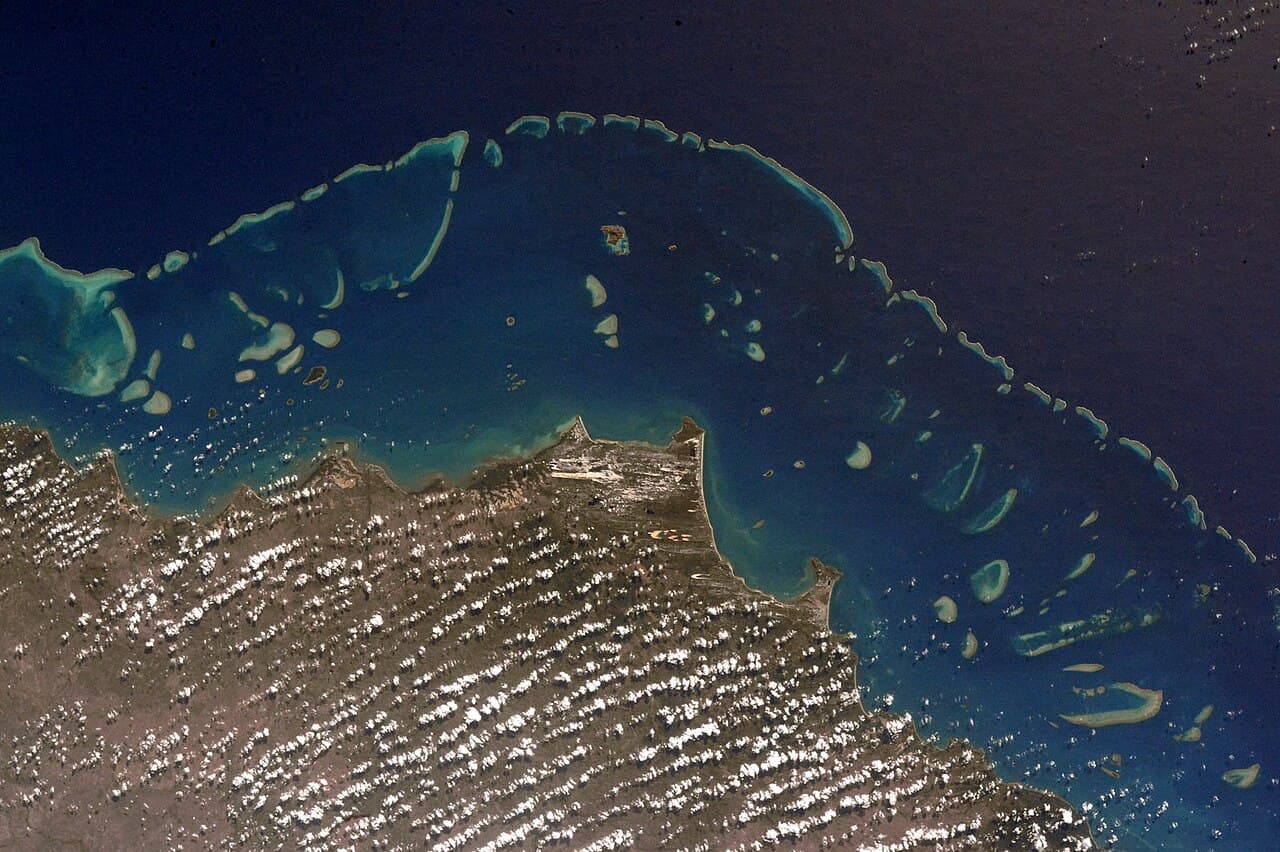
 From the air the reef reads as a single thing. It is about 2,900 separate reefs, and the living layer sits on limestone laid down by everything that grew there before. Photograph by Ank Kumar, CC BY-SA 4.0, via Wikimedia Commons.
That relationship is old enough to remember a different coastline. At the height of the last ice age the sea lay far lower, and much of what is now reef lagoon was a coastal plain; today's islands are the hilltops of a drowned country. Researchers studying Aboriginal oral traditions from around the Australian coast have argued that some stories accurately describe those lower shorelines and their flooding as the seas rose thousands of years ago, which would make them among the oldest continuously transmitted memories on Earth. Whatever the final scholarly verdict, the deeper point stands: the cultures of the Reef coast have carried knowledge of this sea across a span of time that makes written science look like a postscript.
Corals live in partnership with microscopic algae that feed them and give them colour. When the water stays too warm for too long, the partnership breaks down: the coral expels its algae and turns bone white. Bleached coral is not dead, but it is starving, and if the heat persists it dies.
The Reef's recent history can be told in bleaching years. Mass bleaching was recorded in 1998 and 2002, then with gathering frequency in 2016, 2017, 2020, 2022, 2024, and 2025. The 2016 and 2017 events, back to back, devastated the northern Reef. The 2022 event was the first to strike during a normally cooler La Niña year. In March 2024, aerial surveys of over 1,000 reefs found bleaching on around three quarters of them, part of a global bleaching event that scientists describe as the most extensive on record, and a 2024 study published in Nature concluded that the ocean heat driving these events is the highest in at least four centuries. In 2025 the Australian Institute of Marine Science, which has monitored the Reef for four decades, reported the largest annual declines in coral cover ever recorded in two of the Reef's three regions, driven chiefly by heat-stress mortality from the 2024 event alongside cyclones and outbreaks of coral-eating crown-of-thorns starfish.
The Reef is not a single dying organism, it is a vast mosaic in which some reefs recover strongly between shocks. But the interval between shocks is shrinking, and recovery takes longer than the new clock allows.
The plain accounting is this. The Reef's dominant threat is climate change: marine heatwaves that bleach coral, stronger cyclones that smash it, and ocean acidification that slows its regrowth. Behind that sit regional pressures, sediment and nutrient run-off from coastal catchments that cloud the water and feed crown-of-thorns outbreaks, and the cumulative effects of coastal development and fishing.
The stakes have been argued at the highest level of heritage diplomacy. In 2021 UNESCO's advisers recommended placing the Reef on the List of World Heritage in Danger; Australia lobbied hard and the decision was deferred. A UNESCO and IUCN monitoring mission visited in 2022 and also recommended the in-danger listing, but in 2023 the World Heritage Committee again held off, citing Australia's strengthened commitments while demanding continued progress. The draft decision published ahead of the committee's July 2026 session once more stops short of an in-danger listing while keeping the Reef under close watch. Critics call the reprieve political; defenders call it recognition of genuine effort. Both agree on the underlying fact: no management plan on the water can offset a warming ocean. The Reef's future is being decided as much in energy policy as in marine policy.
None of this is a eulogy. Hundreds of thousands of square kilometres of reef remain alive, adaptive, and worth defending, which is precisely why the accounting must stay honest.
Australia's framework response is the Reef 2050 Long-Term Sustainability Plan, adopted with Queensland in 2015 and substantially updated in 2021, which coordinates water-quality targets, crown-of-thorns control, research, and restoration. What is most interesting, from the standpoint of memory, is how far the plan now runs through Traditional Owners. The Reef 2050 arrangements include a dedicated Traditional Owner implementation plan, and Traditional Owner partnerships are named among the priority areas for Reef investment.
The most concrete instruments are Traditional Use of Marine Resources Agreements, TUMRAs, developed by Traditional Owner groups and accredited by the Reef's managers, which set out how each group exercises law and custom on its own sea country: managing the traditional take of species like turtle and dugong, monitoring reef health, and partnering in compliance and research. Ten accredited agreements now involve eighteen Traditional Owner groups and cover roughly forty per cent of the Marine Park's coastline, an area that has grown steadily for two decades.
Alongside them work the Indigenous ranger programmes: Traditional Owners employed on their own country to patrol, monitor seagrass and turtle populations, manage island habitats, record cultural sites, and train the next generation through junior ranger schemes. It is easy to file this under environmental management, but it is equally an act of memory-keeping, elders and rangers carrying names, stories, and ecological knowledge of particular reefs across generations, and now recording sea-country knowledge in mapping projects so that what the old people know does not leave with them. Two systems of observation, one millennia old and one decades old, are being braided together over the same water.
The Great Barrier Reef teaches that the deepest records are kept in people, and that keeping them is a duty that can be organised, funded, and handed on. The oldest information we have about this coast survived not in libraries but in families and clans, in stories told with the obligation to tell them again. Now, as the Reef changes faster than any generation has seen, that same discipline is being turned to the future: rangers logging what their grandparents knew beside what the sensors say, so that whatever the coming decades take, the memory of what was here, and who belonged to it, will not be lost. Confinity's work rests on the same conviction at family scale: that memory survives when its keeping is treated not as nostalgia but as responsibility, passed deliberately from hand to hand.
From the air the reef reads as a single thing. It is about 2,900 separate reefs, and the living layer sits on limestone laid down by everything that grew there before. Photograph by Ank Kumar, CC BY-SA 4.0, via Wikimedia Commons.
That relationship is old enough to remember a different coastline. At the height of the last ice age the sea lay far lower, and much of what is now reef lagoon was a coastal plain; today's islands are the hilltops of a drowned country. Researchers studying Aboriginal oral traditions from around the Australian coast have argued that some stories accurately describe those lower shorelines and their flooding as the seas rose thousands of years ago, which would make them among the oldest continuously transmitted memories on Earth. Whatever the final scholarly verdict, the deeper point stands: the cultures of the Reef coast have carried knowledge of this sea across a span of time that makes written science look like a postscript.
Corals live in partnership with microscopic algae that feed them and give them colour. When the water stays too warm for too long, the partnership breaks down: the coral expels its algae and turns bone white. Bleached coral is not dead, but it is starving, and if the heat persists it dies.
The Reef's recent history can be told in bleaching years. Mass bleaching was recorded in 1998 and 2002, then with gathering frequency in 2016, 2017, 2020, 2022, 2024, and 2025. The 2016 and 2017 events, back to back, devastated the northern Reef. The 2022 event was the first to strike during a normally cooler La Niña year. In March 2024, aerial surveys of over 1,000 reefs found bleaching on around three quarters of them, part of a global bleaching event that scientists describe as the most extensive on record, and a 2024 study published in Nature concluded that the ocean heat driving these events is the highest in at least four centuries. In 2025 the Australian Institute of Marine Science, which has monitored the Reef for four decades, reported the largest annual declines in coral cover ever recorded in two of the Reef's three regions, driven chiefly by heat-stress mortality from the 2024 event alongside cyclones and outbreaks of coral-eating crown-of-thorns starfish.
The Reef is not a single dying organism, it is a vast mosaic in which some reefs recover strongly between shocks. But the interval between shocks is shrinking, and recovery takes longer than the new clock allows.
The plain accounting is this. The Reef's dominant threat is climate change: marine heatwaves that bleach coral, stronger cyclones that smash it, and ocean acidification that slows its regrowth. Behind that sit regional pressures, sediment and nutrient run-off from coastal catchments that cloud the water and feed crown-of-thorns outbreaks, and the cumulative effects of coastal development and fishing.
The stakes have been argued at the highest level of heritage diplomacy. In 2021 UNESCO's advisers recommended placing the Reef on the List of World Heritage in Danger; Australia lobbied hard and the decision was deferred. A UNESCO and IUCN monitoring mission visited in 2022 and also recommended the in-danger listing, but in 2023 the World Heritage Committee again held off, citing Australia's strengthened commitments while demanding continued progress. The draft decision published ahead of the committee's July 2026 session once more stops short of an in-danger listing while keeping the Reef under close watch. Critics call the reprieve political; defenders call it recognition of genuine effort. Both agree on the underlying fact: no management plan on the water can offset a warming ocean. The Reef's future is being decided as much in energy policy as in marine policy.
None of this is a eulogy. Hundreds of thousands of square kilometres of reef remain alive, adaptive, and worth defending, which is precisely why the accounting must stay honest.
Australia's framework response is the Reef 2050 Long-Term Sustainability Plan, adopted with Queensland in 2015 and substantially updated in 2021, which coordinates water-quality targets, crown-of-thorns control, research, and restoration. What is most interesting, from the standpoint of memory, is how far the plan now runs through Traditional Owners. The Reef 2050 arrangements include a dedicated Traditional Owner implementation plan, and Traditional Owner partnerships are named among the priority areas for Reef investment.
The most concrete instruments are Traditional Use of Marine Resources Agreements, TUMRAs, developed by Traditional Owner groups and accredited by the Reef's managers, which set out how each group exercises law and custom on its own sea country: managing the traditional take of species like turtle and dugong, monitoring reef health, and partnering in compliance and research. Ten accredited agreements now involve eighteen Traditional Owner groups and cover roughly forty per cent of the Marine Park's coastline, an area that has grown steadily for two decades.
Alongside them work the Indigenous ranger programmes: Traditional Owners employed on their own country to patrol, monitor seagrass and turtle populations, manage island habitats, record cultural sites, and train the next generation through junior ranger schemes. It is easy to file this under environmental management, but it is equally an act of memory-keeping, elders and rangers carrying names, stories, and ecological knowledge of particular reefs across generations, and now recording sea-country knowledge in mapping projects so that what the old people know does not leave with them. Two systems of observation, one millennia old and one decades old, are being braided together over the same water.
The Great Barrier Reef teaches that the deepest records are kept in people, and that keeping them is a duty that can be organised, funded, and handed on. The oldest information we have about this coast survived not in libraries but in families and clans, in stories told with the obligation to tell them again. Now, as the Reef changes faster than any generation has seen, that same discipline is being turned to the future: rangers logging what their grandparents knew beside what the sensors say, so that whatever the coming decades take, the memory of what was here, and who belonged to it, will not be lost. Confinity's work rests on the same conviction at family scale: that memory survives when its keeping is treated not as nostalgia but as responsibility, passed deliberately from hand to hand.
A wonder inscribed
The oldest memory of the sea
Bleaching: the new clock
What is at risk
Keeping sea country
What the Reef teaches about keeping
References and resources
- UNESCO World Heritage Centre, Great Barrier Reef
- Australian Institute of Marine Science, Coral bleaching events on the Great Barrier Reef
- Australian Institute of Marine Science, Annual Summary Report of Coral Reef Condition 2024/25
- Australian Government DCCEEW, Reef 2050 Long-Term Sustainability Plan
- Great Barrier Reef Marine Park Authority, Traditional Use of Marine Resources Agreements
- Australian Government DCCEEW, Traditional Owner Reef protection
- Henley et al., Nature (2024), Highest ocean heat in four centuries places Great Barrier Reef in danger
- Great Barrier Reef Foundation, Coral bleaching and Reef threats