Heritage · Landmark
The Frauenkirche: the church that shows its own scars
A baroque church with a dome of solid stone stood through two days of bombing in February 1945, then fell on the third morning when its heated sandstone gave way. The rubble lay on the square for forty-five years. When the church was finally rebuilt, the salvaged blocks went back into the walls in the places they had come from, so the facade is mottled dark and pale: a building that carries the map of its own destruction on the outside.Written to last.
By Confinity Heritage Editorial · 2026-08-25 · 7-minute readQuiet tools, kept out of the way.
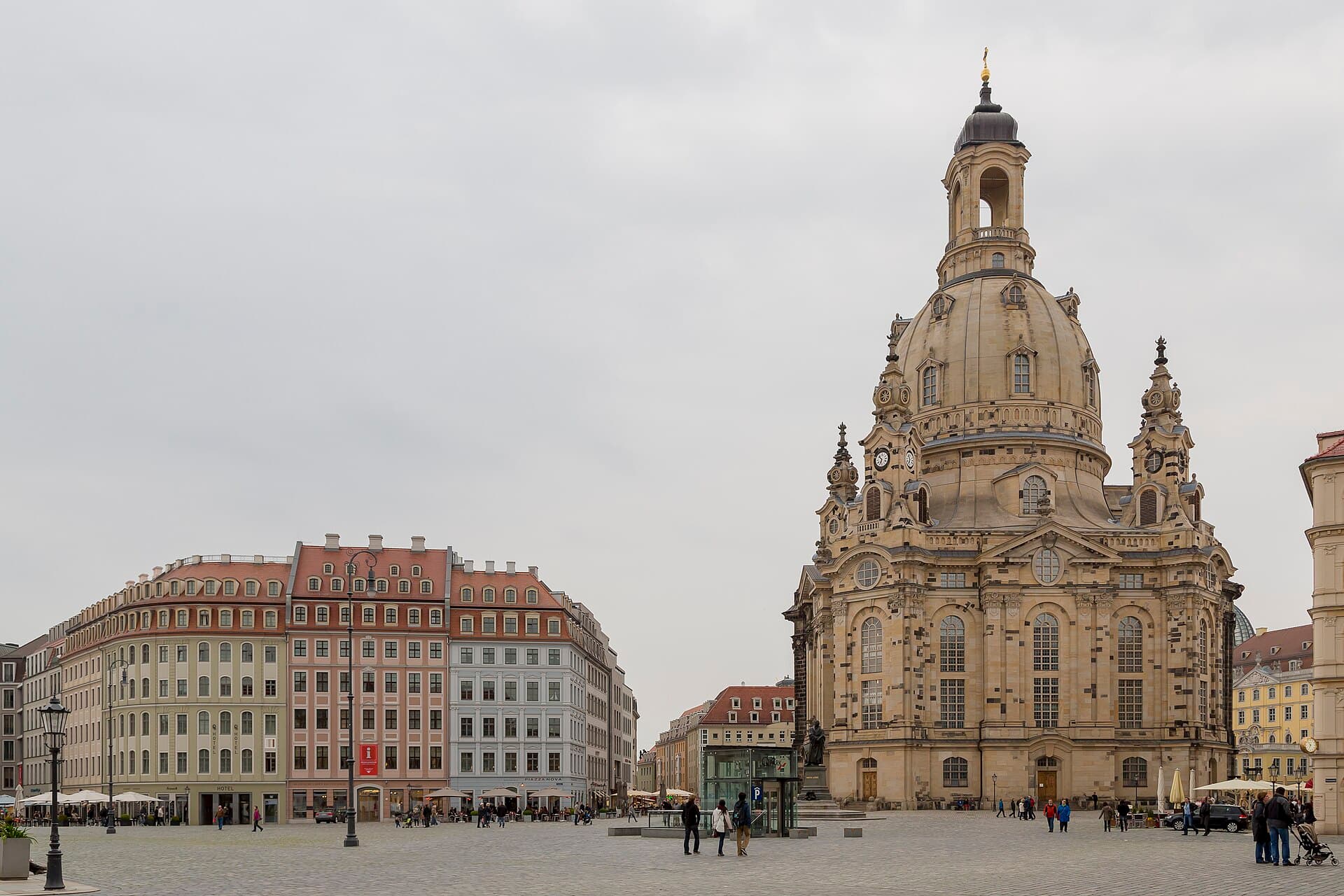
On the Neumarkt in Dresden, in eastern Germany, stands a domed baroque church that looks from across the square like a well-kept original. Walk closer and the walls turn strange. Blocks of near-black stone sit scattered through pale honey-coloured sandstone in a pattern no architect would draw: a dark cluster here, a lone dark block ten metres up, whole bays with none at all. The dark stones are the old church. They spent forty-five years in a rubble heap on this square, and most of them now sit in the position they held before the morning of 15 February 1945.
The Frauenkirche, the Church of Our Lady, is a Protestant church built in the 1720s and 1730s with a dome made not of timber and lead but of solid sandstone. It burned and fell in the bombing of Dresden, and its ruin became the best-known pile of stone in East Germany. What stands there now is not a replica. It is closer to the original object, reassembled from its own wreckage by people who wrote down where every piece landed.
The foundation stone was laid on 26 August 1726, to a design by the Dresden city architect George Bähr. The church was consecrated while still unfinished on 28 February 1734, Johann Sebastian Bach played its Silbermann organ two years later, and Bähr died in 1738 with the building incomplete. The tower cross went up on 27 May 1743.
What made the church remarkable was the dome. Bähr built it of sandstone rather than the usual lightweight shell, some 12,000 tonnes of masonry carried on eight slender interior piers, a structure Dresdeners nicknamed die Steinerne Glocke, the Stone Bell. Contemporaries doubted it would stand. It stood well enough that witnesses in 1760 reported Prussian cannonballs bouncing off it during the Seven Years' War.
Allied bombing of Dresden began on the night of 13 February 1945 and continued through the following day. The firestorm destroyed the historic centre and killed, according to a commission of historians appointed by the city and reporting in 2010, between 22,700 and 25,000 people.
The Frauenkirche came through it. The eight piers held while the interior burned, long enough for the roughly three hundred people sheltering in the crypt to get out, and when the raids ended the church still stood above a flattened city. The fire had done its work inside. Sandstone loses its strength when it is heated hard, and the temperature in and around the church reached about 1,000 °C. At around ten o'clock on the morning of 15 February, with the bombers long gone, the piers glowed red, failed, and the Stone Bell came down, driving nearly 6,000 tonnes of masonry through the floor. No bomb destroyed the Frauenkirche. Heat did, two days later.
Two fragments stayed upright, a corner of the north-west stair tower and part of the choir wall, at the edge of a heap of stone thirteen metres high. Dresdeners began numbering salvaged fragments almost at once, and in 1949 some 600 cubic metres of stone were recovered, measured and inventoried against a rebuilding that politics then postponed for four decades.
 The ruin in October 1985, the surviving fragments of wall rising out of the mound. Photograph by Hajotthu, CC BY-SA 3.0, via Wikimedia Commons.
The decision to leave the ruin has a history of its own, and it was not one decision. East German authorities pulled down many war-damaged buildings in Dresden, including the Sophienkirche, the last Gothic church in the centre, cleared away in 1962 and 1963. Public feeling protected the Frauenkirche site from the same treatment, and in 1966 the city council declared the remains a memorial for the victims of the bombing war. That framing suited the state, which held official commemorations at the ruin each 13 February.
From 1982 the same date drew a different crowd. Around four hundred people came to the stones in silence with candles and flowers, an unofficial peace movement in a country that permitted nothing unofficial, and by 1989 similar gatherings across the republic ran to tens of thousands. On 13 February 1990, three months after the Berlin Wall opened, a citizens' initiative published the Ruf aus Dresden, the Call from Dresden, asking the world to fund a rebuilding.
The heap could have been bulldozed and a new church built on the footprint from Bähr's surviving drawings. Nobody would have known the difference from ten metres away. Instead the mound was excavated.
The archaeological clearing ran for eighteen months from 1993. Some 22,000 cubic metres of stone and architectural fragments were lifted out of the thirteen-metre ruin, every piece recovered and inventoried rather than tipped into a lorry. Each block was measured, photographed, numbered and carried to a storage yard on the site.
Two things then made it possible to work out where a given stone had come from. The first was the geometry of the collapse. Where a block lay in the mound was evidence, because masonry that falls from a known height on a known side lands in a predictable place, so the heap was recorded as a stratified deposit before it was taken apart. The second was a three-dimensional model. The standing ruin was recorded photogrammetrically in 1993 so that the spatial form of the church could be reconstructed from photographs, and that model, matched against Bähr's plans, pre-war surveys and a vast photographic record, let engineers test candidate positions for catalogued stones by computer until a fit was found.
The result is substantially its own predecessor. The church foundation records 8,425 old ashlars set back into the fabric, 7,110 of them in the outer walls, with historic material making up around 45 percent of the finished church once the surviving ruin fragments and the lower church are counted. The rebuilding cost 182.6 million euros, of which 102.8 million came from donations given by tens of thousands of people in more than two dozen countries. The largest personal gift came from the biologist Günter Blobel, who had seen the old church as a refugee child days before the raids and handed over his entire 1999 Nobel Prize money. The first stone went down on 27 May 1994; the exterior was finished in 2004 and the interior in 2005.
Because the salvaged blocks were fire-blackened in 1945 and then left in the open through four more decades of weather and lignite smoke, they came back dark. Set against sandstone freshly cut from the Posta quarries upriver, the same beds Bähr used, they read almost as burn marks. Nobody cleaned them, hid them, or sorted them into a tidy decorative band.
So the facade works as a map. Where dark stone clusters, the old fabric survived the fall in recognisable pieces; where pale stone runs unbroken across a whole bay, the church was pulverised and there was nothing to return. A visitor can read the physics of 15 February 1945 off the outside of the building without being told anything at all.
This is a reconstruction that refuses to pretend, and the refusal is the point. Faithful rebuilding usually asks a city to accept a polite fiction, that the loss can be edited out and the eighteenth century resumed. Dresden declined the fiction while doing the most exacting rebuilding of the modern era. And none of it would have worked without the least glamorous decision in the whole story: keeping a large, awkward, commercially worthless heap of broken stone in the middle of a city for forty-five years, and writing down where each piece came from.
The old tower cross was found in the wreckage, crushed and twisted but recognisable. It stands inside the rebuilt church beside the new altar, unrepaired.
The cross that now tops the lantern was made in Britain. The Dresden Trust, founded in 1993 in answer to the Call from Dresden, raised money from British donors for a new orb and cross, with the Duke of Kent as patron, a personal gift from the Queen and £50,000 from the British government. The commission went to the London silversmiths Grant Macdonald, and the principal craftsman was Alan Smith, whose father Frank had flown with an RAF aircrew in the raids on Dresden. Smith worked the steel and copper by eighteenth-century forging methods and laid on three coats of gold leaf, describing the finished piece as a symbol of reconciliation and a sign of his father's remorse.
The cross was shown in British cathedrals, handed over ceremonially by the Duke of Kent in February 2000, and lifted onto the dome on 22 June 2004. The church was reconsecrated on 30 October 2005, the day before Reformation Day, sixty years and eight months after it fell.
The rebuilding did not stop at the church door. The Neumarkt around it, an empty expanse for half a century, has been filled back in with reconstructed baroque frontages, a project that still divides the city. Dresden's postwar record is mixed: the Zwinger palace restored, the Semperoper reopened on 13 February 1985 for the fortieth anniversary of the raid, the Sophienkirche demolished, much of the centre rebuilt as socialist modernism. Elsewhere the sums came out differently again, and Cologne Cathedral was patched up within about a decade because its structure had never quite come down.
The clearest statement of what Dresden was willing to trade came later. In 2004 UNESCO inscribed the Dresden Elbe Valley on the World Heritage List, an eighteen-kilometre cultural landscape of meadows, palaces, villas and parks along the river. The city then went ahead with the Waldschlösschen bridge, a four-lane crossing in the middle of that landscape. The property was placed on the List of World Heritage in Danger in 2006, and on 25 June 2009, at its session in Seville, the World Heritage Committee voted to delete it outright, finding that the bridge meant the property had failed to keep its outstanding universal value as inscribed. Dresden became only the second property ever removed from the list, after Oman's Arabian Oryx Sanctuary in 2007.
Set the two stories side by side and they are one story told twice. A city spent twelve years putting a church back together from its own gravel, block by numbered block, and a few years later accepted the loss of a global designation rather than route a road differently. Keeping is never automatic and never free. What survives is whatever some group of people decided, at some particular moment, was worth the trouble of writing down.
The ruin in October 1985, the surviving fragments of wall rising out of the mound. Photograph by Hajotthu, CC BY-SA 3.0, via Wikimedia Commons.
The decision to leave the ruin has a history of its own, and it was not one decision. East German authorities pulled down many war-damaged buildings in Dresden, including the Sophienkirche, the last Gothic church in the centre, cleared away in 1962 and 1963. Public feeling protected the Frauenkirche site from the same treatment, and in 1966 the city council declared the remains a memorial for the victims of the bombing war. That framing suited the state, which held official commemorations at the ruin each 13 February.
From 1982 the same date drew a different crowd. Around four hundred people came to the stones in silence with candles and flowers, an unofficial peace movement in a country that permitted nothing unofficial, and by 1989 similar gatherings across the republic ran to tens of thousands. On 13 February 1990, three months after the Berlin Wall opened, a citizens' initiative published the Ruf aus Dresden, the Call from Dresden, asking the world to fund a rebuilding.
The heap could have been bulldozed and a new church built on the footprint from Bähr's surviving drawings. Nobody would have known the difference from ten metres away. Instead the mound was excavated.
The archaeological clearing ran for eighteen months from 1993. Some 22,000 cubic metres of stone and architectural fragments were lifted out of the thirteen-metre ruin, every piece recovered and inventoried rather than tipped into a lorry. Each block was measured, photographed, numbered and carried to a storage yard on the site.
Two things then made it possible to work out where a given stone had come from. The first was the geometry of the collapse. Where a block lay in the mound was evidence, because masonry that falls from a known height on a known side lands in a predictable place, so the heap was recorded as a stratified deposit before it was taken apart. The second was a three-dimensional model. The standing ruin was recorded photogrammetrically in 1993 so that the spatial form of the church could be reconstructed from photographs, and that model, matched against Bähr's plans, pre-war surveys and a vast photographic record, let engineers test candidate positions for catalogued stones by computer until a fit was found.
The result is substantially its own predecessor. The church foundation records 8,425 old ashlars set back into the fabric, 7,110 of them in the outer walls, with historic material making up around 45 percent of the finished church once the surviving ruin fragments and the lower church are counted. The rebuilding cost 182.6 million euros, of which 102.8 million came from donations given by tens of thousands of people in more than two dozen countries. The largest personal gift came from the biologist Günter Blobel, who had seen the old church as a refugee child days before the raids and handed over his entire 1999 Nobel Prize money. The first stone went down on 27 May 1994; the exterior was finished in 2004 and the interior in 2005.
Because the salvaged blocks were fire-blackened in 1945 and then left in the open through four more decades of weather and lignite smoke, they came back dark. Set against sandstone freshly cut from the Posta quarries upriver, the same beds Bähr used, they read almost as burn marks. Nobody cleaned them, hid them, or sorted them into a tidy decorative band.
So the facade works as a map. Where dark stone clusters, the old fabric survived the fall in recognisable pieces; where pale stone runs unbroken across a whole bay, the church was pulverised and there was nothing to return. A visitor can read the physics of 15 February 1945 off the outside of the building without being told anything at all.
This is a reconstruction that refuses to pretend, and the refusal is the point. Faithful rebuilding usually asks a city to accept a polite fiction, that the loss can be edited out and the eighteenth century resumed. Dresden declined the fiction while doing the most exacting rebuilding of the modern era. And none of it would have worked without the least glamorous decision in the whole story: keeping a large, awkward, commercially worthless heap of broken stone in the middle of a city for forty-five years, and writing down where each piece came from.
The old tower cross was found in the wreckage, crushed and twisted but recognisable. It stands inside the rebuilt church beside the new altar, unrepaired.
The cross that now tops the lantern was made in Britain. The Dresden Trust, founded in 1993 in answer to the Call from Dresden, raised money from British donors for a new orb and cross, with the Duke of Kent as patron, a personal gift from the Queen and £50,000 from the British government. The commission went to the London silversmiths Grant Macdonald, and the principal craftsman was Alan Smith, whose father Frank had flown with an RAF aircrew in the raids on Dresden. Smith worked the steel and copper by eighteenth-century forging methods and laid on three coats of gold leaf, describing the finished piece as a symbol of reconciliation and a sign of his father's remorse.
The cross was shown in British cathedrals, handed over ceremonially by the Duke of Kent in February 2000, and lifted onto the dome on 22 June 2004. The church was reconsecrated on 30 October 2005, the day before Reformation Day, sixty years and eight months after it fell.
The rebuilding did not stop at the church door. The Neumarkt around it, an empty expanse for half a century, has been filled back in with reconstructed baroque frontages, a project that still divides the city. Dresden's postwar record is mixed: the Zwinger palace restored, the Semperoper reopened on 13 February 1985 for the fortieth anniversary of the raid, the Sophienkirche demolished, much of the centre rebuilt as socialist modernism. Elsewhere the sums came out differently again, and Cologne Cathedral was patched up within about a decade because its structure had never quite come down.
The clearest statement of what Dresden was willing to trade came later. In 2004 UNESCO inscribed the Dresden Elbe Valley on the World Heritage List, an eighteen-kilometre cultural landscape of meadows, palaces, villas and parks along the river. The city then went ahead with the Waldschlösschen bridge, a four-lane crossing in the middle of that landscape. The property was placed on the List of World Heritage in Danger in 2006, and on 25 June 2009, at its session in Seville, the World Heritage Committee voted to delete it outright, finding that the bridge meant the property had failed to keep its outstanding universal value as inscribed. Dresden became only the second property ever removed from the list, after Oman's Arabian Oryx Sanctuary in 2007.
Set the two stories side by side and they are one story told twice. A city spent twelve years putting a church back together from its own gravel, block by numbered block, and a few years later accepted the loss of a global designation rather than route a road differently. Keeping is never automatic and never free. What survives is whatever some group of people decided, at some particular moment, was worth the trouble of writing down.
The stone bell that George Bähr built
Two days of bombing, and a collapse on the third morning
The rubble that nobody cleared
How it was put back, which was archaeology rather than replication
A building that shows its own scars
The cross that came from London
A listing given, and a listing taken away
References and resources
- Frauenkirche Dresden Foundation. "Dates, facts and figures," "The history of the Frauenkirche," "Reconstruction" and "Challenges of reconstructing the Frauenkirche Dresden." frauenkirche-dresden.de.
- Frauenkirche Dresden Foundation, Erfahrungswege. Feature on the silversmith Alan Smith and the tower cross. erfahrungswege.frauenkirche-dresden.de.
- Landeshauptstadt Dresden. "Frauenkirche," Stadtgeschichte. dresden.de.
- UNESCO World Heritage Centre. "Dresden Elbe Valley," property no. 1156, inscribed 2004 and deleted 2009, with the news release of 25 June 2009. whc.unesco.org.
- The Dresden Trust. "The Story of the Dresden Trust." dresdentrust.org.
- Smithsonian Magazine. "Dresden's Crowning Glory." smithsonianmag.com.
- Wikipedia. "Frauenkirche, Dresden" and "Bombing of Dresden in World War II." Retrieved 2026.