Heritage · Landmark
Himeji Castle: Japan's White Heron Fortress
Rebuilt by Ikeda Terumasa between 1601 and 1609, Himeji Castle is the most complete surviving example of Japanese castle architecture and Japan's first UNESCO World Heritage Site. Its brilliant white keep, ringed by a maze of gates and baileys, came through the feudal age, the Meiji dismantlings and the firebombing of Himeji almost untouched.Written to last.
By Confinity Heritage Editorial · Updated 2026-07-31 · 7-minute readQuiet tools, kept out of the way.
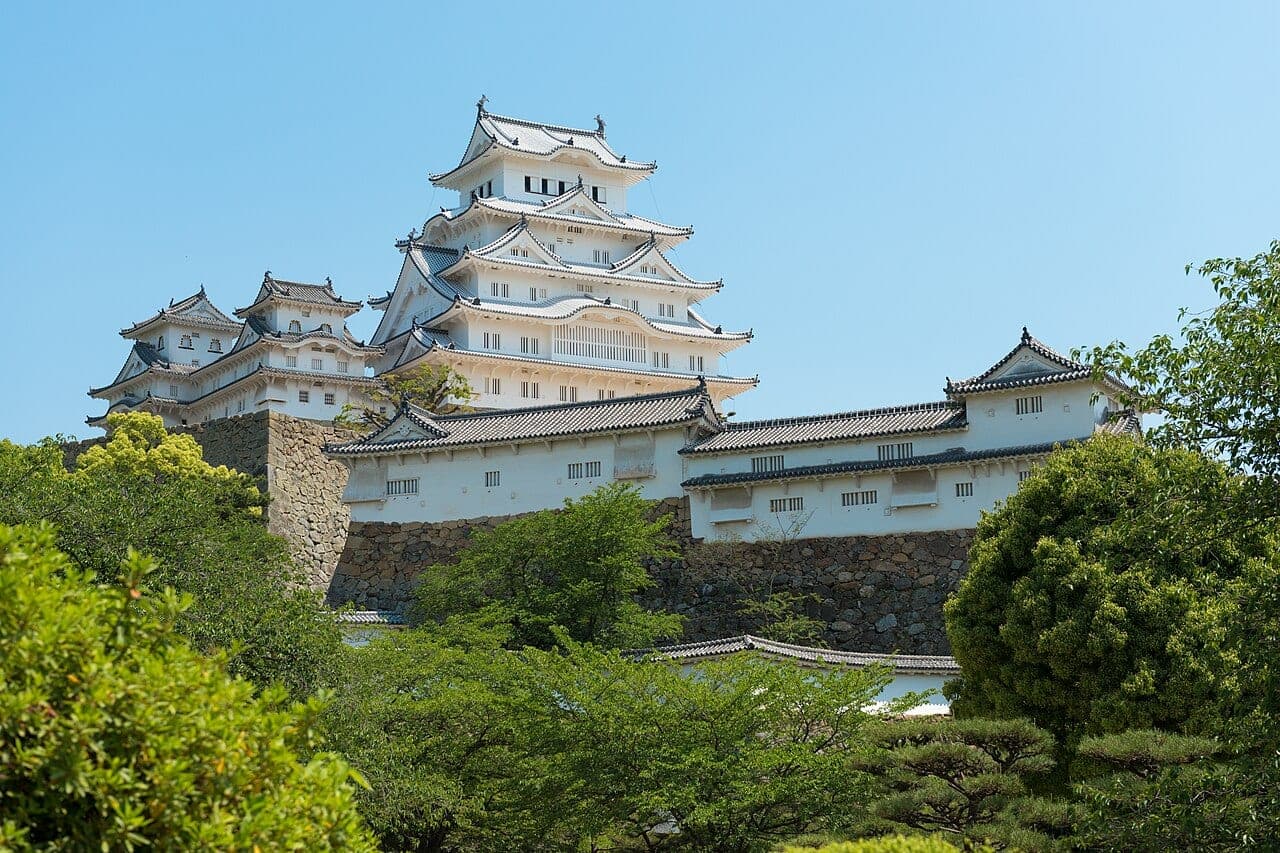
On a low hill above the city of Himeji, in Hyogo Prefecture in western Japan, a white castle rises in tier upon tier of gables and gleaming plaster. For four centuries it has been called Shirasagi-jo, the White Heron Castle, after the pale bird it seems to imitate as it lifts from the plain. Himeji Castle is the largest and most complete of Japan's surviving feudal fortresses, a complex of eighty-three buildings gathered around a main keep, or tenshu, that measures 46.4 metres from the base of its stone platform to the ridge of its roof (Wikipedia). It is at once a weapon and a work of art, built to withstand a siege and to be looked at with wonder.
What sets Himeji apart is not only its beauty but its survival. Most Japanese castles were lost, to fire, to war, or to the deliberate demolitions of the modern age, and were later rebuilt in concrete. Himeji was never destroyed. Its keep and many of its gates, walls and turrets are the original timber and plaster raised in the early seventeenth century, carried intact through the fall of the samurai order, the bombing of the surrounding city in 1945, and a great earthquake in 1995. In 1993 it became one of the first sites in Japan inscribed on the UNESCO World Heritage List, recognised as the finest surviving example of early seventeenth-century Japanese castle architecture (UNESCO). To walk its winding approach today is to move through rooms that generations of defenders, lords and servants knew, kept whole by an unbroken chain of people who chose to preserve rather than replace.
A fortification has crowned this hill since the fourteenth century. The earliest work is traditionally dated to 1333, when the local lord Akamatsu Norimura raised a fort on Himeyama during a period of civil war, and a fuller castle is recorded on the site by 1346 (Wikipedia). Through the warring-states century that followed, the stronghold passed among competing clans and was steadily enlarged; in the 1580s, under the general Toyotomi Hideyoshi, a three-storey keep was built here as a base for campaigns across western Japan.
The castle took its present form after the decisive Battle of Sekigahara in 1600. As a reward for his support, Tokugawa Ieyasu, soon to be shogun, granted the Himeji domain to his son-in-law Ikeda Terumasa. Between 1601 and 1609 Terumasa demolished the older works and rebuilt the castle on a vast scale, raising the great white keep, its three smaller connected keeps, and the rings of baileys, gates and moats that survive today (Visit Himeji). The project drew on an enormous labour force and consumed the resources of a powerful domain. For the rest of the feudal era Himeji served as the seat of a succession of lordly houses, among them the Honda, Sakakibara and Sakai families, guarding the western approaches to the Tokugawa capital region.
The greatest threat to the castle came not from war but from peace. When the han system of feudal domains was abolished in 1871, in the early years of the Meiji Restoration, castles across Japan lost their purpose and many were pulled down as relics of a discredited past. Himeji was abandoned, and the site was put up for auction; a local resident bought it for the sum of twenty-three yen, meaning to demolish the buildings and clear the land, only to find the cost of destruction too great to bear (Himeji UNESCO Association). Some outer corridors and gates were cleared to make way for army barracks, but the keep was spared, in part through the efforts of an army officer, Colonel Nakamura Shigeto, who argued for its preservation and is remembered by a monument within the grounds (Wikipedia).
Fortune held again during the Second World War. In 1945 the city of Himeji was heavily firebombed and much of it burned, yet the castle came through almost untouched. One incendiary bomb is said to have struck the top floor of the keep and failed to ignite (Wikipedia). The White Heron rose white above the ruins of the town, and in the decades since it has become the emblem of the city that rebuilt itself around it.
The heart of the castle is its main keep, a wooden tower that appears to have five storeys from outside but in fact contains six floors above a stone basement (Wikipedia). It is joined by covered passages to three smaller keeps, forming a connected cluster set on a massive curving stone base. The whole structure is finished in white lime plaster, applied not only to the walls but over the roof tiles and their joints, which both protects the timber from fire and gives the castle the luminous pallor that earned its name.
 The keep looks like five storeys from outside and has seven inside, one of many places where the building is not what it shows you. Photograph by Gilles Desjardins, CC BY-SA 4.0, via Wikimedia Commons.
Inside, the keep is a frame of heavy timber. Two great pillars, one of fir and one of cypress, run almost the full height of the tower and carry its weight, joined to beams and floors by the interlocking mortise-and-tenon joinery of traditional Japanese carpentry rather than by nails (Kajima). The upper floors narrow as they rise, and small windows and racks for muskets and spears show that this was, for all its grace, a fighting platform of last resort.
The true genius of Himeji lies in the ground around the keep. The approach is a deliberate labyrinth. Paths climb through a sequence of baileys, or kuruwa, and pass through gate after gate, doubling back on themselves so that an attacker is forced to circle the keep, exposed at every turn, before reaching the innermost bailey (Visit Himeji). The walls are pierced with hundreds of loopholes, round, triangular and square, for archers and gunners, and with openings through which stones and boiling liquid could be dropped on anyone at the foot of the wall. The plan is so confusing that a visitor without a map can lose the keep from sight even while walking toward it. Of the eighty-three surviving buildings, five are designated National Treasures and dozens more are Important Cultural Properties, together making Himeji the most complete picture we have of how a great Japanese castle actually worked (Wikipedia).
Himeji Castle is a National Treasure of Japan and, since December 1993, a UNESCO World Heritage Site, inscribed among the very first Japanese properties to receive that recognition (UNESCO). UNESCO describes it as a masterpiece of construction in wood and the finest surviving example of early seventeenth-century Japanese castle architecture, valued for the unity of its defensive design and its plastered white beauty.
Its silhouette has made it one of the most filmed buildings in Japan. It appeared as a ninja training school in the James Bond film You Only Live Twice in 1967, and Akira Kurosawa used it in his epics Kagemusha and Ran, where its scale and authenticity substituted for the castles of a vanished age (Wikipedia).
The castle also carries a darker inheritance in folklore. Within the grounds is a stone-rimmed well tied to the ghost story of Okiku, a servant said to have been falsely accused of losing one of ten precious plates and, in some tellings, killed and thrown into the well. Her spirit is imagined rising each night to count the plates, reaching nine and breaking off with a cry. The tale, part of a wider tradition known as Bancho Sarayashiki, is one of Japan's best-known ghost stories, and Okiku's Well remains a stop for visitors who know the legend. Such stories are their own kind of remembrance, keeping the names and griefs of ordinary people attached to a place long after the records of the powerful have faded.
For all its endurance, the castle has survived only through repeated and careful repair. Timber weathers, plaster cracks, and foundations settle, and each generation has had to decide anew that Himeji is worth keeping. The most thorough intervention of the twentieth century was the Showa restoration of 1956 to 1964, when the main keep was completely dismantled and reassembled, its decayed posts and beams replaced with traditional materials so that the tower could stand for another age (Wikipedia).
The most recent work, the Heisei restoration, focused on the surface that gives the castle its name. The keep was closed to visitors and enclosed in scaffolding for roughly five years, in a project costing some 2.3 billion yen. Craftsmen removed, inspected and cleaned more than eighty thousand roof tiles, reusing most and recasting the rest from analyses of the originals, and renewed the exterior lime plaster using recipes traced back through earlier repairs to the Edo period (Kajima). When the work was completed in March 2015 the keep emerged a brilliant white it had not shown in generations, so bright that some observers joked the heron had been freshly bleached. The castle had earlier come through the Great Hanshin earthquake of 1995 with only minor damage, a further proof of the resilience built into its timber frame.
Himeji Castle sits at the head of the main avenue leading north from Himeji Station, about a kilometre away, and is easily reached on foot; the station lies on the Sanyo Shinkansen line, less than an hour from Osaka and Kobe, which makes the castle a common day trip from the region's larger cities (JNTO). The white keep is visible from the station forecourt, drawing visitors up the straight approach toward the gates.
The castle grounds are open daily, with seasonal hours that shorten in winter and extend in the busier months, and the keep can grow very crowded in early spring, when the cherry trees within the walls blossom and the pale tower rises behind them. A single ticket admits visitors to the castle, and a combined ticket adds the neighbouring Koko-en, a set of Edo-style gardens laid out on the former samurai quarters beside the western moat. Climbing the keep involves steep wooden stairs and the removal of shoes, and the interior is deliberately spare, so that the experience is less a museum visit than a passage through the working spaces of a fortress. Because opening times, ticket prices and any restoration closures change from season to season, it is worth checking the official city and tourism sites before a visit (Visit Himeji).
The keep looks like five storeys from outside and has seven inside, one of many places where the building is not what it shows you. Photograph by Gilles Desjardins, CC BY-SA 4.0, via Wikimedia Commons.
Inside, the keep is a frame of heavy timber. Two great pillars, one of fir and one of cypress, run almost the full height of the tower and carry its weight, joined to beams and floors by the interlocking mortise-and-tenon joinery of traditional Japanese carpentry rather than by nails (Kajima). The upper floors narrow as they rise, and small windows and racks for muskets and spears show that this was, for all its grace, a fighting platform of last resort.
The true genius of Himeji lies in the ground around the keep. The approach is a deliberate labyrinth. Paths climb through a sequence of baileys, or kuruwa, and pass through gate after gate, doubling back on themselves so that an attacker is forced to circle the keep, exposed at every turn, before reaching the innermost bailey (Visit Himeji). The walls are pierced with hundreds of loopholes, round, triangular and square, for archers and gunners, and with openings through which stones and boiling liquid could be dropped on anyone at the foot of the wall. The plan is so confusing that a visitor without a map can lose the keep from sight even while walking toward it. Of the eighty-three surviving buildings, five are designated National Treasures and dozens more are Important Cultural Properties, together making Himeji the most complete picture we have of how a great Japanese castle actually worked (Wikipedia).
Himeji Castle is a National Treasure of Japan and, since December 1993, a UNESCO World Heritage Site, inscribed among the very first Japanese properties to receive that recognition (UNESCO). UNESCO describes it as a masterpiece of construction in wood and the finest surviving example of early seventeenth-century Japanese castle architecture, valued for the unity of its defensive design and its plastered white beauty.
Its silhouette has made it one of the most filmed buildings in Japan. It appeared as a ninja training school in the James Bond film You Only Live Twice in 1967, and Akira Kurosawa used it in his epics Kagemusha and Ran, where its scale and authenticity substituted for the castles of a vanished age (Wikipedia).
The castle also carries a darker inheritance in folklore. Within the grounds is a stone-rimmed well tied to the ghost story of Okiku, a servant said to have been falsely accused of losing one of ten precious plates and, in some tellings, killed and thrown into the well. Her spirit is imagined rising each night to count the plates, reaching nine and breaking off with a cry. The tale, part of a wider tradition known as Bancho Sarayashiki, is one of Japan's best-known ghost stories, and Okiku's Well remains a stop for visitors who know the legend. Such stories are their own kind of remembrance, keeping the names and griefs of ordinary people attached to a place long after the records of the powerful have faded.
For all its endurance, the castle has survived only through repeated and careful repair. Timber weathers, plaster cracks, and foundations settle, and each generation has had to decide anew that Himeji is worth keeping. The most thorough intervention of the twentieth century was the Showa restoration of 1956 to 1964, when the main keep was completely dismantled and reassembled, its decayed posts and beams replaced with traditional materials so that the tower could stand for another age (Wikipedia).
The most recent work, the Heisei restoration, focused on the surface that gives the castle its name. The keep was closed to visitors and enclosed in scaffolding for roughly five years, in a project costing some 2.3 billion yen. Craftsmen removed, inspected and cleaned more than eighty thousand roof tiles, reusing most and recasting the rest from analyses of the originals, and renewed the exterior lime plaster using recipes traced back through earlier repairs to the Edo period (Kajima). When the work was completed in March 2015 the keep emerged a brilliant white it had not shown in generations, so bright that some observers joked the heron had been freshly bleached. The castle had earlier come through the Great Hanshin earthquake of 1995 with only minor damage, a further proof of the resilience built into its timber frame.
Himeji Castle sits at the head of the main avenue leading north from Himeji Station, about a kilometre away, and is easily reached on foot; the station lies on the Sanyo Shinkansen line, less than an hour from Osaka and Kobe, which makes the castle a common day trip from the region's larger cities (JNTO). The white keep is visible from the station forecourt, drawing visitors up the straight approach toward the gates.
The castle grounds are open daily, with seasonal hours that shorten in winter and extend in the busier months, and the keep can grow very crowded in early spring, when the cherry trees within the walls blossom and the pale tower rises behind them. A single ticket admits visitors to the castle, and a combined ticket adds the neighbouring Koko-en, a set of Edo-style gardens laid out on the former samurai quarters beside the western moat. Climbing the keep involves steep wooden stairs and the removal of shoes, and the interior is deliberately spare, so that the experience is less a museum visit than a passage through the working spaces of a fortress. Because opening times, ticket prices and any restoration closures change from season to season, it is worth checking the official city and tourism sites before a visit (Visit Himeji).
History
Architecture and defenses
Cultural significance
Preservation
Visiting
References and resources
- UNESCO World Heritage: Himeji-jo: the World Heritage inscription, criteria and official description.
- Wikipedia: Himeji Castle: history, architecture, dimensions and preservation.
- Visit Himeji official travel guide: Himeji Castle: visitor information, layout and history from the city's tourism office.
- Japan National Tourism Organization: Himeji-jo Castle: access, overview and travel guidance.
- Kajima Corporation: National Treasure Himeji Castle Main Keep: the Heisei restoration, roof tiles and plaster work.
- Himeji UNESCO Association: The Auctioning of Himeji Castle: the Meiji-era auction and the castle's near demolition.