Heritage · Landmark
Hattusa: the fire that saved a lost empire
A ridge in central Anatolia carries kilometres of wall, five carved gates and the foundations of a Bronze Age capital that governed from the Anatolian plateau to northern Syria. The Hittites who built it were forgotten so completely that they survived only as a name in other people's books, until excavators opened their archive and found tens of thousands of clay tablets baked hard by the fire that destroyed the city.Written to last.
By Confinity Heritage Editorial · 2026-08-25 · 7-minute readQuiet tools, kept out of the way.
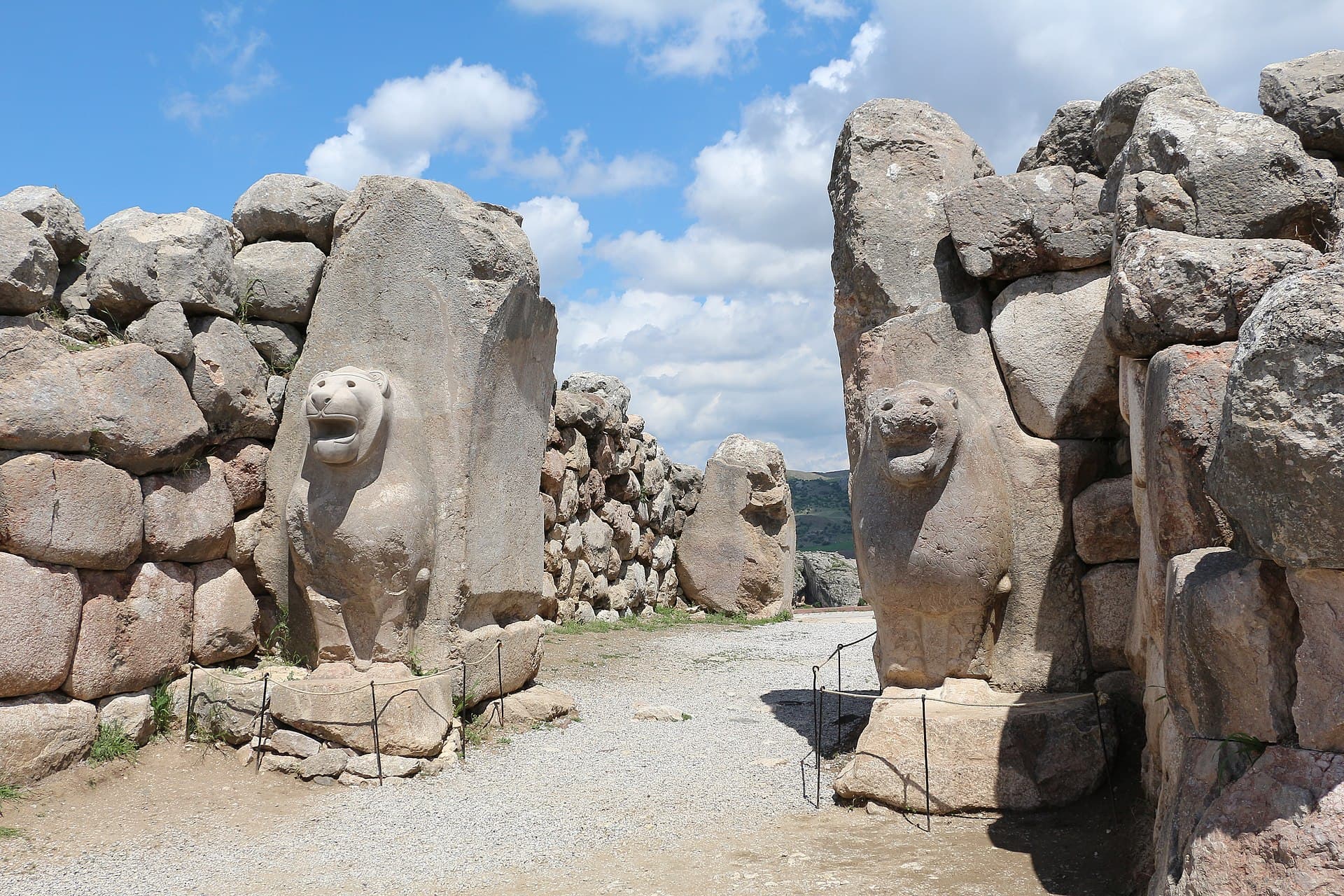
On a slope above the Budaközü plain in central Turkey, near the village of Boğazkale in Çorum province, a wall runs for kilometres along the tops of the ridges. Inside it lie the foundations of temples, a royal citadel, grain pits, and five monumental gates cut with lions and sphinxes. This was Hattusa, capital of the Hittite empire, inscribed by UNESCO in 1986 as a site that gives a comprehensive picture of a Hittite capital.
The Hittites held Anatolia and northern Syria for four centuries and fought Egypt to a standstill. Then they came apart so completely that for three thousand years they survived as a name in other people's books: the children of Heth in Genesis, Uriah the Hittite in the books of Samuel, the Kheta of the pharaohs' battle inscriptions. What brought them back was not the architecture. It was the filing.
The site climbs about 300 metres from the valley floor, split by a creek into a lower city to the north and an upper city on the high ground to the south. An enclosure wall more than eight kilometres long rings the whole of it, the upper city's defences doubled and carrying over a hundred towers, all of it on stone socles that once bore timber framing and mudbrick. Nothing above the stone survives, because mudbrick does not.
Five gates are known. The most famous is the Lion Gate in the south-west, where two lions carved half in the round flank a parabolic opening, shoulders and open mouths still sharp. The Sphinx Gate crowns the highest and southernmost point of the circuit, on an artificial rampart called Yerkapı, the gate in the ground, whose paved slope rises some 30 metres and reads from the plain as a truncated pyramid.
Beneath it runs the postern that gives the rampart its name, a corbelled tunnel 71 metres long, its floor laid with white plaster so that what little light entered carried down its length. Nobody has settled what it was for; it is too conspicuous to be a sally port, and excavators since Peter Neve have read the rampart as a stage for ceremony rather than defence. In 2022 a member of the dig noticed hieroglyphs painted in red-brown on the tunnel stones: 249 signs, mostly names of people and gods, now being read by philologists including Metin Alparslan of the Hittitology department at Istanbul University.
In the lower city stands the best preserved Hittite temple known. UNESCO dates the standing remains of the Great Temple to the thirteenth century BC, though recent work puts its foundation far earlier. The building measures roughly 65 by 42 metres and is wrapped on every side by 82 long magazine rooms, the whole covering some 14,500 square metres. Two sanctuaries at the north end were almost certainly for the chief deities of the state, the storm god of Hatti and the sun goddess of Arinna.
The upper city held dozens of smaller temples. Hittite texts speak of the thousand gods of the land of Hatti, and they meant it as an inventory: when the Hittites took a city they carried its gods home, images included, and added them to the roll.
Beyond the walls, rock outcrops open into two roofless chambers carved with the richest surviving group of Hittite sculpture. Chamber A holds a procession of 64 deities: male figures in kilts and horned caps along the left wall, female figures in crowns and long skirts along the right, converging on the storm god Teshub and the sun goddess Hebat. The one crossover is Shaushka, goddess of love and of war, who walks with the men. Chamber B is smaller, with fewer reliefs but better ones: twelve running gods of the underworld, and the great king Tudhaliya IV held under the arm of the god Sharruma. It may have served as his memorial, and most of the carving belongs to the late thirteenth century BC.
Charles Texier drew the ruins in 1834 without knowing whose they were. Hugo Winckler, a Berlin Assyriologist working with Theodore Makridi of the imperial museum in Istanbul, began digging the royal citadel of Büyükkale in 1906 and lifted 2,500 tablet fragments in the first season. A handful were in Akkadian, which he could read, and they named the place. By 1912 the count was near ten thousand, and thousands more came from the magazines beside the Great Temple. The total is now usually given as around 30,000 tablets and fragments; UNESCO put the Boğazköy tablets on its Memory of the World Register in 2001.
Almost everything known about the Hittites comes from that one recovery: royal annals, treaties, land grants, letters between courts, oracle reports, festival scripts, a law code that fined where its neighbours mutilated. There is no independent tradition to check it against, because there is no other archive.
And it survives because the clay was never fired on purpose. Air-dried tablets soften and dissolve; these were baked hard by the fires that consumed the buildings holding them. The catastrophe was the preservative. The city burned, and that is why it can be read.
Set that against Mohenjo-daro on the Indus, a city of comparable ambition that left thousands of inscribed seals nobody has been able to decipher. Its people are anonymous: no king's name, no god's name, not one sentence. Hattusa left a script scholars could already sound out and a language nobody knew, which turned out to be the difference between silence and an empire.
Cracking it fell to Bedřich Hrozný, a Czech orientalist born in 1879 and trained in Vienna. He went to Istanbul before the war to copy the tablets, was conscripted into the Austro-Hungarian army, and worked the texts in the hours a clerk's posting left him. He fixed on a line reading nu NINDA-an ezzatteni watar-ma ekutteni. NINDA was a known Sumerian sign for bread; the word attached to it resembled Latin edere and English eat, and watar looked like water. The line came out as "now you will eat bread and drink water", and with it the discovery that Hittite belonged to the Indo-European family. He announced the result in 1915 and published a grammar in 1917. Hittite proved to be the oldest attested member of the family, earlier in the record than Sanskrit or Greek.
Among the first tablets Winckler opened was one carrying, in Akkadian, a peace settlement between Hattusili III of Hatti and Ramesses II of Egypt. He recognised it at once: the Egyptian version had been legible on temple walls at Karnak and the Ramesseum since Champollion.
The agreement was reached around 1259 BC, some fifteen years after the two armies fought to a draw at Kadesh on the Orontes. It ends hostilities, promises mutual aid against attack or revolt, provides for the return of fugitives, and calls the gods of both lands to witness. It is the oldest surviving peace treaty, and the only one from the ancient Near East with a version preserved on each side. The two largely agree; where they part is posture. The Egyptian text says plainly that the states had been at war, while the Hittite one implies the gods had never permitted hostility between them. Both descend from silver tablets exchanged between the courts, and both originals are lost.
The Hittite copies are in Istanbul and Berlin. In 1970 Turkey gave the United Nations a copper relief reproduction by the sculptor Sadi Çalık, accepted by Secretary-General U Thant. It hangs in a delegates' corridor near the entrance to the Security Council chamber.
Around 1200 BC the Hittite state came apart, in the same decades that brought down Mycenae and Ugarit. Hattusa went with it, and the obvious story is a sack: there are burnt layers to hang it on.
The excavations complicate it. Fire damage shows up all over the site, but the rooms had been cleared first: valuables and cult images are absent rather than smashed in place, and the burning cannot be shown to have happened at once. The reading now favoured is that the court and the administration withdrew in an orderly way over some years, and that the fires came afterwards, to a city already mostly empty.
Why they left is unresolved: internal conflict, the failure of the trade that fed the state, and pressure from the Kaska to the north all appear in the arguments. In 2023 a study of tree rings from an Anatolian burial mound found three consecutive years of severe drought around 1198 to 1196 BC, lining up with the end of the empire.
Between 2003 and 2005 the German Archaeological Institute rebuilt a 65-metre length of the lower city fortification: three stretches of wall seven to eight metres high and two towers of twelve to thirteen. The team made 64,000 mudbricks by hand from 2,700 tonnes of clay soil and 100 tonnes of straw, at a size copied from surviving bricks, and took the shape of the parapets from clay models of city walls that Hittite potters had applied to the rims of cult vases. Twenty-seven workers spent eleven months on it, with machines doing the hauling. Jürgen Seeher, who ran the project, reckoned the Hittites would have needed roughly a thousand people to raise a kilometre of wall in a year, much of it probably captive labour brought home from campaign.
The rebuilt stretch doubles as an experiment in weather: its plaster washes off in the rain and has to be renewed, which is why nothing of the Bronze Age wall stands above its stone footings. What lasted at Hattusa was not what the Hittites built to last. The gates were quarried, the mudbrick went back to earth, the palaces burned. What came through was the clay they wrote on and stacked in a store room, hardened by the disaster that ended them. An empire kept its records, lost everything else, and was handed back three thousand years later by its own scribes.
Walls, gates, and the tunnel under Yerkapı
The Great Temple and the thousand gods of Hatti
The gods in procession at Yazılıkaya
The archives, and the fire that preserved them
A treaty on two walls and a copy at the United Nations
How the city ended
The wall built twice
References and resources
- UNESCO World Heritage Centre. "Hattusha: the Hittite Capital." World Heritage List, property no. 377, inscribed 1986.
- United Nations Gifts. "Replica of Peace Treaty between Hattusilis and Ramses II." Gift of Turkey, 1970.
- Manning, S. W., et al. "Severe multi-year drought coincident with Hittite collapse." Nature 614 (2023).
- Falvey, Christian. "Bedřich Hrozný, re-discoverer of the Hittite language." Radio Prague International, 2009.
- Seeher, Jürgen. Die Lehmziegel-Stadtmauer von Hattusa. Istanbul, 2007.
- Wikipedia. "Hattusa," "Yazılıkaya," "Egyptian-Hittite peace treaty" and "Bedřich Hrozný." Retrieved 2026.