Heritage · Landmark
Meroe: the pyramid fields of the kingdom of Kush
On low hills above the Nile north of Khartoum stand the royal cemeteries of Meroe, capital of the kingdom of Kush. Sudan holds more ancient pyramids than Egypt does, built steeper, smaller and hollow underneath, each with a chapel on its eastern face. Almost every summit is missing, and the reason has a name and a date.Written to last.
By Confinity Heritage Editorial · 2026-08-25 · 7-minute readQuiet tools, kept out of the way.
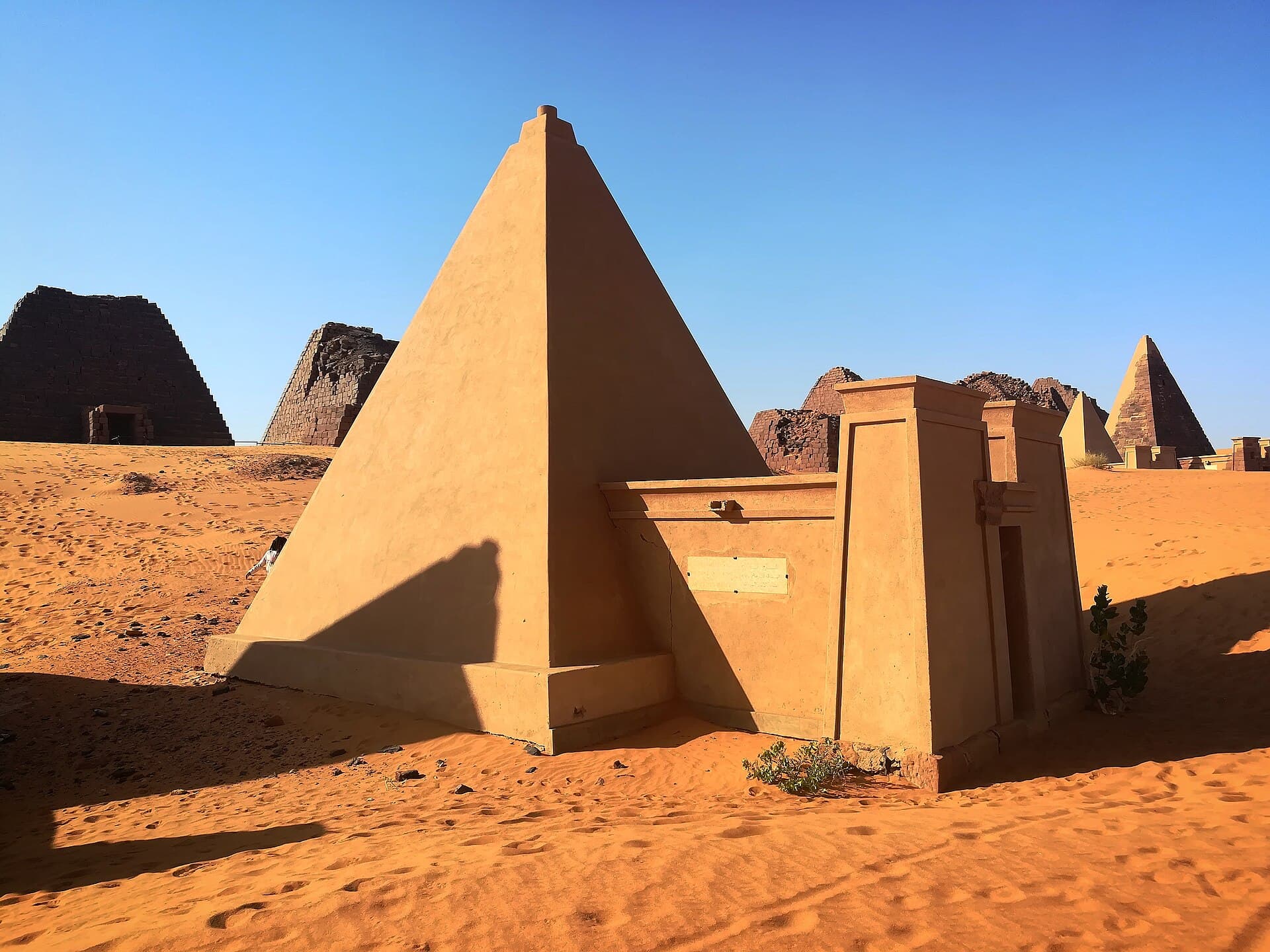
About two hundred kilometres north east of Khartoum, on low hills above the Nile, a field of small steep pyramids stands in orange sand. This is Begrawiya, the royal cemetery of Meroe, southern capital of the kingdom of Kush and for more than six centuries the burial ground of its kings and queens. Sudan holds more ancient pyramids than Egypt does, and the largest concentration is here.
The first thing a visitor sees is not the pyramids but their tops. Row after row ends in a flat broken stump. A few have been restored, smooth faced with their chapels rebuilt, and they stand among the ruined ones like corrected lines on a damaged page. The damage was not the work of time. Most of it was done in one season in 1834 by an Italian army surgeon with a licence to dig.
Kush was a power on the middle Nile from about the eighth century BC to the fourth century AD, and for roughly a century its kings ruled Egypt as the Twenty-fifth Dynasty. Its first capital was Napata, near Jebel Barkal. After an Egyptian army under Psamtik II sacked Napata in 593 BC the kingdom's weight shifted upstream to Meroe, in the semi desert between the Nile and the Atbara that classical geographers called the Island of Meroe. Royal burials followed by about 300 BC.
The move made economic sense. Meroe sat on the fringe of the summer rainfall belt, on ground rich in iron ore and the hardwood needed to smelt it, within reach of caravan routes running east to the Red Sea. UNESCO inscribed it with the nearby religious centres of Naqa and Musawwarat es Sufra on the World Heritage List in 2011.
Kushite rulers built roughly 255 pyramids, more than twice the number raised in Egypt. Meroe has three cemeteries, north, south and west, over about a quarter of a square kilometre, holding over a thousand graves, at least 147 of which carried pyramids. Counts approaching two hundred are common in print, because ruined and unexcavated superstructures are hard to tally.
Nothing here approaches the Pyramids of Giza in bulk. A Meroitic pyramid stands between about ten and thirty metres, built of stepped courses of horizontally laid sandstone on a small footprint, its faces rising at around seventy degrees. An Egyptian pyramid of similar height sat on a base at least five times wider and leaned back at forty to fifty degrees. Most were left stepped rather than dressed smooth, and end in a slight flattening rather than a point.
Two features matter more than the silhouette. The first is the chapel: a small offering temple against the eastern face, entered through a pylon and carved inside with the dead ruler among the gods. The second is that the tomb is not in the pyramid. The chambers were cut into rock beneath, reached by a stair in front of the chapel that was filled in and hidden after the funeral, so the pyramid works as a marker rather than a container.
By the time the Kushites revived the pyramid, Egypt had not raised one over a pharaoh in more than seven centuries; its New Kingdom rulers lay in the rock cut corridors of the Valley of the Kings. The Kushites were not copying a living fashion. They took up a discontinued one and rebuilt it to their own proportions.
Heaps of slag still lie around the town site. Archibald Sayce called Meroe the Birmingham of Africa, a phrase specialists now treat with caution, since the slag has never been shown to represent output on that scale. What is not in question is that Meroitic smiths worked iron well and the kingdom traded hard: ivory, ebony, gold, copper, rare skins, ostrich feathers, cotton and jewellery went out, and Hellenistic bronze vessels, glass and wine amphorae came back as grave goods under the pyramids.
Meroitic had a word, written kdke, for a queen or queen mother. Greek and Roman writers heard it as Kandake and Latinised it as Candace, taking the title for a personal name; it reached the New Testament that way, in the Acts of the Apostles, as Candace queen of the Ethiopians. The title is attested for six or seven women, and one who ruled in her own right also carried qore, the same word a king used.
One of them fought Rome. In 25 BC Kushite forces crossed into Roman Egypt while the prefect was away in Arabia and took Syene, Elephantine and Philae. Strabo describes their queen as blind in one eye; she is generally identified with Amanirenas. The war ran three years and ended in a settlement that left Kush independent. Among the things carried home was a larger than life bronze head of Augustus, which the Kushites buried beneath a temple staircase at Meroe so that anyone entering trod on the emperor's face. It was dug out in December 1910 and is in the British Museum.
The kandake who matters most here is Amanishakheto, who ruled in the early first century AD. Her pyramid, N6, was the tallest in the north cemetery at about twenty eight metres.
Giuseppe Ferlini was a doctor from Bologna who joined the Egyptian army during its conquest of Sudan and rose to surgeon major. In 1833 he obtained permission from the governor general in Khartoum to excavate, and left for Meroe in August 1834. Frederic Cailliaud had drawn the pyramids in good condition in 1821, so there is a record of what Ferlini found.
He started on small pyramids and got nothing. Then he turned to N6 and took it down from the top, using explosives. A little below the apex he broke into a sealed chamber holding the jewellery of Amanishakheto: ten bracelets, nine shield rings, sixty seven signet rings and a mass of amulets in gold and silver, untouched since the burial, in a cemetery robbed out in antiquity.
How much he destroyed is not settled. His own catalogue, published in Bologna in 1837 and in French the year after, describes dismantling five, possibly six, pyramids stone by stone. Later writers put the figure above forty, and that is the number usually repeated. His own account is the main source for what he did with his own hands, which is why the count is uncertain, and when Karl Richard Lepsius reached Meroe in April 1844 he found news of the discovery still current locally, other pyramids opened in imitation, and an Egyptian commander at the site with five thousand men and orders to pull them apart for gold.
In Europe almost nobody would buy the jewellery. The British Museum looked and declined, some of its experts having concluded that goldwork of that quality could not have been made in sub Saharan Africa. It sold in Germany in the end, part to Ludwig I of Bavaria and the rest to Berlin on the advice of Lepsius and Christian von Bunsen. It is in Munich and Berlin still.
UNESCO's assessment of the property records no intervention as damaging to the integrity of the Meroe cemeteries since Ferlini's treasure hunting in the 1830s. The damage is still the first thing anyone sees. The loss is larger than the summits, though. A pyramid here is a marker over a sealed stair, with a chapel naming its owner on the eastern side; where an object sat, and what lay beside it, is what tells you whose tomb it is. Ferlini kept the gold and threw the arrangement away. That is the difference between treasure and evidence. Treasure is worth what it weighs. Evidence is worth where it was found.
The Kushites wrote. From the third century BC they used two scripts of their own, a cursive derived from Egyptian demotic and a monumental set adapted from Egyptian hieroglyphs, with twenty three characters including four vowels. In 1909 the British Egyptologist Francis Llewellyn Griffith worked out the sound values by comparing Meroitic spellings of Egyptian names against the originals.
That solved the writing and left the language. Meroitic still cannot be translated with confidence: there is no long bilingual text to work from, and the surviving corpus is mostly funerary formulae and short inscriptions. Specialists disagree even about its family, Claude Rilly arguing from word order and morphology that it is Eastern Sudanic and related to Nubian, others for an Afroasiatic connection. So a visitor can stand at an offering table, pronounce every syllable, recognise the name of the dead and the titles qore and kandake, and still not know what the sentence around them says. It is the position of someone who can read the name on a headstone but not the line beneath it.
Meroe's troubles predate the fighting. The Khartoum to Port Sudan highway runs between the town site and the cemeteries with a high voltage line beside it, and floodwater reached the pyramids for the first time in September 2020.
Since April 2023, when war broke out between the Sudanese army and the Rapid Support Forces, the record has been consistent. UNESCO said in September 2024 that it was deeply concerned by reports of looting and damage at Sudanese museums including the National Museum in Khartoum, and that it had assessed risk and damage at the Meroe and Jebel Barkal World Heritage properties. Reporting that month described site maintenance and monitoring at Meroe as almost entirely absent, with unauthorised building in the buffer zone and the nearby temple site of Naqa ringed by landmines.
By August 2026, with the war into its fourth year, conservation work had stopped altogether. Foreign missions have gone and Sudanese archaeologists are dispersed. Sand is piling into the chapels, vegetation is taking hold, salt is working at the sandstone and blocks are coming loose. UNESCO's count by then was more than a hundred sites damaged and at least twenty two museums looted or destroyed.
The pyramids at Meroe were built to keep names: each carries a chapel naming its owner in a script we can sound out, over a chamber we can no longer reconstruct, under a summit a man with a permit removed in one season. What is left is a field of markers for a kingdom that held a thousand kilometres of river, smelted its own iron, was ruled at times by women whose title outlived their language, and wrote a record that stops just short of speaking. Those looking after it now do so in the hardest conditions the site has known.
The capital that moved south
Steeper, smaller, and hollow underneath
Iron, ivory and the road to the Red Sea
The kandakes
Giuseppe Ferlini and the difference between treasure and evidence
An alphabet you can read and a language you cannot
Sand, war, and a site left alone
References and resources
- UNESCO World Heritage Centre. "Archaeological Sites of the Island of Meroe." World Heritage List, property no. 1336, inscribed 2011. whc.unesco.org/en/list/1336.
- UNESCO. "Sudan: UNESCO raises the alarm on reports of illicit trafficking of cultural heritage." 12 September 2024. unesco.org.
- The Art Newspaper. "Sudan's cultural heritage is threatened to an 'unprecedented level', Unesco says." 27 September 2024. theartnewspaper.com.
- Al Jazeera. "Sudan war threatens ancient Meroe pyramids, a UNESCO Heritage Site." 6 August 2026. aljazeera.com.
- British Museum. Bronze head of Augustus from Meroe, 1911,0901.1. britishmuseum.org.
- Ferlini, Giuseppe. Cenno sugli scavi operati nella Nubia e catalogo degli oggetti ritrovati. Bologna, 1837; French edition, Rome, 1838.
- Markowitz, Yvonne, and Peter Lacovara. "The Ferlini Treasure in Archaeological Perspective." Journal of the American Research Center in Egypt 33 (1996).
- Rilly, Claude, and Alex de Voogt. The Meroitic Language and Writing System. Cambridge University Press, 2012.
- Wikipedia. "Meroe," "Pyramids of Meroe," "Nubian pyramids," "Giuseppe Ferlini," "Amanishakheto," "Kandake," "Meroitic script" and "Meroe Head." Retrieved 2026.