Heritage · Landmark
Mesa Verde: the cliff dwellings of the Ancestral Puebloans
In the sandstone alcoves of a green tableland in southwestern Colorado, the Ancestral Puebloans built more than 600 cliff dwellings, lived in them for roughly a century, and then walked away south. Their descendants in the Hopi, Zuni, Acoma, and Rio Grande pueblos never stopped calling these rooms home, even as newcomers spent a hundred years calling them a mystery.Written to last.
By Confinity Heritage Editorial · 2026-08-23 · 7-minute readQuiet tools, kept out of the way.
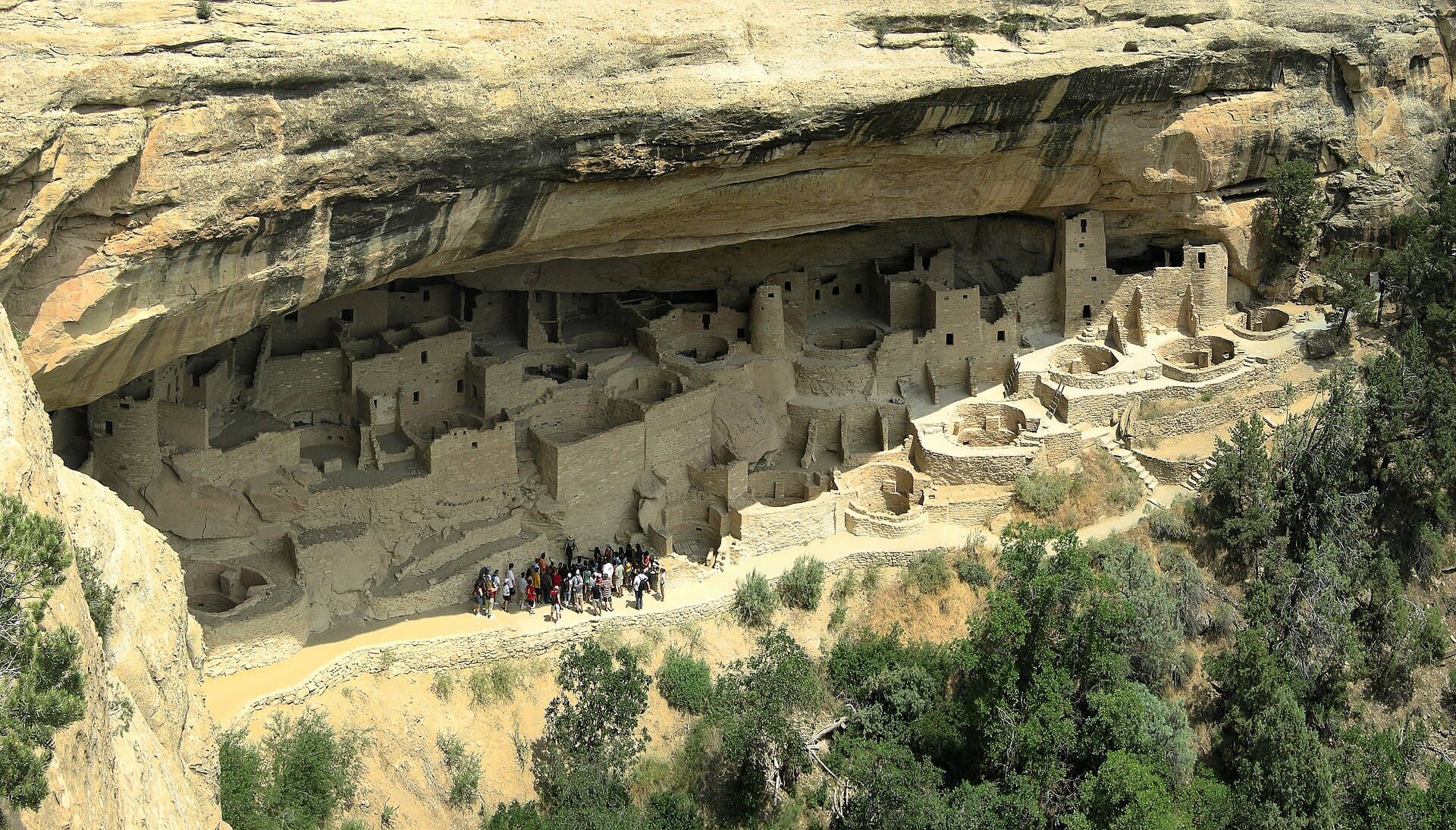
In the far southwestern corner of Colorado, in the United States, a great tableland rises above the surrounding canyon country, its top dark with pinyon and juniper. Spanish travelers called it Mesa Verde, the green table. Cut into the sandstone walls of its canyons are natural alcoves, and inside those alcoves stand villages of shaped stone: towers, plazas, storage rooms, and round ceremonial chambers. The people who built them are known today as the Ancestral Puebloans. An older label, Anasazi, has largely been retired: it is a word from the Navajo language, an exonym often translated as "ancient enemies," not a name the builders' descendants use for their own ancestors. The park protects nearly 5,000 known archaeological sites, more than 600 of them cliff dwellings, the densest concentration of such architecture anywhere in North America.
For most of the twentieth century the standard story of Mesa Verde was a mystery tale. A civilization builds castles in the cliffs, then vanishes without explanation, leaving jars on the shelves and ladders against the walls. It made for good copy and bad history. The people of Mesa Verde did not vanish. They moved, deliberately and in stages, and their descendants live today in the Hopi villages, at Zuni and Acoma, and in the pueblos along the Rio Grande. Those communities kept oral traditions that name these canyons as ancestral homes their people never ceased to hold in memory. The real story of Mesa Verde is not a disappearance. It is a migration remembered on one side and misread, for about a century, on the other.
The cliff dwellings are the famous chapter, but they are the last chapter of a long book. People began farming the mesa tops around 550 AD, drawn by relatively deep soils and dependable rain. These early families, whom archaeologists call Basketmakers for their extraordinary woven work, lived in pithouses, rooms dug partly into the earth and roofed with timber and mud, clustered into small villages on the mesa top. They grew maize, squash, and later beans, kept domesticated turkeys, and hunted with the bow.
By about 750 the pithouse villages were giving way to something new: rooms of posts and mud, then of coursed stone masonry, built above ground and joined wall to wall in long arcs. These are the first pueblos, a Spanish word for village that has come to name both the architecture and the peoples. Over the next four centuries the masonry grew more assured; by the 1100s the people of Mesa Verde were raising multi-storey stone buildings, terracing fields, and storing water behind check dams and in built reservoirs. Through all of it, one habit held: the round, sunken ceremonial room stayed at the heart of every settlement, a memory of the ancient pithouse carried forward in sacred form.
Then, in the space of a generation or two, the whole society changed its address. Beginning in the 1190s and through the early 1200s, families moved off the mesa tops and into the alcoves beneath the canyon rims, building villages in spaces mostly used until then for storage. Nobody recorded why. The alcoves offered shelter, defensible positions, and seep springs at the back of the rock, and the move came in decades that were growing drier and more crowded. What is certain is the speed: within a couple of generations, hundreds of cliff dwellings existed where almost none had been.
Most were small, a few rooms tucked into a crevice, homes for a single family. A handful were something else entirely. Cliff Palace, built and rebuilt through the 1200s beneath an immense arching alcove, holds about 150 rooms and some 23 kivas, and is the largest cliff dwelling in North America. Perhaps a hundred or more people lived there, though its unusual concentration of ceremonial rooms suggests it was more than housing, a civic and ritual center for the villages around it. Nearby stand Balcony House, still reached by ladders and a tunnel, Spruce Tree House, the best preserved of them all, and Long House, nearly as large as Cliff Palace. The masonry is careful and human: sooted ceilings, painted plaster, and fingermarks pressed into mortar seven and a half centuries ago.
The kiva is the key to reading these villages. A kiva is a round chamber, usually sunk into the ground or the alcove floor, entered by ladder through a hatch in its flat timber roof, which doubled as a small plaza. Inside, the furnishings follow a pattern repeated across the region: a central fire pit, a ventilator shaft and deflector stone to draw fresh air, an encircling bench, and a small hole in the floor called a sipapu, understood by Pueblo peoples as a symbol of the place where humans emerged into this world. Kivas were gathering rooms, weaving rooms in winter, and above all ceremonial rooms, where the ritual life that bound families into a community was carried on.
They are also the plainest evidence of continuity. Kivas remain at the center of Pueblo religious life today, in living villages far to the south, and their descent from the chambers in the alcoves is direct. The ceremonies did not end when the alcoves emptied. They traveled.
The departure can be dated with unusual confidence because dry air preserved the roof beams, and tree rings do not lie. Dendrochronology, a science built partly on Mesa Verde timber, shows construction slowing after mid-century and a megadrought gripping the region from 1276 to 1299, the span called the Great Drought. Two dry decades landed on a society already pressing its limits: soils and forests worn down by centuries of use, game depleted, and evidence of conflict in a region pulling back to defensible ground. Household by household, people weighed the future and chose to leave. By about 1300 the mesa was silent.
But leaving is not vanishing, and here the oral traditions carry what tree rings cannot. Pueblo accounts remember these migrations as part of a longer purposeful journey, clans moving through a sequence of homes. The people went south and southeast, joined and founded villages among the Hopi mesas, at Zuni, at Acoma, and along the Rio Grande, and wove the cliff villages into clan histories, songs, and pilgrimage. In the Pueblo understanding, the ancestors remain present in these places, which is why many Pueblo people today avoid the word "abandoned" altogether. A house may stand empty and still be spiritually inhabited, still owned in the way that matters.
The written record of the cliff dwellings begins on a December day in 1888, when two ranchers, Richard Wetherill and his brother-in-law Charlie Mason, rode across the mesa top after stray cattle in blowing snow and stopped at a canyon rim. Across the gorge, through the storm, they saw a city in a cave. Wetherill is said to have called it a palace, and Cliff Palace it became. The Wetherills spent the following years exploring, guiding visitors, and selling artifacts, work that made Mesa Verde famous and reads very differently now.
Among the visitors was Gustaf Nordenskiöld, a 22-year-old Swedish-speaking Finnish scholar who arrived in 1891 for his health and stayed to conduct the first systematic excavation and photographic documentation of the dwellings. His 1893 book, The Cliff Dwellers of the Mesa Verde, set a scientific standard. But Nordenskiöld also shipped some 600 artifacts, including human remains, to Scandinavia. Locals had him arrested at Durango, only to discover that no American law forbade what he had done. The collection ended up in the National Museum of Finland, and the outrage over its export became one of the sparks in a long campaign for legal protection. The story found its ending only recently: in 2020, Finland returned the remains of twenty ancestors and their funerary objects to the descendant tribes, who reburied them at Mesa Verde, a landmark repatriation answering a wrong of the 1890s across an ocean and a century.
The protection campaign that followed was led in large part by two Colorado women, Virginia McClurg and Lucy Peabody, and converged with a national movement against the looting of ancient sites across the Southwest. In June 1906 Theodore Roosevelt signed the Antiquities Act, the first general American law protecting archaeological sites, and in the same month he signed the bill creating Mesa Verde National Park, the first national park established to preserve the works of human beings rather than a landscape of scenery. In 1978 UNESCO inscribed Mesa Verde on the World Heritage List among the first twelve properties in the world, alongside Yellowstone the first in the United States.
The park's most important modern change is quieter. Mesa Verde now consults formally with 26 associated tribes on how the sites are studied, interpreted, and cared for, so decisions about excavation, reburial, and what visitors are told involve the people whose ancestors built the rooms. The park describes the dwellings not as ruins of a lost race but as the homes of a living people's ancestors, which is what the Pueblo nations had said all along.
Mesa Verde holds a lesson about who keeps memory. For a century after that snowstorm, newcomers stood in Cliff Palace and asked where the people went, writing books about a vanished race while the answer lived in plain sight in the pueblos to the south. The descendants never lost the thread. Hopi, Zuni, Acoma, and Rio Grande communities carried the alcove villages in clan tradition and ceremony through every year of that supposed mystery, waiting for the rest of the world to catch up. It took the return of ancestors from a museum in Finland, and a seat for 26 tribes in the running of the park, for the official story to align with the remembered one. The dwellings were never abandoned in the way the word implies. The people walked south carrying the memory of home, and memory kept faithfully outlasts even stone. At Mesa Verde the stone survived too, and the two records are finally being read together.
Seven centuries on the green table
The move into the alcoves
Kivas and the shape of belief
The leaving
A snowstorm in 1888
The first park for the works of people
The rooms were never empty
References and resources
- National Park Service. "Mesa Verde National Park, Colorado." nps.gov/meve.
- National Park Service. "Cliff Palace" and "Mesa Verde History and Culture" pages. nps.gov/meve/learn/historyculture.
- UNESCO World Heritage Centre. "Mesa Verde National Park." World Heritage List, property no. 27, inscribed 1978. whc.unesco.org/en/list/27.
- Encyclopaedia Britannica. "Mesa Verde National Park." britannica.com/place/Mesa-Verde-National-Park.
- Nordenskiöld, Gustaf. The Cliff Dwellers of the Mesa Verde. Stockholm, 1893.
- Wikipedia. "Mesa Verde National Park," "Cliff Palace," "Ancestral Puebloans," and "Gustaf Nordenskiöld." Retrieved 2026.