Heritage · Landmark
Ephesus: the harbour city the sea left behind
A marble avenue in western Turkey runs downhill toward a harbour that vanished centuries ago, past a library built as a tomb and a theatre that once seated 24,000. Ephesus held a wonder of the world, a riot recorded in the Bible, and a hundred thousand Romans, and it survives today because the sea that made it rich slowly walked away.Written to last.
By Confinity Heritage Editorial · 2026-08-23 · 7-minute readQuiet tools, kept out of the way.
On the Aegean coast of western Turkey, a short drive from the modern town of Selçuk, a marble street slopes downhill between fallen columns toward a harbour that no longer exists. This is Ephesus, in its day one of the great port cities of the Mediterranean: home of a temple counted among the Seven Wonders of the Ancient World, capital of the Roman province of Asia, a stage for one of the most vivid crowd scenes in the New Testament, and now a UNESCO World Heritage property, inscribed in 2015. Few places on earth let a visitor walk so far through an intact classical city, past its library, its theatre, its fountains, its paving stones.
That completeness is not an accident of care but an accident of catastrophe. The river that fed the harbour also carried silt, and over centuries the sea retreated kilometre by kilometre until the port city stood inland, feverish and poor, and its people drifted away. No later city was ever built on top of the ruins. Ephesus survives because it died, which is only the first of the strange bargains with memory that run through its whole history.
The fame of Ephesus began with its goddess. Artemis of the Ephesians was not the slim huntress of mainland Greece but an older Anatolian mother figure, and her sanctuary on wet ground outside the city walls was destroyed and rebuilt so many times that reconstruction became part of its identity. A flood wrecked an early shrine in the seventh century BC. The version that made the temple famous rose from about 550 BC with the backing of Croesus, the proverbially rich king of Lydia: a forest of marble columns on a platform larger than a football pitch, one of the first monumental Greek temples built of marble at all.
Its successor, raised after a fire in 356 BC, was grander still, and it was this building that the ancient list-makers placed among the Seven Wonders of the Ancient World. Antipater of Sidon, who compiled one of the earliest surviving lists, wrote that beside the temple of Artemis the other wonders lost their brightness. That building stood for six centuries until Gothic raiders sacked it in AD 262, after which its stones were gradually carted off into churches and lime kilns. Today a single re-erected column stands in a marshy field near Selçuk, with storks nesting on top. The wonder itself is gone; what endures is the story of the man who burned it.
On a night in 356 BC, by tradition the very night Alexander the Great was born, a man named Herostratus set fire to the temple of Artemis. Later writers joked that the goddess could not save her own house because she was away attending Alexander's birth. Under interrogation Herostratus confessed his motive without shame: he had burned the most beautiful building in the world so that his name would be remembered.
The Ephesians executed him, and then did something more unusual. They passed what the Romans would later call a damnatio memoriae, a formal condemnation of memory, making it a capital offence even to speak his name. The erasure failed almost immediately. The historian Theopompus recorded the name, later authors repeated it, and the ban itself became the most memorable part of the story: a whole city ordering forgetfulness, and forgetfulness refusing the order. More than two millennia later, "Herostratic fame" is still the term for renown sought through destruction. The people who tried hardest to erase Herostratus are the reason anyone knows him.
The city's own summit came under Rome. When Augustus reorganised the East, Ephesus became the seat of the governor of the province of Asia, and for roughly two centuries it flourished as one of the largest cities of the Roman Mediterranean, with a population plausibly above 100,000. The wealth of that age is what the visitor walks through now: the colonnaded Curetes Street descending between temples and fountains, the Temple of Hadrian with its arched porch, the commercial agora where goods from three continents changed hands, aqueducts, baths, and a grand civic quarter.
The most intimate survivals are the Terrace Houses, a block of wealthy homes built into the slope opposite the library and now protected under a modern roof. Occupied from the first century AD onward, they kept their frescoes of muses and philosophers, their floor mosaics, their marble-panelled dining rooms, and their heated floors, a record of private life to rival Pompeii, preserved not by volcanic ash but by ordinary collapse and burial. Conservators are still piecing their painted walls back together.
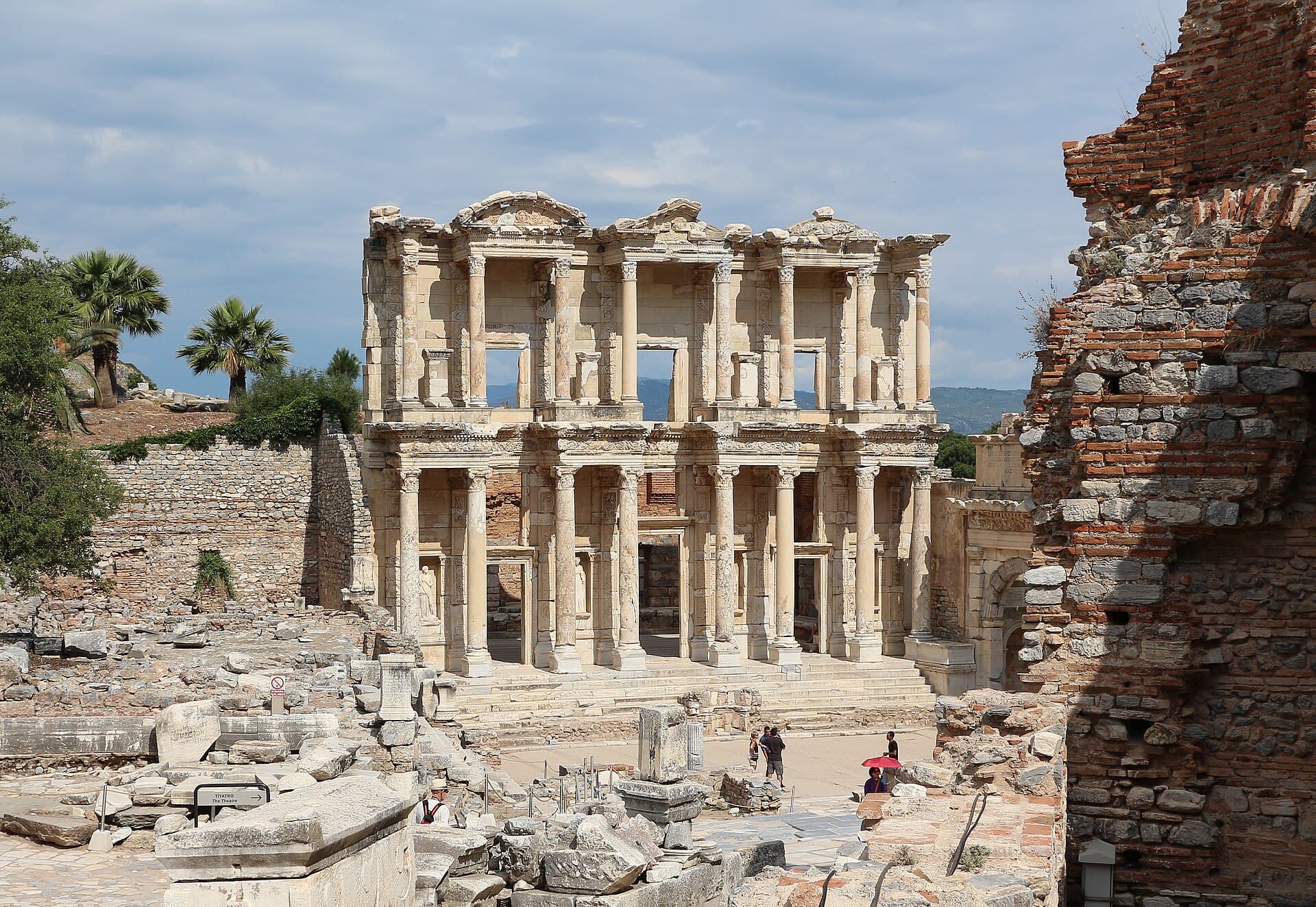
At the foot of Curetes Street stands the building on every photograph, the Library of Celsus. It is a memorial disguised as an institution. Tiberius Julius Celsus Polemaeanus, a Greek from nearby Sardis, rose through the Roman system to become consul in AD 92 and later governor of Asia. When he died, his son Gaius Julius Aquila built a library in his honour, completed around AD 120, with money left for books and upkeep. Its galleried hall held an estimated 12,000 scrolls in wall niches, which would have made it one of the larger libraries of the Roman world after Alexandria and Pergamum.
Beneath the apse, in a vaulted crypt, lies the marble sarcophagus of Celsus himself. Burial inside a city's walls was a rare and jealously guarded honour, and so the consul rests to this day under his own reading room, a man interred inside his monument to learning. The facade preaches the same message: in its niches stand four female figures personifying Sophia, Arete, Ennoia, and Episteme, wisdom, virtue, thought, and knowledge, the virtues the son claimed for the father. The statues there now are copies; the originals were taken to Vienna a century ago. The interior burned in the calamities of AD 262 and the facade later fell in an earthquake, lying in fragments until Austrian archaeologists reassembled it stone by numbered stone between 1970 and 1978, a celebrated act of anastylosis.
Carved into the slope of Panayır Hill, the Great Theatre of Ephesus could seat around 24,000 people, and it earned a permanent place in world literature through a riot. The Acts of the Apostles records that when Paul the Apostle preached in Ephesus in the 50s AD, a silversmith named Demetrius, who made shrines of Artemis, saw the trade in the goddess threatened and whipped up the craftsmen. The crowd surged into this theatre and chanted "Great is Artemis of the Ephesians" for two hours before a city official talked them down. Paul stayed in Ephesus longer than in any other city of his journeys, over two years, and his letter to the Ephesians carries the city's name across every Christian tradition.
The Christian layer of Ephesus kept deepening. Tradition holds that the apostle John settled here and brought Mary, the mother of Jesus, with him; a small stone house on the hill above the ruins, the House of the Virgin Mary, has drawn pilgrims for over a century and has been visited by three popes. In 431 the Council of Ephesus met in the city's Church of Mary and declared her Theotokos, bearer of God, one of the defining decisions of early Christianity, taken in a harbour town built for a very different goddess.
What ended Ephesus was not war but geography. The Küçük Menderes, the river the Greeks called the Kaystros, dropped its silt into the bay year after year. Engineers fought back for centuries, dredging channels and building moles, and at least one well-meant breakwater made the deposition worse. Slowly the harbour became a marsh, the marsh bred malaria, and the sea withdrew until open water lay several kilometres from the quays. Trade found other ports, the Byzantine town contracted to the fortified hill at Ayasuluk, modern Selçuk, and by the later Middle Ages the classical city was empty ground.
That slow strangulation is why Ephesus exists for us. Because no living city sat on the ruins, they waited nearly intact under soil and scrub. The British engineer John Turtle Wood located the buried temple of Artemis in 1869 after six years of searching, and since 1895 the Austrian Archaeological Institute has led excavation and conservation at the city itself, a continuous scholarly commitment now past its 130th year, interrupted only by wars. Even after that long labour, a substantial share of the city is still unexcavated. In 2015 UNESCO inscribed Ephesus on the World Heritage List, citing the rare completeness of its record from Hellenistic streets to Christian councils.
Ephesus is what happens when remembrance refuses to follow instructions. A son built a library so his father would be remembered for wisdom, and the father is remembered mostly because tourists photograph his facade without learning his name. A city outlawed the memory of an arsonist, and the outlawing preserved him, so that Herostratus outlived the wonder he destroyed. A goddess whose silversmiths rioted to defend her trade lost her temple to lime kilns, while the travelling preacher who provoked the riot is read aloud every week on every continent. And the city itself endures only because its harbour failed, the disaster that killed it doubling as the act that kept it. Walk down Curetes Street toward the library at closing time, when the marble goes amber, and the lesson is hard to miss: what survives of us is never quite what we arranged to survive, and the keeping of memory is too important to be left to chance.
A wonder built to be rebuilt
The arsonist the ban preserved
Capital of Asia
A library built as a tomb
The theatre, the riot, and the new faith
The sea that walked away
A case study in how memory misbehaves
References and resources
- UNESCO World Heritage Centre. "Ephesus." World Heritage List, property no. 1018, inscribed 2015. whc.unesco.org/en/list/1018.
- Encyclopaedia Britannica. "Ephesus" and "Temple of Artemis." britannica.com.
- Austrian Archaeological Institute (OeAI), Austrian Academy of Sciences. Excavations at Ephesos since 1895. oeaw.ac.at/en/oeai.
- Wikipedia. "Ephesus," "Library of Celsus," "Temple of Artemis," and "Herostratus." Retrieved 2026.
- The Acts of the Apostles, chapter 19, on Paul in Ephesus and the riot of the silversmiths.
- Ephesus Museum, Selçuk, and the Ephesos Museum, Vienna, for finds from the site including the library's original statuary.