Heritage · Landmark
The Valley of the Kings: Egypt's hidden royal necropolis
For five hundred years the kings of Egypt's New Kingdom were buried in secret, in painted corridors cut into a desert valley beneath a pyramid-shaped peak. The tombs were robbed within centuries, yet the valley still holds the most famous discovery in archaeology and, next door, the best-recorded working lives of the ancient world.Written to last.
By Confinity Heritage Editorial · 2026-08-23 · 7-minute readQuiet tools, kept out of the way.
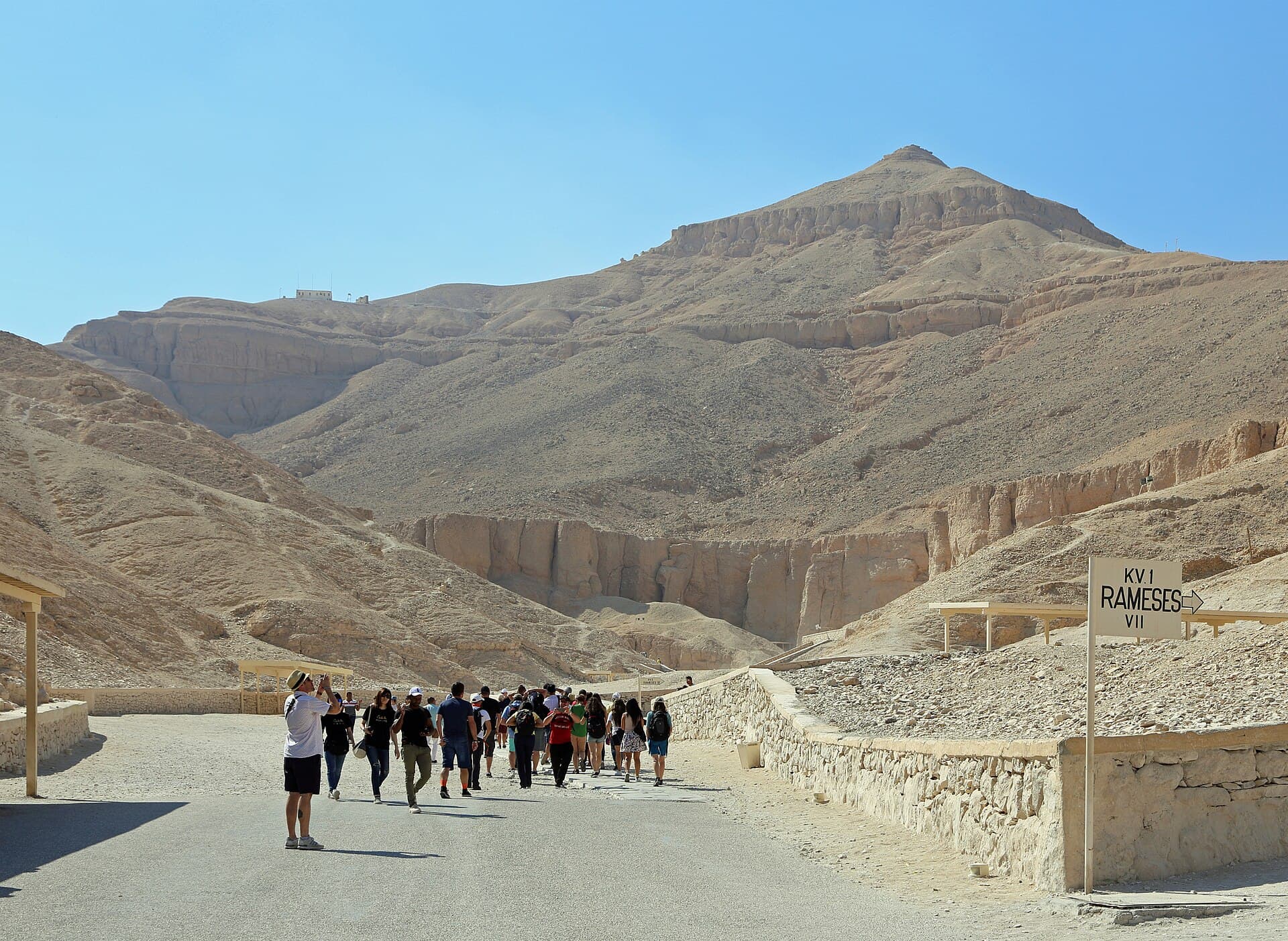
On the west bank of the Nile opposite modern Luxor, in Egypt, a dry limestone valley runs back into the Theban hills beneath a peak called al-Qurn, "the horn." Seen from the valley floor, that peak forms a natural pyramid, and the resemblance is not a coincidence of siting. For around five centuries, from roughly 1500 to 1070 BC, the kings of Egypt's New Kingdom were buried here in corridors cut deep into the rock, along with favoured queens, princes, and officials. Sixty-five tombs have been numbered so far, from KV1 to KV65, and since 1979 the valley has been inscribed by UNESCO within the World Heritage property "Ancient Thebes with its Necropolis", together with Karnak, Luxor, and the temples and cemeteries around them.
The valley exists because of a decision to stop building pyramids. For a thousand years Egyptian kings had marked their burials with monuments designed to be seen, culminating in the Pyramids of Giza. Every one of those monuments had also served as an advertisement to robbers, and by the New Kingdom the lesson had sunk in. Around 1500 BC, Thutmose I chose instead to separate the public temple from the hidden grave: a mortuary temple on the plain, visited each year by the Beautiful Festival of the Valley, where offerings could be made forever, and a body in a shaft in the desert. His architect Ineni recorded the change in his own tomb chapel, writing that he had supervised the excavation alone, "no one seeing, no one hearing." Secrecy replaced spectacle, and the pyramid shrank to the peak of al-Qurn, a mountain the whole valley could share.
The tombs that followed Thutmose I share a family resemblance while varying enormously in scale: a doorway in the cliff, a descending corridor, pillared halls, and a burial chamber where the king lay in a nest of shrines and sarcophagi. The eighteenth dynasty hid its entrances under rubble and flood debris; the nineteenth and twentieth dynasties, giving up on concealment, cut grander, straighter tombs whose doorways were closed but never really secret. The longest run more than a hundred metres into the mountain.
The numbering system that tames this labyrinth dates to 1827, when the English traveller John Gardner Wilkinson painted numbers over the doorways of the tombs then known. His sequence became the KV numbers, for Kings' Valley, still in use today, and the list is not closed. In 1995 Kent Weeks and the Theban Mapping Project, which has surveyed and published the whole necropolis, re-entered a dismissed doorway numbered KV5 and found behind it the largest tomb in the valley, a mausoleum for sons of Ramesses II with well over a hundred corridors and chambers, still under excavation decades later.
The men who cut and painted these tombs did not commute from the city. They lived with their families in a purpose-built walled village on the desert edge, now called Deir el-Medina, which its inhabitants knew as the Place of Truth. Because the crews included draughtsmen and scribes, and because the dry ground preserved whatever was thrown away, the village left behind tens of thousands of inscribed potsherds and limestone flakes: attendance registers, laundry lists, love poems, lawsuits, prayers, jokes, and notes about borrowed donkeys. No community of ordinary working people anywhere in the ancient world is documented in such depth.
The documents include a landmark of labour history. In the twenty-ninth year of Ramesses III, around 1157 BC, the grain rations owed to the crews fell weeks into arrears. The workmen put down their tools, marched to the mortuary temples on the plain, and staged sit-down protests until officials scrambled to pay them, a sequence recorded on a papyrus now in Turin. It is the first known strike in recorded history, organised by the very men entrusted with the pharaoh's eternity.
What the crews built was not simply a vault but a machine for resurrection. The walls of the royal tombs carry a distinct literature of the afterlife, painted and carved in ordered registers. The oldest of these compositions, the Amduat, "that which is in the netherworld," maps the sun god's journey through the twelve hours of the night, with the dead king travelling in the solar barque toward rebirth at dawn. Later tombs added the Book of Gates, in which each hour is closed by a guarded gate the king must pass.
These royal compositions belong to the same tradition as the Book of the Dead, the collection of spells that ordinary Egyptians had copied onto papyrus and placed in their own coffins. The difference is one of privilege: the king's guidebook was written on the walls themselves, so that the tomb became the netherworld in miniature and the dead man at its centre could never lose his way. In tombs such as that of Seti I, where the ceiling of the burial chamber is an astronomical map of the night sky, the decoration survives with startling freshness, its colours sealed in darkness for three thousand years.
The secrecy failed. Almost every tomb in the valley was robbed in antiquity, some within a generation of the funeral, and by the late twentieth dynasty the plundering was systematic enough to reach the courts. A group of documents known as the tomb-robbery papyri, written under Ramesses IX around 1110 BC, records inspections of violated tombs, interrogations, confessions naming accomplices, and the quarrels of rival officials over who had let it happen, down to a stonemason describing how he tunnelled into a royal burial and stripped the gold from the mummies.
Unable to protect the dead kings where they lay, the priests of the twenty-first dynasty gathered them up. Royal mummies were rewrapped, labelled, and moved, sometimes more than once, into hidden group burials. One cache, in a cliff tomb at Deir el-Bahari, held more than fifty mummies including Thutmose III, Seti I, and Ramesses II; a local family quietly mined it for saleable antiquities for years before the authorities traced it in 1881 and emptied it in a single frantic day. A second came to light in 1898, when Victor Loret found Amenhotep II still in his own sarcophagus in KV35, with a side chamber stacked with further kings. Between them, the two caches returned most of the New Kingdom's rulers to the modern world.
By the early twentieth century the valley was widely believed to be exhausted. Howard Carter, digging under the patronage of Lord Carnarvon, thought one king was still unaccounted for: Tutankhamun, a short-lived ruler of the late eighteenth dynasty who had died around eighteen. On 4 November 1922, in almost the last season Carnarvon was willing to fund, Carter's workmen uncovered a step beneath the huts of the Ramesside tomb builders, and a staircase leading down to a sealed doorway and the only substantially intact royal burial ever found in the valley.
Tutankhamun mattered because he had been minor. His tomb, KV62, was small, and robbers had twice broken in and been caught early, so the burial survived nearly complete: more than five thousand catalogued objects, from the gold mask and nested shrines to chariots, childhood chairs, and bouquets left at the funeral. Carter spent a decade clearing and recording it all. If a boy king buried in a hurry went to the afterlife with such wealth, the lost funerals of Seti I or Ramesses II can only be imagined. Nor was KV62 the valley's last word. In 2005 excavators found a new shaft a few metres away, opened the following year as KV63, an embalming cache of coffins and jars holding natron and linen from someone's mummification. Radar surveys and excavation continue, and few Egyptologists will say the valley is finished.
The forces threatening the tombs today are quieter than robbery. The valley drains a wide catchment of bare rock, and rare cloudbursts send flash floods down its channels; a storm in 1994 poured water and debris into several tombs, and flood control now shapes the site's engineering. The other threat walks in through the door: millions of visitors exhale moisture that swells the plaster and lifts the paint, so the antiquities service rotates tombs open and closed and caps daily numbers in the most fragile.
The reference project for this kind of care lies over the ridge in the sibling Valley of the Queens, where the tomb of Nefertari, chief wife of Ramesses II, holds the finest painted surfaces in the necropolis. Between 1986 and 1992 the Getty Conservation Institute and Egyptian antiquities authorities conserved its murals jointly, stabilising the plaster without repainting a single line, and the tomb is now shown under strict limits. The kings themselves have moved one final time: in April 2021, twenty-two royal mummies, Ramesses II and Seti I among them, were carried through Cairo in the televised Golden Parade to a purpose-built hall at the National Museum of Egyptian Civilization.
The Valley of the Kings was built on a wager: that a name could live forever if the body that carried it was hidden well enough. The wager was lost almost immediately. The tombs were emptied by the very state that dug them, the kings were bundled into caches by embarrassed priests, and the treasure that was meant to fund eternity funded burglars instead. Yet the memory survived anyway, carried by other means. The painted hours of the night still guide their kings through the dark. A boy pharaoh forgotten by his own successors became the most recognisable human being of the ancient world because his obscurity saved his tomb. And the deepest record the valley preserved belongs to nobody royal at all: the artisans of Deir el-Medina, whose shopping lists and strike demands outlasted the gold they guarded. The kings built for remembrance and were robbed of it; the workers wrote for the day and were remembered. Keeping, the valley suggests, has less to do with stone than with the record.
A hidden answer to the pyramids
The village of the Place of Truth
Painting the hours of the night
Robbers, trials, and hidden caches
Carter and the tomb that survived
Floods, breath, and the work of keeping
What the valley keeps
References and resources
- UNESCO World Heritage Centre. "Ancient Thebes with its Necropolis." World Heritage List, property no. 87, inscribed 1979. whc.unesco.org/en/list/87.
- Theban Mapping Project. Tomb database and atlas of the Valley of the Kings. thebanmappingproject.com.
- Encyclopaedia Britannica. "Valley of the Kings." britannica.com/place/Valley-of-the-Kings.
- Getty Conservation Institute. "Conservation of the Tomb of Nefertari." getty.edu/conservation.
- Wikipedia. "Valley of the Kings," "Deir el-Medina," "KV62," "KV63," and "Pharaoh's Golden Parade." Retrieved 2026.