Heritage · Landmark
The Pyramids of Giza: History, Facts and Visitor Guide
The Giza pyramid complex holds the Great Pyramid of Khufu, the pyramids of Khafre and Menkaure, and the Great Sphinx, from Egypt's Fourth Dynasty.Written to last.
By Confinity Heritage Editorial · Updated 2026-07-31 · 7-minute readQuiet tools, kept out of the way.
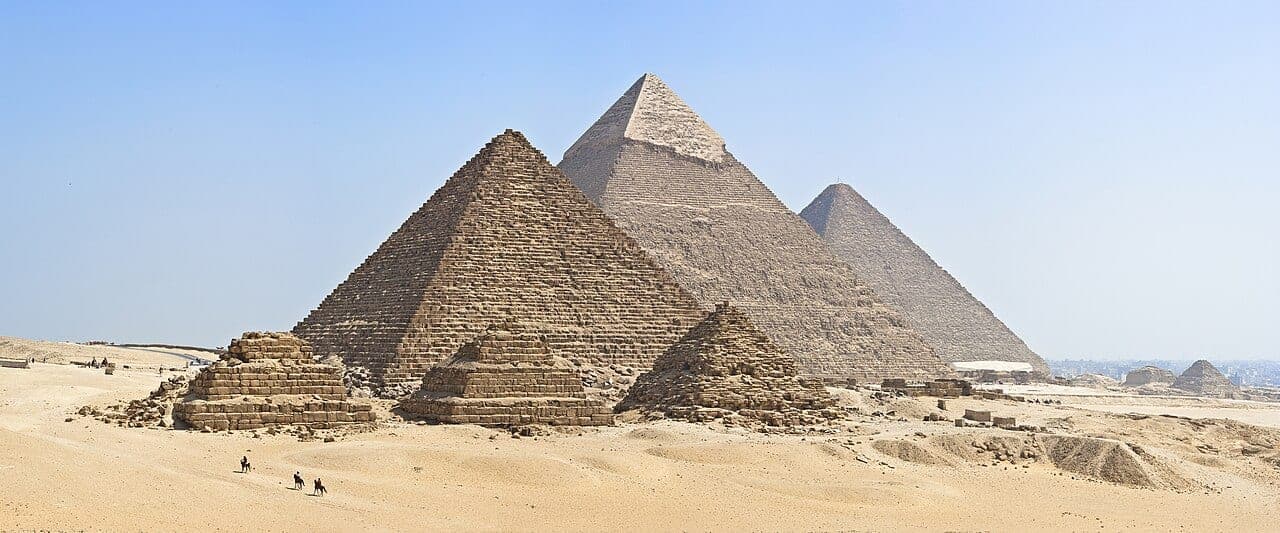
Few structures are as instantly known as the pyramids of Giza. On a limestone plateau at the western edge of Cairo, three great pyramids rise in a rough diagonal line, built as tombs for three kings of ancient Egypt's Fourth Dynasty. The largest, raised for the pharaoh Khufu, was the tallest building made by people for close to four thousand years. Beside them crouches the Great Sphinx, ringed by the temples, causeways and lesser tombs of a royal cemetery. The complex is the last of the ancient world's Seven Wonders still surviving (Wikipedia).
The three pyramids belong to Khufu, his son Khafre and his grandson Menkaure, and were built roughly between 2600 and 2500 BC (Wikipedia). They form the best known part of a wider run of pyramid fields along the Nile, which UNESCO inscribed together in 1979 as "Memphis and its Necropolis: the Pyramid Fields from Giza to Dahshur" (UNESCO).
The pyramids were royal tombs and mark the high point of a building tradition developed over several generations. Earlier kings experimented nearby: the step pyramid of Djoser at Saqqara, and the first smooth-sided pyramids at Dahshur, the Bent Pyramid and the Red Pyramid, both built for Khufu's father Sneferu. At Giza the form reached its largest scale.
The Great Pyramid was the tomb of Khufu, called Cheops by the Greeks, who reigned in the first half of the twenty-sixth century BC. The second pyramid was built for his son Khafre, who ruled roughly 2558 to 2532 BC (Wikipedia). The third and smallest belongs to Menkaure and was finished around 2510 BC (Wikipedia). Each king surrounded his pyramid with the buildings needed for his funeral and for offerings meant to sustain him, so the plateau worked as one organised necropolis rather than three isolated tombs.
The Great Pyramid is the defining structure. It originally rose to 146.6 metres (481 feet), each side of its base measuring 230.33 metres; the loss of its outer casing and capstone has reduced it to about 138.5 metres today (Wikipedia). It was assembled from roughly 2.3 million stone blocks over about twenty-six years during Khufu's reign (Wikipedia). The core is local limestone; the outer casing was fine white limestone from Tura, once polished smooth; and the King's Chamber was roofed with granite beams brought from Aswan, some weighing many tonnes.
Khafre's pyramid is only slightly smaller, originally 143.5 metres and now 136.4 metres, but because it sits on bedrock about ten metres higher it can look like the tallest of the three, and it still keeps a cap of casing stone near its summit (Wikipedia). Menkaure's pyramid is far smaller, originally about 65.5 metres and now around 61 metres, and its lowest courses were faced not in limestone but in red granite from Aswan (Wikipedia).
A persistent myth holds that the pyramids were built by slaves, a claim that goes back to the Greek writer Herodotus. Egyptologists reject it. Excavations by Mark Lehner and Zahi Hawass uncovered a workers' settlement and cemetery south of the plateau, revealing a paid, organised workforce that ate good rations of meat and bread, received medical care and was given proper burial close to the kings they served (Wikipedia). The builders were skilled crews and seasonally conscripted laborers. The old story of chattel slavery does not survive the evidence. Exactly how the blocks were raised is still debated: proposals include long straight ramps, spiralling ramps around the outside and internal ramps, and no single theory has won general agreement.
Carved from a single mass of bedrock limestone, the Great Sphinx guards the approach to the plateau. It measures about 73 metres long, 20 metres high and 19 metres wide, with the body of a lion and the head of a man wearing a royal headdress (Wikipedia). It is usually connected with Khafre and may carry his features, though some scholars argue for Khufu or Djedefre, and no consensus has been reached (Wikipedia).
 The Sphinx was carved from a single outcrop of limestone left in the quarry that supplied the pyramid behind it. Photograph by Kallerna, CC BY-SA 4.0, via Wikimedia Commons.
Each pyramid formed part of a linked set of buildings: a mortuary temple against its east face, a causeway down the slope, and a valley temple at the desert edge where the king's body arrived by water. Khafre's valley temple survives especially well, built from huge blocks of granite and limestone. Near the Great Pyramid, archaeologists in 1954 found a dismantled cedar boat in a sealed pit, one of the oldest large vessels to survive from antiquity.
For the ancient Egyptians the pyramids were machines for the afterlife. Their sides are aligned closely to the cardinal directions, and their form was tied to the cult of the sun, meant to help the dead king rise and join the gods. Long after the Old Kingdom ended they kept drawing travellers, and Napoleon's expedition of 1798 brought scholars whose surveys helped launch modern Egyptology. The Great Pyramid is the oldest of the classical Seven Wonders of the ancient world and the only one still largely intact (Wikipedia).
The plateau lies about fifteen kilometres from central Cairo and is one of Egypt's most visited places, open daily with a general ticket and separate tickets for entering the interior chambers, which are cramped and often crowded. A short distance away, the Grand Egyptian Museum was built to hold the fuller Tutankhamun collection and other antiquities. Preservation is a genuine concern. The growth of Cairo has brought the modern city up to the edge of the ancient cemetery, and pollution, groundwater, wind erosion and heavy visitor numbers all put pressure on the stone. Egyptian authorities manage access, restoration and crowd flow to keep the monuments protected and open to the millions who come each year.
The Sphinx was carved from a single outcrop of limestone left in the quarry that supplied the pyramid behind it. Photograph by Kallerna, CC BY-SA 4.0, via Wikimedia Commons.
Each pyramid formed part of a linked set of buildings: a mortuary temple against its east face, a causeway down the slope, and a valley temple at the desert edge where the king's body arrived by water. Khafre's valley temple survives especially well, built from huge blocks of granite and limestone. Near the Great Pyramid, archaeologists in 1954 found a dismantled cedar boat in a sealed pit, one of the oldest large vessels to survive from antiquity.
For the ancient Egyptians the pyramids were machines for the afterlife. Their sides are aligned closely to the cardinal directions, and their form was tied to the cult of the sun, meant to help the dead king rise and join the gods. Long after the Old Kingdom ended they kept drawing travellers, and Napoleon's expedition of 1798 brought scholars whose surveys helped launch modern Egyptology. The Great Pyramid is the oldest of the classical Seven Wonders of the ancient world and the only one still largely intact (Wikipedia).
The plateau lies about fifteen kilometres from central Cairo and is one of Egypt's most visited places, open daily with a general ticket and separate tickets for entering the interior chambers, which are cramped and often crowded. A short distance away, the Grand Egyptian Museum was built to hold the fuller Tutankhamun collection and other antiquities. Preservation is a genuine concern. The growth of Cairo has brought the modern city up to the edge of the ancient cemetery, and pollution, groundwater, wind erosion and heavy visitor numbers all put pressure on the stone. Egyptian authorities manage access, restoration and crowd flow to keep the monuments protected and open to the millions who come each year.
History
Design and construction
The Sphinx and the complex
Cultural role
Visiting
References and resources
- UNESCO World Heritage Centre: Memphis and its Necropolis, the Pyramid Fields from Giza to Dahshur (whc.unesco.org)
- Encyclopaedia Britannica: Pyramids of Giza (britannica.com)
- Wikipedia: Giza pyramid complex (en.wikipedia.org)
- Wikipedia: Great Pyramid of Giza (en.wikipedia.org)
- Wikipedia: Great Sphinx of Giza (en.wikipedia.org)
- Wikipedia: Pyramid of Khafre (en.wikipedia.org)
- Wikipedia: Pyramid of Menkaure (en.wikipedia.org)