Heritage · Landmark
Tikal: a Maya capital in the rainforest
In the forests of northern Guatemala, the Maya city of Tikal raised limestone temple-pyramids that still break above the canopy. Once one of the great powers of the Classic Maya world, it carved the names of its kings into stone, then fell silent as the jungle closed over its plazas.Written to last.
By Confinity Heritage Editorial · Updated 2026-07-31 · 7-minute readQuiet tools, kept out of the way.
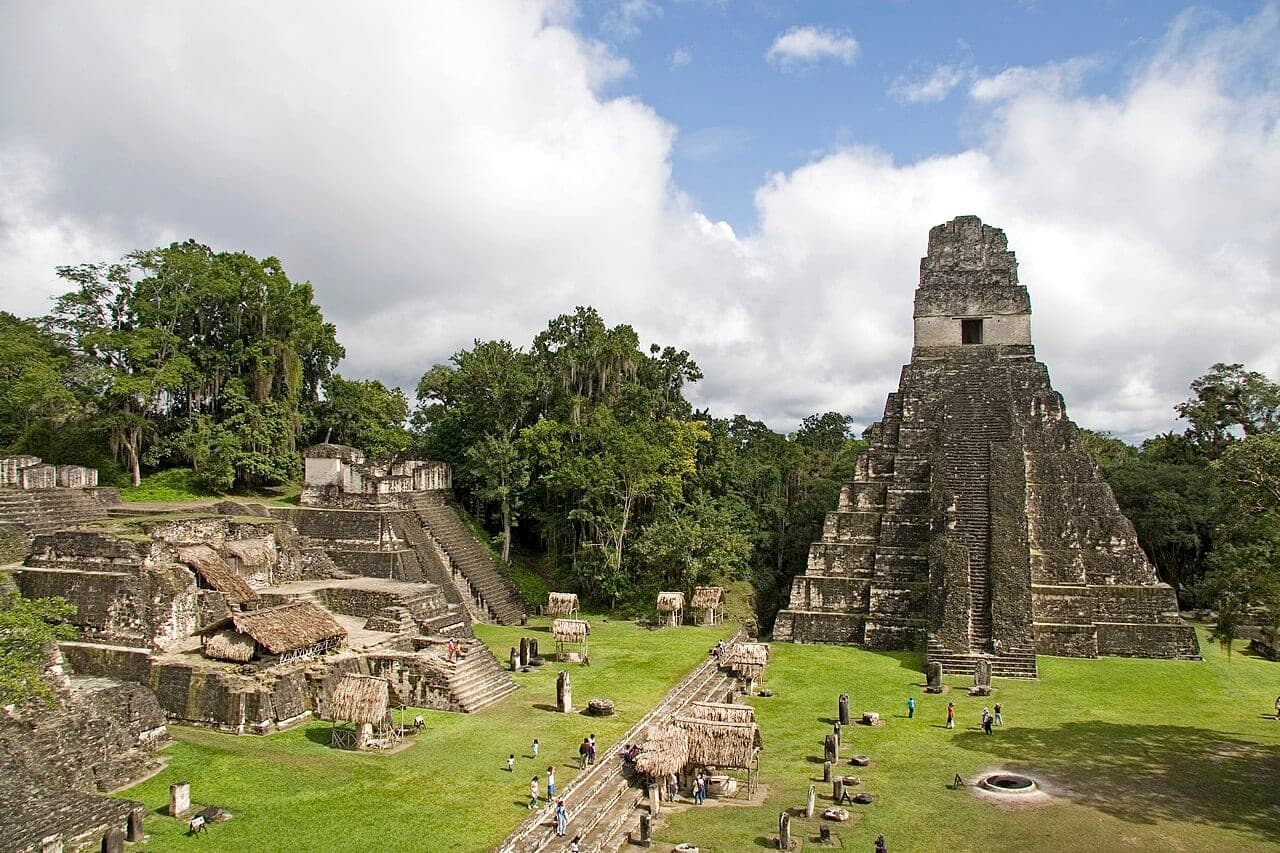
In the forests of the Petén, in the far north of Guatemala, six steep temple-pyramids break above a sea of green. They belong to Tikal, once among the largest and most powerful cities of the ancient Maya, whose people knew it as Yax Mutal, the founding place of the Mutul kingdom (Wikipedia). Across roughly sixteen square kilometres of low limestone hills lie some three thousand mapped structures: temples and palaces, ballcourts and reservoirs, causeways and thousands of humbler house platforms, most of them still wrapped in root and vine (Wikipedia).
Tikal National Park was inscribed by UNESCO in 1979 for both its cultural and its natural worth, among the first places on the World Heritage List recognised on both counts (UNESCO). The ruins sit inside a protected rainforest where howler monkeys call across the canopy and the sound carries for miles, so that the archive of a vanished dynasty is kept, quite literally, in a living wood. What survives at Tikal is above all a record of memory: a city that cut the names, dates and deeds of its rulers into stone so that they might outlast the people who raised them.
People were farming the ridges around Tikal by about 1000 BC, and the first monumental building began in the Middle Preclassic, roughly 400 to 300 BC, when platforms and early shrines rose on the ground of the later North Acropolis (Wikipedia). By the first centuries AD a ruling line had taken hold. Later inscriptions trace the dynasty back to a founder named Yax Ehb Xook, remembered as the first king of a succession that would run for some thirty rulers across the Classic period (Britannica). The city reached the height of its power and its art between about 600 and 800 AD, in the Late Classic, when its people may have numbered in the tens of thousands, with estimates for the wider settlement running as high as sixty thousand or more (Wikipedia). For more than a thousand years Tikal held a first rank among the lowland Maya, its fortunes rising, breaking and recovering in step with the calendar its scribes kept so carefully.
At the heart of Tikal lies the Great Plaza, a paved square framed on four sides by the city's grandest works. On the east rises Temple I, the Temple of the Great Jaguar, a funerary pyramid of about forty-seven metres raised for the ruler Jasaw Chan K'awiil I in the early eighth century; facing it across the plaza is Temple II, the Temple of the Masks, a little lower at some thirty-eight metres (Wikipedia; Britannica). Behind Temple I stands the North Acropolis, a dense platform of shrines and royal tombs whose building began around 350 BC and continued for over a thousand years; by the ninth century it carried more than forty carved stelae and some thirty altars (Wikipedia). To the south the Central Acropolis, a maze of courtyards and vaulted rooms, served as palace and administrative quarter.
 Temple I is the tomb of Jasaw Chan Kawiil I, who died around 734. Temple II faces it across the plaza and is generally taken to be his queen's. Photograph by Arian Zwegers, CC BY 2.0, via Wikimedia Commons.
Beyond the plaza the tallest pyramids climb higher still. Temple IV, built to honour the ruler Yik'in Chan K'awiil, reaches about seventy metres and remains the highest surviving pre-Columbian structure in the Americas; its roof-comb rides clear of the treetops, and from its summit the crowns of Temples I, II, III and V seem to float on the green like islands (Wikipedia). Older than any of these is the Mundo Perdido, or Lost World, a Preclassic ceremonial group built around a broad radial pyramid, its roots reaching back centuries before the great temples (Wikipedia). Tikal also raised a kind of monument almost unique to it: the twin-pyramid complex, a matched pair of flat-topped pyramids set east and west of a plaza, built to mark the close of each k'atun, the twenty-year unit of the Maya calendar, and furnished with rows of carved and plain stelae (Wikipedia).
What sets Tikal apart is how much of its own story it wrote down. Its stelae and altars carry dates in the Long Count and record accessions, marriages, wars and deaths, giving one of the fullest dynastic histories anywhere in the Maya world (Britannica). Those texts capture a turning point in January of 378 AD, when a figure named Siyaj K'ak', "Fire is Born," arrived at Tikal from the west; on the same day the reigning king, Chak Tok Ich'aak, died, and within a year a new ruler, Yax Nuun Ahiin I, took the throne with clear ties to Teotihuacan, the great city far off in the Valley of Mexico (Wikipedia). Central Mexican dress, weapons and imagery enter Tikal's art from this moment, marking one of the most debated episodes of contact in ancient America.
For much of the Classic period Tikal's chief rival was Calakmul, seat of the Snake kingdom to the north, and the two powers pulled the smaller kingdoms of the lowlands into their orbits. In 562 AD Tikal suffered a heavy defeat, its king captured and, the record suggests, sacrificed; there followed the long silence known as the Tikal hiatus, more than a century in which few monuments were raised (Wikipedia). The recovery came with Jasaw Chan K'awiil I, who took the throne in 682 and, in 695, won a decisive victory over Calakmul and its ruler, capturing the enemy and turning the balance of power back toward Tikal (Wikipedia). It was Jasaw who ordered Temple I, and his tomb, laid with jade, jaguar pelts, worked shell and finely carved bone, was found deep beneath it (Wikipedia).
Tikal's last century of greatness ran into the eighth and ninth centuries, and then the city faltered. Across the southern Maya lowlands the same strains gathered: growing population, cleared forest, exhausted and eroding soils, and spells of severe drought that the reservoirs could not outlast (Wikipedia). The last securely dated monument at Tikal was set up in 869 AD, and building of any ambition had ceased (Britannica). Between roughly 830 and 950 the population fell away, and by the tenth or eleventh century the great plazas were empty (Wikipedia). The forest returned to the courtyards it had been cleared from. Roots split the terraces, trees rose through collapsed vaults, and within a few generations the pyramids became hills of rubble and green, their painted plaster gone, their names unread. For close to a thousand years Tikal belonged to the jaguar and the monkey more than to any human city.
The Maya of the Petén never wholly forgot the ruins, and in 1848 a Guatemalan expedition led by Modesto Méndez and Ambrosio Tut reported the site to the wider world, with drawings made by the artist Eusebio Lara (Wikipedia). Later explorers followed: Alfred Maudslay photographed the temples in the 1880s, and Teoberto Maler, Alfred Tozzer and Sylvanus Morley recorded its monuments and inscriptions in the decades after (Britannica). Systematic work began in earnest when the University of Pennsylvania ran the Tikal Project from 1956 to 1970, mapping the core, excavating the acropoleis and consolidating the temples; Guatemalan teams have carried the work forward since (Wikipedia).
Guatemala made Tikal a national park in 1955, and that protection was joined to the land around it. Today the ruins sit within the vast Maya Biosphere Reserve, and the park's rainforest is a refuge in its own right: home to jaguar, puma and three smaller cats, to howler and spider monkeys and Baird's tapir, to more than three hundred bird species and over two thousand kinds of plant (UNESCO). Conservators carry a double charge here, holding fragile limestone and lime plaster against a hot, wet climate and steady tourism while keeping the forest that shelters them intact. The two tasks are bound together, since the same canopy that hid Tikal for a millennium now guards it.
Tikal was built, in part, to be remembered. Its rulers raised stelae so that their accessions and victories would be read long after their deaths, and beneath the pyramids they laid their dead with the treasures of a lifetime, expecting to be honoured by the generations that followed (Wikipedia). For a time that memory broke, when the jungle closed and the writing went unread; the recovery of Tikal has, more than anything, been the slow work of learning to read those names again, of matching a king to a tomb and a date to a war. Something of that pull reaches beyond scholarship. When Temple IV appeared on screen in 1977 as the edge of an imagined world, millions who would never learn the name Yik'in Chan K'awiil still felt the weight of the place (Wikipedia).
To stand in the Great Plaza at dawn, as the mist lifts and the howler monkeys begin, is to feel how a city can outlast its people and still keep their memory. Tikal is at once a ruin and an archive: a record, in stone and forest, of who its people were, what they made, and how they wished to be kept. That, in the end, is what draws visitors up the worn stairs and out along the causeways, the sense that the past here was not erased but stored, waiting to be remembered.
Temple I is the tomb of Jasaw Chan Kawiil I, who died around 734. Temple II faces it across the plaza and is generally taken to be his queen's. Photograph by Arian Zwegers, CC BY 2.0, via Wikimedia Commons.
Beyond the plaza the tallest pyramids climb higher still. Temple IV, built to honour the ruler Yik'in Chan K'awiil, reaches about seventy metres and remains the highest surviving pre-Columbian structure in the Americas; its roof-comb rides clear of the treetops, and from its summit the crowns of Temples I, II, III and V seem to float on the green like islands (Wikipedia). Older than any of these is the Mundo Perdido, or Lost World, a Preclassic ceremonial group built around a broad radial pyramid, its roots reaching back centuries before the great temples (Wikipedia). Tikal also raised a kind of monument almost unique to it: the twin-pyramid complex, a matched pair of flat-topped pyramids set east and west of a plaza, built to mark the close of each k'atun, the twenty-year unit of the Maya calendar, and furnished with rows of carved and plain stelae (Wikipedia).
What sets Tikal apart is how much of its own story it wrote down. Its stelae and altars carry dates in the Long Count and record accessions, marriages, wars and deaths, giving one of the fullest dynastic histories anywhere in the Maya world (Britannica). Those texts capture a turning point in January of 378 AD, when a figure named Siyaj K'ak', "Fire is Born," arrived at Tikal from the west; on the same day the reigning king, Chak Tok Ich'aak, died, and within a year a new ruler, Yax Nuun Ahiin I, took the throne with clear ties to Teotihuacan, the great city far off in the Valley of Mexico (Wikipedia). Central Mexican dress, weapons and imagery enter Tikal's art from this moment, marking one of the most debated episodes of contact in ancient America.
For much of the Classic period Tikal's chief rival was Calakmul, seat of the Snake kingdom to the north, and the two powers pulled the smaller kingdoms of the lowlands into their orbits. In 562 AD Tikal suffered a heavy defeat, its king captured and, the record suggests, sacrificed; there followed the long silence known as the Tikal hiatus, more than a century in which few monuments were raised (Wikipedia). The recovery came with Jasaw Chan K'awiil I, who took the throne in 682 and, in 695, won a decisive victory over Calakmul and its ruler, capturing the enemy and turning the balance of power back toward Tikal (Wikipedia). It was Jasaw who ordered Temple I, and his tomb, laid with jade, jaguar pelts, worked shell and finely carved bone, was found deep beneath it (Wikipedia).
Tikal's last century of greatness ran into the eighth and ninth centuries, and then the city faltered. Across the southern Maya lowlands the same strains gathered: growing population, cleared forest, exhausted and eroding soils, and spells of severe drought that the reservoirs could not outlast (Wikipedia). The last securely dated monument at Tikal was set up in 869 AD, and building of any ambition had ceased (Britannica). Between roughly 830 and 950 the population fell away, and by the tenth or eleventh century the great plazas were empty (Wikipedia). The forest returned to the courtyards it had been cleared from. Roots split the terraces, trees rose through collapsed vaults, and within a few generations the pyramids became hills of rubble and green, their painted plaster gone, their names unread. For close to a thousand years Tikal belonged to the jaguar and the monkey more than to any human city.
The Maya of the Petén never wholly forgot the ruins, and in 1848 a Guatemalan expedition led by Modesto Méndez and Ambrosio Tut reported the site to the wider world, with drawings made by the artist Eusebio Lara (Wikipedia). Later explorers followed: Alfred Maudslay photographed the temples in the 1880s, and Teoberto Maler, Alfred Tozzer and Sylvanus Morley recorded its monuments and inscriptions in the decades after (Britannica). Systematic work began in earnest when the University of Pennsylvania ran the Tikal Project from 1956 to 1970, mapping the core, excavating the acropoleis and consolidating the temples; Guatemalan teams have carried the work forward since (Wikipedia).
Guatemala made Tikal a national park in 1955, and that protection was joined to the land around it. Today the ruins sit within the vast Maya Biosphere Reserve, and the park's rainforest is a refuge in its own right: home to jaguar, puma and three smaller cats, to howler and spider monkeys and Baird's tapir, to more than three hundred bird species and over two thousand kinds of plant (UNESCO). Conservators carry a double charge here, holding fragile limestone and lime plaster against a hot, wet climate and steady tourism while keeping the forest that shelters them intact. The two tasks are bound together, since the same canopy that hid Tikal for a millennium now guards it.
Tikal was built, in part, to be remembered. Its rulers raised stelae so that their accessions and victories would be read long after their deaths, and beneath the pyramids they laid their dead with the treasures of a lifetime, expecting to be honoured by the generations that followed (Wikipedia). For a time that memory broke, when the jungle closed and the writing went unread; the recovery of Tikal has, more than anything, been the slow work of learning to read those names again, of matching a king to a tomb and a date to a war. Something of that pull reaches beyond scholarship. When Temple IV appeared on screen in 1977 as the edge of an imagined world, millions who would never learn the name Yik'in Chan K'awiil still felt the weight of the place (Wikipedia).
To stand in the Great Plaza at dawn, as the mist lifts and the howler monkeys begin, is to feel how a city can outlast its people and still keep their memory. Tikal is at once a ruin and an archive: a record, in stone and forest, of who its people were, what they made, and how they wished to be kept. That, in the end, is what draws visitors up the worn stairs and out along the causeways, the sense that the past here was not erased but stored, waiting to be remembered.
The founding place: from Preclassic village to Classic capital
Temples above the canopy: the Great Plaza and its acropoleis
Written in stone: the record, Teotihuacan and the Calakmul wars
The closing jungle: collapse and abandonment
Recovered from the forest: park, excavation and conservation
A city that kept its names
References and resources
- UNESCO World Heritage Centre: Tikal National Park: the 1979 inscription and the site's combined cultural and natural values, including its rainforest wildlife.
- Encyclopaedia Britannica: Tikal: overview of the city's history, its rulers and its principal monuments.
- Wikipedia: Tikal: occupation dates, the dynastic sequence, the Teotihuacan arrival, the Calakmul wars, collapse and rediscovery.
- Wikipedia: Tikal Temple I: the Temple of the Great Jaguar and the tomb of Jasaw Chan K'awiil I.
- Wikipedia: Tikal Temple IV: the tallest pyramid at Tikal and the reign of Yik'in Chan K'awiil.
- Wikipedia: Jasaw Chan K'awiil I: the ruler who ended the Tikal hiatus and defeated Calakmul.